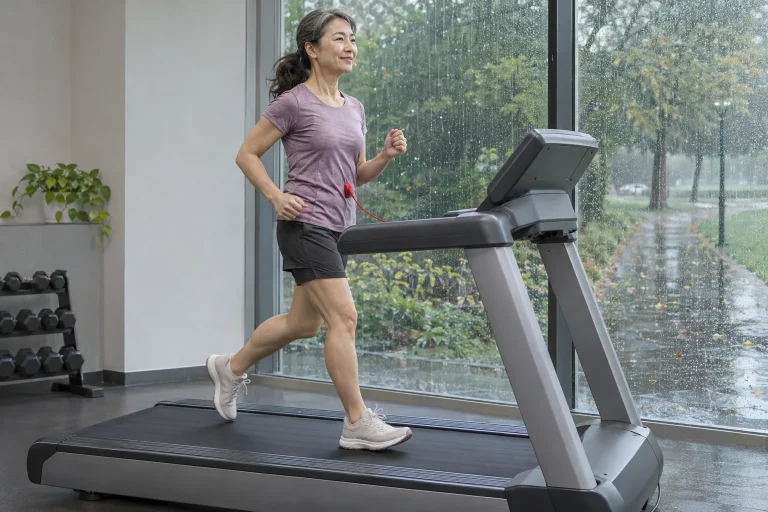
Being in one place while your body moves elsewhere
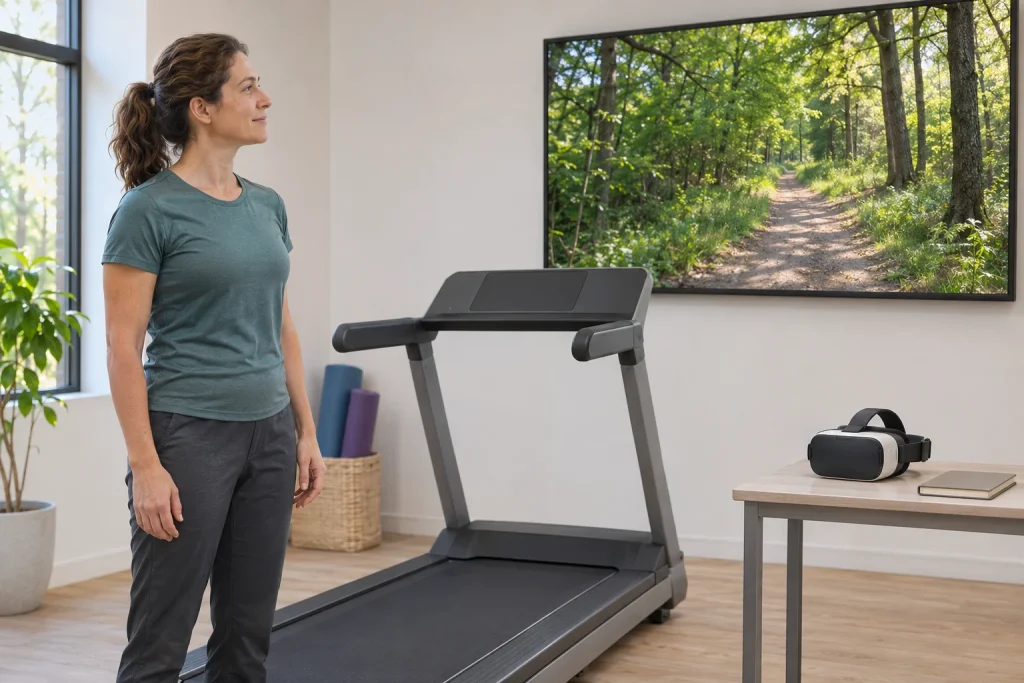
A forest path in front of a treadmill can be a background, or create some sense of moving through the landscape. Research into virtual environments calls this subjective feeling of being there “presence”. Technology and experience are separate questions: detailed graphics, a head-mounted display or a large screen alone cannot establish how much you feel part of the depicted space.
This matters to running because indoor activity can be shaped in many ways. One person enjoys following their own thoughts, another watches a programme and another finds variety in virtual scenery. Research gives no identical content prescription for everyone. It can instead reveal distinctions between presentation, experienced presence, movement and emotional response.
This article starts from two different experiments. One compared treadmill walking in virtual nature with other conditions; the other examined visual environments while running. We keep the activities and designs separate. The aim is to assess virtual-workout promises more precisely and ask concrete questions about your own indoor setting.
What did the 2022 study compare?
Litleskare and colleagues’ 2022 study examined treadmill walking in 60 adults. After a sadness-inducing video, participants moved with 360-degree nature footage, a three-dimensional model or a blank wall as their environment. Compared with control, the 3D condition involved greater enjoyment and the 360-degree video lower walking speed. No significant condition differences were found for heart rate, perceived exertion, blood-pressure changes or emotional changes.
Several presence questions were assessed separately. No significant differences between virtual conditions were detected on them, while written accounts described more nuanced experiences. This shows why interesting personal accounts and group-level detected differences do not replace each other. Read impressions such as “it seemed more real” or “I enjoyed it more” alongside their measurement and comparison.
The design ties the findings to its conditions. It did not investigate a long-term running programme, and the preceding emotional task formed part of the setup. Results from treadmill walkers do not automatically become recommendations for fast running or every home device. Individual enjoyment can be real even if the experiment found no difference on another measure.
What distinguishes footage from a three-dimensional model?
A 360-degree recording uses imagery of a recorded environment. A 3D model is a digitally constructed space, with potentially different ways of displaying it and linking it to movement. A specific system’s design determines operation. Calling scenery virtual does not establish identical responses to head movement, steps or speed across apps.
Coordination can matter to the experience. How fast does visual progress seem relative to bodily movement? Is the image easy to follow, is delay disturbing, and how aware are you of the real space? These are use questions. One impression need not become a verdict on the technology’s general success or failure. The experience of specific content and settings differs from judging the whole virtual-exercise category.
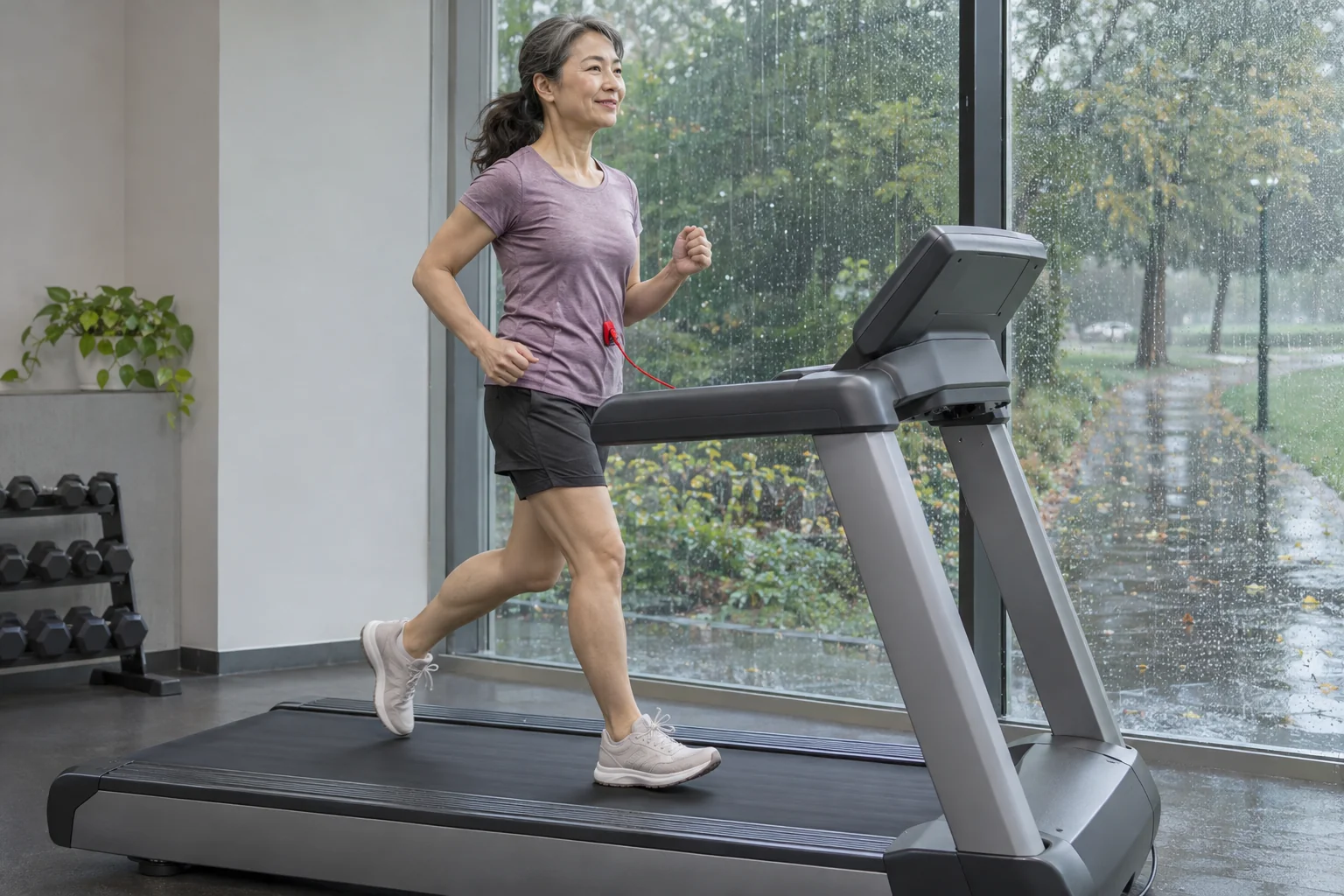
In our illustration, a landscape approaches slowly while your legs suggest faster progress. Another display’s visual rhythm fits the movement better. These may engage attention differently. This is not a personal case measured in the study, but an example of coordination between movement and sight. It does not establish one correct visual speed for every device.
 Enlarge image
Presence means more than liking an image
A landscape can look beautiful without immersing you. Presence concerns how much the displayed space feels like the setting of your experience. An exciting film can hold attention, but virtual-space research uses more specific questions about being there. Liking, perceived realism and enjoyment of the task can relate while remaining separately measurable.
Keep several simple statements in your own observations: “I liked the scenery”, “I checked the clock less”, “the image movement bothered me” or “I always knew I was in a room”. These describe different details and need not become one presence score. Everyday language helps identify precisely what was pleasant or uncomfortable and what could change.
Strong immersion is not compulsory for every workout either. Varied imagery may suit an easy session, while another day you want to follow workout audio cues. Planning can leave room for both. Virtual surroundings do not become useful only when you forget every real environmental sensation. Safe machine operation and awareness of bodily feedback still matter.
Enjoyment, activity volume and bodily response
Greater enjoyment need not mean greater speed, and moving faster is not identical to a more pleasant emotional experience. Studies may therefore report several outcomes together. A summary highlighting only one favourable number can hide unchanged measures or another pattern elsewhere. Full interpretation requires knowing the task’s aim and measurement type.
Decide your own session’s purpose too. For easy, manageable activity, greater enjoyment may matter without requiring a bigger display number. When following a defined coaching task, scenery should not replace it. Appropriate load is not judged from a digital landscape’s beauty. Experience and organisation can be shaped together.
A heart-rate difference on one occasion likewise does not establish an overall bodily benefit or disadvantage. Exercise settings, measurement device, individual condition and surroundings can influence it. This article gives no personal heart-rate prescription. It helps avoid confusing a more enjoyable virtual walk with exercise proven better in every respect.
What was examined during actual running?
In Yeh and colleagues’ 2017 study, 30 participants completed three twenty-minute treadmill runs at a self-selected pace. Conditions were a static nature image, moving nature imagery and self-selected entertainment. The latter produced greater distance and heart rate, while nature imagery was associated with more favourable post-run happiness. This differs from the 2022 virtual-walking design.
The distinction matters practically too. Indoor visual environments are not one uniform product or method. Content selection, activity, duration and display can all vary. Different conditions cannot simply be pooled into one outcome ranking. A runner may gain more from asking which study resembles their question than seeking an overall winner.
Self-selection can form part of real use. Viewing a scene assigned by someone else differs from choosing content yourself. We do not use these studies to prescribe compulsory viewing. It is more useful to keep attention on following the task, comfortable posture and how much attention you want to give the image alongside personal choice.
A research setup is not a home assembly plan
Research combining head-mounted displays and moving machines has defined equipment, space and supervision conditions. A scientific paper’s setup does not establish that any treadmill and headset can safely be combined. At home, permitted use of the specific equipment governs. Presenting research does not become our own guide to assembling a running VR system.
Discomfort with virtual content need not become a performance task. If imagery bothers you, the situation feels uncertain or you become unwell, continuing is not compulsory. An impressive technology in theory does not override your experience. Pleasant indoor activity can take several forms; choice itself matters when building a usable environment.
Placement matters with simple screen-based scenery too. Preferably set it up while the machine is stopped, rather than diverting attention into menus during movement. Maximum immersion should not be the only criterion. The machine’s instructions, clear controls and awareness of the real environment belong alongside enjoyment.
 Enlarge image
How can you choose content for your own session?
First name what you want from the view: variety for a monotonous easy loop, a calmer background or a virtual route followed together? Different goals imply different content and attention demands. You need not meet all at once. If content distracts on a particular day, switching it off or changing it remains valid.
Second, separate content settings from movement settings. Showing a virtual landscape does not establish that an app controls the machine or automatically changes load for a displayed hill. That is a specific hardware and software question. A psychological experiment does not replace compatibility documentation. The moving route on screen and treadmill operation need separate checks.
Third, identify what you want to retain next time. Perhaps you liked the landscape changing slowly or not needing to follow a story. Another day your own programme was more enjoyable. These are personal use experiences rather than proof that a category is superior. Choosing one clearly identified circumstance again may provide enough information for the next session.
A brief experience log with separate levels of inference
One line can describe content and presentation: a nature video on screen, entertainment or a virtual system. Another can describe activity type and duration, and a third your experience. This makes the memory more specific later. The log is neither a validated presence questionnaire nor a controlled experiment, but can help comfort and organisational choices.
Separate observation from explanation. Checking time less is an observation; scenery engaging attention is an explanation. Session difficulty, your day or other circumstances may also contribute. Keeping explanations open does not weaken an enjoyable experience. It prevents one good occasion from creating expectations too broad to meet later.
Virtual scenery can remain one option among many. The studies show that presentation, enjoyment, presence and physical participation can be examined separately. This idea helps your running when it gives greater freedom to shape the setting. Digital forests need not appear every time, and home exercise need not be renamed real outdoor experience to have value.
Sources and distinctions between the studies
We checked the sources on 21 November 2026. The 2022 study’s treadmill walking and virtual conditions remain separate from the visual environments used during running in 2017. This is neither our own test of a particular VR product nor permission for equipment use. Photographs are original AI illustrations rather than original study images.
- Litleskare and colleagues: Taking real steps in virtual nature: a randomized blinded trial, 2022
- Yeh and colleagues: Physical and Emotional Benefits of Different Exercise Environments Designed for Treadmill Running, 2017
How Futószív articles are prepared: our editorial guidelines.