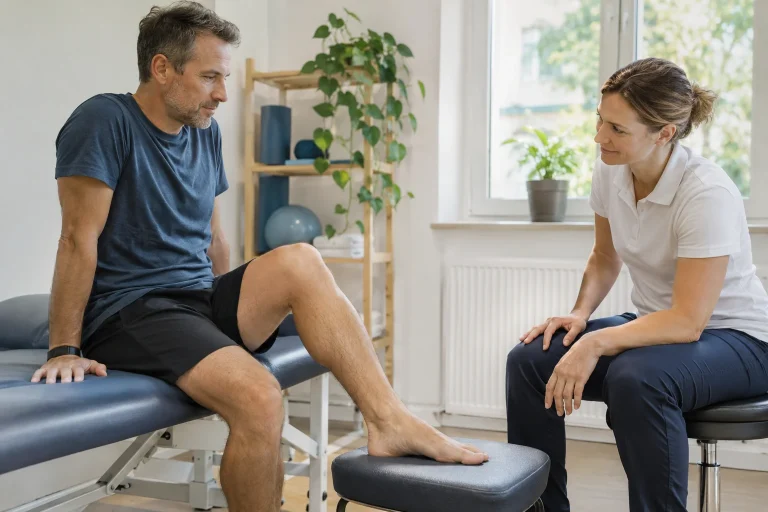
If lifting the front of your foot or your toes has newly become difficult, do not begin by investigating it through running drills. Sudden weakness needs immediate emergency help, because even weakness affecting a limited area can involve stroke or a transient ischaemic attack. The NICE NG127 guideline specifically warns about this. Do not wait for facial or speech symptoms too, and do not drive yourself to care.
Facial or arm weakness, speech difficulty, sudden one-sided numbness or visual changes also call for immediate help, even if symptoms stop; the NHS stroke information emphasises this too. New bladder or bowel control or emptying problems, or reduced sensation around the perineum, alongside severe low-back pain radiating into a leg also need immediate assessment according to NICE. Reading this article must not delay help.
Lifting the foot is not the same as raising the knee
The position of the front of the foot contributes to bringing the leg forward during walking. Knee and hip movements differ from lifting around the ankle. If one function becomes difficult, a more conspicuous movement elsewhere does not necessarily resolve the cause. New difficulty should therefore not simply be answered with high-knee running drills.
The NHS uses foot drop to describe difficulty lifting or moving the foot and toes. This can affect walking and often involves one foot. The term describes a change in function rather than one definite disease. Identifying the cause is a separate task requiring individual healthcare assessment.
If the toe of your shoe catches more often or your step feels different, describe your own experience. You do not need to deliberately reproduce it. A walking video cannot replace assessment of new weakness either. A coach’s or companion’s observation may add useful detail without turning a newly developed problem into a technique fault.
Pain, weakness and sensory changes are different histories
A foot can hurt without the same movement difficulty, and weakness need not be accompanied by severe pain. Describe these separately. “It doesn’t hurt as much” is different information from “I can lift it normally again”. Do not make pain the sole measure overriding every other function.
The NHS information on peripheral neuropathy distinguishes involvement of nerves controlling movement from those carrying sensation. The former may involve weakness, the latter tingling, numbness or altered sensation. Different symptoms can coexist. You need not assign them to nerve types at home, but each can be reported as a detail of its own.
Everyday descriptions are enough: “It’s hard to pull up the front of my right foot”, “it has caught twice on the pavement” or “my lower leg feels different”. You do not need a strength scale or resistance test. If unsure whether this is true weakness or another difficulty, say so too. Uncertainty is no reason to try resolving the change through running technique alone.
The time of onset matters when seeking help
Sudden onset, deterioration over a short period and a difficulty noticed more slowly provide different information. When asking for help, say when the foot last worked normally and when you noticed the change. You do not need a definite cause. Describing onset can matter more than an anatomical explanation selected beforehand.
The NICE also treats rapidly worsening limb weakness as requiring urgent investigation. You do not need to wait until function disappears completely. Gradual onset does not remove the need for assessment either: the NHS recommends medical examination for difficulty lifting the foot. The particular symptom and accompanying signs determine urgency.
If you noticed the change on waking, describe that and when you last definitely moved your foot normally. Do not invent an exact starting minute if unknown. Nor should temporary improvement automatically close the story. Sudden neurological symptoms can require immediate care even after stopping; the next workout should not determine their significance.
 Enlarge image
The cause is not necessarily where movement feels difficult
The NHS describes several possible backgrounds, including involvement of a nerve controlling foot lift, a spinal issue or another neurological condition. This is not a list from which one symptom allows you to choose. It explains why inspecting only the shoe or foot’s surface is insufficient.
Mention a recent injury, surgery, prolonged immobility or another important health event. The clinician may also ask about sustained postures you commonly adopt. These are history details rather than automatic proof. You need not connect symptoms with one uncomfortable sitting position or workout merely because you found that possible explanation.
The area of numbness, weakness in another limb, back symptoms or any other new functional change should also be reported. Do not exclude details because they fail to fit your first theory. The assessment can begin from the whole story. Imagining a local shoe problem does not justify treating a new symptom elsewhere as an insignificant side issue.
| What you notice | What to describe | What not to decide alone |
|---|---|---|
| Difficulty lifting | Which side and which familiar task changed? | This is not automatically a technique fault. |
| Altered sensation | Where does it tingle, feel numb or different? | It does not independently identify a definite nerve cause. |
| Onset | Sudden, worsening or noticed more slowly? | Do not wait for complete loss of function. |
| Other symptom | New changes in speech, face, arm, back or bladder/bowel function. | Do not hide these behind a local footwear explanation. |
A compensating movement is not necessarily the treatment goal
If lifting the foot while walking is difficult, you may instinctively use another movement to avoid catching it. This is understandable adaptation, but the new compensation does not clarify the cause. It need not become a running drill. A workaround that functions temporarily is not necessarily a pattern to repeat and strengthen now.
“Pay more attention to your step” can suggest the problem is merely concentration or discipline. That is a premature explanation for a new movement difficulty. The nervous system, muscle function and particular condition may require individual assessment. The symptom does not become less real because you can sometimes consciously manage the step differently.
Coaching feedback may help a later plan for an established condition, but cannot replace healthcare assessment of new weakness. A general running video does not determine the sequence of technique practice. If already receiving care, sport-related tasks must fit your own plan. Quickly making the visible movement look better is not the first question.
Safe mobility matters before investigation too
The NHS highlights increased risk of tripping and falling. Clear routes at home, appropriate lighting and removing loose obstacles can help organise the environment. This is not treatment or a movement test. The aim is to avoid unnecessary obstacles while arranging care.
You do not need to manage stairs or your usual route alone to assess the difficulty. If mobility is uncertain, ask for practical help. A relative can bring necessary items or assist in contacting care. Accepting help is not a performance failure, and you need not prove a near-fall first.
Choosing a stick, support or another aid individually may be a separate task. A borrowed aid may not fit the current condition. Mention any previously provided aid and its instructions. But do not try to replace assessment of a new functional change solely by modifying equipment. Organising the environment and clarifying the cause may both be necessary.
Assessment considers function and its background together
The NHS discusses an in-person examination of the foot and walking, with further specialist assessment if needed. Not every lifting difficulty calls for the same sequence of tests. The history and signs shape the investigation. This article does not order MRI, nerve-conduction tests or other investigations for every reader.
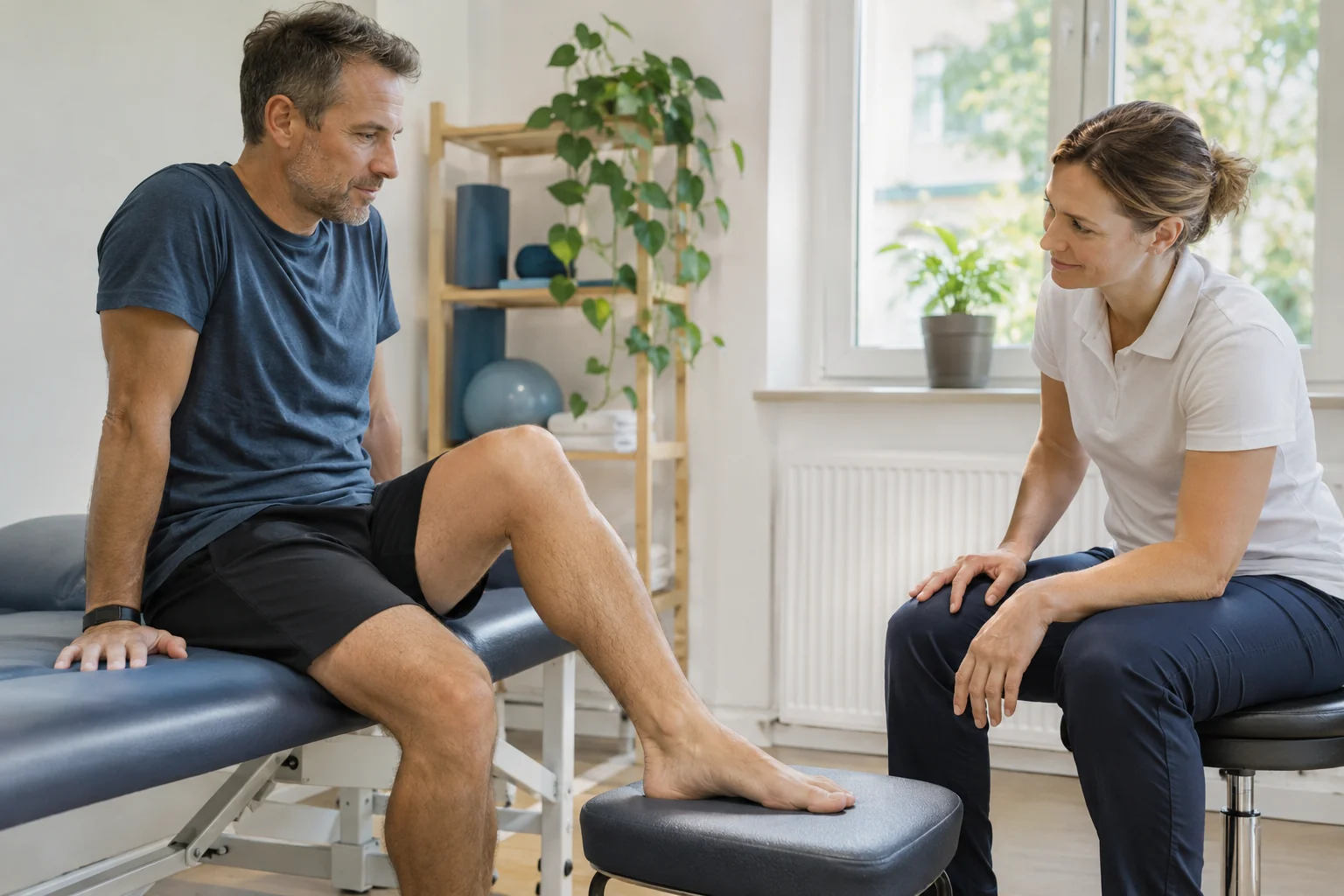
At the consultation, describe how walking differs from your own usual state and any other symptoms. You need not learn examination manoeuvres beforehand. A home resisted foot-lift test neither validates nor disproves your account. The clinician selects an examination for the specific question and interprets it within the overall condition.
An explanation can include what remains uncertain. Not every cause becomes clear immediately, but the next step should be understandable. Know who follows changes and which new symptoms call for earlier help. A broad word such as “nerve-related” may not yet explain your individual questions about loading and everyday mobility.
 Enlarge image
Footwear and rehabilitation depend on the established condition
Well-fitting shoes can support comfort and mobility arrangements. That does not make shopping a treatment for new difficulty lifting the foot. A lighter model does not exclude a neurological or other cause, and momentary improvement does not prove function has recovered. You do not need to try several pairs before a new symptom receives medical assessment.
The NHS relates care to the cause and persistence of the condition; different rehabilitation or equipment-based options may be considered. These are not an identical menu for everyone. A personal goal may be safer walking or support for a daily task. You need not compare every option through your own experiments.
If taught a task, understand its purpose and how effects will be followed. Forced repetitions or high-knee movements alone cannot establish which condition is improving. A name selected online from a symptom should not determine the action. An individual plan links the functional goal, specific condition and way to report back.
Give the new functional change its own place in your account
A runner may say “I’m stepping oddly” or “my technique has become poor”. If lifting the foot is actually newly difficult, say so separately. The specific functional change is more informative than an aesthetic judgement of movement. You do not need to walk elegantly in the clinic to receive help or turn a symptom into self-criticism.
If the first conversation did not capture it accurately, clarify at later contact: you are not simply seeking to improve your running stride, but experiencing a new lifting difficulty. Report new or worsening changes separately too. This does not contradict your earlier account; it refines the history to support assessment of urgency and the next step.
Do not treat new difficulty lifting the foot as training discipline or a property of one shoe. Onset and accompanying signs determine the urgency of help, while individual examination clarifies the cause. Running technique only becomes meaningful within that assessed condition. Give the real functional change attention first, rather than using a painful or uncertain trial as an explanation.
Sources
- NHS: foot drop, assessment and mobility considerations, 2025
- NHS: sensory and motor symptoms of peripheral nerve involvement
- NHS: sudden stroke symptoms and immediate help
- NICE NG127: new limb weakness and other urgent neurological symptoms
How Futószív articles are prepared: our editorial guidelines.