A running route involves more than the view
On the same forest path, one day you notice wet leaves, another distant traffic or suddenly cooler air. A running location is not simply a background image: sounds, smells, light and bodily impressions combine. This helps explain why a screen showing a forest differs from a real route. It does not establish that forest scent alone is proven to calm every runner.
Forest scent can become an appealing but imprecise explanation. After a pleasant experience, saying the smell of trees did you good feels natural. There may also have been less noise, more shade, a slower pace or more free time. Research on smell helps separate parts of the impression. It does not authorise prescribing essential oils, deeper inhalation or a specified quantity of pine scent for training.
This article draws on a multisensory virtual experiment and a study in a real urban environment. Their shared question concerns how a place’s perceived restorative effect may develop. The two studies did not investigate identical situations or people. Questions applicable to your own running are therefore kept separate from the results: the former are editorial observation ideas, while the latter depend on each research design.
What did the multisensory experiment compare?
Hedblom and colleagues’ 2019 study compared virtual urban, park and forest environments in 154 participants. Alongside visual scenes, matching smells and sounds were used, and a stress response associated with skin electrical conductance was followed after an experimental stress task. More favourable recovery patterns appeared in the park and forest settings; analysis also considered the relationship between how pleasant stimuli were rated and the bodily measure.
This directs attention to the combined role of several senses. It did not expose runners doing identical workouts to different forest smells and then measure racing performance. The virtual environment, preceding stress task and selected bodily signal together formed the experiment. Omitting them from a short news item can make the result sound like a claim the researchers did not actually test in that form.
The directly measured bodily indicator and ratings of environmental pleasantness are separate data. They ask different questions and do not always move entirely together. In your own experience, liking a route’s scent can coexist with finding the run tiring, or tension not immediately easing in a quiet place. One signal cannot describe an entire mental state or every benefit of a location.
How pleasant the smell is also forms part of the question
In everyday language, “scent” often already implies a favourable judgement. “Odour stimulus” is more precise for the research question: one person may find it pleasant, another too strong or neutral. A smell matching the landscape is not necessarily a good smell for every participant. Retain this distinction when discussing a route’s character. Personal preference is not measurement error to overcome for nature’s sake.
In an illustration of our own, two runners pass the same pine woodland. One recalls a previous hike, while the other mainly notices the nearby car park’s smell. This does not establish who is paying attention correctly. They may be sensitive to different details and associate different memories with the place. The example is not a study result; it shows why vegetation type alone cannot describe the entire experience of an environment.
When choosing routes, it can therefore help to name both pleasant and troublesome impressions. If a section has a strong unpleasant smell, you need not stay because a forest is theoretically restorative. You can turn another way, choose another time or a shorter loop. Learning your own experience is not an odour endurance test, and seeking increasingly intense stimulation is not the goal.
 Enlarge image
Skin conductance is not a happiness meter
Changes in skin electrical conductance can be used experimentally to follow physiological activation. A measurement defined for the study situation is not the same as a personal wellbeing score. It does not directly reveal how much you enjoy running, how settled you consider your life or what the forest means to you. Bodily data always needs interpreting alongside the task and measurement procedure.
A watch’s so-called stress value does not automatically replace the research sensor. A wrist device may use different inputs and its own algorithm, while running and fit during movement also affect its signal. A more favourable number after a forest loop does not prove that smell caused it. The device may supply useful log data, but does not erase the difference between laboratory measurement and a display at home.
It may be simpler to describe the experience in words first: the surroundings were quieter, a smell bothered you, letting attention turn to the landscape seemed easier, or you noticed nothing particular. These statements are not instrumental evidence. They can nevertheless guide personal route choices better than one app signal treated as a complete summary. Every pleasant detail of running need not become a number.
What does the study in a real park add?
In Ojala and colleagues’ field experiment published in 2019, 83 healthy women aged 30–61 visited central Helsinki, a landscaped urban park and an urban forest. At each location, 15 minutes of viewing was followed by 30 minutes of walking. Differences appeared in psychological restoration measures, but not blood pressure; individual orientation towards natural or built settings also influenced the experience.
This brings the complexity of a real place closer, but does not isolate forest smell as an effect of running training. Participants walked, and the sample was defined by age, sex and health. The result cannot be transferred unchanged to every running pace, children or health situation. The studies instead provide two perspectives: controlled stimuli in one, and real settings and individual differences in the other.
For readers, this suggests that environment can matter to experience, while the amount of green space alone is insufficient. An accessible park, a predictable route or a quieter time for you can contribute to a choice. These are practical considerations, rather than personal recipes proven by the study. One value of the field experiment is precisely that differences between people can shape the effect of the same place.
What changes when the laboratory setting becomes running?
Running involves physical exertion and attention to the ground, traffic and your own movement. Perception of the environment can change with pace and task too. A root-covered climb leaves a different amount of attention for landscape details than walking on a broad path with clear visibility. Results from resting or controlled virtual situations therefore cannot be treated as if measured directly during a long trail race.
A real forest is not a fixed package of stimuli either. Moisture, wind, light, vegetation, visitor numbers and path conditions change. Yesterday’s good impression need not have the same explanation as today’s. Strong expectations about a place may enter the experience too. You do not need to select one cause after every run. Saying several favourable conditions came together is often more accurate.
A training goal and enjoyment of a place can coexist, but every outing need not become both a study and a performance test. On an easy loop, curiosity about the environment can leave room for observation. On technical or busy sections, safe progress takes priority. Exploring wellbeing is not served by ignoring route conditions or your own state for the scenery’s sake.
Why does this not become an essential-oil recommendation?
A landscape-matched experimental odour stimulus and use of a commercial essential oil are different interventions. Composition, amount, placement and circumstances may differ. The research presented does not establish that a bottled product before or during running produces the same result. It sets no scenting protocol for runners and proves no individual treatment effect. A nature-related product name cannot bridge these differences.
You do not need to create an artificial forest scent around a home treadmill to change the environment either. You can consider ventilation, layout, screen position or reducing sounds you find disturbing. These are general comfort considerations, rather than performance enhancers calculated from the odour experiment. Others’ needs matter in a shared space: what smells pleasant to you may be unpleasant to someone else. Choice is therefore a more useful starting point than a compulsory scent for everyone.
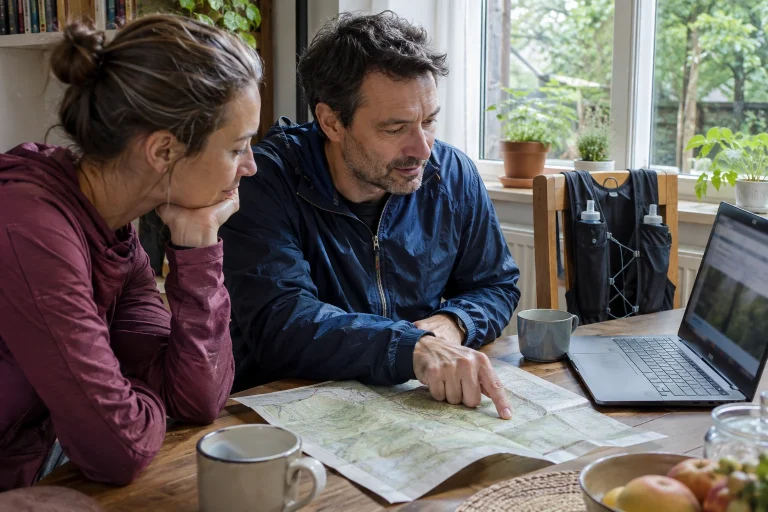
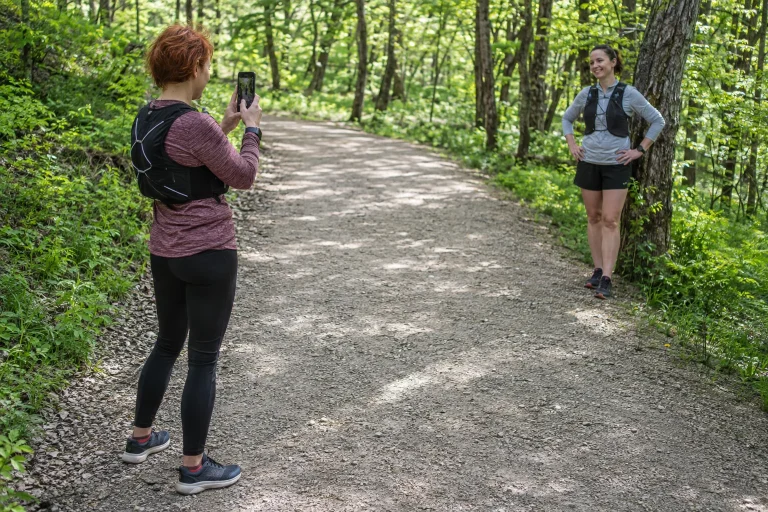
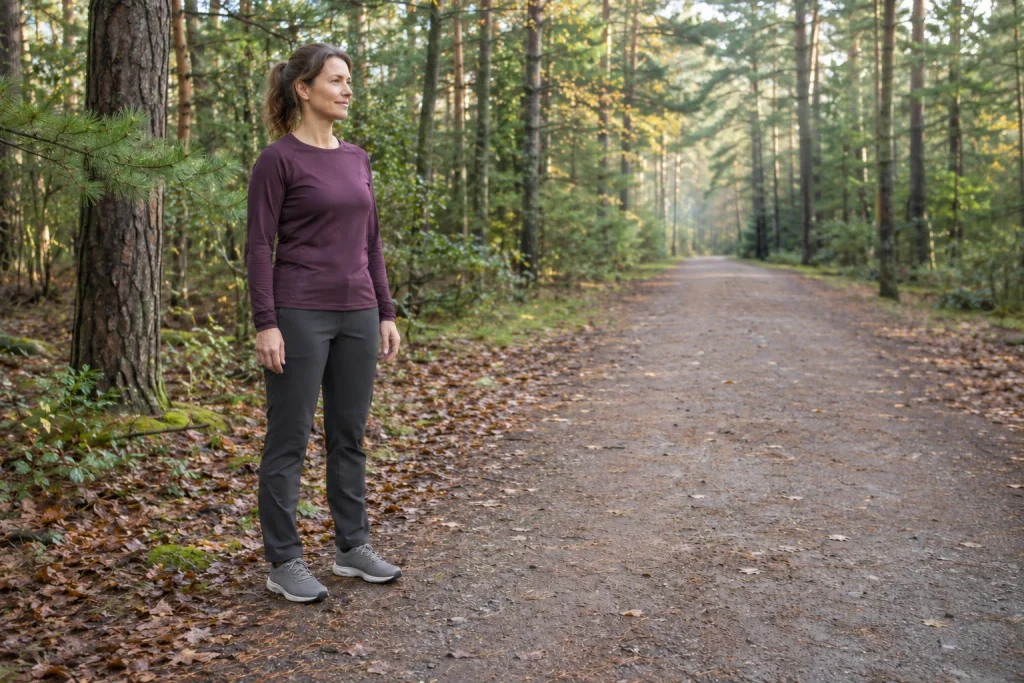
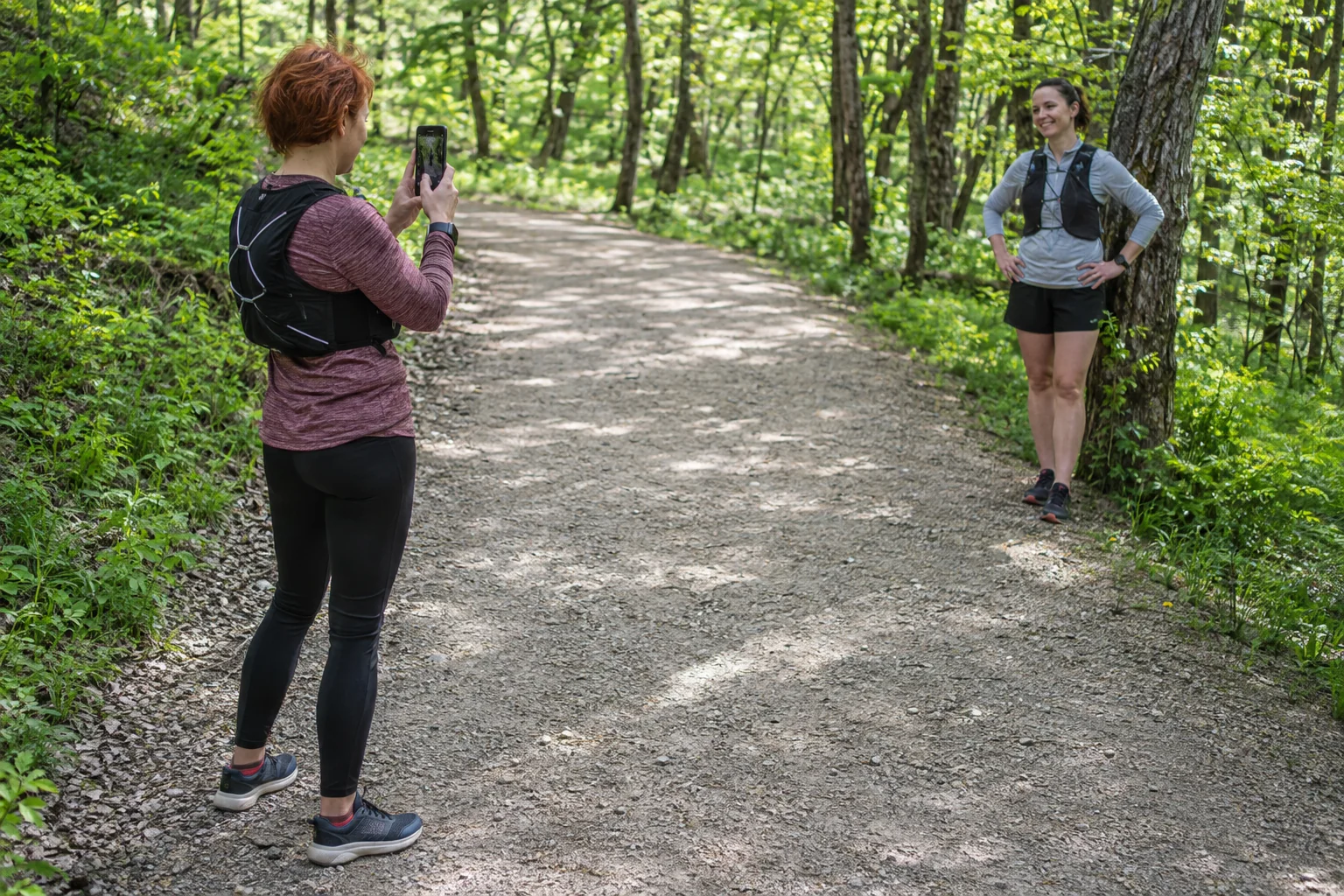
The photographs in this article do not depict use of aromatic substances or healing inhalation. A pause beside vegetation illustrates the running environment. It is not documentation of a real measurement or evidence of the compounds present in the air. Separating visual atmosphere from a research claim matters just as much as distinguishing sight and smell within the experiment itself.
 Enlarge image
A simple, non-diagnostic route log
If you want to understand your running places better, choose a few easily described aspects. How easy was the route to follow, did noise bother you, did you notice pleasant or unpleasant smells, and what was the overall impression at the end? No scientific-looking score or extra sensor is needed. The aim is to remember which place suited which day through more than speed alone.
Add brief context: time, weather, company, route and session type. This does not eliminate confounding variables or make the diary a controlled study. It gives you a chance to notice that a pleasant forest loop may have coincided with an easier pace or a freer morning. Such a connection remains a personal observation and is best kept as an open explanation.
Do not record only exceptionally good days. A neutral or less pleasant outing can help route choices too. If nearby traffic bothers you in one place and crowds in another, changing the time may help more than travelling farther for a theoretically perfect forest. Start from options accessible to you. Seeking a setting you experience as restorative is not another compulsory task on a running checklist.
Making room for different perceptions
On a group run, do not assume everyone likes the same thing about the place. One values open visibility, another nearby trees and another an easy journey home. A brief discussion should allow troublesome stimuli to be mentioned without anyone having to explain their health or personal past. Choosing an environment can be a practical shared decision, rather than a test of love for nature.
Pass research on without enlarging its claim along the way. The multisensory virtual experiment examined environmental stimuli in relation to a defined stress response. The field experiment highlighted real locations and individual differences. For your own running, the main implications can be curiosity and freedom of choice: notice what is pleasant for you and leave room for the same route to offer someone else something different.
Sources and limits of applying the findings to running
We checked both primary studies on 21 November 2026. We do not describe the virtual odour-stimulus study as a running-training experiment or extend the Helsinki walking protocol to every running load. The diary and route-choice examples are our editorial ideas. The article is not an essential-oil recommendation, individual medical treatment guidance or the result of documented medical review.
- Hedblom and colleagues: Reduction of physiological stress by urban green space in a multisensory virtual experiment, 2019
- Ojala and colleagues: Restorative effects of urban green environments and the role of urban-nature orientedness and noise sensitivity, 2019
How Futószív articles are prepared: our editorial guidelines.