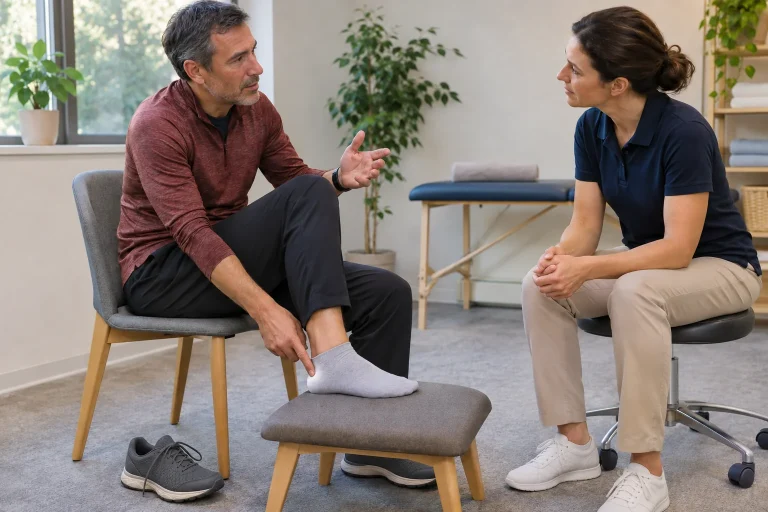
You stop, take off your shoe and shake it out, but find nothing. When walking, though, it feels as if a small pebble or a fold is sitting behind your toes. This experience does feature in descriptions of Morton’s neuroma, but the comparison is not a diagnosis. Describe burning, numbness and symptoms spreading towards the toes precisely, without trying to settle their cause with a home test.
If your foot is severely painful, you cannot walk, its shape has suddenly changed, you heard a snap during an injury, or hot, swollen symptoms come with feeling unwell, fever or chills, seek urgent medical help. The NHS treats these as specific warning signs. A characteristic pebble-like sensation does not automatically explain such a new condition or remove the need to assess it.
A pebble-like sensation is a comparison, not proof of a lump
The NHS lists sharp, burning or shooting pain, a pebble-like sensation, tingling and numbness among possible symptoms of Morton’s neuroma. Symptoms often occur around the area between the third and fourth toes. Understand this as one possible explanation, rather than a formula in which three matching words establish a definite condition.
The comparison describes how the foot feels under load. It does not mean there is definitely an object you can feel beneath the skin. Finding an actual pebble or bunched-up sock in your shoe is a different observation from finding nothing of that kind. Keep those situations distinct, but the second does not automatically mean that only one nerve condition is possible.
Your own language can be particularly useful: “as though something is underneath”, “it sometimes shoots”, “it burns towards my toes”. You do not have to use the descriptions you found online. If you do not have numbness, do not add it to your account simply because it appears in the description. Actual symptoms and symptoms that are absent together give a more accurate picture than a seemingly perfect list assembled afterwards.
What does the name Morton’s neuroma mean?
According to the AAOS, the name can be misleading: Morton’s neuroma is not a true tumour, but a condition involving thickening of tissue around a small nerve leading to the toes. It therefore does not mean what many people initially infer from “neuroma”. Understanding the name can reduce misunderstanding, but an individual assessment still establishes the diagnosis.
Nerves also contribute to sensation in the sole and toes. Symptoms involving a nerve may therefore appear as more than pressure that stays in one place: an experience of radiation into the toes, tingling or burning may matter too. An obvious external lump need not be present. A photograph of a normal-looking foot cannot by itself describe what you feel when walking.
The BOFAS professional summary discusses compression symptoms involving the nerve between the toes, but does not regard all theories explaining details of its development as established. The simple story that “one bad step trapped it, so a good movement will pop it back out” therefore implies too much certainty. Understanding the condition does not begin by imagining a component you can put back into place at home.
 Enlarge image
Describe the location and spread of the sensation together
Try to recall whether the sensation begins under the front of the foot, between the toes or mainly in one toe. If it spreads, where does it go and in which circumstances do you notice it? You do not need to press or pull apart every toe. Your existing experience of walking or wearing shoes may be enough to give the discussion a more precise direction.
“Numbness” can also cover different experiences. It may mean tingling, reduced sensation or an unfamiliar feeling that is difficult to describe. Explain your own version, and mention any weakness too. The NHS recommends healthcare assessment for changes in sensation, weakness, and worsening or recurring symptoms as well. These need not be treated as natural consequences of running.
If you have symptoms elsewhere in the foot, do not omit them because you have already found a name for the feeling behind your toes. According to BOFAS, the assessment needs to distinguish this problem from other forefoot causes and nerve conditions involving other locations. A general article cannot decide which explanation fits you in place of the full symptom history.
Relief after taking off a shoe matters, but is not conclusive
The information describes tight shoes and compression of the foot as factors that may worsen symptoms of Morton’s neuroma. You may also experience relief after removing a shoe. That is worth reporting, but it must not become a definite diagnosis. Relief shows that something changed in the situation; it does not independently identify the structure involved or the care needed.
You can review sports footwear and everyday shoes separately. Symptoms may be less common while running but frequent in work shoes, or the reverse. You do not need to bring out every old shoe and arrange test walks. Differences already known from normal use usually provide a better starting point than a series of comparisons completed in one afternoon.
Temporary improvement in a new, more comfortable shoe does not necessarily remove the need to assess recurrent numbness or pain that interferes with everyday tasks. A shop fitting and a healthcare assessment have different purposes. You do not need to replace all your footwear before asking for help, and a brand name does not automatically establish that a shoe suits a particular symptom.
| Experience | A useful account | A premature explanation |
|---|---|---|
| Pebble-like sensation | Where did you feel it, and was there an actual object in the shoe? | There must be a lump under the sole. |
| Burning quality | Does it stay in place or spread towards the toes? | Definite proof of one nerve condition. |
| Milder without shoes | After which familiar situation, and how did it change? | Taking the shoe off established the diagnosis. |
| No external sign | The foot’s appearance and the sensation are separate information. | Anything invisible needs no attention. |
Why not try to squeeze out the click you are looking for?
Online, you can often find examination manoeuvres intended to provoke pain or a click by compressing the foot. A professional examination consists of more than the movement alone, however. Selecting the location, the full history, other observations and interpreting the result all form part of it. A sensation produced at home does not provide the same information.
The BOFAS also notes that interpreting clinical tests requires experience, and that the absence of a characteristic click does not settle the question either. There is therefore no point repeating pressure until something “right” happens. Successfully provoking pain is not the same as establishing its origin.
If you have already tried such an online test, simply explain what you did and felt. You do not need to repeat or prove it. The assessment will still follow its own process. Producing a clinical sign is not the patient’s job, and you do not need to arrive with a complete test battery for your experience to be taken seriously.
Imaging findings also need to relate to the symptoms
X-rays, ultrasound and MRI can help answer different questions. According to the AAOS, imaging may help consider abnormalities that cause similar symptoms and, in some cases, examine the area around the nerve. This does not mean everyone needs to buy all three investigations or that the most expensive image is automatically the most useful.
The BOFAS emphasises that imaging can find changes of this kind in a foot without symptoms too. Findings must therefore be interpreted alongside actual symptoms and an individual examination. Not every visible change explains every sensation, and the size stated in a report does not alone determine questions of running or treatment.
If you already have a result, clarify at the consultation what relationship is seen between the imaging finding and your own history. An investigation can also aim to look for another explanation, rather than merely confirm a name chosen beforehand. This helps the next step relate to a condition that is genuinely understood, rather than a single word in a report.
 Enlarge image
Understand the purpose of treatment rather than just its name
The NHS discusses several options for managing an established condition, from changes to footwear and load through individually recommended aids to specialist treatments when needed. This list is not a personal selection menu. You do not need to request the procedure that sounds strongest simply because the symptom is unpleasant or a race is approaching.
A useful question is what the particular step aims to change: reduce pressure, improve comfort or address the symptom in another way. If several interventions are suggested together, their roles can also be explained separately. Understanding the purpose helps you provide meaningful feedback about everyday use, beyond simply reporting that you “bought” or “tried” something.
Mentioning an injection or surgery does not make it an automatic next step either. Expected benefits, risks, alternatives and uncertainty need to relate to the specific situation. This article does not choose a procedure or set an individual recovery deadline. Another runner’s success story may be encouraging on a human level, but cannot replace consideration of your own condition.
Do not try to solve a recurring sensation during a race
If a pebble-like feeling or burning pain occurs increasingly often, do not make “we’ll see after warming up” the only plan. Recurring symptoms and those interfering with normal activities may need assessment even if they sometimes disappear. A change in toe sensation or a symptom following a recent injury is a particularly important detail that should not be hidden behind an earlier label.
Before the assessment, consider what you would like to do more easily again: walk comfortably to work, stand through a necessary task or run later on. These may be separate goals, with their order shaped by your circumstances. Running is not the only measure of better or worse foot function. More predictable comfort in shoes and everyday mobility matters too.
An accurate description of the pebble-like feeling is a good starting point, but you do not need to manufacture your own diagnosis. Its location, quality, spread and relationship with familiar situations can help together. The aim is to turn an apt comparison into an understandable history, and an assessment into a clear individual plan. The unusual sensation then need not remain trapped by a home test or a quick online label.
Sources
- NHS: Morton’s neuroma, symptoms and seeking help, 2025
- NHS: urgent warning signs with pain in the ball of the foot
- AAOS: anatomy, assessment and management questions
- BOFAS: interpreting clinical examination and imaging
How Futószív articles are prepared: our editorial guidelines.