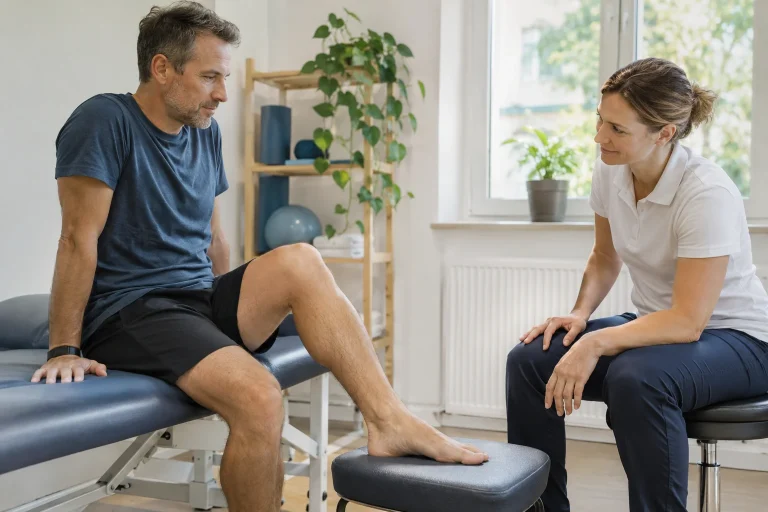
A familiar cycle: your ankle gives way, you put the running shoes aside for a few days, pain eases and you return to the same place. Weeks or months later it happens again. It is easy to treat each case as a separate unfortunate step. Recurrence raises another question, however: what actually changed during the break, and what made the ankle better prepared for the task in which it was injured again?
First assess the new injury as an event in its own right. Severe pain, significant or worsening swelling and inability to bear weight may require urgent help; deformity, numbness or a cold or blue-grey limb may require immediate emergency assistance according to the NHS information. “This always happens” does not establish that this injury is the same or equally mild.
Rest and recovery are different tasks
Interrupting loading after an injury may matter, but the number of days missed does not itself show ankle function. Pain or swelling may change during a short break while range of motion, strength, balance and function needed for the particular sport remain unresolved. Do not derive return timing solely from the calendar.
The NIAMS sports-injury overview connects rehabilitation with restoring strength and range of motion in the injured area and returning to activity. The process may have home-based and professionally supervised parts. This differs from merely waiting until morning pain is less noticeable, then restarting in the same place and manner.
A break does not become a mistake because it cannot answer everything alone. The problem is repeating it as the sole method while nobody reassesses the recurring situation. You need not blame yourself for not knowing which capacity remained below its earlier level. Repeated injury calls for clearer assessment and planning rather than simply complaining less.
Review the incidents together, not just the latest
Reviewing the series needs a short timeline rather than detailed self-examination. When was the first injury? Which further events do you remember, and what was shared or different? Some may have been genuine new sprains; others only a feeling of unsteadiness. Preserve this distinction rather than automatically counting every uncomfortable step as the same injury.
Environment is meaningful information too: a gravel trail, hurried change of direction, kerb or end of a workout. Recurring circumstances do not prove a cause, but can help analyse the task. If every occasion involved uneven ground, for example, this does not mean trails are prohibited forever. It identifies the functional situation to understand in an individual return plan.
Add what happened between events: assessment, exercises provided and how you returned to work and sport. The date you ran again is not all that matters. Prolonged standing, travel or other physical tasks may have returned to your day earlier. Real life between two injuries can reveal far more about load than blank days in the running log.
| Detail to note | Why organise it? |
|---|---|
| Approximate date and event | Separates a new injury from a longer-standing sensation. |
| Task and environment | Reveals the situation in which the problem recurs. |
| Care and guidance received | Clarifies what assessment and rehabilitation actually occurred. |
| How return happened | Makes the sequence of tasks understandable, not just the date. |
| New or different symptom | Prevents current change disappearing into the “usual ankle” story. |
 Enlarge image
What does an actual study tell us about preventing reinjury?
A 2009 randomised trial included 522 athletes aged 12–70 who had sustained a lateral ankle sprain. Both groups received usual care; one additionally completed an eight-week home proprioceptive programme. Over one year, 56/256 participants in that group self-reported another sprain, compared with 89/266 in the other group. These are approximately 22 and 33 per cent.
The study matters because it did not merely observe who liked exercising: participants were randomly allocated. The outcome was nevertheless self-reported, and findings apply to that programme, participants and follow-up period. They do not mean your exact risk is the same or that buying one device reproduces the research’s entire intervention.
New injuries also occurred within the group receiving the additional programme. This illustrates the difference between reducing risk and a guarantee. The research is not an individual exercise prescription, and eight weeks in its description is not an instruction to copy tasks without medical assessment. The useful message is that targeted rehabilitation beyond usual care may have a meaningful role; link the appropriate programme to your condition.
A rehabilitation plan is also a learning task
The 2021 clinical guideline relates therapeutic exercise structure to identified problems, injury and individual circumstances. This is not the name of one resistance-band exercise. Movement, muscle performance, balance and task-specific function may each have different roles. Assessment should clarify which you need.
For learning, what matters is understanding the task’s purpose and how to perform it. A demonstration given only once may not leave execution clear later. Ask for explanations suited to your circumstances: where it can be done, what help is needed and how feedback will occur. You need not improvise uncertainly because an exercise name on paper seems familiar.
Increasing the plan’s difficulty should also be a shared, understandable process. Achieving something once is not the same as meeting that stage’s objective. A general article cannot select suitable progression or repetitions. Follow-up should clarify when and on what grounds to move forward. Rehabilitation then becomes more than a randomly assembled series of internet tasks.
The role of an ankle support and the promise of certain protection
The 2021 guideline discusses external support and therapeutic exercise separately too. With chronic instability, a brace or tape alone is insufficient to develop balance and postural stability. This does not mean a device has no place. Its role, use and accompanying tasks need defining in an individual plan.
A product advertisement often organises the whole story around one solution: buy it, wear it and be safe. Recurrent ankle injury may contain more questions. Distinguish the device’s specific function from what the user can ultimately do. A support cannot show for you whether function has recovered or assess new pain and the consequences of an awkward step.
If prescribed support, understand its practical use too. Which task is it for, how does it fit the shoe, what should you watch for and whom should you ask if unsuitable? A borrowed device or another runner’s trusted brand is not an individual prescription. Choosing equipment helps when integrated into complete care rather than distracting from assessing recurrent injury.
Returning requires more than the calendar
The 2021 PAASS consensus brings together five broad areas for professional return-to-sport consideration: pain, ankle impairments, athlete perception and readiness, sensorimotor control and sporting performance. International experts’ opinions were organised using the Delphi method. It is an important decision framework rather than an automatic clearance test validated for every runner.
The framework explains why “it has not hurt for three days” or “two weeks have passed” is insufficient. Task demands and the athlete’s experience matter too. The consensus does not provide uniform thresholds for home use or prove that reaching a score prevents every reinjury. You do not need to perform its listed jumps or sport tasks alone.
As a recreational runner, connect understandable questions with your own goal. Movement on a calm, predictable route differs from an event involving sudden direction changes or uneven ground. An individual plan can help establish the order and conditions for reintroducing important situations. The aim is not turning an expert framework into a self-administered exam sheet.
 Enlarge image
What interrupted the process before?
Reviewing repeated injuries also includes what failed in earlier care arrangements. Perhaps follow-up was inaccessible, workplace load was not discussed or easing pain suggested no further step was needed. Say these things. The process does not improve by retrospectively blaming only one person’s discipline or decision.
If the next plan rests on the same obstacles, it may stop at the same point. Clarify how you can ask questions between appointments, when learned tasks will be checked and what fits your working day, for example. These do not replace clinical content but make it usable. Practical conditions for a feasible plan are part of care rather than mere motivation questions.
A running companion or coach can support agreed arrangements without taking over clinical decisions. They might help avoid an expected fixed start date or adapt route selection to your plan. You need not prove at every group gathering that your ankle is “good now”. Returning means undertaking an appropriate task rather than fulfilling social pressure.
Make the next checkpoint foreseeable rather than the next reinjury
The cycle of short breaks is tempting because it is simple: no assessment question, just a few empty days and restarting. A more organised path contains intermediate feedback. What needs clarification, which functional goal are you working on, how will change become apparent and what counts as a new event? An individual care plan rather than a general weekly mileage figure can answer these.
The NIAMS advises against working through injury pain and recommends healthcare help for persistent or worsening symptoms. In your situation, this means not automatically calling a new symptom training difficulty. If already following an individual therapeutic plan, follow its agreed reporting rules and report a new injury separately.
You need not expect guaranteed prevention for recurrent ankle symptoms to deserve attention. Realistic aims are better understanding of the condition, appropriate rehabilitation and return connected to your own tasks. Research may indicate risk reduction, and professional frameworks may aid judgement. In your story, what matters is that the next step is no longer determined only by a few days having passed.
Sources
- Martin and colleagues: ankle-sprain clinical guideline, 2021
- Academy of Orthopaedic Physical Therapy official guideline document
- NIAMS: sports injuries, treatment and rehabilitation, 2024
- Hupperets and colleagues: home proprioceptive programme and recurrent ankle sprain, randomised trial, BMJ, 2009
- Smith and colleagues: PAASS, international expert consensus on return-to-sport considerations, 2021
- NHS: urgent warning signs after injury
How Futószív articles are prepared: our editorial guidelines.