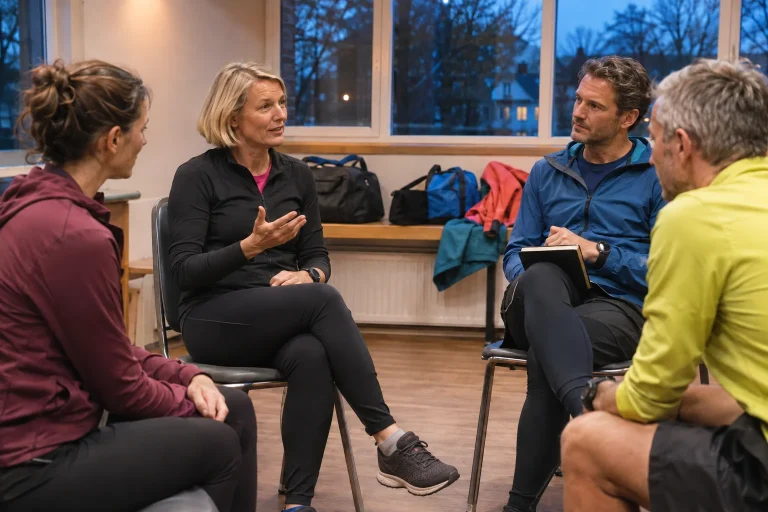
You have no specific symptom, yet would welcome someone to discuss which activity could fit your life. Perhaps online tasks are unclear, a group feels uncertain or you simply do not want another programme you cannot sustain. You do not need to wait for injury or choose a major race goal first. Individual activity planning can also offer help with learning and organisation.
Professional help does not mean one single service, however. Sports instruction, programme organisation, rehabilitation for a known condition and medical assessment are different tasks. Absence of symptoms is not, by itself, a complete health assessment, while a larger body does not automatically make every appointment medically supervised. The following helps clarify your question and the type of support you seek.
You do not need to find a fault in yourself to ask
Movement includes details you can learn. How should a task be interpreted, what is a session for, how can you express uncertainty and how does the programme connect to daily life? You can discuss these personally even without symptoms suggesting illness. Asking for help does not prove you are incapable of independence. It can prepare you to make clearer decisions based on your own priorities later.
Start with a specific question. “I’d like to know what a suitable beginner session would look like for me.” “I find written movement tasks hard to understand and want a demonstration.” “I’d like a programme adaptable to my changing work schedule.” The question shows which service you expect. You do not need an invented healthcare reason to legitimise wanting to learn and plan.
The NHLBI information on starting activity emphasises considering benefits that matter to you, preferred movement and everyday routine. Activity does not require becoming a marathon runner to have meaning. Your own consultation question can therefore centre on practical daily life, not only performance improvement or changing body size.
What help can an activity professional provide?
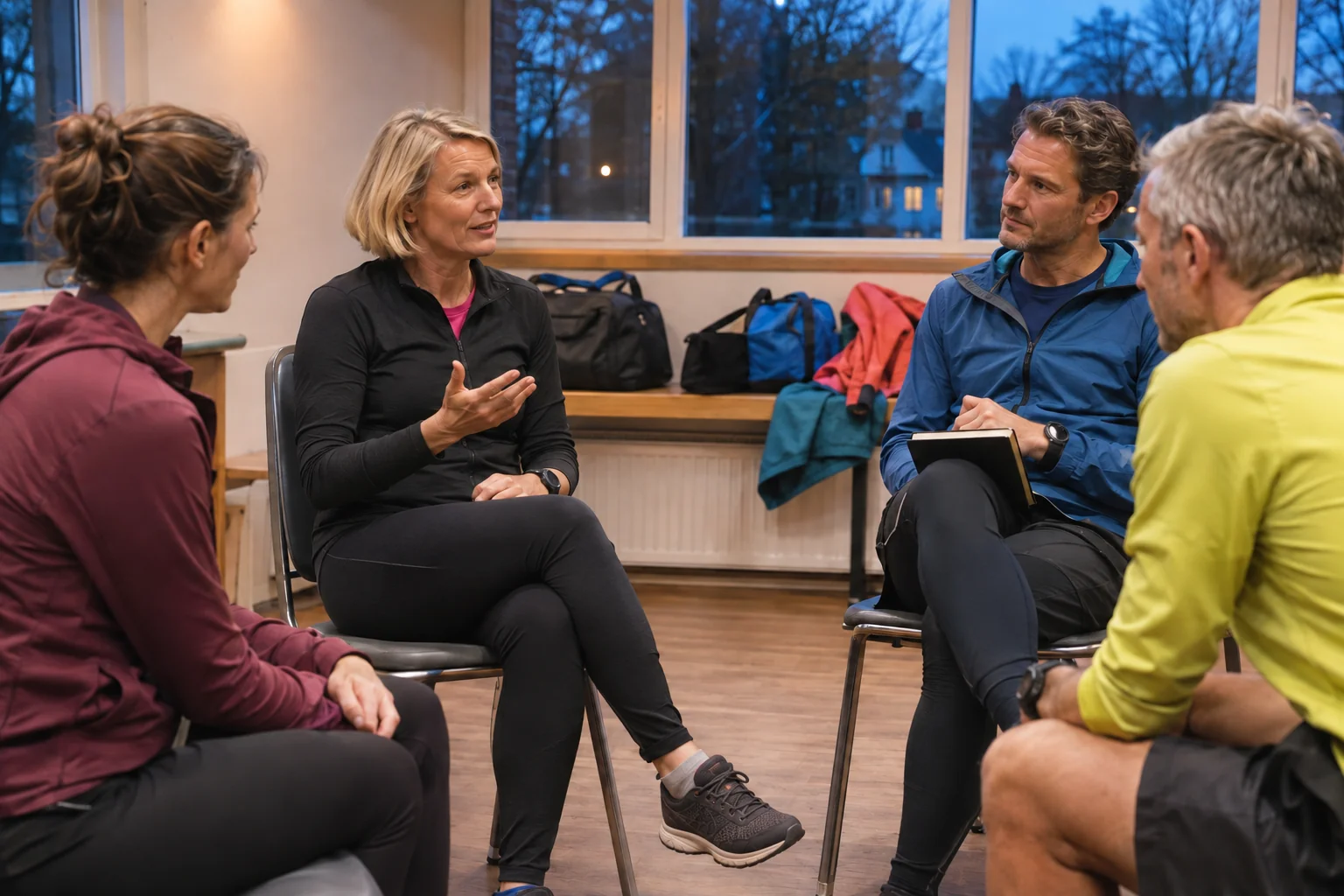
A professional working within their qualifications and role can help clarify sporting goals, explain tasks and plan practical participation. “Personal plan” alone does not reveal the service’s content, however. It may mean a single discussion and written material, or demonstrations, an accompanied session and later feedback. Find out beforehand what you receive and what you can ask about later.
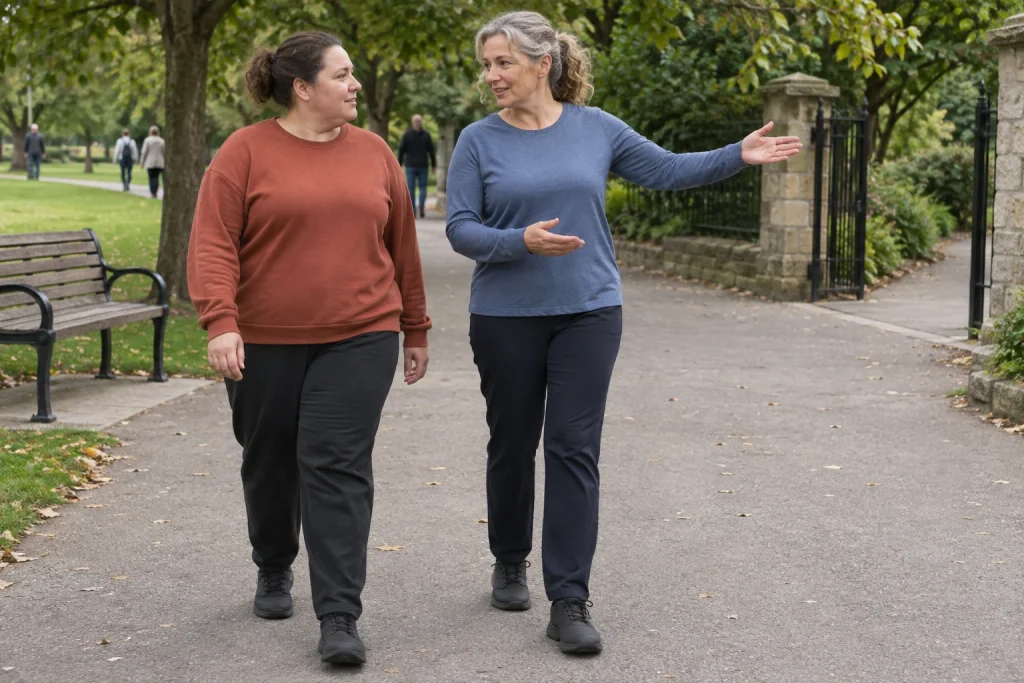
A joint route review may help, for example: where you meet, the surface, shortening options and the journey home. At another time, explaining a task matters so you do not guess from video fragments. These are not necessarily clinical examinations. The professional’s role should be clear, including which questions they refer onwards when healthcare competence is required.
The NIDDK programme-selection guide also recommends asking about staff qualifications, how the programme works and necessary professional cooperation. It concerns weight-management services, so it is not a list of Hungarian coaching entitlements. We use it as a principle for questions: alongside a title or good impression, understand the actual task and professional background.
 Enlarge image
What makes a healthcare discussion different?
Healthcare assessment is not simply a more detailed coaching conversation. A known condition, symptom, treatment or certain planned exertion changes can raise separate questions. NHLBI recommends healthcare discussion for chronic conditions and symptoms such as chest discomfort or dizziness. This article does not decide unseen which category applies to you or request the same test package for every reader.
If a professional hears information beyond their role, referral can be responsible. Understand why it arose and which question needs clarifying. This differs from requiring healthcare supervision for every activity without explanation solely from body size. Reasoning based on individual circumstances helps distinguish necessary clarification from a general assumption.
Beginning without symptoms is not permanent certification of health either. Later new symptoms need assessment in their current context. An earlier plan or enjoyable first session does not clear every future situation. Equally, professional help is not valuable only when it finds a problem: a clearer task and more workable arrangements can themselves be outcomes of the meeting.
Bring a few useful facts about your present
For the first discussion, briefly reviewing activity in your current days, existing experience and what would be new may be enough. Do not present a sportier picture than reality or call everyday activity nothing. The present matters, not a best performance years ago. The professional can then relate questions to your understood situation rather than an imagined “average beginner”.
Add the full time needed for participation and which circumstances matter: travel, family duties, costs, venue or changing clothes. The NIDDK starting-activity information also recommends considering specific barriers and possible solutions. These are not distracting extras in an individual plan. A programme that fits only into a nonexistent free time slot is not a usable starting point.
If important history or care instructions exist, share their actual content in the appropriate setting. You do not need to disclose every personal detail in front of a group. If unsure what is relevant, ask the professional what they need and why. Good information-sharing is not collecting the most possible data, but creating the clear framework needed for the task.
Make the appointment shared work, not a lecture on your suitability
One useful sequence is to clarify the question first, then understand the proposed task and finally explain back in your own words what you understood. This is an original editorial organisation idea, not a clinical examination. It helps reveal whether you mean the same thing. Where something is unclear, ask for another explanation rather than filling missing steps alone at home.
Questions matter alongside demonstration. What is the task’s purpose? Under which conditions can it be done? How do you report circumstances differing from the agreement? Not every session needs a long theory lesson, but the essential framework must be clear. A document full of data and technical terms is not more personal if you still do not know the next practical step.
The outcome may be simpler than expected. Another venue, clearer task description or better time may resolve uncertainty. Not every request for help has to lead to complex measurement, new equipment or greater exertion. Personalisation means answering the question understood, not making the programme complex.
Know what happens after the meeting
A plan is usable when you know what to report, whom to approach and how feedback goes both ways. Even for a one-off service, understand when its commitment ends and which questions need another appointment. This is practical clarification, not a legal contract template. Unclear follow-up can easily leave a participant trying to resolve emerging questions alone.
You do not need a perfect log for feedback. Name which part was clear, what remains uncertain, what worked organisationally and whether the activity experience changed. A symptom is information with separate significance, not a satisfaction score. The professional should be able to say when clarifying a task is enough and when another type of assessment is needed.
Reviewing a plan does not necessarily mean increasing it. It may mean clarification, simplification, a venue change or realising you seek another service. Help may still have been valuable if you continue with a different activity from the one you arrived with. Your first choice need not be a permanent identity, and every experience need not be judged as success or failure.
 Enlarge image
Three everyday questions you can seek help with
In the first invented situation, an adult feels uncertain about starting in a group. They come without symptoms, wanting to understand the meeting place, session process and requesting a different task. Help may mean orientation and understanding the participation framework. No illness needs to be assumed, but a newly emerging healthcare question need not be withheld either.
In the second example, someone has watched many videos but cannot see how to build a meaningful programme from them. The personal meeting may clarify the relationship between tasks and their starting point, rather than collect the maximum number of exercises. The third involves fitting participation around variable shifts. Schedule and organisation matter as much as session content here. All three stories are original editorial examples.
Naming the question in these examples helps find an appropriate service. Not every coach or programme offers all three kinds of help, which is not a judgement in itself. You need to know whether the task offered meets your need. Individual support need not be an expensive, lengthy package, but understand actual contents and professional scope before focusing on price.
Clearer independence can be the aim of help
Discussing a start with someone does not commit you to perpetual supervision. You can learn to ask more precise questions, recognise circumstances needing clarification and describe experience. This is sporting orientation, not complete health self-assessment. Independence also includes knowing when not to guess alone and which question needs another professional.
Seeking individual activity planning can therefore make sense without symptoms. You do not need first to prove you do something badly enough or present body size as a problem. Separately understanding your question, the service’s actual contents and healthcare framework can help you choose support that leaves usable knowledge and a feasible next step.
Sources and service boundaries
NIDDK: Tips for Starting Physical Activity; NHLBI: Getting Started and Staying Active; NIDDK: programme-selection considerations. The invented situations and organisational ideas do not replace individual healthcare assessment or judge a particular Hungarian provider’s professional authorisation.
How Futószív articles are prepared: our editorial guidelines.