You are interested in activity but do not want a weight target. Perhaps you want company, a better understanding of tasks that suit your body or activity as part of a healthcare plan. These can be goals in their own right. A larger body does not automatically turn every sporting decision into a diet. The specific programme’s conditions and the activity’s individual suitability still need to be understood separately.
The brief answer is therefore that activity can have meaning and purpose separate from weight loss, but not every advertised service offers the same thing. A weight-loss programme, beginner sports class and therapy group may perform different tasks. The following considerations help you seek an opportunity whose operation you understand and that fits your circumstances. They do not provide general permission to run or an activity dose for everyone.
Activity goals can extend beyond weight change
The WHO overview of physical activity describes benefits for physical and mental health, including activity during transport, work and household tasks alongside leisure sport. Activity is therefore broader than a calorie-burning workout. This article does not promise one chosen class will produce every listed benefit for you or replace treatment of a condition.
Learning movement can be a goal of your own too. You might want to understand a task’s process, recognise important conditions at a venue or learn to communicate in a group so you receive suitable help. Regular meetings with supportive company can also be a goal. These do not need to appear in weight measurements to be real intentions you can discuss.
A health goal and a weight goal are not identical either. If you receive care, it may have assessment criteria to understand with your provider. A choice about sport does not remove these, but weight loss does not become every activity’s exclusive measure. Name which question you are discussing and with whom so different purposes do not quietly exchange places.
Check what kind of programme is advertised
A recreational class may focus on shared movement and learning the activity. A weight-management service may instead be organised around a defined goal with several professional components. A rehabilitation programme may relate to a known condition and individual care requirements. Everyday adverts can mix the names, so read the content and participation conditions rather than only the title.
If the offer is unclear, ask what happens at a session, the programme’s purpose, whom it was designed for and which data or outcomes are tracked. Ask in advance about participation without a weight-loss goal too. The answer may be that another group or service better suits your need. You do not need to adapt every offer to yourself; knowing clearly what it provides and does not provide is useful information too.
A participation condition is not always about public comparison or medical suitability. It might involve group size, venue access, previous experience or the instructor’s scope. Discuss these specifically. Declining weight loss does not explain every organisational difficulty on its own, just as agreeing to it does not automatically make every task suitable.
 Enlarge image
Health gains cannot be read from one scale
The NICE recommendations on activity for adults explain that other health benefits of activity matter even without weight loss. The NIDDK information on activity in a larger body also addresses this. Two distinctions follow: weight change is not the same as every health change, and assessment of a personal health outcome does not come solely from enjoying movement.
If you like the group more or find getting out easier, describe that as valuable personal experience. You do not need to claim it definitely changed a laboratory result or cured a condition. Personal experience and appropriately assessed health data are different information. Both can have a place among your goals, but neither needs to prove something it cannot.
Likewise, a favourable scale result does not make a painful or overly demanding programme appropriate. Your activity feedback still matters when numbers move as expected. Participation without a weight-loss goal can therefore mean handling different questions more precisely rather than ignoring health. Individual condition still requires appropriate professional assessment.
Name what you want to experience or learn
Add a detail to “I want to feel good” that you can actually discuss after a session. Did you understand the process? Was reaching the meeting point manageable? Could you say when you needed explanation? These are not medical metrics or new performance pressures. They are simple reference points so your sporting experience consists of more than a photograph or others’ opinions.
The goal can change with the situation. Initially, finding your bearings may matter, while later a particular skill or community event comes forward. You do not have to identify with one sport for an entire year before the first session. An open learning goal allows actual experience to shape decisions. That still does not remove the need for task suitability and appropriate healthcare discussion.
If you want brief notes afterwards, two sentences may suffice: what worked in participating and where you would ask for another solution. You do not need a daily assessment form or another metric to chase. If logging causes tension, seek another way to discuss it. The aim is clear feedback, not replacing a weight-loss graph with an equally strict attendance graph.
Individual suitability matters without a weight-loss goal too
Respecting a sporting goal does not mean every activity automatically suits everyone. Current health, previous and present activity, symptoms, the task and environment matter. NICE also emphasises current ability and fitness when choosing activity. An inclusive programme may therefore need more than a reassuring slogan: it needs ways to handle different starting points.
Ask how preliminary discussions work, who leads and what happens when another version is needed. New symptoms or uncertain health questions should be clarified with an appropriate professional, not deduced from the programme’s goal. An existing personal treatment or rehabilitation plan is not overridden by a generic group offer. A sporting goal without weight loss and responsible healthcare decisions can fit together.
Physical-environment details can also matter: changing, toilets, stable equipment, an easy-to-navigate route, turning-back options and getting home. You can ask about these factually. Access is different from whether someone is a suitable athlete. If a venue does not work for you, your goal does not become invalid; seek another setting or format within your circumstances.
A group does not require identical outcome commitments
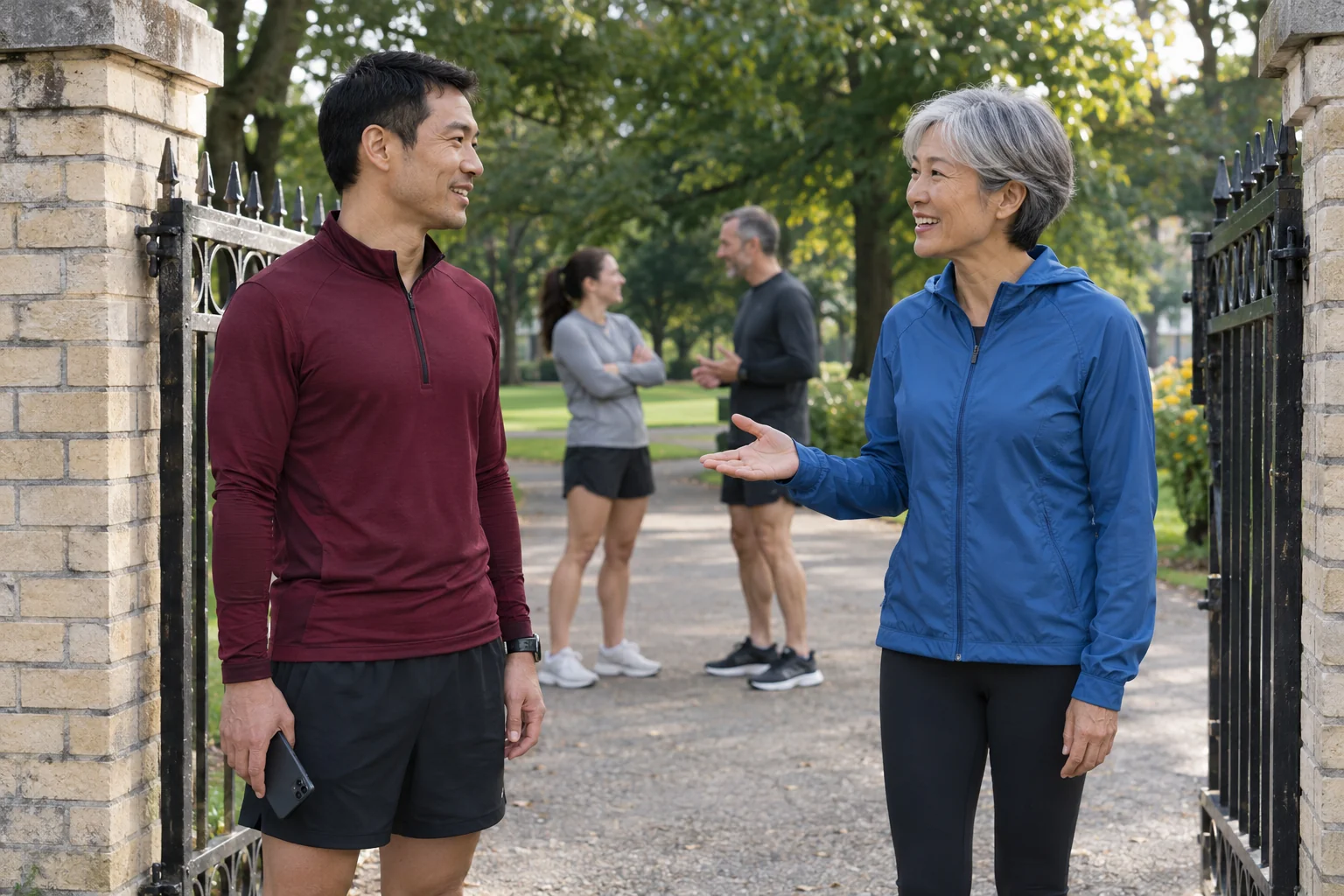
Group members can arrive with different intentions: one seeks company, another wants to learn a task and someone else exercises with an individual healthcare goal. A shared session does not necessarily require committing to the same weight change. Organisation should make participation conditions and available help clear, rather than letting different needs emerge unexpectedly halfway through.
You can discuss social communication too. Simply say if you do not want comments about weight or shape. People can enjoy a good meeting, thank each other for help or recognise something learnt without centring bodily change. Friendly intention does not automatically identify your needs; a specific request can help.
You do not, however, have to take responsibility for changing everyone’s outlook to join a community. Recurrent uncomfortable comparisons or unsolicited judgements can be addressed with the organiser, and looking elsewhere may be a reasonable decision too. A community’s value appears in its actual operation, not solely its inclusive advertising language.
 Enlarge image
Three fictional programmes, three sets of questions
The first example is a general community exercise class whose description explains the process, preliminary discussion and modifications without targeting a weight result. Clarify whether the task and environment fit your situation. The second is an explicit weight-management package. Ask in advance about participation without a weight-loss goal and any separate sports class, rather than assuming every component can be omitted.
The third is a therapy group for a known condition with its own healthcare participation framework. Agreement on personal care goals and suitability is the starting point there, not whether it resembles recreational training. All three examples are invented, not descriptions of specific providers. Their differences show why understanding a programme’s actual task matters before seeking a generic yes or no.
For your decision, state the type of help you seek. A service can suit others while not offering what you need now. You do not have to rewrite your goal to fit the advert. Clarification may lead to joining, further discussion, another programme or postponing the decision. None judges the value of your interest in movement.
Keep the goal while reviewing the plan
After initial experiences, look back at whether you received what was agreed. Was there room for your feedback? Were the task and necessary modifications clear? You can change participation arrangements without immediately setting a new weight target. Symptoms or important health changes require separate assessment and cannot wait for an end-of-programme satisfaction discussion.
Activity without a weight-loss goal can therefore be a meaningful, deliberate sporting choice. You do not have to prove every health question is resolved or monitor yourself equally strictly with a new yardstick. In a suitable programme, your goal, individual condition and actual requirements shape participation together. A session can then be more than a tool for future bodily change: an understandable, manageable part of your current life.
Sources and the examples’ limits
NIDDK: Staying Active at Any Size; NICE NG246: Physical activity and diet; WHO: Physical activity. The sources describe general health and care contexts; programme types and sample phrases are original editorial illustrations, not specific providers’ conditions or individual activity prescriptions.
How Futószív articles are prepared: our editorial guidelines.