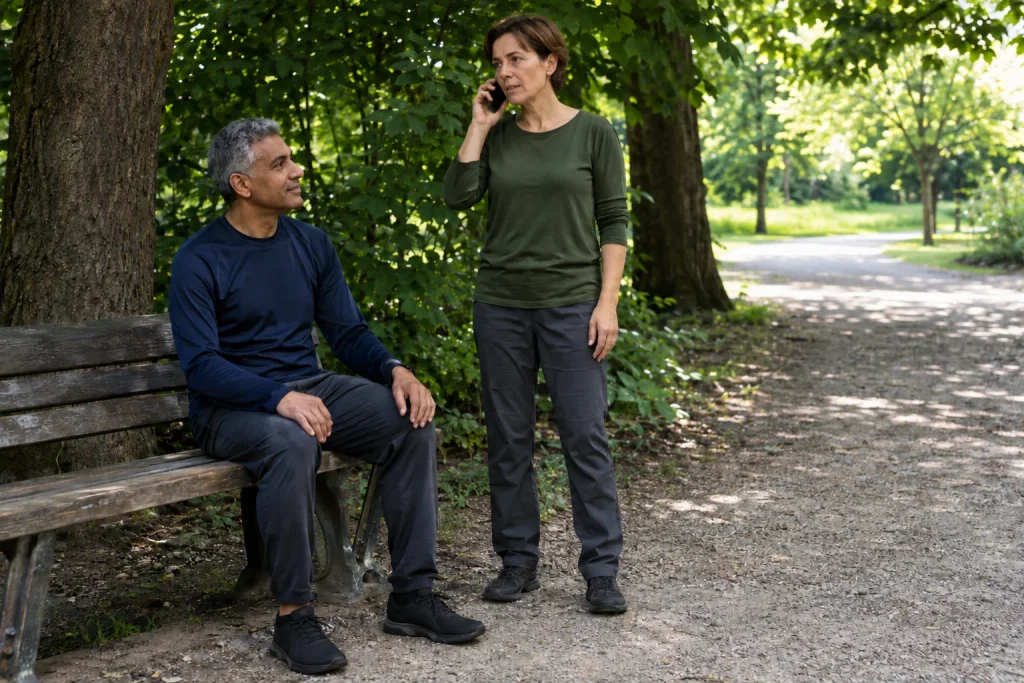
If a companion running in hot conditions becomes confused, behaves unusually, moves unsteadily, struggles to speak or loses consciousness, immediate help is needed. Heatstroke is possible, but you do not need to determine the exact cause at the scene. In Hungary, call 112, stop the exertion and follow the emergency operator’s instructions. Prompt cooling matters alongside arranging help. NHS: urgent signs of heatstroke.
This article explains important connections in recognition and help from non-professionals. It does not replace first-aid training, an event’s medical protocol or emergency-dispatch instructions. The running programme is no longer the primary goal: the person’s safety, the call and access to appropriate help come first.
Heatstroke is a serious condition, not a name for a very hot run
The CDC describes heatstroke as the most serious heat illness, involving severe disruption of temperature regulation. Without emergency care, permanent injury or death can follow. The everyday phrase ‘I nearly got heatstroke’ can therefore mislead when used simply for unpleasant heat. CDC/NIOSH: heat-related illnesses.
In running, feeling unwell is easily treated as a natural part of effort. Slowing pace or tiredness alone can belong to many situations, but a change in mental state or usual behaviour is a different level of signal. Do not begin by evaluating performance. Take the present condition seriously.
Knowing the name can help communicate quickly, but is not a requirement for calling. You can say that an adult exercising in the heat has become confused and unwell. Actual symptoms, location and current responsiveness matter more to the operator than a diagnosis you declare certain. You do not need to prove suspected heatstroke’s urgency yourself.
A mental-state change can appear in ordinary behaviour
OSHA lists confusion, slurred speech, loss of consciousness and seizures among heatstroke warning signs. It emphasises that heat-illness symptoms can overlap and non-professionals need not diagnose the precise type. Confusion requires immediate help and cooling. OSHA: heat illnesses and first aid.
As a running companion, you may notice someone no longer understands a familiar situation, struggles to follow conversation or reacts noticeably differently. You do not need to classify this as personality, stubbornness or race nerves. What matters is what has changed from usual. You can describe your observation in a simple sentence when seeking help.
You do not need improvised memory tasks, calculations or walking tests. They are not home exclusion tests and may consume time needed for the call. If the change is worrying, do not try to prove how confused the person is. Get help, stay beside them and let the dispatcher’s questions guide further observation.
Sweating is not a safety indicator
The CDC lists both hot, dry skin and profuse sweating among heatstroke symptoms. Sweating therefore does not rule it out. A simplified dry-skin rule can mislead: mental state, illness and circumstances matter together. Do not make seeking help depend on whether clothing is wet.
Nor must every detail fit a typical image seen on screen. Judging colour change may differ with skin tone and light. Instead of seeking the most recognisable appearance, report what you observe now: responsiveness, speech, movement, breathing and how the person feels. You do not need to diagnose from skin appearance.
A companion who still answers or can take a few steps is not necessarily fit to continue alone. The task is not choosing one reassuring detail over the other signs. Report the complete observed change on the call, and do not let finishing the workout organise the situation.
 Enlarge image
The call must not wait for precise temperature evidence
Heatstroke information may mention a high body temperature, but non-professionals must not make requesting care depend on available measuring equipment. If someone is unwell and confused in hot conditions, an urgent symptom is already present. This article gives no displayed threshold below which you can classify the situation as safe at home.
A sports watch or environmental thermometer may provide data for a different question from assessing the health condition. A favourable-looking figure does not override observed confusion. If asked, explain which device’s data is available. Do not automatically call an environmental or wrist reading body temperature.
If no thermometer is available, do not let every helper leave to find one while the person remains alone. A phone, location information and someone staying beside them already provide real help. Precise diagnostic measurement belongs to care. Uncertainty at the scene is not a reason to delay the emergency call.
Cooling and seeking help should happen together
St John Ambulance emphasises cooling as quickly as possible and arranging emergency help for heatstroke. It recommends a cooler, shaded place and removing unnecessary outer clothing where feasible. Its information includes cool, wet material or wetting with cold water for cooling. St John Ambulance: first aid for heatstroke.
Do not organise things by collecting every item at length before phoning. With several people present, one can call while another arranges locally available help and cooling according to instructions. Naming tasks helps: who stays with the person, who speaks to dispatch and who guides help to the scene?
This article does not teach immersion or recommend improvised bathing carried out alone. Trained event medical staff may follow their own protocol. As a non-professional, follow emergency-dispatch guidance and state which equipment and how many helpers are present. Continue observing the person and communicating with helpers during cooling.
Do not force drinks on a confused person
The National Weather Service heatstroke first-aid information does not recommend giving fluids. Giving drinks to someone confused or unconscious is not an appropriate substitute for emergency care. Do not try to determine the cause using sports drinks, salt tablets or energy gels. Follow the emergency operator’s guidance for the actual situation. NWS: heat illness and first aid.
This matters because drinking is often the first response to illness in running communities. Familiar exercise-nutrition routines do not fit every health condition. Hot weather does not prove the person simply needs more fluid. A change in mental state is an emergency question.
If the person says they will drink and continue, report the observed change anyway. Your task is not to make a home diagnosis from a drink’s effects. Explain current responsiveness, breathing and condition, and remain available for communication with helpers.
Do not leave them alone or let them continue under their own steam
OSHA particularly emphasises someone staying with a person affected by heat illness, because their condition may worsen quickly. The aim is not sending them home alone to rest or persuading them to walk to the finish. Obtain help appropriate to the condition while someone observes changes.
‘There is only a short section left’ concerns the running programme, not medical care. Reaching shade and arranging medical help must not become a race against the finish arch. State that the run has ended and you are seeking help. Ask for guidance about further movement based on the location and condition.
At an event, alert medical staff and name the symptom rather than merely saying someone is tired. A race number can help identify the participant, but the present condition takes priority. If several people are there, arrange guidance for arriving help while someone stays beside the person.
Overlapping symptoms mean you do not need to distinguish every cause
Feeling unwell in heat can have several causes, and some symptoms occur in more than one condition. OSHA therefore does not ask non-professionals to diagnose the precise heat-illness type at the scene. Recognising change, appropriate first aid and urgent professional help matter. You can state uncertainty on the call too.
The CDC rhabdomyolysis page likewise explains that some symptoms resemble heat illness or dehydration, and tests are needed to distinguish them. Dark urine, unusual muscle symptoms or weakness may be important history if known. Do not use them to exclude other possibilities. CDC/NIOSH: overlapping symptoms and assessment.
Keep observations on the emergency call short and specific: ‘They ran in the heat; now they do not understand what is happening properly and are unsteady.’ Add the location and answers to questions. You do not need to choose among every possible diagnosis, and no assumed cause should prevent help.
 Enlarge image
Location and current responsiveness matter on the phone
An accurate location helps assistance actually reach you. Give the town, entrance, known route point or access details as best you can. Arranging for someone to wait at a gate for an ambulance can be a separate task. Provide the actual present location rather than a saved sports-app route.
| Information | What to report |
|---|---|
| Location | Where are you, and how can the spot be reached? |
| Current condition | Are they responsive, how are they speaking and breathing, and what changed? |
| Circumstances | Known history of running or other physical exertion in heat. |
| Actions taken | Exertion has stopped; who is beside them and what help is available? |
| New change | Immediately report worsening responsiveness or breathing during the call. |
If the person is unresponsive or not breathing normally, tell dispatch immediately and follow instructions on resuscitation and necessary positioning. Reading more of an online article should not be the next step. Telephone guidance can respond to the actual condition.
Feeling better does not automatically change the call’s purpose
If responsiveness changes during cooling or rest, tell helpers too. Do not independently decide the original confusion no longer matters. Agree the next step with professional help informed about the condition. This article gives no clearance to continue running or return later.
A change in mental state can therefore be a crucial practical sign in recognising heatstroke. You do not need to wait for dry skin, collapse or a particular displayed temperature. A companion staying beside the confused, unwell runner, a prompt call and cooling according to instructions together support access to appropriate care.
Sources
- NHS: Heat exhaustion and heatstroke
- CDC/NIOSH: Heat-related Illnesses
- OSHA: Heat-Related Illnesses and First Aid
- St John Ambulance: Heatstroke
- National Weather Service: Heat Cramps, Exhaustion, Stroke
- CDC/NIOSH: Rhabdomyolysis and Work
How Futószív articles are prepared: our editorial guidelines.