One running programme promises to remove fat from your belly, while another video marks a target area on your body with specific abdominal exercises. The idea is simple and easy to imagine: choose a place, exercise and lose fat from there. The real question is more complex. A muscle’s work, measured change in a body region and a promise that someone will definitely lose fat from their preferred place are different things.
The research presented cannot establish a guaranteed personal running programme targeting only the abdomen. Equally, possible local effects of local training should not be discussed as though every scientific question were settled forever. A useful answer distinguishes research findings from advertising overreach and allows movement to have a personal purpose beyond appearance.
What exactly does ‘only from the belly’ mean?
First unpack a promise in everyday language. Does it claim stronger abdominal muscles? A change in waist circumference? A reduction in instrument-measured trunk fat mass? Or that nothing changes elsewhere and only your chosen region transforms? These are different outcomes. When advertising switches between them, a programme can sound more powerful than what was actually studied.
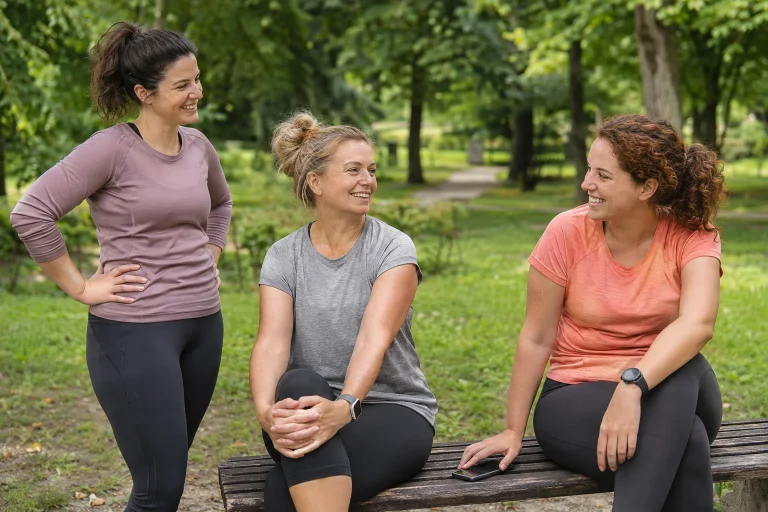
Exercising a body region is not the same as measuring change in nearby fat. A picture of someone doing abdominal exercises shows only the movement. It does not prove where, how much or which tissue changed. Likewise, a photograph emphasising a runner’s abdomen is not an exercise-physiology measurement. An image may sell a story, but does not itself answer the central claim.
‘Only’ is a particularly strong word. To discuss it meaningfully, before-and-after data for one region are insufficient: other changes and the comparison would need to be understood too. Someone feeling happier with their clothes’ fit after a programme can be a real personal experience. Yet we still do not know which change caused it, and it does not become a reliably repeatable body-part-targeted method for others.
Two kinds of outcome in an earlier abdominal-exercise study
In Vispute and colleagues’ 2011 study, 24 healthy, previously relatively inactive adults aged 18–40 were randomly allocated to abdominal-exercise or control groups. After the six-week programme, muscular endurance improved in the exercise group, but no significant effect was found on the abdominal-fat measurements or circumference studied. This concerns that particular programme and small sample, not a final verdict on every possible training approach.
The two outcomes are interesting together: improved movement ability and an absence of body-composition change are not contradictory. Judging training solely by whether your belly shrank could overlook the ability you actually practised. A region-specific strengthening goal and an appearance goal therefore deserve separate wording.
The lesson is not that everyone should perform or avoid that exercise sequence. Rather, a study may measure answers to several questions that cannot be interchanged. When an article highlights one positive result, check what it was: more repetitions, different effort, measured fat or something else entirely. Even copying a study’s task exactly does not replace an activity plan fitting your own condition.
 Enlarge image
Read the newer positive local finding in context too
A 2023 randomised study compared treadmill activity with a programme combining running and abdominal endurance work over ten weeks in 16 men with overweight, aiming to match energy expenditure. Trunk fat mass decreased more in the combined group, while total fat mass and body-weight reductions were similar between groups. The authors interpreted this as evidence supporting spot reduction.
Importantly, combined sessions were longer and the programme included specialised machine-based abdominal work. The study did not examine running alone, included no women and could not establish which fat depots changed from the measured trunk-fat change. The authors also identified a lack of dietary control and other limitations. The result does not mean a few abdominal exercises or any running plan will reliably affect the place you choose.
Research can be interesting without being turned into a weight-loss recipe. Advertising often removes the words needed for interpretation: who, in what programme, compared with what and measuring which outcome. Once these disappear, readers no longer receive the claim actually examined by the study. Meaningful information preserves the difference between a possible effect and a promise made to you.
Circumference, instrument data and the mirror ask different questions
Waist circumference can have a healthcare role, but is not a direct display of one fat depot. The NICE NG246 guideline uses waist-to-height ratio together with BMI in a defined adult group to estimate central adiposity practically and assist further risk assessment. That estimate is not proof that a running programme removed fat from a selected place.
Conditions can vary in home comparisons: posture, clothing, light or measuring technique may differ. Do not infer precise tissue changes from two pictures. If monitoring requires a measurement, ask for clear guidance on what and how to track and who interprets it. A tape measure cannot decide fitness to run or the cause of abdominal symptoms.
Satisfaction or dissatisfaction with the mirror is another experience again. You need not deny caring about appearance, but you do not have to turn every bodily feeling into health data. A health goal and an appearance goal may require different discussions. When they merge, sport can seem useful only if a photograph meets an earlier expectation.
| Observation | What does it tell you? | What is it insufficient for? |
|---|---|---|
| An exercise becomes easier | Experience of that particular movement task | Demonstrating local fat loss |
| Waist circumference changes | The course of the circumference being tracked | Identifying one tissue or the cause of change |
| Trunk fat decreases in research | The measured outcome in that sample | A personal running guarantee targeting only the belly |
| A photograph looks different | A difference in the visible image | Precise health or body-composition assessment |
A health estimate is not a training command
If abdominal fat distribution or waist measurement comes up at an appointment, clarify its purpose. Which question does it inform, and what further assessment is needed? NICE also emphasises not automatically attributing every symptom to weight, and asking permission to discuss weight and take measurements. New pain or another health problem does not disappear because body size can also be discussed.
Choosing activity also involves your current abilities, previous experiences and any restrictions. A waist measurement does not mean you must run or that only a particular intensity has value. A movement plan should fit your actual condition and goal. Risk assessment and detailed sports planning may connect, but are not the same task.
Your own goal can be simple: moving more comfortably through the day, returning to social activities or eventually undertaking a permitted running task. If you also receive healthcare weight management, it can be coordinated with sport. But you do not need to evaluate every activity through your belly’s appearance. Clothing size does not validate the enjoyment of a shared outing or learning a skill.
How can you recognise an exaggerated claim?
It may be questionable when a programme cites research but shows only before-and-after photographs. ‘Scientifically proven’ is also insufficient if participant numbers, the task or outcome type are unclear. Having a reference does not itself ensure that an advertisement makes the same claim as its source. Place the statement and underlying study side by side.
In a fictional example, a provider turns improved abdominal-muscle endurance into a claim that the programme removes belly fat. Another converts a specialised combined-training result into a simple running plan. Important details disappear in both cases. You do not need a scientific qualification to ask whether this movement was actually studied, this effect measured and these kinds of participants involved.
Everyday conditions also reveal something about a suitable service. Is the programme understandable, is there individual discussion, are costs clear and are you free from pressure exploiting body insecurity? Do providers explain where they cannot guarantee results? Health and weight-loss promises are particularly strong claims; a guaranteed body-part transformation does not become better founded because it comes with a limited-time discount.
 Enlarge image
Movement can aim for more than reshaping one body region
The WHO physical activity overview discusses several health benefits of physical activity. Its meaning need not be narrowed to visible change in one region. An individually suitable programme can support endurance, strength, everyday function or social participation. Discuss separately which matters to you.
The NIDDK page on physical activity myths also reminds readers that activity need not occur only in long sessions. This helps counter the message that only a dramatic, exhausting abdominal programme counts. Organising movement around your schedule and condition is a different question from changing a body region selected by an advertisement.
Choose observations related to the goal you value. Is it easier to set out for an agreed session? Do you understand the task? Does the timing fit your day? These do not replace healthcare checks or measure body composition. They help give sport meaning within your own experience rather than making it something done only in hope of a future photograph.
Four questions before choosing a belly-targeted programme
When you next encounter such a promise, first restate it as a specific claim. Exactly what would change, over how long, and what does the result mean? Then examine the source: did it study the same movement, outcome and similar participants? Finally, consider your own situation. An interesting study can still lack everything that makes a programme appropriate and feasible for you.
- Are they discussing muscle function, circumference, measured fat mass or merely a photograph?
- Do they show the whole programme, or extract one appealing detail from research?
- Do they personally guarantee something the study did not establish for every participant and circumstance?
- Does the programme fit your health and goals, or exploit insecurity about part of your body?
We can discuss research on local effects openly and accurately while rejecting promises of certain personal transformation. You do not have to choose between simplifying science and accepting advertising. Running or another suitable activity can matter in your life without serving to eliminate one designated body part. A better goal is one you understand, help shape and can pursue through a feasible plan fitting your actual condition.
Sources
- NIDDK: Some Myths about Nutrition & Physical Activity
- NICE NG246: Identifying and assessing overweight, obesity and central adiposity
- Vispute and colleagues, 2011: The effect of abdominal exercise on abdominal fat
- Brobakken and colleagues, 2023: Abdominal aerobic endurance exercise reveals spot reduction exists
- WHO: Physical activity
How Futószív articles are prepared: our editorial guidelines.