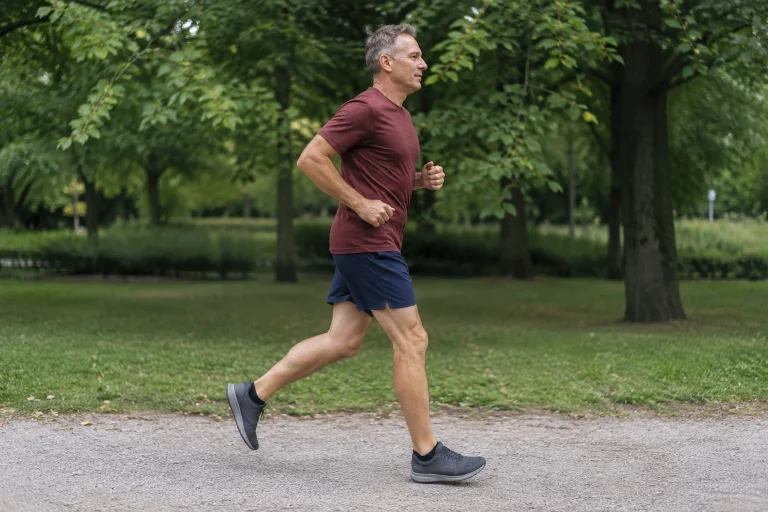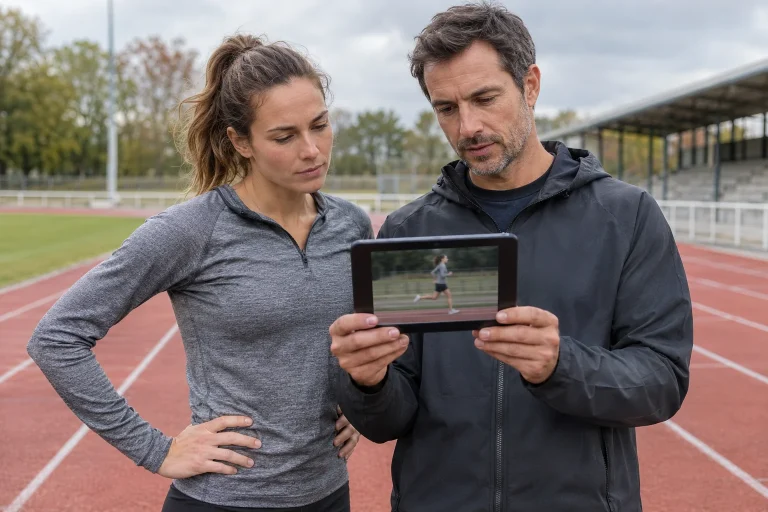
You watch two running videos. One movement looks effortless, the other unusual. Which runner uses less energy at the same speed? An immediate answer from appearance is tempting, but economy is measured in a specified task, whereas ‘beautiful’ movement is judged through the observer’s expectations. The relationship between the two perspectives can be studied, but their equivalence should not be assumed.
This does not deny technique’s importance. On the contrary: movement is complex enough to warrant taking evidence seriously. Which characteristics accompany economical running in a group is one question; what happens when a particular person consciously changes their movement is another. The following seven perspectives help separate aesthetic impressions, observed associations and actual interventions.
1. Video gives an impression first, then a measurable question
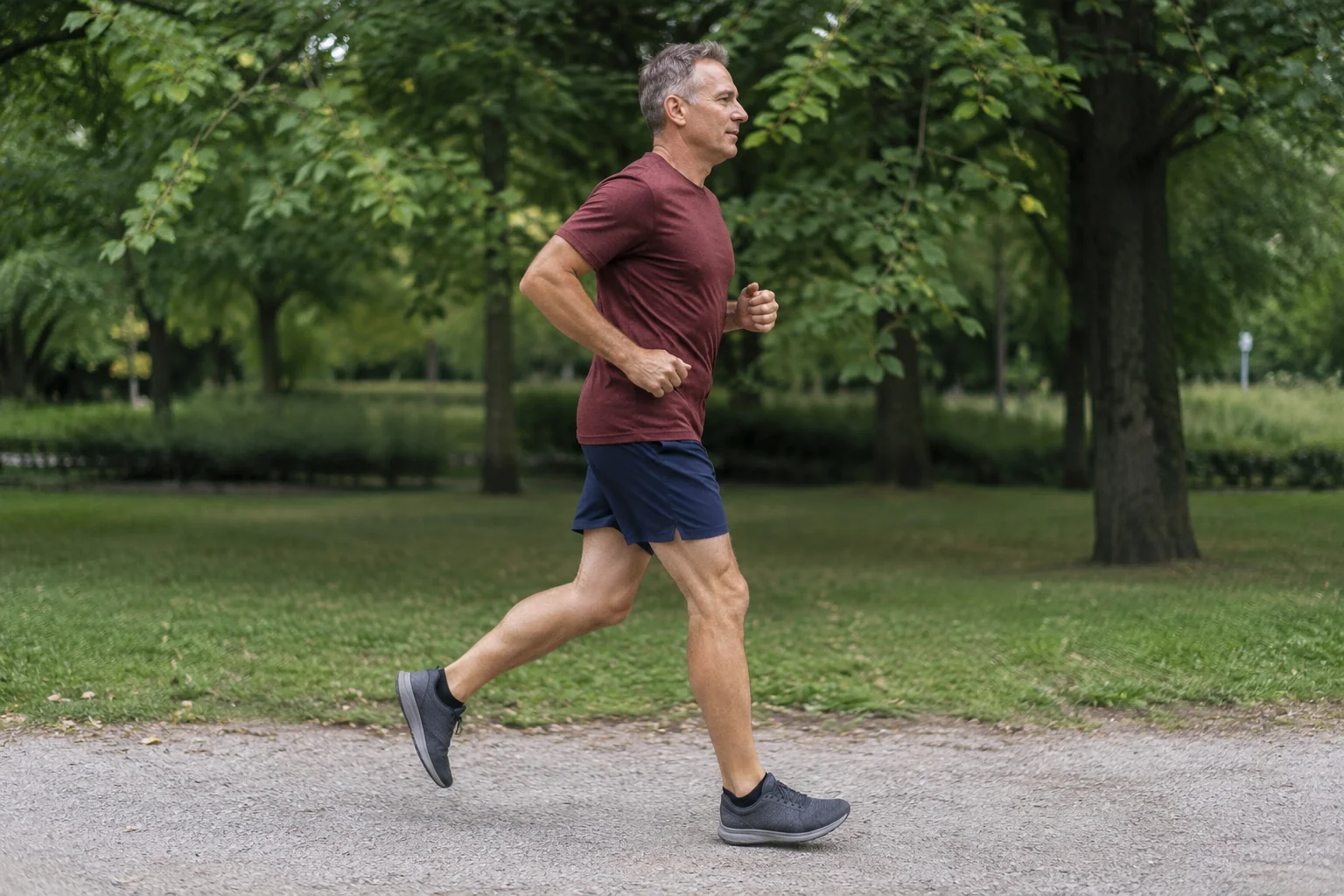
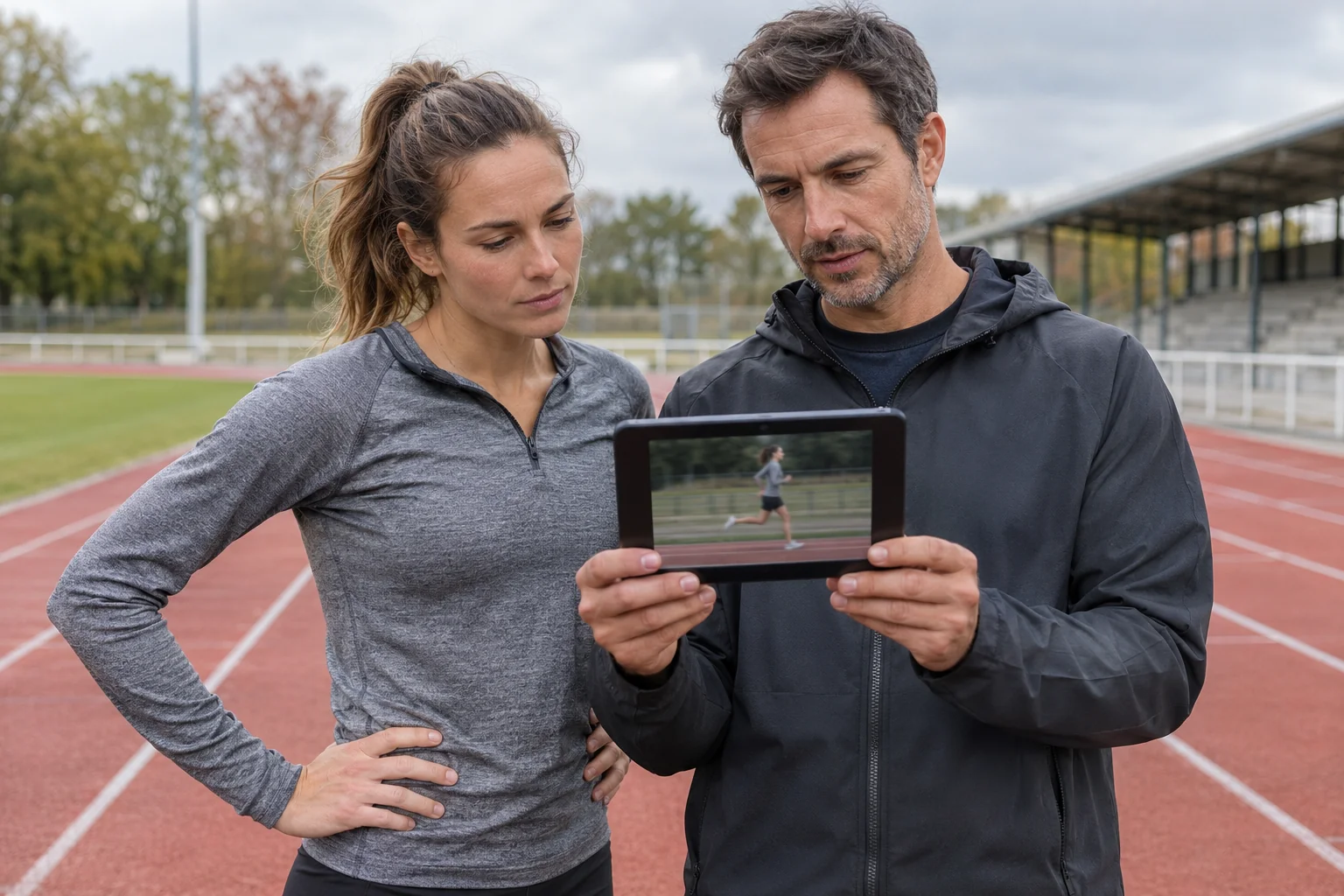
Effortlessness may have several visible components: a relaxed face, arm rhythm, trunk position or the continuity of steps. Not all can be measured accurately from one camera view, and not all express energy demand. A plain background, good lighting and slow-motion playback can also create a more orderly impression. A striking video is therefore an interesting starting point for observation, but not an economy assessment in itself.
It is worth turning an adjective into a question. Instead of ‘bouncy’, ask how far a specified point moves vertically at a given speed. Instead of ‘hurried’, ask about the relationship between step frequency and length. Instead of ‘stiff’, identify exactly which body part’s range of motion you see. This does not automatically make observation a good measurement, but at least gives it a testable meaning.
The kind of running you watch matters too. An accelerating sprinter, an athlete doing an easy long run and a trail runner ascending rocky ground solve different tasks. Their different appearances do not justify a shared beauty ranking. A comparison should first identify speed, surface and task. A movement removed from its setting is not the whole runner’s functioning.
2. An association found in a group is useful, but makes a different claim
In Folland and colleagues’ study analysing ninety-seven runners, several movement categories were compared with running cost. Multiple variables together explained part of the variation in economy. This is important evidence about technique’s relationship with energy demand, while remaining an observational association: researchers did not change every participant’s movement to determine whether the same variable caused the same personal improvement.
In a fictional example of our own, better-trained group A has a mean frequency of 180 steps per minute and a cost of 190 units per kilometre; less-trained group B has values of 160 and 210. Across the groups, higher frequency accompanies lower cost. This does not yet tell us what happens if one member of B forces their rhythm to 180 the next morning. Fitness, body size, speed and other movement factors may differ too.
An association can therefore generate a hypothesis: frequency’s role may be worth examining. Intervention is a new step towards that. We must define what changes, what stays constant, how long adaptation is allowed and which outcome is measured. Between understanding a group mean and planning one person’s change lie several testable questions. Skipping them turns an interesting research association into an exaggerated prescription.
Multivariable analysis must also be read at this level. If a model explains a certain proportion of group differences, it does not mean everyone can improve their movement by the same percentage. Explained variation characterises a statistical relationship. Individual scope for improvement, changes over time and an intervention’s effect require separate data.
 Enlarge image
3. Deliberate change immediately creates a new task
If runners are told to shorten ground contact, hold their arms differently or change vertical movement, they no longer perform the same freely chosen task. They must attend to the instruction, and the modification may affect other movement components. A short test then measures the immediate response to that instruction. It does not necessarily show what would happen after longer practice or in another environment.
In Tseh and colleagues’ experiment with nine female runners, several deliberately altered movements were compared with natural running. Exaggerated vertical displacement and placing the hands on the head accompanied higher oxygen uptake. The study shows that certain movement modifications can substantially increase cost. It does not establish that every visible feature of natural running needs correction, or that any amount of change in the opposite direction is beneficial.
Greatly exaggerating vertical movement and reducing it slightly are not automatically mirror images. If pushing a variable far in one direction worsens a result, it does not follow that pushing it farther and farther the other way produces continuous improvement. A curved relationship is possible, as is a range where several solutions work similarly. ‘Less is always better’ often asks too much of a single experiment.
In an illustrative case of our own, a runner moves comfortably without instructions, then tries barely rising vertically for a video. They may look smoother on the recording while choosing different joint movements or muscle activity. Without measuring energy demand, we know only that appearance changed and how they experienced it. That is already an observation in its own right, but need not be renamed an energetic success.
4. A favourable partial indicator does not replace total cost
Shorter contact time, higher frequency and smaller range of motion can easily look like badges of efficiency. In fact, each is a descriptive variable. Their relationship with energy demand may depend on the task and how they were changed. Contact time tells us how long contact lasted, rather than how much energy muscles used. A shorter period may involve different force production too.
In Moore and colleagues’ study modifying contact time, ten trained runners showed a curved relationship between contact time and metabolic cost. The minimum did not correspond to the shortest contact time in everyone. Perceived effort also did not adequately substitute for the cost of the modified movements. The experiment therefore supports examining the whole measured response, rather than generally minimising one displayed number.
In a frequency experiment involving fifteen trained male runners, published in November 2026, a rhythm ten per cent above baseline produced shorter contact time, but not significantly lower oxygen or energy cost. The baseline condition was always measured first, limiting causal identification of optimal frequency. This specific result clearly shows that mechanical change and energetic advantage are separate claims.
In such comparisons, we should not select a single preferred indicator as the winner. Knee movement, ground contact and cost may respond differently to the same intervention. This is not necessarily contradictory; it reflects several consequences within the system. A technical decision requires defining the target outcome in advance and which other changes need consideration alongside it.
5. Three claims worth writing separately
The first claim may be aesthetic: ‘movement looks more continuous in this recording’. The second is descriptive: ‘measured contact time became shorter at the same pace’. The third is energetic: ‘energy cost was lower during the designated measurement section’. All three may be true, but none automatically establishes the others. Clear wording helps prevent video analysis from promising more than it actually examined.
A fourth, more distant claim concerns lasting performance improvement or changes in symptoms. This would require follow-up over time and measurement suited to that aim. A single better-looking frame or brief energy average does not replace it. If someone recommends a technique change, ask which claim they have data for. The professional discussion then stays concrete, and the runner knows which result might be expected and what will be checked.
- Appearance: what does the observer see, from which view and at what playback speed?
- Movement data: which variable changed, at what speed and on which surface?
- Cost: by which method and within which time window were oxygen or energy measured?
- Longer-term goal: what follow-up supports the claim about performance or usability?
This separation also works briefly in your own log. For example: ‘arm rhythm looked different to me, running comfort stayed similar, and cost was not measured’. This is honest, usable feedback. It does not judge missing instrument data as failure or call appearance a definite improvement. A well-worded experience may lead to a more meaningful decision later than an overly broad efficiency label.
6. A personal goal says more than an image of ideal running style
One runner wants greater comfort during long training, another practises a particular race pace, and a third seeks professional help for symptoms. These are different aims. Judging movement therefore need not impose the same video image on everyone. A usable technique question identifies the task and expected change, rather than simply requesting a copy of a famous athlete’s position.
If a change is considered, record the starting task, instruction and experience. What changed immediately, what remained comfortable and which data were actually measured? After many new instructions at once, it is hard to identify what mattered. A precisely named question also helps prevent runners from constantly scoring their movements during every easy session.
With symptoms, the goal also includes understanding those symptoms and training history, so a technique decision can be interpreted with a professional. An unusual arm rhythm or different foot strike alone is not a diagnosis. Whether someone can move painlessly and enjoyably in the task is important personal feedback; however, a specific problem should not be explained solely through aesthetic correction.
 Enlarge image
7. Turning ‘better-looking’ into a meaningful professional discussion
At a coaching or laboratory discussion, four short questions may suffice for clarification. What do we mean here by better-looking or better? Which variable did we observe? What evidence connects it with the desired goal? What would show that the change helps this runner? These are foundations for good cooperation, rather than obstacles to movement development. The answers turn an impression into a goal that can be followed.
The reading sequence for research is similar. Does it report an observational association or an intervention? How do speed, fitness and surface feature in the comparison? Was only an immediate response measured, or was there follow-up over time? Was total energy demand measured, or merely one movement detail? With these answers, an article can offer much more precise guidance than ‘run this way’ extracted from its headline.
Beautiful running can remain an aesthetic pleasure, while technique remains a real professional question. Economy becomes interpretable through measurement in a specified task and presentation of results alongside the method’s limits. Progress is possible amid the diversity of natural movement when the goal is clear, evidence is precise and attention centres on the runner’s own functioning.
Sources
- Folland and colleagues: observational association between technique variables and running economy.
- Moore and colleagues: contact-time modification and energy cost.
- Tseh and colleagues: deliberate movement modifications in female runners.
- Li and Wu: frequency changes, mechanics and metabolism, 2026.
How Futószív articles are prepared: our editorial guidelines.