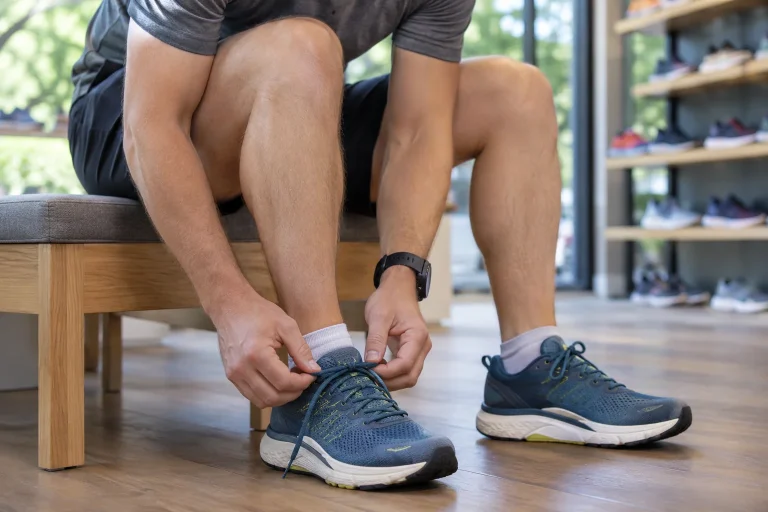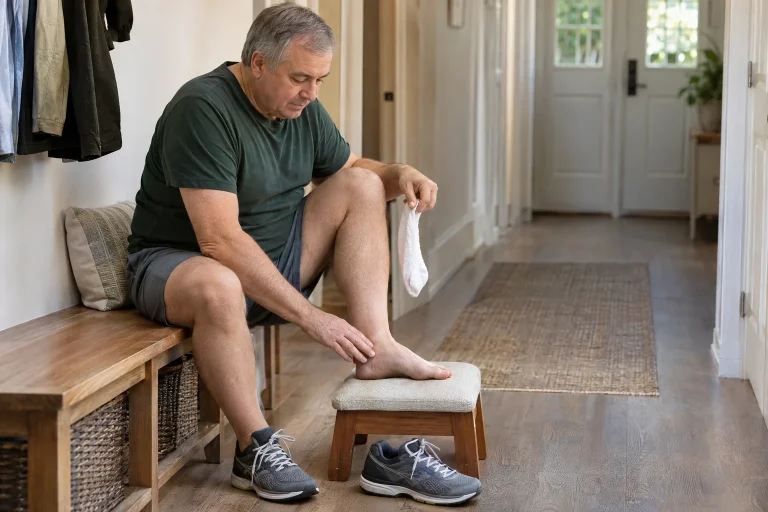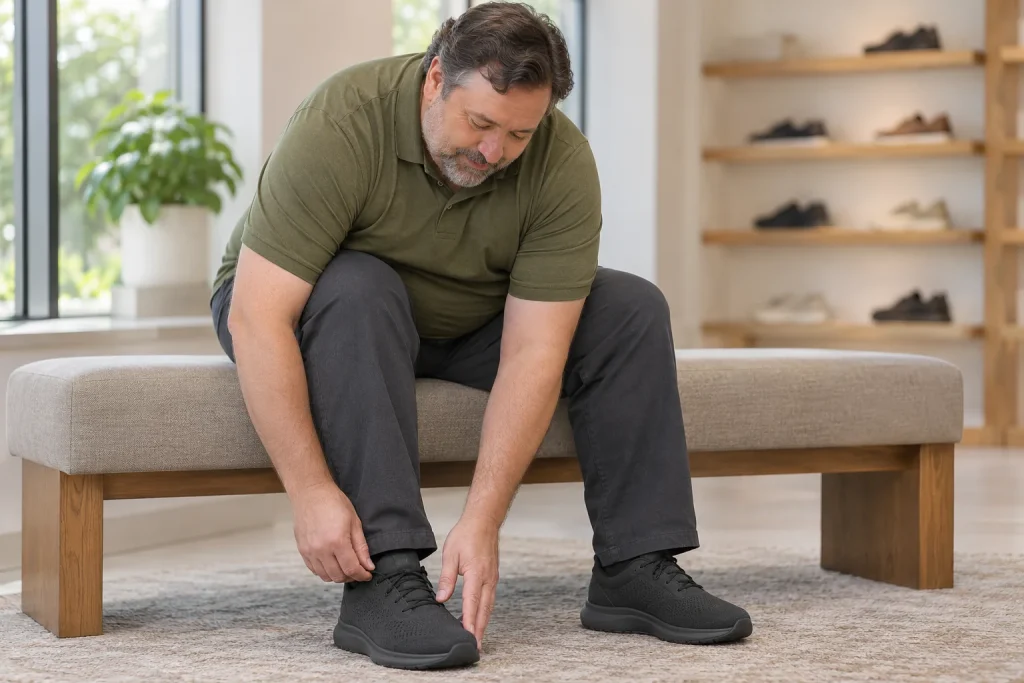
You slip into a new running shoe. Its sole feels pleasantly soft, yet your foot is squeezed. The salesperson brings a more cushioned version, but the pressure at the sides remains. Two questions can easily become confused: how the shoe feels underfoot, and how much usable space it gives your foot. Improving one property does not necessarily solve a problem with the other.
For a person at a higher body weight, conversation may particularly emphasise cushioning while saying less about foot shape. But body mass does not automatically reveal foot width or every detail of the shoe shape you need. Perhaps you need a wider toe box, perhaps the upper’s position bothers you, or perhaps the symptom is not simply a fit issue.
Severe foot pain, inability to walk, deformity after injury, or a hot, swollen and painful foot require urgent assessment. If fever or feeling unwell accompanies it, do not continue shoe fitting either. The NHS information on pain in the ball of the foot also identifies recurring or worsening problems, tingling and loss of sensation as needing healthcare attention. Looking for a better size cannot replace this.
Your foot needs room in three dimensions
Shoe size usually draws attention to length, but a foot is not a flat length measurement. Width, toe-box shape and space beneath the upper matter too. Toes squeezed from the sides can indicate a different problem from material pulling across the top of the foot. Naming the exact location helps avoid receiving the same larger size as the answer to every discomfort.
At the heel and midfoot, you seek a different fit from the space ahead of the toes. The aim is not to let the entire foot slide freely for the sake of spaciousness. Comfortable room and insecure retention are different things. If one version fits well at the front but constantly moves at the back, say so separately. A single “tight” or “loose” should not close the discussion of internal space.
The AAOS information on finding the right shoe fit explains that different sizing and shapes make actual fitting important, and that extra length is not necessarily the answer to a width problem. Increasing length can create unnecessary movement elsewhere. Look for a separate width or differently shaped version rather than simply moving up through size numbers.
A soft sole does not reshape the upper
Cushioning describes a different property from the space occupied by your foot. A sole that compresses easily by hand can still come with a narrow toe box, a pressing seam or a tight upper. In the shop, describe impressions independently: “The sole feels pleasant, but it presses against the outside of my foot.” You can acknowledge a favourable sensation while having the problem taken seriously.
The cushioning study involving 848 recreational runners compared two prototypes and analysed injury follow-up. It did not examine the personal fit of shop shoe sizes and widths. Its finding therefore does not determine whether your foot has enough room in a particular soft shoe. Data about another property cannot replace your own fit question.
Sole thickness, softness felt by hand and the overall impression during wear are not identical either. You do not need to turn them into a homemade technical ranking. The practical question is which detail you actually observed and which you know only from the product description. A thicker-looking sole alone cannot establish that an uncomfortable upper has been resolved.
 Enlarge image
Do not put pressure, rubbing and numbness under one label
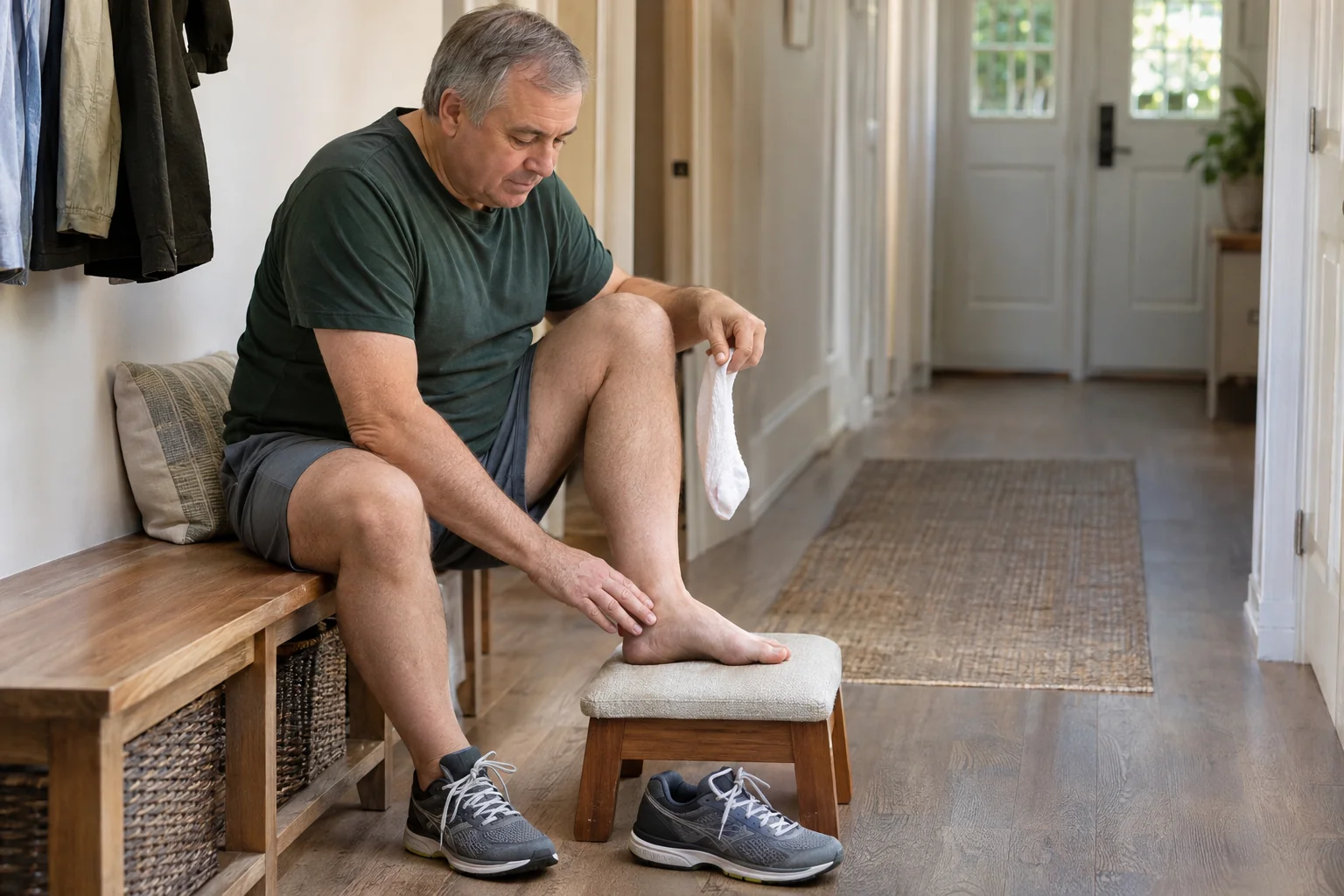
Pressure at a particular point, skin rubbing and altered sensation are experiences to describe separately. For example: the shoe squeezed the sides of the toes; it moved and rubbed at the heel; part of the foot felt numb. You do not need to assign a disease to them. Precise description helps establish what can be clarified through fit and what also needs healthcare attention.
The NHS notes that tight shoes can contribute to pain in the ball of the foot, but several other causes are possible. This does not mean every such symptom comes from shoe size. If pain recurs, worsens or interferes with daily activities, do more than keep trying new shapes. Finding more comfortable footwear may matter, but cannot establish the cause of a symptom with certainty.
The NHS page on peripheral neuropathy lists numbness, loss of sensation, burning, balance problems and weakness among symptoms that may warrant assessment. This does not mean every numb sensation in a shoe is that condition. It means recurring or persistent altered sensation should not automatically be dismissed as tight laces, particularly with a known risk condition.
Observe lacing in the actual situation too
Tightening laces affects how the upper holds the foot, so do not fit a completely unlaced shoe. Equally, making it uncomfortably tight to keep the heel in place is not the goal. If the shoe feels secure only with very forceful tightening that presses on your foot, describe both problems. Its shape may not suit your foot, rather than simply needing even more lacing force.
Many lacing patterns appear online. Do not treat them as treatment for pain or persistent altered sensation. A salesperson may show an option compatible with the shoe’s intended use, but the fitting result still matters. If the shape is unsuitable, more complicated lacing may not provide a usable solution. A fit compromise need not be renamed an expert trick.
Account for socks and any prescribed insert too. Space that seems adequate with a thin shop fitting sock may differ at home with your usual equipment. An added insert can also occupy internal space. If you use one, clarify fit alongside its own instructions; do not pile extra layers into the shoe at random to increase softness.
A simple fitting log helps you be precise
For comparison, write four short lines: where it squeezes; where it moves; during which movement it occurs; what changed with the other candidate. This is not a medical scale, and you need not score your foot numerically. The aim is to keep impressions of successive shoes distinct. Alongside model and size, note the width designation if there is one.
| Your observation | A more precise question |
|---|---|
| It squeezes the sides at the front, although length is sufficient. | Is another width or toe-box shape available? |
| The front is comfortable, but the heel constantly slips. | Does another shape provide both adequate room and retention? |
| The sole is soft, but it presses across the top of the foot. | Does upper volume or lacing create a fit problem? |
| Altered sensation recurs or persists without the shoe. | What healthcare assessment is needed? |
The table organises questions; it does not diagnose. You do not need to keep testing a shoe until discomfort definitely recurs. If a situation is already clearly wrong, describing it and stopping is enough. A good fitting is not about reproducing symptoms as accurately as possible, but obtaining information that supports a more usable choice or appropriate help.
Ask about your own foot rather than body size
If the recommendation consists only of “this is what you need at your weight”, bring the conversation back to actual fit. For example: “I understand the sole recommendation, but I want to know how my foot fits this shape.” This separates cushioning from internal room. You do not need a debate about your build to point out the pressing area.
Measuring the feet or comparing the two sides can usefully inform selection, but cannot replace observing the shoe on your foot. A model that seems suitable by one measurement can still be uncomfortable because of another shape detail. You need not know the full technical name of your “foot type” beforehand. Finding usable footwear does not require self-diagnosis before entering the shop.
Nor must you accept that every discomfort exists because you still need to lose weight to fit the shoe. Seeking correctly sized and shaped equipment concerns your present situation. If a shop lacks suitable stock, that can be treated as a stock limitation. Seeking another shape, width or shop is a real option, not an admission that your body is faulty.
 Enlarge image
Observation after buying should not become forced breaking-in
Match the first session’s conditions to your current activity plan and the retailer’s trial policy. You need not decide immediately through a long run whether the shoe works. If pressure or slipping occurs during familiar, appropriate movement, record its location and circumstances. Home use should not become a duty in which justifying the purchase matters more than your experience.
If told “it will stretch”, ask what that means for the particular material and shape, but do not treat a painful start as compulsory. Softness or price does not justify persistently constricting footwear. If symptoms appear, act according to their severity; the possibility of exchange and healthcare assessment remain separate questions.
Your own observation need not become a general judgement on the entire model. It may suit someone else but fail to fit you. This is a natural part of choosing. Equally, a favourable first session does not prove future freedom from injury. The shoe remains a tool for your movement, rather than insurance making every other circumstance irrelevant.
Separate questions build an understandable decision
At the end, be clear why the shoe seems suitable. Retain more than “it is soft” or “it was recommended for larger runners”. Instead, note that your toes have room, there is no troublesome side pressure, heel retention is usable and no new symptoms appeared during your appropriate trial. These are your observations, not general medical suitability criteria.
Do not let an impressive technical term hide an unresolved question. Keep cushioning information in its proper place and check size and shape separately. Assessing pain or altered sensation is another task, involving healthcare when needed. These three areas together are clearer than offering the same softer sole as the answer to everything.
Comfortable equipment does not require changing your body first, and shoe shopping need not become continuous self-judgement. You seek usable room for your foot, appropriate retention and equipment suited to the movement. Explaining this precisely makes it easier to match stock and advice to the real questions: what fits, what holds appropriately, and what requires a different kind of help?
Sources
- NHS: Pain in the ball of the foot
- Malisoux and colleagues: shoe-cushioning study
- AAOS: Shoes – Finding the Right Fit
- NHS: Peripheral neuropathy
How Futószív articles are prepared: our editorial guidelines.