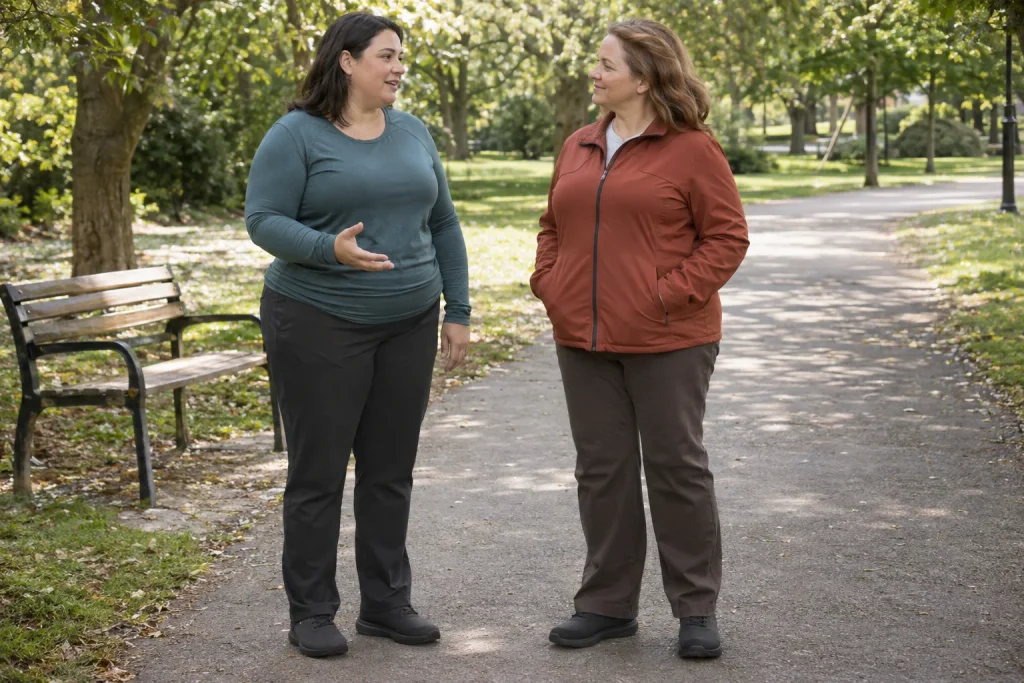
Your pace is much slower than your companion’s, yet you can barely fit a few words between breaths. It is easy to think you are simply weak or must endure this at a higher body weight. Speed and individual effort are different, however. A ‘slow’ label does not automatically make a situation easy.
Being able to talk can provide an intensity reference, but does not establish the cause of breathlessness. That distinction shapes the next step. A programme feeling harder than intended differs from appropriate assessment of a new, unusual or severe breathing symptom. You do not need to hide your experience to fit the chosen pace.
When is help needed rather than a talk test?
If you have severe difficulty breathing, are gasping or choking and cannot get words out because of it, this may be an emergency. The NHS information on breathlessness lists this, chest tightness or heaviness, changes in colour and sudden confusion as signs requiring immediate help. Do not test what happens by continuing to run.
New or worse-than-usual breathlessness deserves attention even when less dramatic. Other symptoms may accompany it, and causes vary. Appropriate healthcare assessment is not a running app’s job. If unsure of severity, seek appropriate help rather than trying to exclude a problem through an online intensity rule.
A symptom that later resolves does not automatically become insignificant. Retain what happened and in which situation, without recreating it as proof. Actual history matters more for individual assessment than a speech challenge performed at home. Completing today’s sporting goal is not the priority then.
What does the talk test actually say?
The talk-test rule in the CDC intensity guidance says that moderate aerobic effort generally permits talking but not singing; at vigorous intensity, a breath is needed after a few words. It is a simple reference for exertion level. It is not a standalone diagnosis, fitness assessment or proof that a symptom is harmless.
Do not use the rule by forcing yourself to recite a long poem or sing loudly to prove appropriate intensity. Experiencing ordinary conversation as possible can provide information. You need not keep trying against breathlessness until you somehow manage the selected sentence.
Not speaking and being unable to speak because of exertion are different too. You may prefer quiet movement, the environment may be noisy or company may not be your priority. The experienced breathing difficulty matters when interpreting the talk test. Silence alone does not measure intensity.
A slow pace can still be vigorous for you
The CDC also discusses intensity relative to the individual: the same activity can challenge people differently at different fitness levels. A pace per kilometre therefore does not imply identical effort for everyone. If a planned easy section feels vigorous, the speed’s name does not resolve the mismatch.
Beginners can easily adopt a more experienced companion’s vocabulary. What they call conversational may be difficult for you. You do not have to regard your experience as wrong. Shared planning works when both can describe a manageable task, instead of one person’s pace defining everybody’s intensity.
Comparison with your earlier self can mislead too. After a longer break, formerly easy movement may feel different. Past results remain part of your life but do not establish today’s task as appropriate. You need not rewrite present effort for an earlier sporting role.
 Enlarge image
Body size should not decide the cause of a breathing symptom
The NICE weight-management recommendation warns against automatically attributing every symptom to body weight. This matters in discussions of breathlessness too. Body size may be relevant but does not replace assessing a new symptom’s history and character.
You do not need to prove beforehand that the symptom is definitely unrelated to your weight. Describe when it began, the situation and what changed. The appropriate question is not whether you deserve help, but which individual assessment is needed. Interest in movement and taking symptoms seriously can coexist.
Treat social explanations cautiously too. Someone else’s similar sensation having been attributed to little training does not establish your cause. Equally, a serious story read online does not automatically become your diagnosis. Your symptom’s individual history needs more information than either.
What can you observe without provoking it?
When discussing a non-urgent question, recalling onset and background may help. Did you feel it before leaving, only on a hill, or did something new occur on a familiar level section? You do not need to repeat the same route to retain possible details.
Associated experiences may matter: coughing, wheezing, a chest sensation or another unwell feeling? Naming them does not establish a diagnosis. The aim is to make the specific event visible behind ‘I cannot manage running’. Uncertain details can remain uncertain without selecting a ready-made cause.
Mention circumstances too: route, weather, a pace change or a long break. These are neither proven excuses nor necessarily explanations. They can form part of the history in individual assessment. Recording details must not delay necessary help or occupy your whole day.
| A detail to retain | A clarifying question |
|---|---|
| Onset | A new phenomenon, recurring symptom or familiar experience? |
| Situation | During which task did it appear, and what differed that day? |
| Accompanying symptoms | Were there other breathing or general symptoms? |
| Change | How did the actual event develop, without retesting? |
An individual plan has its own role with a known airway condition
The NHS information on asthma describes cough, wheeze and chest tightness alongside breathlessness, with exercise and cold air among possible triggers. This does not mean your running breathlessness is definitely asthma. Establishing the cause needs separate assessment.
If you already have a diagnosis and action plan, fit the sporting occasion within it. Your individual care plan determines product use and what to do when symptoms change. Do not construct another dosing schedule from a general article or a companion’s experience, or borrow medicine for your own trial.
If symptoms recur during familiar activity, reviewing the plan may matter more than choosing a new pace goal. Symptom control and an appropriate activity type can be discussed together. Seeking help for breathing difficulty does not automatically mean permanently abandoning movement, but a general promise cannot precede the individual answer.
If the question concerns intensity, easing the task is a real option
The NIDDK guidance on starting activity emphasises building gradually and choosing activity appropriate to health status. The same activity and dose do not suit every beginner. Within your individual framework, seeking an easier task can mean recognising your actual starting point rather than failure.
Walking may currently fit a planned easier section better. A walk is not merely a failed version of running. It can have its own role in the selected goal, and naming the activity precisely helps the plan. You need not preserve a running motion at all costs to call the occasion sport.
Easing should not become a hidden circuit of proving yourself. If the symptom’s cause remains unclear, progressively slower runs are not necessarily an appropriate assessment method. The individual health question and programme modification need consideration together. The choice should respond to the current situation, not a running label retained on a display.
 Enlarge image
You can agree the language of exertion with your companion
Say simply that at this pace you cannot talk comfortably, which differs from the planned session. Your companion’s role is not to convince you otherwise. Together you can choose another format, different sections or a separate meeting point if these fit your individual frameworks.
You can also make clear that a symptom means help or stopping is needed now. You need not share every health detail with the group. A specific signal can suffice for organising together. Good support attends to the expressed need instead of making finishing the programme a condition of acceptance.
If the group calls every slower pace ‘recovery’, raise individual differences. Agreed effort or an activity format may be more precise than a speed label. This is particularly important for beginners, so the community’s words do not teach them that their own signals have no place.
A useful answer keeps two questions visible at once
A fictional beginner follows her friend’s easy pace while conversation soon becomes broken. She recognises that shared speed does not mean shared intensity. If the experience involves a new or unusual breathing symptom, however, she does not treat it merely as agreeing pace. The symptom’s character also matters for the next step.
In another situation, she seeks an easier activity within a known, individually reviewed movement framework. She does not force herself to run because an even slower speed would feel embarrassing. The story establishes no diagnosis or ready-made training dose. It shows that personal effort can be expressed.
Difficulty speaking can therefore indicate intensity but does not decide breathlessness’s cause. Whether a pace is useful also depends on your programme, condition and symptom character. ‘Slow’ must not override what actually happens to you during movement.
Sources
CDC: relative intensity and the talk test; NIDDK: starting gradually; NHS: breathlessness and seeking help; NHS: asthma and an individual action plan; NICE NG246: avoiding attribution of all symptoms to body weight. Checked: 21 November 2026. The examples are not breathing assessments, diagnostic scales or individual treatment instructions.
How Futószív articles are prepared: our editorial guidelines.