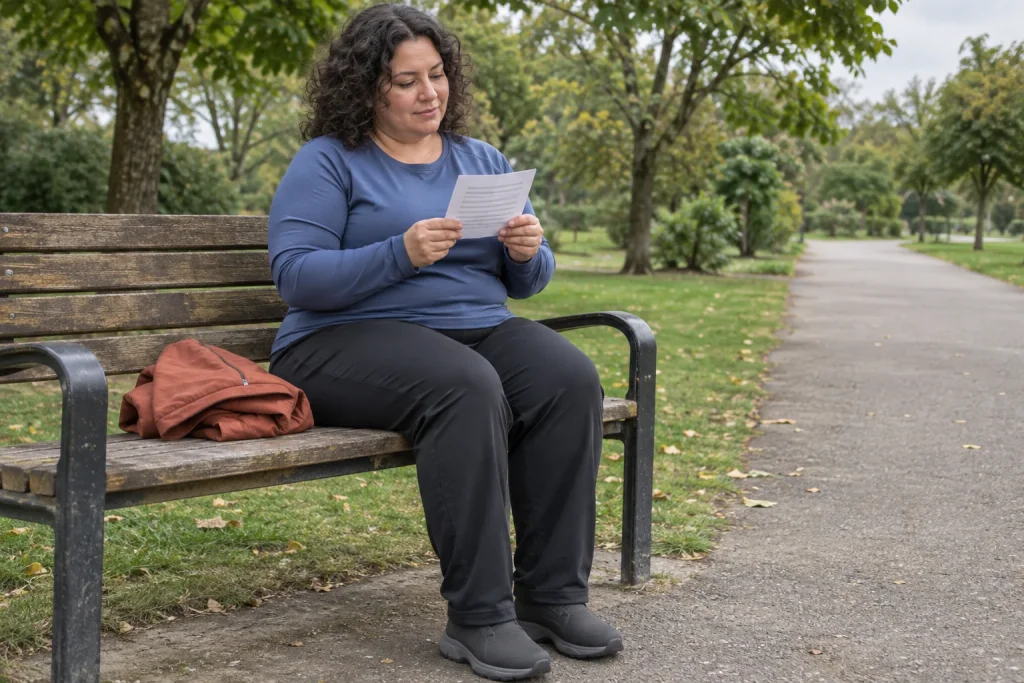
The app has opened a new week, but the next running interval feels much harder than expected. Perhaps it lasts longer, includes less walking or simply needs fitting into different days. The screen moving forward does not prove that you must complete the same task in that calendar week.
A runner starting at a higher body weight does not have to validate their body’s worth through programme success. The present question is more specific: what became difficult, what relates to your own condition and which continuation fits? Repeating, modifying or choosing another activity are different possibilities. None automatically answers every difficult week.
Pain or feeling seriously unwell should not become a weekly task
If the difficulty is new, severe or worsening pain, substantial swelling, inability to bear weight or feeling seriously unwell, do not try to determine its cause by continuing the programme. Symptoms that seem urgent need appropriate help. An encouraging app message cannot individually assess what you are experiencing.
The NIAMS information on sports injuries warns against continuing sport through injury-related pain. Individual assessment and an appropriate return are separate tasks. This article does not provide a pain score below which everyone could safely continue a general beginner programme.
Name a less dramatic but recurring symptom precisely too. General effort differs from pain recurring in a particular place. You do not need to choose a diagnosis alone. History, onset and changes in daily function can support the appropriate conversation without retesting the painful part.
A programme week is not a compulsory calendar deadline
The official NHS Couch to 5K introduction describes a nine-week structure but also allows people to take longer and progress at their own pace. The plan starts by alternating running and walking, with rest days between running days. This is a programme structure, not a guaranteed result or readiness decision for everyone.
‘Week three’ can therefore name a stage in the plan rather than establish how many days have passed since downloading it. If your circumstances or experience require another manageable pace, the calendar date alone does not resolve that. The app’s sequence should not become a stronger argument than your body’s signals.
Beginner programmes do not all share the same structure. Selecting pieces from several plans can easily erase the sequence’s purpose. Combining longer running intervals from one, more sessions from another and a faster pace from a third creates a new programme. ‘Beginner’ in the name does not guarantee that the resulting version fits your current situation.
What does ‘I cannot manage it’ mean for you?
The first useful step is naming the difficulty. Do you run out of breath during the longer interval? Does pain appear? Is the whole day overcrowded? Does running still fit, but leave no manageable framework for the next task? Different questions may need different answers, so do not summarise them as a general lack of willpower.
The CDC also interprets intensity as effort relative to the individual. Time specified in a beginner programme does not alone tell you how demanding your chosen pace and environment are. A hill, rushed departure or companion faster than usual can change the experience. Keep ‘I ran slowly’ alongside the actual task too.
Uncertainty about the programme can be a barrier in its own right. Perhaps you do not know when to walk, confuse the intervals or cannot follow audio prompts because of traffic. Clarify usage first in this case. It is not necessarily your body that cannot do something; the task or environment may not have been clear enough.
| Type of difficulty | What needs separate understanding? |
|---|---|
| A new or worsening symptom | The individual health question, instead of experimenting with continuing. |
| Unusual effort | Pace, circumstances and current condition alongside the task. |
| A scheduling obstacle | How the whole week and opportunities for rest fit together. |
| An unclear programme section | The actual instruction before inventing your own version. |
 Enlarge image
Repeating is an option, not replaying painful loops
If an earlier stage was appropriate and manageable for you, slower progression or repetition may be considered within your personal framework. Every new week need not add difficulty. Repeating an earlier session can help consolidate a routine, rather than merely delay the next demand.
It is different when the same task regularly caused symptoms. Staying at that stage does not make it appropriate. ‘Repeat it a few more times’ alone may then be insufficient. The programme’s name does not resolve the problem; clarification of your situation and the appropriate next activity does.
Repetition should not be a hidden punishment either. You do not need to complete the same stage faster and faster until you feel good enough to progress. If the original task silently becomes harder, you are no longer repeating the same thing. Keep the actual content visible in your notes, not just the week number.
Sometimes repetition is not the most useful question. If the whole programme does not fit your life or you dislike the chosen activity, look for another possibility. The aim is manageable movement, not ticking every row in an app. A new choice does not require describing the earlier attempt as a failure.
When shortening, know which task changes
‘I will do less’ can mean many modifications. Is the entire session shorter, the running-to-walking ratio different or the week reduced to fewer days? These are different changes. Name precisely what you are adjusting within your individual plan. This article does not set general running minutes for every reader.
Do not automatically compensate for reduced time by speeding up. Fewer minutes do not mean the task requires less effort. Equally, do not treat walking as an error to remove when it belongs to the chosen programme. Different parts can have their own roles within a session.
The NIDDK recommends manageable goals and reviewing practical barriers alongside starting gradually. This does not imply one compulsory modification. The useful question is which framework fits your day and which content is appropriate for your current condition.
Do not use rest to catch up on missed sessions
Missing a session early in the week can tempt you to schedule everything consecutively at the end. The programme’s count would be complete, but its structure would change. A rest day is not an empty space for automatically moving every missed task. When reviewing the week, record the missed session and the next step openly.
Daily tasks also need time and energy. Movement may feel different after a long shift, travel or another unusual activity. You need not convert every daily job into training minutes. Simply recognise that an app displays only the part recorded within it, giving a narrower picture than your whole day.
The following week need not simultaneously make up for the past and complete a new increase in difficulty. Replanning time can be a sensible response to a missed session. If absence relates to symptoms or a worsening condition, however, that has a separate role. Do not make every missed session a motivational task for which more encouragement is the only solution.
Choosing another activity is not moving to a lower class
The NHS activity guidance for adults presents a week involving several types of movement. Running is one option, not a synonym for all activity. Walking, appropriate strengthening or another chosen form can also play a meaningful role in your programme.
If your goal is getting out and meeting people, another activity may currently support it better. If running still interests you, a temporary alternative does not erase that. You do not need a final identity decision every time. The appropriate choice now and a later possibility can fit in separate sentences.
An alternative activity is not automatically suitable for every symptom either. Pushing through another sport after painful running is not a general solution. If switching is linked to a health reason, the individual plan matters. If the issue concerns organisation or enjoyment, your interests and access can also form part of the decision.
 Enlarge image
Do not let an external deadline silently rewrite the plan
A booked race or friendly challenge can make the next week feel urgent. The entry date does not change your body’s current condition. If preparation is unmanageable, reconsider the decision about the event too. You do not need to squeeze the programme into less time because of a previously recorded goal.
You can tell companions specifically that you are progressing at a different pace now. Setting a boundary does not require explaining your weight or entire health history. Conditions for exercising together can be discussed: where you meet, which pace and which programme are appropriate. Support should not mean ignoring pain or illness.
Prejudice about a larger-bodied beginner is not a good training planner either. Difficulty with a programme does not prove your body has no place in sport. Nor do you need to earn community acceptance by completing an unsuitable task. Respect is not the reward for successfully finishing the next week.
A more precise decision about continuing
A fictional beginner finds they always start the new interval too fast because they follow a companion. Even without symptoms, the session feels much harder. They first clarify how their own programme and the shared pace fit, rather than respond by adding sessions. In another case, a repeated stage brings recurring pain: individual assessment then comes first.
The app may display the same message in both situations, yet the actual histories differ. Before the next step, one concrete sentence helps: what became difficult, under which circumstances and what remains uncertain? You need not fit the answer to a programme’s general promise. Your experience belongs in the plan.
A beginner programme is useful when it helps organise the process without hiding individual differences. Slower progress, appropriate modification or another activity can be realistic continuations. Completing a painful section or one involving illness does not become a compulsory test of willpower.
Sources
NIDDK: starting gradually and practical barriers; NHS: varied adult activity; NHS: Couch to 5K, individual pace and rest days; CDC: intensity; NIAMS: sports injuries and avoiding continuing through pain. Checked: 21 November 2026. The situations are original illustrations, not a personal modification prescription or clinical decision algorithm.
How Futószív articles are prepared: our editorial guidelines.