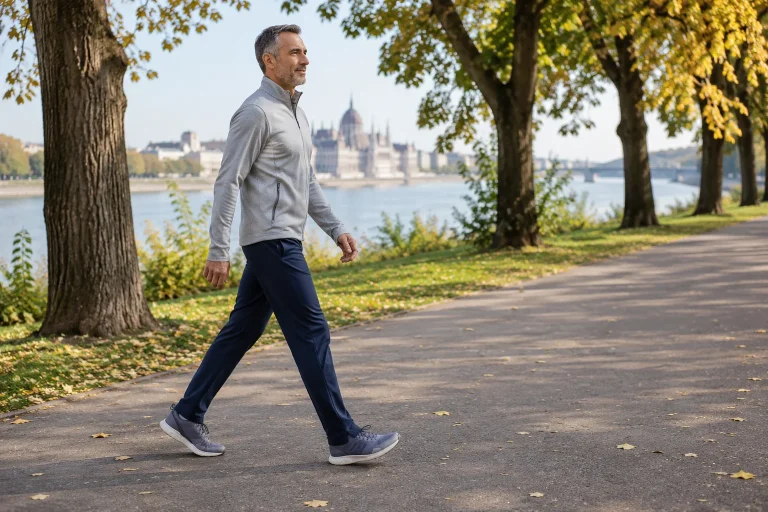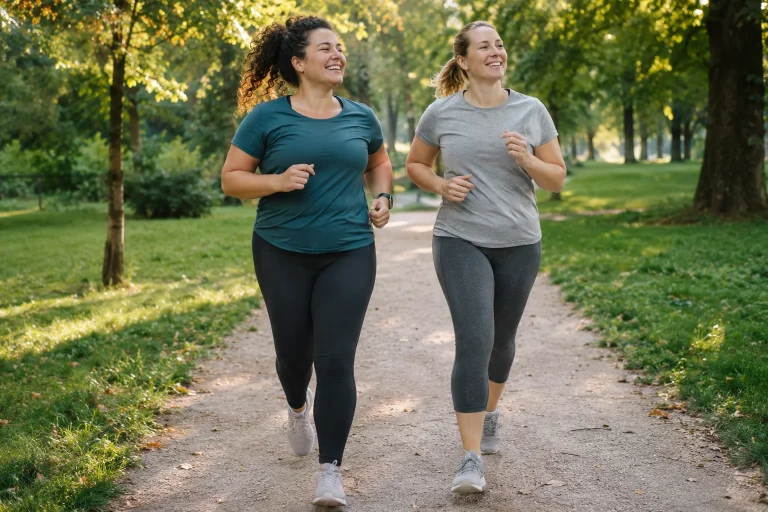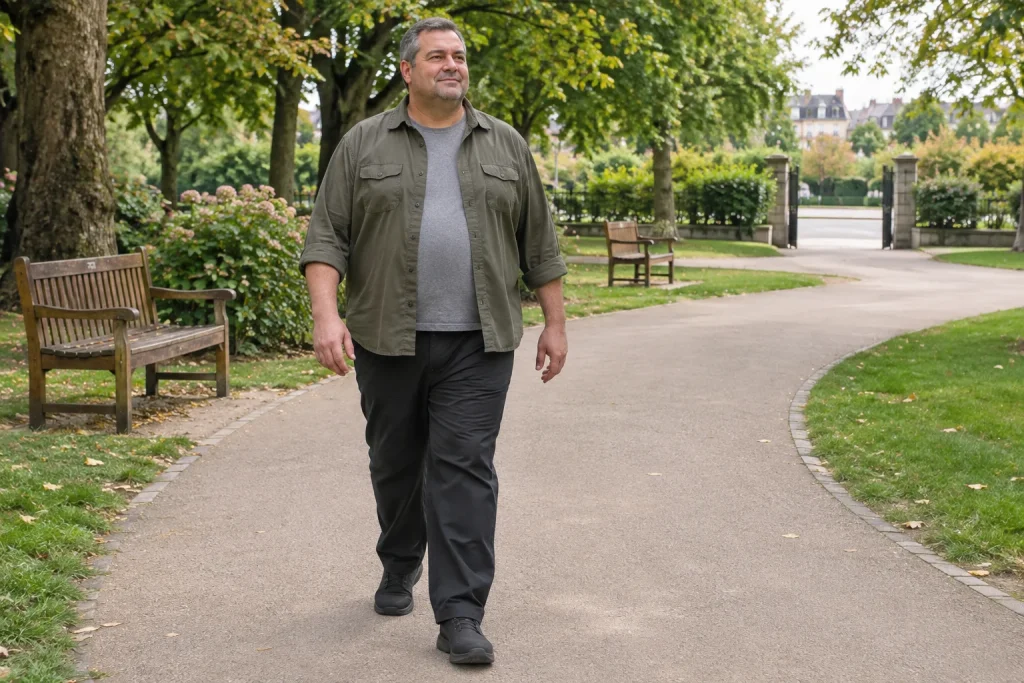
You want to jog but do not know what the first step should be. An online programme says you should first walk a specified distance, while an acquaintance suggests running immediately. Observing your current walking may be a more useful starting point than a generic entry requirement. The aim is not to prove eligibility, but to see more precisely where you are starting.
Even at a higher body weight, body size should not be used to guess every movement experience. You may have a regular walking routine or a long period of inactivity behind you. In your own story, the route, the effort involved and how the day continues afterwards matter. Interpret these together; one distance covered is insufficient on its own.
Observing your starting point is not a performance test
You do not have to organise your longest or fastest walk to have something to describe. Familiar daily walking can also provide information: which section is comfortable, where you usually stop and what has changed recently. The aim is to retain real experience, not seek a new limit.
The NIDDK guidance on getting started emphasises starting slowly and building gradually, with individual discussion where a known health problem exists. Its older specific time doses are not personal prescriptions. This article does not adopt a compulsory minimum duration or a rate of increase applying to everyone.
The current WHO activity overview states that all movement counts and some activity can be valuable compared with complete inactivity. This does not automatically authorise running, but it does mean a shorter, appropriate walk is not made insignificant by round numbers in programmes.
Which health questions matter before setting off?
If walking brings new or worsening symptoms, do not start by completing a compulsory distance to prove anything. Feeling seriously unwell during movement, chest symptoms, extreme breathlessness or dizziness may require appropriate help. Such a situation is not a trial for building endurance. A symptom’s significance is not determined by the fact that you were walking rather than running.
The NIDDK material on activity at different body sizes recommends individual professional discussion where movement or balance is difficult, breathlessness occurs easily, or a known illness or joint problem exists. Selecting the next activity type and amount then relates to the specific condition. You do not have to choose among possibilities at random based on body size.
If you already have a current movement or rehabilitation plan, observe walking within it. Even a familiar route may contain a section unsuited to the present framework. Clarify uncertain instructions instead. Walking’s everyday name does not make it the same task in every situation and condition.
 Enlarge image
Gather experience on a route you can leave
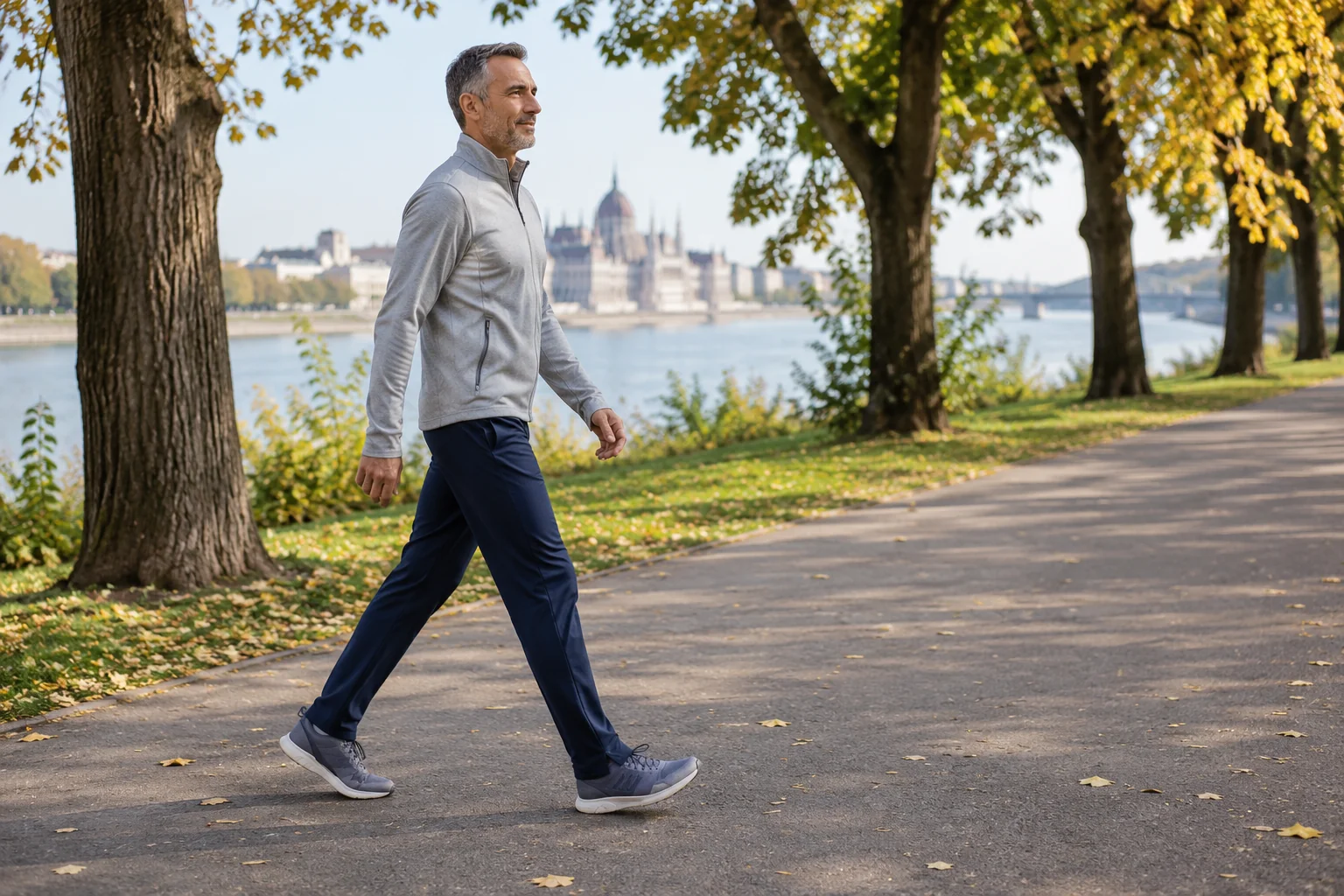
A long, one-way walk may initially seem simple, but the return journey is equally part of the outing. A familiar place with genuine options to shorten the route and stop may be more useful. A loop on a map does not necessarily tell you whether the exit is open or a resting place usable.
Check the surface, gradient and crossings. A level, wide path may produce a different experience from a broken pavement with many junctions. Observation does not require a perfect environment, but know the situation you are describing. The actual task then remains visible behind the distance.
The NHS information on walking mentions comfortable, well-fitting footwear and a gradual return to walking. Shoe comfort is an important practical condition, but does not treat every symptom. Even without buying new equipment, you can identify something that rubs, presses or makes setting off uncertain.
Do not leave the outward journey out of planning. If reaching the park entrance already involves a longer walk, that is part of the day too. A closer option may sometimes provide a simpler start than a distant, theoretically ideal venue. You are evaluating the whole outing’s usability, not just the middle section selected on the map.
Give the first observation a simple purpose
It may be enough to experience a familiar walking section more attentively, provided it is currently appropriate for you. Do not test a faster pace, new shoes, longer route and steeper section all at once. If everything changes, understanding what made the occasion different becomes harder later. A new challenge is unnecessary for gaining a clearer picture.
Stopping should not become a point of failure. Know in advance where you can rest calmly and how you will end the outing if needed. Searching for a bench or arranging the journey home should not begin only once you are uncomfortable. The option to turn back is an organisational condition, not a lack of perseverance.
If you go with a companion, explain your intention: you want a clearer picture of your own walking experience now. This reduces the chance of well-meant encouragement becoming a pace contest. The companion’s role can be conversation and agreed support. They need not become an amateur examiner or interpret your body’s signals for you.
A sketch of the route needs only two important points: where you can take a shorter return and where the planned journey home is accessible. At a bench, check whether it is genuinely usable and whether it or the surrounding area is wet or blocked. Preparation does not aim to plan every moment of the walk, but to avoid deciding how to finish under pressure. If conditions have changed that day, you can choose another occasion or solution.
What should you observe during movement?
The CDC intensity guidance also discusses effort relative to the individual. Pace alone does not say how demanding the task is for you. You can record whether the particular situation felt easy, moderately demanding or unusually difficult. Your description aims to convey experience, not identify a medical condition.
Alongside effort, record what happened. Was there a hill, were you carrying a bag, did you need to hurry at a crossing, or was the route calm throughout? A slower section does not necessarily indicate deterioration if you were doing a different task. Equally, a faster average does not override a new symptom arising during it.
Your breathing experience and foot or leg comfort may be separate strands. You may manage well in terms of breathing but feel discomfort at one point; another time there is no local symptom yet the effort feels unusual. Do not turn these into your own diagnosis. Precise naming helps you explain what happened appropriately if needed.
You do not have to analyse every step continuously. Your attention is also needed for travel and surroundings. You can record one or two important experiences afterwards. Do not turn the walk into so many measurements that your comfort and safe movement take second place.
The rest of the day belongs in the picture too
Do not define the outing’s end solely by stopping your watch. You still need to get home and probably have other daily tasks. Record how the walk fitted with them. The question is not whether you felt completely unchanged every minute, but whether there was an important new change in familiar functioning.
You can also describe later or next-day experience concretely: which daily task became harder, whether a new symptom occurred or whether the day continued as usual. This article does not provide an hour-specific rule that automatically decides the next load. Your individual health framework and the nature of the change matter.
If new or worsening pain appears, do not record it as compulsory proof of progress. Evaluating something felt after movement does not become more accurate because everyone gives it the same name. Describing onset, location, change and daily function may help an individual question. The next occasion should not become a forced repeat test.
| When? | What is worth recording? |
|---|---|
| Before leaving | Your current individual framework, a familiar route and options to shorten it. |
| During the walk | Task, effort, local comfort and important circumstances. |
| After the outing | Getting home, daily tasks and significant changes. |
| Later | Identify new or worsening symptoms separately, without a ready-made explanation. |
 Enlarge image
A short note may be worth more than a compulsory distance
Your note can be a few lines: the route, approximate duration, how you felt and what happened to the rest of the day. If you do not know the exact distance, do not invent it. An honest ‘the park’s short loop’ may be more useful than a confident performance claim calculated from uncertain GPS data.
A fictional note might read: I used the familiar level path in the nearby park, turned back beside the exit and managed my usual shopping afterwards. On another day there was stronger wind in the same place and I carried a bag. These stories retain comparable details without treating different occasions as clinical tests.
A few occasions of real experience can add detail, provided no symptom requires earlier help. You do not have to complete a predetermined number of walks before raising a question. Observation is not a condition for delaying help. It is there to make your starting point clearer to you and, where needed, a supporting professional.
The next step should not be a reward for passing an entry test
A manageable walk provides valuable experience but does not automatically prove readiness for every running programme. Jogging is a different movement task, and planned frequency and surroundings may change too. You therefore do not ‘earn’ the next step by crossing an online walking threshold. You are seeking a process suited to your own condition and goal.
A walking routine may remain the appropriate activity for now, or you may choose something else. You may develop a programme towards running with individual professional support. This choice is not a moral judgement on body size. What matters is that the next task starts from your actual baseline rather than being organised around a need to prove yourself.
Observing your current walking serves its purpose when it produces a more precise question: which movement, in which environment and with what experience is manageable for me? This needs no record, compulsory pace or painfully completed distance. A plan starting from your present functioning has a usable story.
Sources
NIDDK: general principles of starting activity; NHS: walking and a gradual return; CDC: intensity relative to the individual; WHO: every activity counts; NIDDK: personal capabilities and health questions. Checked: 21 November 2026. The sample note is an original illustration, not a walking test, permission to run or personalised rehabilitation.
How Futószív articles are prepared: our editorial guidelines.