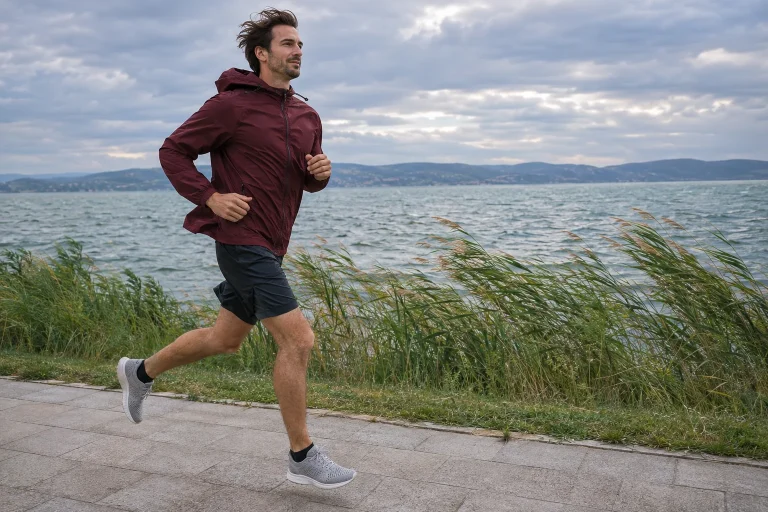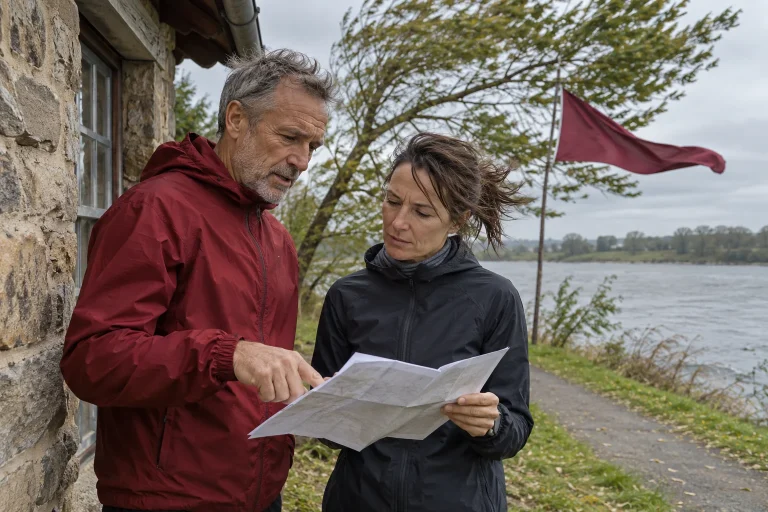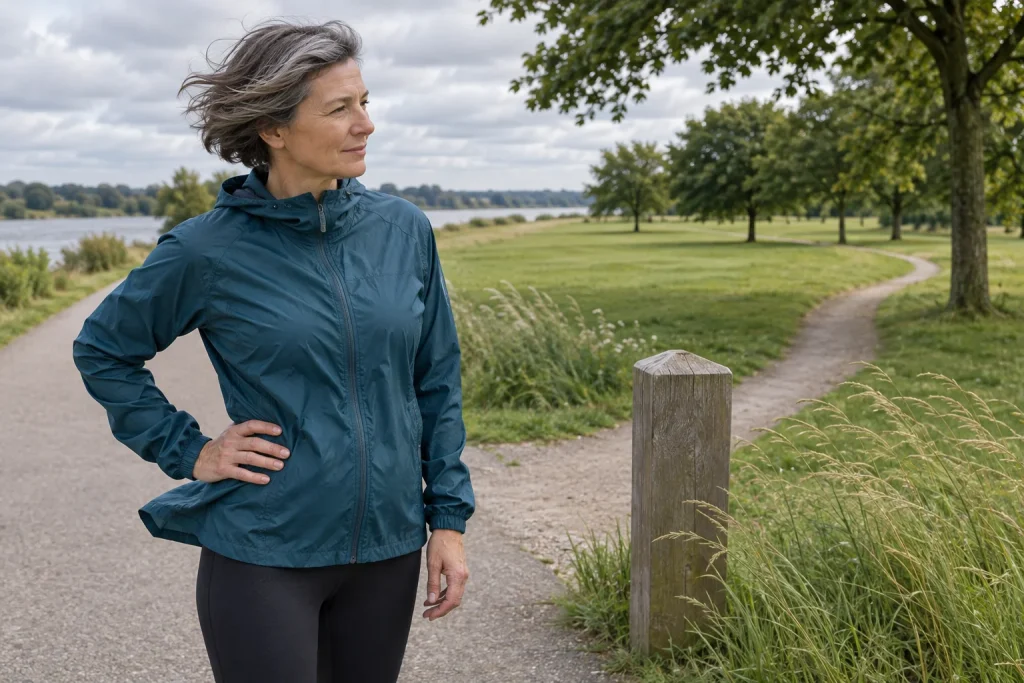
You see 18 km/h beside the wind reading, yet at times the airflow feels much stronger on an exposed route. This does not necessarily contradict the forecast. You may have looked at mean wind while shorter, stronger gusts also influence your outing. The average and maximum condense different information into a single number. First understand the displayed field, its time window and location, rather than retrospectively turning your own sensation into precise instrument data.
Your movement also changes your running environment, and the route may pass between sheltered and exposed sections. One km/h value therefore does not describe every detail around your body. The original numerical examples below explain averaging and simple relative airspeed. They are not derived from actual wind measurements, do not supply a target-time correction, and attach no general running limit suitable for everyone to any value.
Mean wind summarises a period
HungaroMet’s wind information calls the speed averaged over a given period the mean wind and distinguishes it from that period’s highest speed. The ten-minute maps described display measurements taken at a height of ten metres. This already gives two important labels: over what time was the average taken, and from what observation setting did the data come? Learn these alongside the large digits on your phone before expecting the same value at every point on your route.
The next two datasets are original teaching examples. We select five equally weighted speed values in km/h. Series A is 14,14,14,14,14. Series B is 10,10,10,10,30. Both have an arithmetic mean of 14, but the first has a largest element of 14 and the second of 30. The five numbers are not an actual measurement sample or a gust-measurement standard. They show only that an average cannot uniquely reconstruct detailed variation.
| Fictional series | Five equally weighted values | Mean | Largest element |
|---|---|---|---|
| A | 14;14;14;14;14 km/h | 14 km/h | 14 km/h |
| B | 10;10;10;10;30 km/h | 14 km/h | 30 km/h |
The mean of series B comes from its sum of 70 and its five elements: 70/5 = 14. The average is mathematically correct but does not separately report the element of 30. Runners can use this basic statistical idea: do not expect a mean wind speed to contain the complete description of the strongest brief change. Provider documentation defines an actual gust, not the simple maximum calculation in our table.
For gust data too, the period assessed matters
The public instrument description for the American ASOS system explains a two-minute mean wind speed and gust information updated every five seconds. This is a specific observing system, not a shared description of every Hungarian app. It illustrates that sampling, averaging, updating and reporting are different operations. A label saying ‘hourly wind’ therefore cannot, by itself, reveal all the underlying time windows.
When comparing two gust values, look for the same period and definition. One may be an observed maximum from a past period, the other an expected value for a later time. A shared km/h unit does not remove this distinction. In your notes, also write ‘forecast’ or ‘measured’ where the source clearly identifies it. If the details are unknown, do not claim a degree of comparison between the two numbers that you cannot substantiate.
A gust does not automatically mean the stronger speed prevails throughout the entire indicated period. A mean, however, does not guarantee that such a strong interval never occurs. Reading both together tells you more than selecting one instead of the other. If the app hides gusts in a separate menu, learn where to find them before leaving. Searching menus belongs in your preparation, not in divided attention while running.
 Enlarge image
Do not calculate your own fixed gust multiplier
Multiplying the average by a familiar ratio and calling it a gust estimate may seem convenient. The two original datasets above already show why the average alone does not determine the maximum. The same 14 km/h can summarise several detailed histories. Do not use a typical ratio read in a general explanation as a certain upper limit for your own loop. Find the gust forecast for the specific situation and consider its limitations too.
Call the displayed gust-to-mean ratio only what it is: the ratio of two given values. If, in an original fictional situation, the mean is 20 and the maximum 40 km/h, the quotient is 2. This does not mean your runner experiences double the force every second, nor provide a universal formula for the next period. Connecting mechanical loading with meteorological speed would require further factors; a simple ratio is not a measurement of personal loading.
Ratios with a small mean can be particularly misleading: changing the denominator alone can produce a large quotient. Keep both original values, units and periods in your own information-gathering, rather than only the calculated ratio. Knowing the details of a pair of numbers helps you find the next information more than an impressive multiplier disconnected from the practical question. A decision about the specific route remains separate.
The runner’s movement makes ground-relative and body-relative airspeeds different
Meteorological wind data and airflow relative to a moving runner use different reference frames. The 2020 analytical study of the mechanical power of running includes both runner and wind speeds among its model variables. This is a mathematical model, not a watch-based force meter applicable to every individual. Our next kinematic example shows only direction and relative speed; we do not use the study to predict personal performance.
Suppose, solely for the calculation, that a runner moves in a straight line at 3 m/s and ground-relative airspeed is 2 m/s, constant everywhere and throughout. With wind directly opposing the runner, relative speed has a magnitude of 5 m/s; with wind in the same direction, 1 m/s. In a perpendicular crosswind, the magnitude from the two components is √(3² + 2²), approximately 3.6 m/s. These are predefined geometric assumptions, not recommended training speeds.
The sideways component remains in the example even when total relative speed is expressed as one number. Direction therefore matters alongside the number, and an out-and-back route does not give the same situation in both directions. In reality, runner and wind can both change, and station data do not necessarily represent local speed around the body. We therefore do not use the addition above to calculate injury risk, lean angle or a pace adjustment suitable for everyone.
An exposed running route consists of separate sections
You can identify open waterside sections, routes along embankments and passages beside buildings separately in your map planning. The aim is not to assign each an exact local wind speed by sight. You are preparing for where conditions may differ from the starting point and where you have genuinely usable alternatives. One ‘windy’ label for the entire loop provides fewer decision details than identifying important passages specifically.
HungaroMet’s warning-system description also identifies spatial and altitude limitations for gust warnings and distinguishes locations with particular local wind climates. A regional warning is therefore not your own instrument placed at every step. Equally, do not dismiss official information because a sheltered starting point feels more favourable. These describe different areas: a local sensation does not prove conditions on the next exposed section will also be suitable.
Do not enter an uncertain section exposed to strong gusts merely to ‘test’ your watch or jacket data. If the outing cannot be carried out appropriately in the conditions, changing it is the task. You do not have to experience a difficult place before choosing another time or location. Comparing sporting equipment is not a reason to accept uncertainty already present in route planning.
Before leaving, include mean, gust, direction and time together
Your own checking sequence can use four items: what wind data the source reports, for which period, from which direction and where. Add the relevant official warning, route condition and personal programme. If the run covers a longer time or several areas, do not check only the first kilometre. The return journey and waiting belong to the whole outdoor task, not incidental details after the distance planned on your watch.
Save an alternative in advance that you can genuinely use in the conditions. It need not be a shortened version of the original loop: it may omit the entire exposed section. Include the approach and journey home in the alternative too. Detailed planning prevents completing the distance from appearing to be your only choice on site. Changing an outing does not require a preliminary experiment in optimising pace.
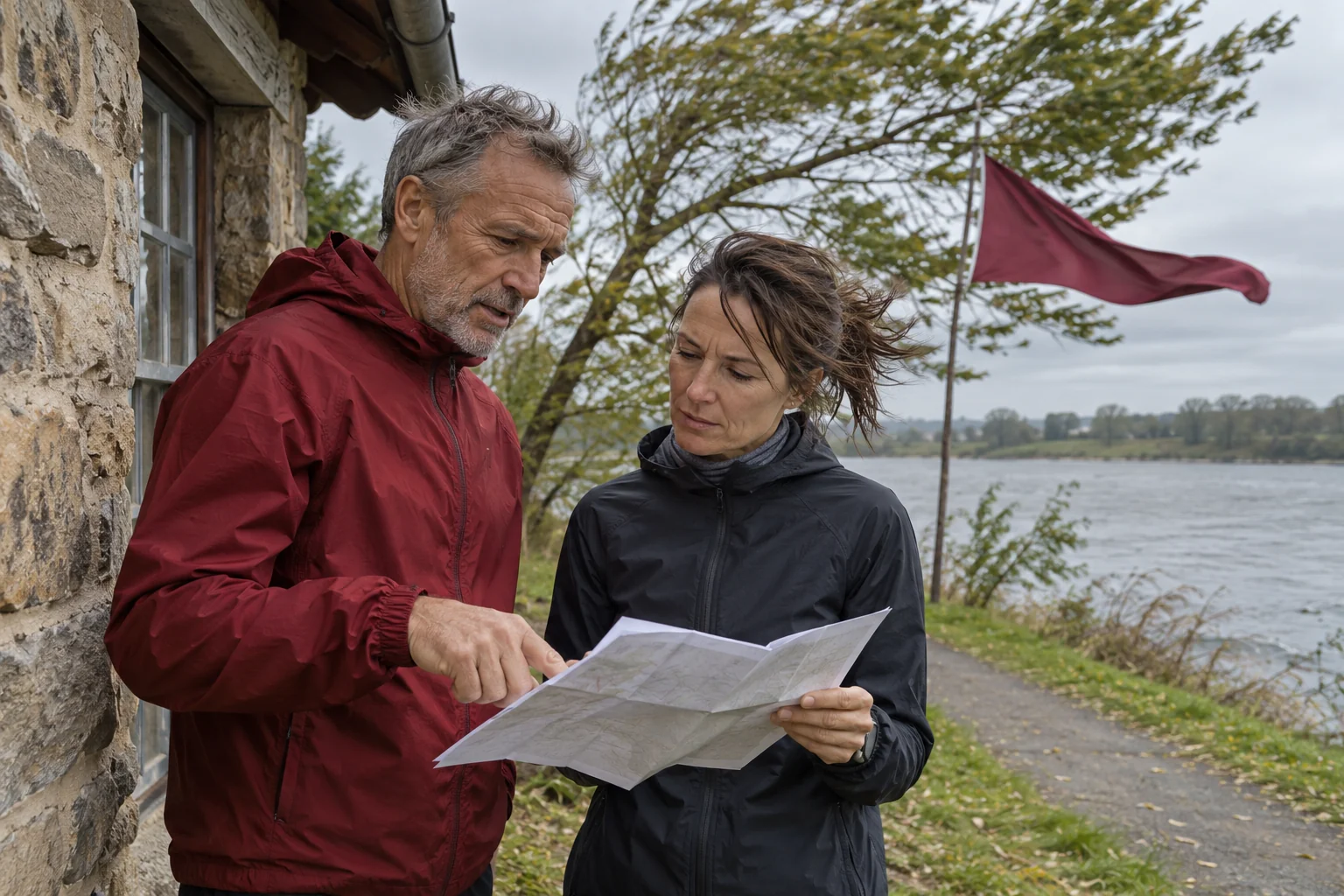
If you set off with others, agree which place and period the data cover and how you will signal a necessary change. The fastest or most confident participant’s experience does not measure everyone’s circumstances. Discuss the displayed mean and gust as data, not numbers judging someone’s ability. A well-organised group outing still includes the option to change the loop or the entire programme.
 Enlarge image
Keep personal observations and source data on separate lines in your log
For later review, note the provider’s field name, value and time, then record your experience separately. ‘I changed the loop at the exposed crossing’ is a precise personal note. ‘The gust that hit me was definitely this many km/h’ would claim instrument data where you made no appropriate measurement. A pace change on your watch or moving clothing does not itself validate wind speed at the body. The log remains useful without acquiring invented retrospective precision.
Reading mean wind and gusts together is therefore not another complicated calculation, but correctly naming the displayed information. You understand what averaging lost, check the time window and interpret direction together with your own movement. The full situation on an exposed running route still comes from source data, official information and actual surroundings together. These can underpin an appropriate outing plan; one km/h number need not answer every question.
Sources and original illustrations
HungaroMet: Wind – measurements and forecasts. National Weather Service: ASOS Wind Sensor – an example of time windows in a specific observing system. On the mechanical power output required for human running – Insight from an analytical model, 2020; the study’s publisher identifier. HungaroMet: the warning system, particularly the spatial interpretation of gusts. The five-value speed series and kinematic cases for a runner at 3 m/s are original mathematical illustrations, not actual wind measurements, running experiments or estimates of personal loading.
How Futószív articles are prepared: our editorial guidelines.