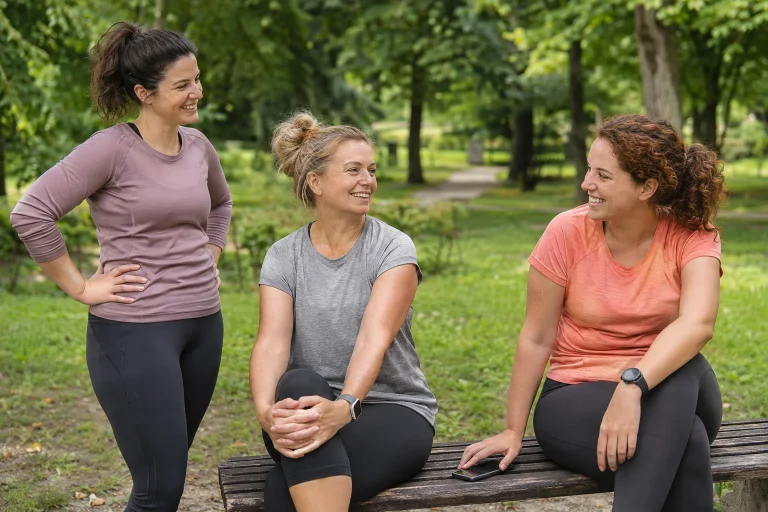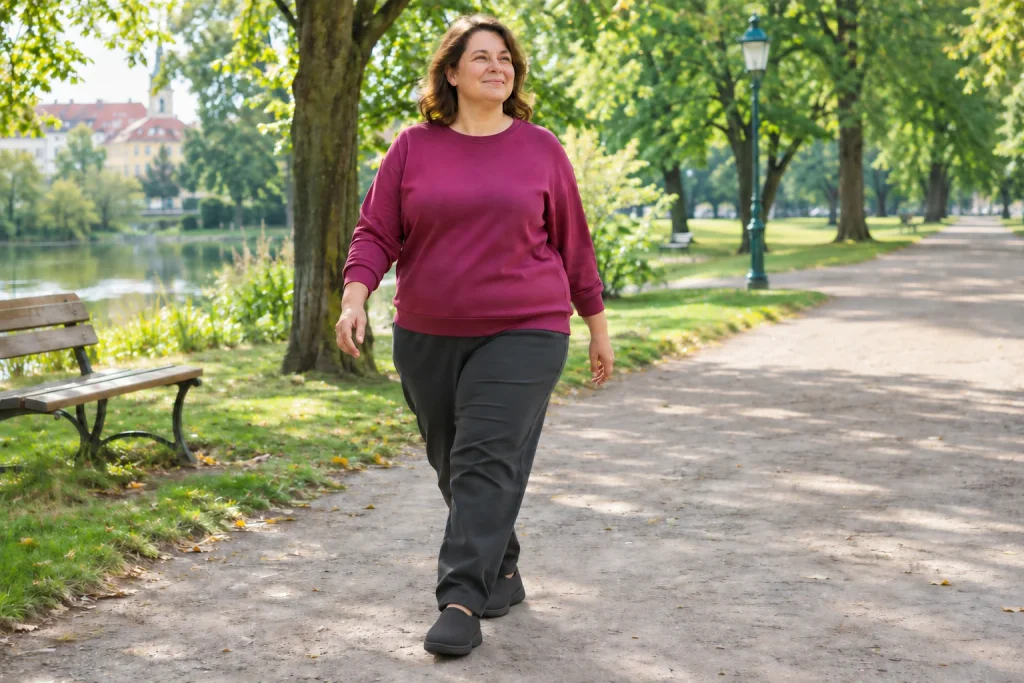
Walking along your familiar park path is less difficult now, and you are happier to stay and chat afterwards, yet the scales show a similar number. It is easy to think nothing has happened after all. In fact, body weight and your experience of movement answer different questions. Neither piece of information has to erase the other.
Feeling that things are easier can be an important change, but clarify what it means for you. The same task seeming less effortful, knowing the route better and moving in more pleasant conditions are different things. Distinguishing them gives a more meaningful picture of your own process than a single answer to ‘Have I lost weight or not?’
Scales and movement do not measure the same thing
Body weight is information about body mass. It does not directly measure how much effort movement takes, how familiar a task is or how you organise the outing. Retaining this distinction means unchanged weight does not automatically disprove progress in movement. Equally, more pleasant movement does not reveal your entire health situation.
The NIDDK information on activity emphasises that appropriate regular movement can have health benefits even without weight loss. This is a useful starting point for broadening scale-centred thinking. It does not mean every activity is beneficial in every circumstance, or that other health goals connected to body weight become unnecessary.
The activity section of the NICE weight-management recommendation also supports appropriate movement for its other benefits even when it does not lead to weight loss. It considers the person’s current capabilities and agreed goals too. This allows your movement to have several outcomes that can be named more precisely.
What does an original study show about different changes?
A randomised study published in 2000 assigned 52 men living with obesity to four groups, followed for three months. The groups involved diet-induced weight loss, exercise-induced weight loss, exercise without weight loss and a control condition. Researchers measured body mass, body-composition characteristics and cardiorespiratory fitness separately, among other outcomes.
Body weight did not change in the exercise-without-weight-loss group, while the exercise groups improved cardiorespiratory fitness compared with the control. This illustrates how two outcomes do not necessarily develop in the same way. The study is not a promise applying to everyone: it involved a small male sample and a particular programme. Study percentages do not become personal improvement deadlines.
The study’s other results did not develop identically across every variable either. It is therefore inaccurate to conclude that because one indicator improved, every risk and laboratory value must have become favourable. Interpreting physical processes involves several separate questions. Easier movement can be an outcome you experience, while other data remain important in healthcare assessment.
 Enlarge image
‘Easier’ can describe several experiences
Setting off along the same route may feel like less of a task. You know the exit, where you will turn back and have less uncertainty to carry with you. This is a real practical change, even though it is not identical to an endurance outcome measured in a laboratory. Organising movement can also be a learnable part of your routine.
At other times, the physical effort feels different. The CDC explanation of intensity specifically addresses how demanding a task is for the individual. The same external activity is not equally strenuous for everyone. Describe your experience together with the task, rather than retaining pace alone.
You may find it easier to continue your usual day after the programme, or dressing and setting off may feel more comfortable. These can matter for participation. You do not have to compress every change into the single word ‘fitness’. The more specific your own sentence, the clearer it becomes what is different.
Feeling better and ignoring pain are different things, however. ‘I can manage more’ should not mean you have learned to suppress a new or worsening symptom. If such a change accompanies the sense of ease, it deserves its own place in individual assessment. A favourable experience does not oblige you to turn every other signal into a positive one.
| General statement | An experience you can record more precisely |
|---|---|
| Walking has become easier. | The effort feels lower on the same section. |
| Getting started is easier. | I know the route and have what I need ready beforehand. |
| I can manage more of the day. | After the programme, an important daily task remained manageable. |
| Movement feels better. | I identify whether the experience, comfort or social element changed. |
Keep the comparison conditions too
A cool, level, calm route may be a different task from an outing in heat, wind or hills. When comparing two entirely different days, you cannot simply select the cause of greater ease. You need not impose laboratory conditions on every walk. Keep the circumstances that matter for your own understanding.
A change in outside help can also be part of the story. If you previously set off alone but now go with a patient companion, the experience differs. Finding a closer venue also makes the outward journey simpler. You do not have to deduct these as ‘cheating’. They simply represent a different kind of change from physical adaptation demonstrated by measurement.
Interpret sports-watch data in its own context too. The route, recording or settings may have differed. Not every more favourable number needs immediate attribution to training, and an uncertain measurement does not erase your experience. Both can be retained: this is what I felt, this is what the device recorded, and this is what I am unsure about.
Do not create a harder trial merely to prove improvement. Everyday observation is not intended to be an independent exercise stress test. If you follow an individual programme, interpret your experience within it. Recognising progress does not require you to seek a new limit every week.
If you measure weight, make the information comparable
Not every active day needs a weigh-in. If weighing is part of your personal goal or healthcare plan, the NHS England weighing guidance recommends consistent conditions: the same scales and location, a stable level surface and similar time of day and clothing. Here too, a comparison’s usefulness depends on its conditions.
A decimal-place display does not mean every tiny difference needs a new explanation. If you weighed yourself in different clothes, at another time or with another device, do not silently treat those as identical conditions. You can record the value as an uncertain comparison. You do not need to keep measuring until a number you like appears.
Do not invent a change in body composition simply because weight is unchanged but movement feels easier. It may be an interesting question, but a feeling and a scale reading do not provide a full composition explanation. ‘I must have replaced fat with muscle’ claims more certainty than the information actually provides.
You can name the pressure associated with measurement too. If the display spoils your enjoyment after every session, consider your purpose in using it and what support you have. Other observations can help you understand your movement process. You do not have to validate every change through the scales.
Choose a few meaningful forms of feedback for yourself
Keep something connected to why you began moving. If community participation mattered, reaching the session and wanting to return may count. If an everyday journey became easier, name it. Your personal goal and feedback can then describe the same story.
You do not have to monitor every imaginable benefit at once. A short note can include the activity, important conditions and your experience. For example: I walked along the same park path in calm weather, and the task felt less difficult by the end. This is a description, not a clinical scale, and does not claim an outcome you did not measure.
- The type of movement and the conditions in which it took place.
- One specific experience of comfort or effort.
- How daily participation that matters to you is developing.
- A separate flag for a new symptom or uncertain data.
The list is not a compulsory daily schedule or self-rating test. If note-taking takes too much attention, simplify it. Its usefulness is ensuring that more than a weight graph remains of your story. Your movement can have its own language that does not express change solely in body size.
 Enlarge image
A favourable experience is not an instruction to speed up
When something feels easier, curiosity about what comes next is understandable. You do not, however, need to add more days, longer duration and faster pace all at once. Your personal framework and suitable progression still matter. You can acknowledge a joyful result without immediately turning it into a new requirement.
Disappointment over unchanged weight should not be a reason to increase movement as punishment either. ‘I will run even more until it finally shows’ may create pressure different from your chosen goal. Weight-management questions can be reviewed with appropriate individual support. You do not have to force training volume to provide every answer.
Someone else’s praise can be more precise too. Instead of ‘You have not lost weight, but at least you exercise’, they can recognise your effort, sustainable habit or reported experience. Movement is not a consolation prize for a missing body-size result. It can have its own role in the day while other health goals also exist.
Two different changes can belong in the same story
After a few weeks, a fictional larger-bodied woman finds joining the local walk easier. Her weight shows no substantial change. She notices that she no longer worries about an unfamiliar route, and the movement itself seems less difficult. She names these separately rather than claiming one explained physiological change.
Her weight data can remain in her own log if they have an agreed role for her. Alongside them, changes in comfort and participation are visible too. If a new symptom appears, the favourable experience does not override it. The story is more precise because it allows several separate questions, not because every change is labelled favourable.
Progress beyond the scales, then, need not be a secret promise; it can be a process named more precisely. Body mass, measured fitness, daily function and your experience are different kinds of information. Keeping each in its place lets you acknowledge easier movement without imagining weight loss or complete freedom from risk alongside it.
Sources
NIDDK: activity at different body sizes; NICE NG246: activity and other health benefits; Ross and colleagues, 2000: movement and different physical outcomes; CDC: interpreting exertion in relative terms; NHS England: comparable body-weight measurement. Checked: 21 November 2026. The observation examples and stories are original illustrations, not a body-composition diagnosis or an individual exercise prescription.
How Futószív articles are prepared: our editorial guidelines.