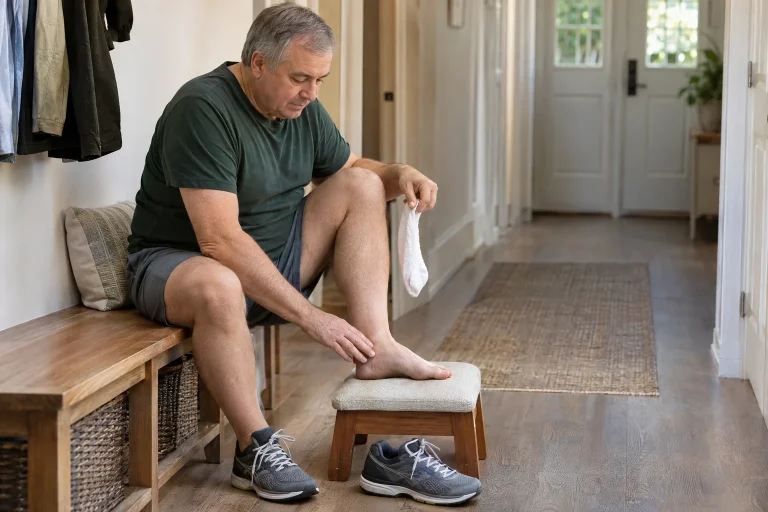
Your shoes feel tighter in the evening, and removing your socks makes ankle swelling noticeable. Perhaps you changed sports socks recently, making them an obvious suspect. Clothing can indeed be an important detail, but cannot alone determine the cause of new or recurring swelling. As an older athlete too, name the change accurately and have it assessed in the appropriate place.
This article does not establish what causes your swelling. Onset, side, change and accompanying symptoms provide separate information. Recognising them helps prevent everything remaining hidden behind one explanation, or necessary help being delayed because the event appeared at the end of a running day.
Which situations make prompt help important?
Swelling accompanied by breathing difficulty, chest pain or tightness, feeling faint, confusion or severe illness may require immediate help. The NHS information on swollen ankles, feet and legs highlights these as urgent situations. Do not wait for a change of socks or the following morning’s condition to settle the question.
Unexplained one-sided leg, ankle or foot swelling may need urgent medical assessment. Sudden, severe, painful, red or warm swelling, substantial worsening after injury, fever or feeling unwell also matter. Persistent or worsening changes on both sides likewise belong in healthcare discussion, particularly with known heart, kidney or vein problems.
The NHS material on deep vein thrombosis describes one-sided pain and swelling as possible signs, and emphasises immediate care when breathlessness or chest pain accompanies them. Not all swelling means thrombosis, but a photograph or pressing test at home cannot safely decide this. A self-examination challenge should not replace clarification of the cause.
Describe the swelling before selecting a cause
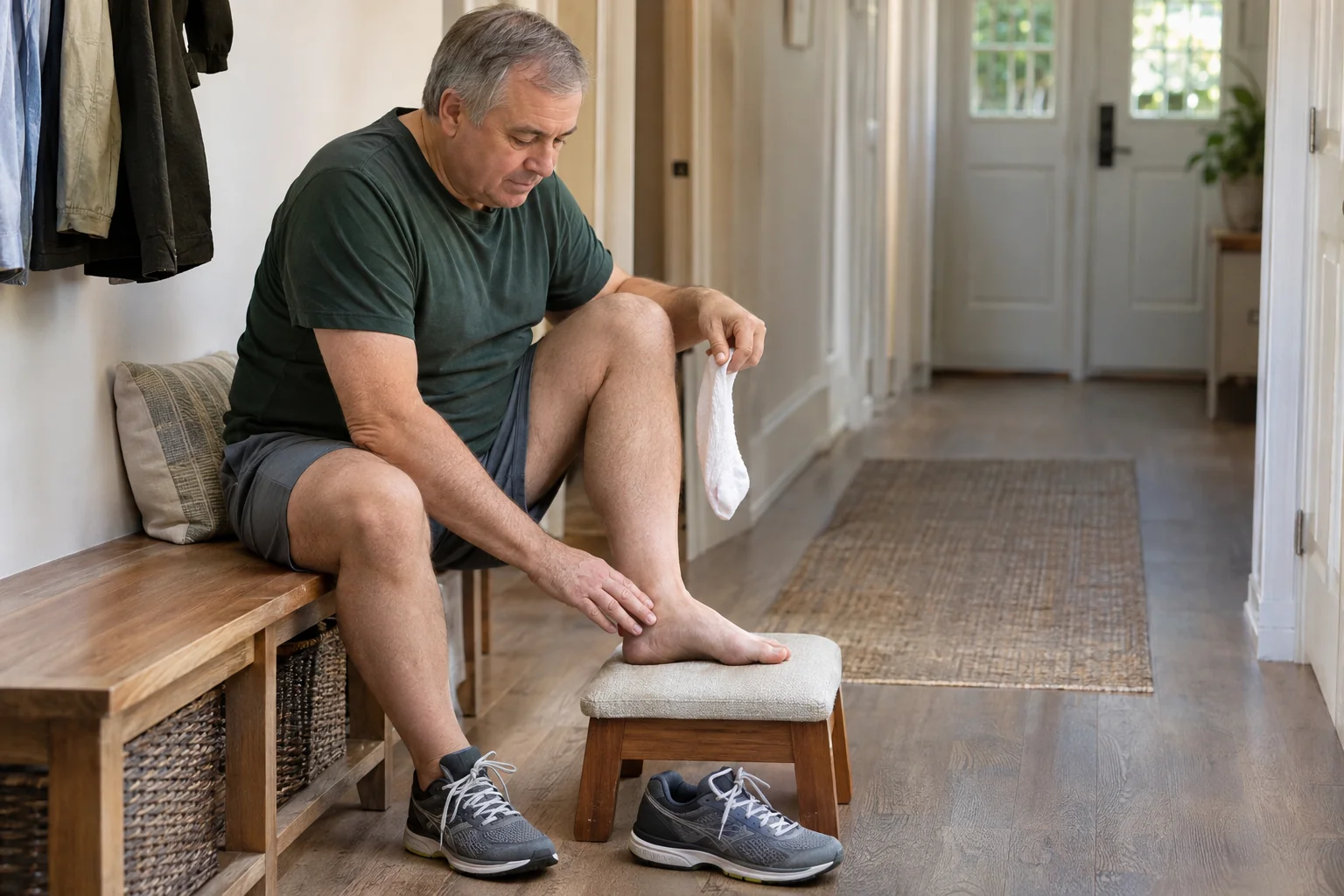
Is it visible on one side or both? Only around the ankle, also in the foot or higher up? When did you first notice it, and how has it changed? These questions refine your observations. They require no new trials or firmly pressing a painful area. The aim is preserving experience rather than producing an online diagnosis.
A sock mark and visible swelling do not provide exactly the same information. Clothing fit can be mentioned, but a mark’s shape does not establish the whole health background. Likewise, greater comfort in another shoe does not automatically prove the cause has resolved. A change in comfort and the bodily event remain separate observations.
A photograph can help you remember a visible change if taken calmly and handled with appropriate privacy. It does not replace examination, and you need not take more pictures before seeking help. Do not make the need for appropriate care depend on a social-media group’s judgement from an image.
 Enlarge image
Why can several different questions arise?
The NHS explains that swelling often involves fluid accumulation and can relate to various circumstances, medicines, injuries or diseases. Naming the phenomenon does not select a cause. Concluding that an evening appearance must be ordinary and insignificant is inaccurate too. A time pattern is information, rather than a ready diagnosis.
A sporting day may include travel, standing, movement, waiting and sitting. Naming these helps explain history. Yet no detail need be forced into an exclusive explanation. Mentioning a long car journey or new clothing may matter while another individual circumstance also needs assessment.
Your previous experience belongs in the discussion too, without overgeneralisation. If a similar event once had a known cause, the new event is not necessarily the same. Conversely, you need not project another person’s serious story onto your own situation. Appropriate assessment considers the present onset, symptoms and history together.
Preserve medication changes accurately as history
If you started a new preparation or a treatment changed, note when. The timing may be relevant but does not prove a cause alone. Do not stop medication or raise or lower its dose because swelling appeared in the same period. Treatment purpose and your whole condition need interpretation together.
The National Institute on Aging medication-safety guidance recommends an up-to-date list of products actually used, including over-the-counter preparations and supplements. The list supports discussion rather than independent medication selection. Occasional use should not automatically be treated as insignificant either.
Keep previous diagnoses and individual advice in the discussion too. If several clinicians participate in care, the swelling question should not become trapped among advice invisible to each other. The NICE recommendation considering multiple chronic conditions also emphasises coordinated planning and individual goals. The next decision should connect with these too.
Keep the roles of socks and shoes in perspective
Well-fitting, comfortable clothing matters for everyday mobility. An overly tight item may be unpleasant, but determining the swelling’s cause remains separate. You need not buy several new products to discover which makes the sign disappear. Shopping does not replace healthcare assessment when symptoms or history warrant it.
Sports socks and medical compression equipment are not the same concept either. A product description cannot determine appropriate treatment for you. Do not independently begin compression treatment for new swelling of unknown origin. If you already have an individually established equipment plan, clarify usage changes and questions with the relevant professional.
Likewise, independently taking a diuretic or another product is not a general first response. The cause and individual condition determine treatment. Excess water may be too simple an everyday phrase for deciding about medicine or a major lifestyle intervention. The next step should interpret the symptom appropriately rather than remove it at all costs.
What should you describe from your day?
A few specific details may suffice: when you noticed it, which side, what changed meanwhile and whether other symptoms accompanied it. Injury, longer travel, treatment or known disease can be mentioned as history. These are not proof for your own diagnosis. They help convey the actual story without selecting an explanation for every detail beforehand.
| Observation | Why should it be accurate? |
|---|---|
| One side or both | The history and assessment question are different. |
| Onset and change | Is it new, sudden, recurring or worsening? |
| Accompanying symptom | Did pain, warmth, breathlessness or other illness occur too? |
| Treatment and event | Which actual history should be mentioned? |
The table is not an emergency score. Do not spend time completing every row with worrying symptoms. In a less urgent discussion, however, it may reveal differences behind it always swells by evening. Uncertain data can be reported as uncertain, and missing times need not be invented.
You need not organise the whole day around checking the ankle. Retain important changes and follow the individual plan received. Constant measuring does not necessarily add useful information, particularly when conditions or method change. Accurate, relevant observations may help more than a difficult-to-interpret collection of data.
When seeking help by phone, give the side, onset and accompanying symptoms immediately rather than merely my leg is swollen. Information potentially important for the next step then appears at the start. With hearing or communication difficulties, ask for help making contact while keeping your own experience central. You need not first arrange transport home or reorganise the entire week before seeking advice about an urgent symptom.
 Enlarge image
Do not turn running into a home swelling test
Do not try to determine the cause by whether it disappears or returns during a harder run. Loading is not a diagnostic experiment. A new symptom or one requiring urgent assessment puts appropriate help first. A familiar route or shorter distance does not automatically settle the health question.
If an individual movement plan already exists, clarify within it what remains appropriate and which changes need reporting. An app labelling a programme easy does not make it safer. Sports data and swelling history provide separate information. A completed target time does not justify setting relevant bodily experience aside.
Tell a running partner specifically if a health question means changing today’s outing. You need not share a complete report with the community. Name assistance needed for getting home or arranging a discussion. Sporting persistence does not oblige you to overcome a new symptom.
Seek an answer connected with the cause in the next plan
An imaginary older woman initially suspects a clothing fault because of new socks. She later recognises new swelling and pain on one side and seeks appropriate urgent assessment. She does not test it with another shoe or harder exercise. The example does not identify the cause; it shows why the specific symptom matters before an obvious explanation.
In another situation, individual assessment may lead to a clear plan connected with an existing condition and treatment. Understand what to monitor, whom to contact with questions and which changes require renewed discussion. Not every swollen ankle presents the same task, so another person’s solution is not automatically yours.
Sports socks can thus be one detail of the story without being its whole explanation. Onset, side, associated symptoms and individual history together produce a more accurate question. Appropriate assessment and following your own plan provide a more useful foundation than a product or home treatment intended to remove the sign quickly.
Sources
NHS: swollen ankles, feet and legs; NHS: signs of deep vein thrombosis and urgent care; NIA: medication safety and an up-to-date list; NICE NG56: coordinated individual care. Checked: 21 November 2026. The note-taking list and story are original illustrations, rather than a diagnostic scale or treatment recommendation.
How Futószív articles are prepared: our editorial guidelines.