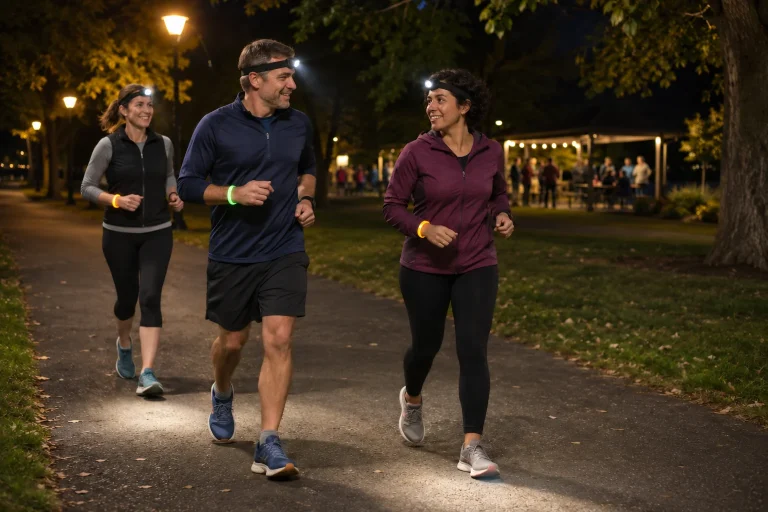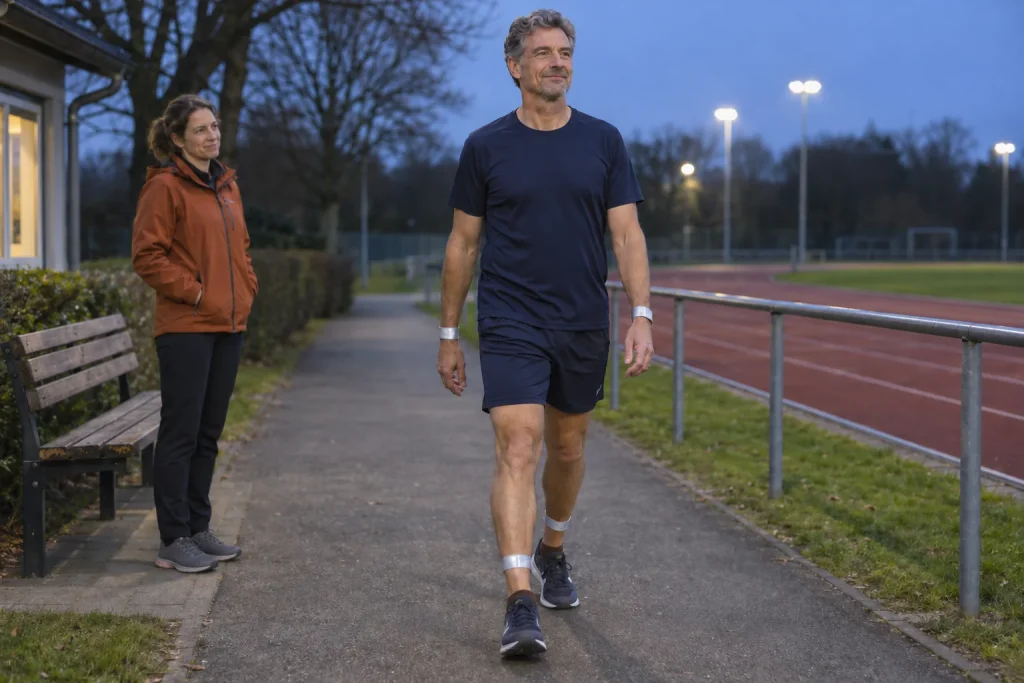
When looking at reflective details on evening running clothing, it is easy to focus only on area: more silver strips, a larger shiny slogan or a more striking back panel. One interesting line of traffic-perception research asks a different question. What matters is not only whether something flashes, but whether the observer recognises human form and movement. Markings around the wrists and ankles can provide distinctive information for this.
In this context, biomotion, or biological motion, refers to a pattern making human movement recognisable. It is neither a new energy source nor the running-dynamics data on your watch. The studies below concern noticing pedestrians and judging their direction of travel. They offer useful guidance for understanding marker placement, while neither establishing a guaranteed recognition distance for your own running outfit nor making every road section suitable for an evening run.
Marker placement can also convey information about form
A single bright point against a dark background may leave many details missing. What it belongs to, its position in space and its direction of travel may not immediately be clear. Markings associated with the limbs, however, can show a pattern changing relative to one another. The studies presented here examine how these cues to human form and movement support perception. The emphasis is recognisable information, rather than the isolated shine of a decorative element.
At the ankles and wrists is therefore more than a buying slogan. The question behind placement is which pattern remains available to an observer from particular markings under appropriate illumination and viewing conditions. Clothing, movement and environment shape the situation together. Copying a strap seen online does not reproduce a study’s conditions. Understanding research supplies considerations for your own equipment rather than a recipe for home certification.
The 2008 study also relocated an equal amount of marking
In the study by Balk and colleagues, 120 participants were driven along an open-road route at night. They pressed a button when they recognised a pedestrian. The target person stood or walked in place on an unlit pavement, wearing black clothing or 302 square centimetres of reflective markings in one of four arrangements. The greatest response distance belonged to the arrangement indicating the full biological-motion pattern, and the wrist-and-ankle subset also performed favourably. The vest used in the experiment produced no better response than unmarked black clothing.
The study compared specific arrangements, so we do not generalise its vest result to every present-day product. Placement clearly matters, but evaluating a current shop item requires its own documentation. The research result does not override local clothing requirements either.
Response distance is different from a driver’s decision in an unexpected situation or an accident outcome. We do not treat a button press as proof of an ability to stop. The next study asks another question again: direction of movement alongside pedestrian presence.
 Enlarge image
Recognising direction differs from noticing someone is present
The 2021 study by Black and colleagues involved 21 young drivers with normal vision. From a stationary car with dipped headlights, they judged the direction of a pedestrian walking 135 metres away on a closed-road course. Five clothing configurations were used. Correct responses reached 80 per cent for the biomotion arrangement; other reflective configurations yielded 50–64 per cent, and black street clothing 33 per cent in this task. The relationship between confidence and accuracy was weak within individual clothing conditions.
The percentages concern specific responses, rather than accident-avoidance rates. The 135 metres is not an individual safety boundary. Read the result together with its young observers, stationary car and pedestrian task; recognising presence and judging direction are different endpoints.
| Study | Observation situation | Primary question |
|---|---|---|
| Balk and colleagues, 2008 | Participants transported along a night-time route; a pedestrian stands or walks in place | When does the participant signal recognition of the pedestrian? |
| Black and colleagues, 2021 | Stationary car, dipped headlights, closed course | How accurately is the pedestrian’s direction of travel judged? |
If product information cites either study, check whether the promised property matches the measured question. Do not read a direction-judgement result as a recognition distance measured over an entire route. Likewise, a study’s clothing arrangement is not identical to every later product advertised as biomotion. A reference is an important first step; a properly bounded claim makes it genuinely usable.
A separate experiment considered visual clutter
The 2009 study by Tyrrell and colleagues examined pedestrian perception on a closed course at night with 12 younger and 12 older drivers. Additional reflective cones and poles formed visual background in some trials. In this task, clothing arrangement mattered, and the added distracting points did not remove the biological-motion advantage. This is a separate study, rather than another account of the 120-person 2008 experiment, and is not evidence covering every urban lighting environment.
Your route’s shop windows, vehicles, obstructions and junctions may differ from the research setting. The result therefore does not justify ignoring a cluttered environment. It instead illustrates how a specific uncertainty can become a separate research question. Clothing effects need not be imagined only against a perfectly empty background, but experimental visual clutter does not encompass every real traffic circumstance either.
As a reader, ask two questions alongside a result: what changed in the study, and what stayed fixed? Adding cones, for example, modified a particular background rather than every lighting situation in the world. This thinking is useful for other running-equipment topics too. A well-defined result is valuable precisely because you can recognise the question it answers; naming its limits applies it more accurately rather than diminishing it.
As a runner, examine placement on the outfit actually worn
Review your equipment in a calm place away from traffic. Wear the full outfit rather than only the newly bought accessory: long sleeves, gloves, trousers, jacket and bag may all belong in the picture. First identify which details have recognisable manufacturer information. Then check where they sit and what covers them. This familiarises you with use; it is not a trial establishing detection distance or standards compliance.
A sleeve or glove can cover a wrist detail, while a trouser leg can hide an ankle detail. A loose accessory may rotate or interfere with wearing it; follow your own product’s instructions for adjustment. Everyone need not force the same solution, and a general article does not justify accepting uncomfortable tightness. If a detail is not in its planned position during use, do not count it as though it remained fully available.
Keep brief personal notes about coverage: The wrist detail disappears with gloves; long trousers cover the ankle element’s position. These are clear observations on which to change the outfit. Do not add an exact number of metres supposedly lost in recognition; you have no such data. Another person’s help checking coverage may be useful, while a home video or photograph still does not replace a controlled perception experiment.
An impressive movement video is not necessarily measurement data
Advertising often shows clothing from a favourable viewpoint in a situation known beforehand. The viewer knows where the person will be, and a camera may differ from how we perceive things in traffic. A strap flashing every other frame can illustrate the material’s appearance, but does not itself say when an observer in an unexpected situation would recognise it. Precise descriptions of task, method and outcome distinguish illustration from interpretable measurement.
Look beneath the video for data naming conditions and the assessed endpoint. Detected, recognised and correctly judged direction are not interchangeable terms. Likewise, on average participants does not mean every individual responded in the same place. If there is only one impressive shot, treat it as a demonstration. The equipment may still interest you, but persuasive imagery need not fill the missing measurement.
Do not take your own photograph by standing on a dark road while someone approaches in a vehicle. Traffic tasks used in studies are not suggestions for home experiments. Gathering documentation and reviewing clothing coverage somewhere safe may be enough for your own aim. A running club organising an equipment session should likewise begin with an appropriate setting separated from traffic for participants; an impressive demonstration must not become risk-taking.
 Enlarge image
A detail aiding recognition does not replace other tasks
Ankle and wrist markings still belong alongside questions about the entire outfit, your own lighting and the route. A retroreflective surface does not automatically illuminate an obstacle in front of your feet. An urban approach to a lit sports area may create separate circumstances in addition to the actual loop. Think through the outing door to door: where and when you move, which environments you pass through and what may change for the return.
Consult current Hungarian information for Hungarian traffic rules rather than copying the entire system of a research country. Police information discusses other visibility accessories alongside reflective-vest or clothing obligations outside built-up areas. A recognition advantage presented here does not imply that any small strap replaces all required clothing. Check rules according to the particular road, time and circumstances.
Choosing a time or location with less uncertainty can also be a fully valid decision. Better equipment does not oblige you to tackle harder traffic conditions. Taking a new accessory onto a previously avoided road does not prove you have tried it properly. Clothing should support an appropriately planned outing in your routine, rather than retrospectively fix an unsuitable environment.
Three questions help you read a biomotion promise more accurately
First: to which body part and complete outfit do the markings relate? Second: which perception task was studied behind the claim? Third: what does the product’s own documentation say, and what remains uncertain in your use? These questions separate the important placement idea from general promises. You need not disprove every advertisement; it is enough not to attribute more than the identifiable data actually report.
The interesting value of reflectors at ankles and wrists is therefore more than adding two shiny pieces. Under appropriate conditions, they can convey an interpretable pattern of a moving human. Studies examined this through different tasks, and their results make placement’s importance understandable. You can add this consideration responsibly to your running by reviewing the entire outfit, coverage, route and local traffic situation.
Primary studies and further information
Balk and colleagues, 2008: Highlighting Human Form and Motion Information Enhances the Conspicuity of Pedestrians at Night – the 120-participant recognition study on an open-road route. Black and colleagues, 2021: Using retro-reflective cloth to enhance drivers’ judgment of pedestrian walking direction at night-time – the 21-participant direction-judgement study; public primary-study record and abstract. Tyrrell and colleagues, 2009: Seeing pedestrians at night: Visual clutter does not mask biological motion – a separate closed-course study. Police: The aim is pedestrian visibility. The questions on reviewing clothing and reading advertising claims are original editorial applications, rather than running programmes tested in these studies.
How Futószív articles are prepared: our editorial guidelines.