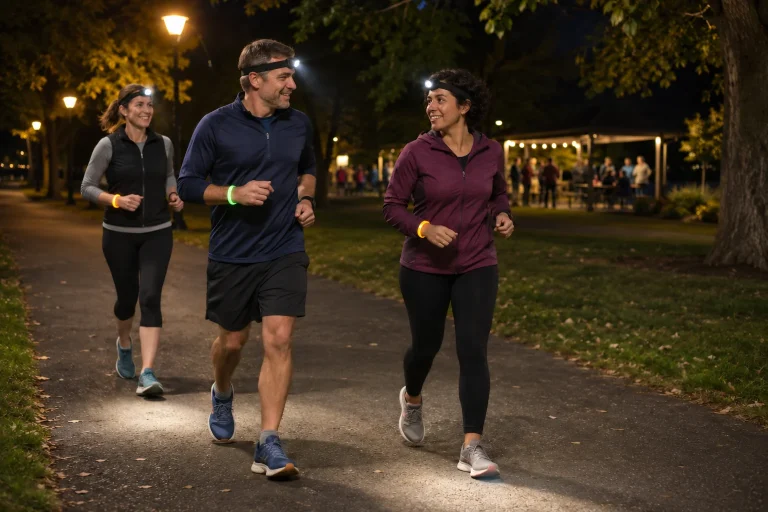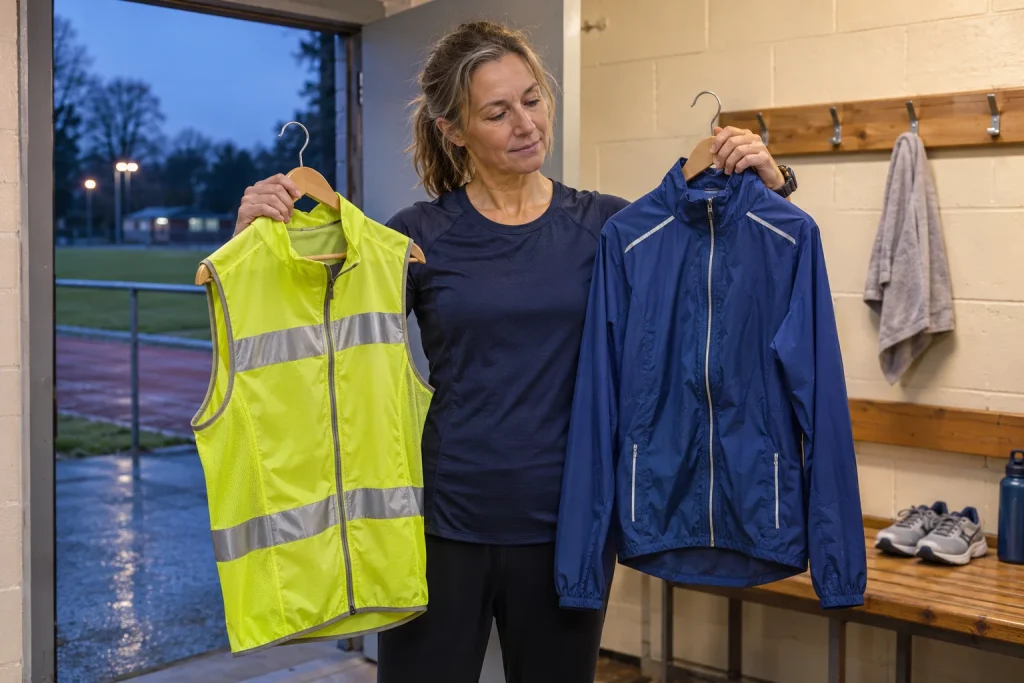
A lemon-yellow running top looks striking even indoors, while a grey strip seems unremarkable in daylight. Under evening lighting, those two parts can take on quite different roles. Fluorescent colour and a reflective surface are not two names for the same property. Treating them separately makes a garment description easier to understand and reduces the chance of mistaking an impressive product photograph for the information your own route requires.
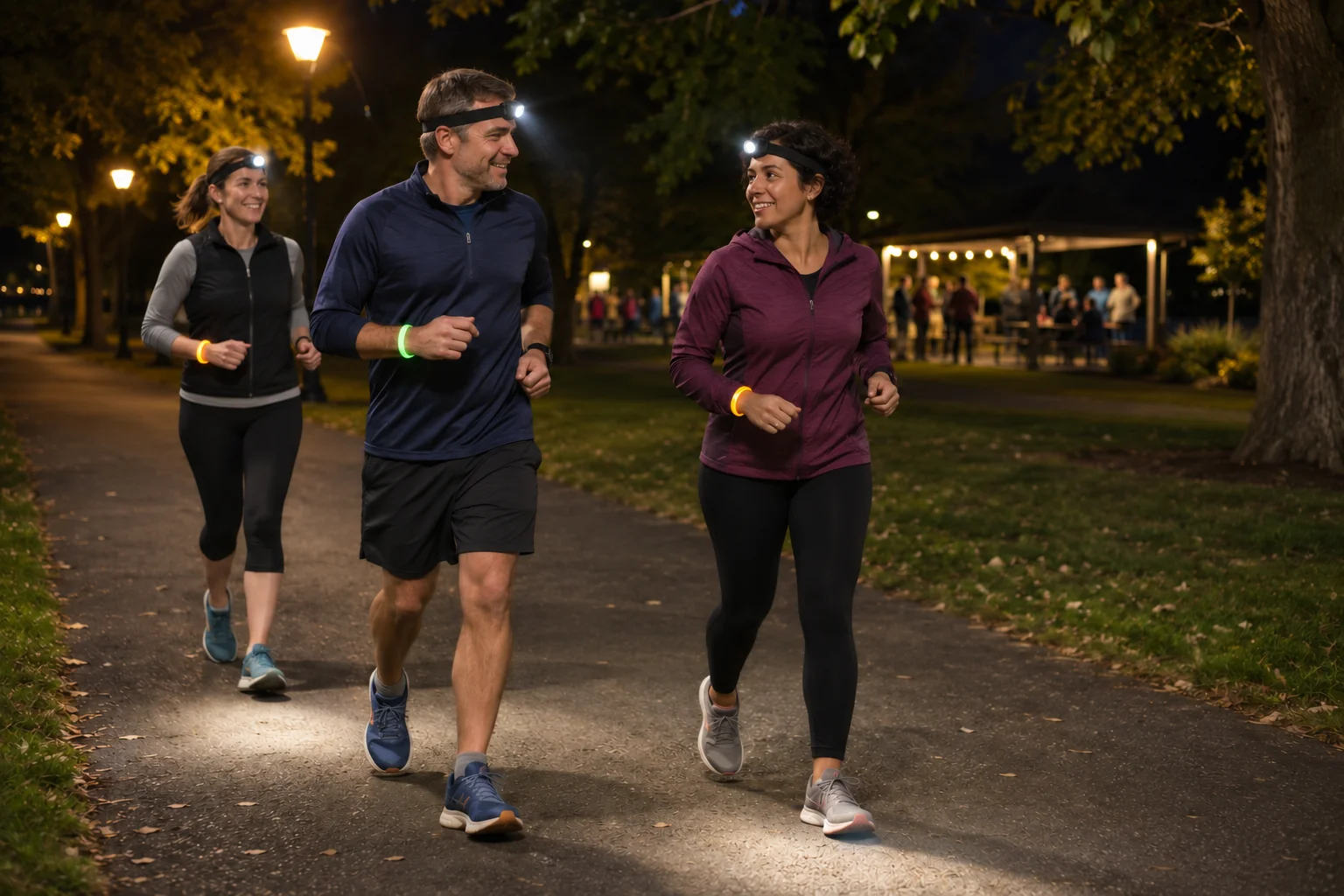
Three tasks can become confused for a runner: seeing the path ahead, making your presence visible to others and complying with local traffic rules. A colourful top does not illuminate the trail, while a headtorch does not automatically establish the visibility properties of clothing. This guide examines the relationship between light and material, then develops an original equipment-checking method. We promise no invented detection distance or guaranteed protection.
Fluorescence: striking daytime colour without its own power supply
The 3M explanatory material describes a fluorescent surface returning part of the incoming light as light in another, visible range; it needs illumination to work. This differs from a battery-powered lamp and does not mean the clothing glows by itself in complete darkness. Daytime conspicuity and reflection useful in darkness are therefore separate questions. Do not automatically translate a neon-like colour into a claim that the garment supplies every property needed for travelling at night.
Look for the exact description when choosing a product. Bright yellow or orange on a screen does not prove fluorescence: rendering, photography and the monitor all change appearance. A manufacturer’s data sheet or instructions may supply an identifiable claim. If only an imaginative colour name such as vivid lime appears, do not infer separate materials testing or certification. You can like a colour while having insufficient information about its visibility properties.
Break your outing down by time too. You may set off in daylight but plan to return after dark. Choosing clothing only for the light at your door is then insufficient. Consider the entire planned journey, including waiting and getting home. You need not use every last minute of daylight: leaving earlier or choosing another location may be simpler than supplementing an incomplete equipment plan afterwards.
Retroreflection: light returns towards its source
An important type of reflective material used on clothing is the retroreflective surface. According to 3M’s description of a particular material, such a surface can help a wearer be noticed by directing incoming light back towards the light source. Appropriate illumination is needed; a reflective strip is not a lamp generating its own light. The relative positions of source, material and observer therefore belong in the explanation. A detail that looks greyish by day can become conspicuous under suitable conditions without containing a battery.
Do not identify mirror-like decoration and retroreflective material as the same thing merely because they shine. If clothing has a metallic-effect print, check its own product description first. The same applies to a shiny logo: appearance does not reveal its purpose or properties. Your buying notes can include a separate line: Does the manufacturer identify it as reflective, or show it only as decoration? This remains a question to clarify, rather than a conclusion derived from the photograph.
Check what the reported data cover too. Documentation for a fabric or iron-on element does not prove every property of an entire top made with it. On the finished garment, the detail may be covered, differently positioned or a different size. Examine your complete equipment arrangement rather than only an advertisement for one component. A manufacturer’s material description can explain how it works while leaving further information necessary to choose the actual garment.
 Enlarge image
Both properties can be present on one garment
You need not classify each item as exclusively fluorescent or exclusively reflective. For example, 3M’s cited 9687 material describes a fluorescent background combined with a retroreflective component. This is manufacturer documentation for a particular material, rather than a general running-clothing recommendation. The useful lesson for reading descriptions is that several differently functioning parts can work on the same equipment, each understood in its appropriate environment.
Use three columns to review your own wardrobe. The first records an identifiable property aiding daytime conspicuity, the second an identifiable reflective detail and the third missing data or uncertainty. I do not know is valuable here: it prevents attributing a definite certification to an old unlabelled jacket. You need not begin the list with a new purchase; first investigate what you already own and would actually use on the next outing.
| Element | What information are you seeking? | What does it not automatically replace? |
|---|---|---|
| Bright or fluorescent surface | The exact manufacturer description and intended daytime use | Night-time reflective properties |
| Reflective detail | An identifiable description of the material and finished item | Illumination of your own route |
| Disposable- or rechargeable-battery lamp | Its own operation, adjustment and instructions | Clothing certification and traffic rules |
What does a standard add to a visibility-garment description?
The public ISO 20471 overview concerns more than colour: retroreflection, minimum material areas and their positioning are among its requirement topics. A small strip or conspicuous logo therefore cannot establish compliance of the entire garment. When this article was checked, the ISO website listed the 2013 edition as a published standard with an amendment, while a new version was under development. We do not treat a draft as a completed new edition.
Look for the specific reference on the clothing label and in its documentation. Which standard, edition, classification and usage instructions appear? If a retailer merely says the material meets a standard, request information for the complete finished item. This article cannot retrospectively certify an unknown product. A home photograph or the word safety or night in a product name does not replace the documents needed for compliance.
A documented product property and suitability for an individual outing are also different questions. Even a correctly identified item must be worn and used properly, while the route can remain unsuitable. A classification does not promise that every road user will definitely notice you in time. Keep location, time of day and whether you can travel and return home under appropriate conditions within your own plan.
A running vest and rain jacket can cover what you counted on
Put on the complete outfit you will actually wear. Add the rain jacket, hydration vest or backpack and gloves if they belong to the outing. Ask someone in a calm place away from traffic to look from the front, rear and sides at which identified details remain exposed. This is your own coverage check, rather than a certified visibility assessment. It helps you notice that part of a surface you originally counted on is now underneath another layer.
How clothing is arranged while moving is another important practical detail. Rolling up sleeves, raising trouser legs or removing an outer layer can change what is visible in the whole outfit. Note this during your own check, then compare it with the manufacturer’s instructions. The task is not to collect as many separate accessories as possible, but to understand the set actually worn clearly. Do not count an item carried unworn in a bag as a worn surface.
Do not stand on a dark road for the check or ask a driver to approach you in traffic as a trial. Traffic is not a setting for home demonstrations. A flash-lit picture taken somewhere safe can show how a detail appears, but supplies no verified detection distance and does not replace documentation. Reviewing coverage and measuring road visibility remain different tasks.
Look for Hungarian rules for a Hungarian route
Section 21(12) of Hungary’s road traffic rules, KRESZ, connects wearing a reflective vest or clothing with specified night-time or reduced-visibility circumstances on the carriageway, emergency lane or verge of a road outside a built-up area, separately from the rules for a closed group. Police accident-prevention information also emphasises this. Check the complete current provision before your route; do not automatically treat an arbitrary small logo or illuminated watch display as a substitute.
The UK Highway Code advice distinguishing clothing properties useful by day and in darkness offers an understandable example, but its complete traffic arrangements should not be copied onto a Hungarian route. The physics of visibility and local legal obligations are different questions. When travelling abroad, learn that country’s current rules. A running-clothing label does not give general permission to use any road type or select a route for you.
Consider more than conditions at departure: include the planned return and possible waiting. If part of the outing would lead to a stretch for which you lack an appropriate plan or equipment, find another route. Only a few minutes is not a separate clothing category. A general online article cannot resolve specific legal compliance and personal circumstances for every individual situation.
 Enlarge image
Care and departure: a short, usable personal checking routine
Care for a finished item with visibility details according to its own label and instructions. Do not adopt a washing temperature or cycle count specified for another model. If documentation gives a use or care limit, record it against that specific product. Ask the manufacturer about damaged, peeling or uncertain surfaces; do not restore assumed certification through home painting or an unknown iron-on strip.
Your preparation can consist of three questions. First: which parts of today’s outing happen in daylight, darkness or more difficult visibility? Second: what properties and documentation do you know for the entire worn outfit? Third: if conditions or condition are unsuitable, what alternative can actually be used? This need not become a long list; what matters is a meaningful answer to all three before setting out.
Treating fluorescent and reflective details separately ultimately supports more precise equipment decisions. You understand the lighting conditions to which each relates, notice coverage and avoid confusing your own lighting with clothing properties. You need not justify conspicuous appearance through exaggerated promises. Documented properties, correct use and a considered route all enter your plan, each with its own role and limits.
Sources and checking
3M: Scotchlite Reflective Material – explanation of fluorescence and retroreflection; 3M: 9687 Series product description – manufacturer information for a particular material, rather than all running clothing. ISO: 20471:2013 public overview and publication status. Hungarian National Legislation Database: KRESZ, particularly Section 21; Police: Visibility = safety. UK Highway Code: pedestrians, Rule 3 – an illustrative example from abroad. Reviewing your own wardrobe and checking coverage are editorial methods, rather than certification or a road experiment.
How Futószív articles are prepared: our editorial guidelines.