After a rainy run, shoes can feel heavier than before setting off. The upper, lining and insole change condition, while mud or small debris may remain on the outsole. A household scale can help describe your own shoe’s current mass if you record the starting point and measurement conditions clearly. The result does not automatically become a race-time prediction, however, nor can the entire mass difference always be called pure absorbed water.
The following method is our own simple observation procedure. It is not standardised shoe testing and does not require deliberately soaking new or used shoes. If equipment became wet anyway during an outing appropriate for you, you can record its condition as part of normal care. Follow the particular shoe manufacturer’s cleaning and drying instructions. The aim is understanding your equipment better, rather than seeking a dangerous route or damaging test for a scale reading.
First decide exactly what you are weighing
One shoe, a pair or shoes and socks together? These are three different measurement objects, so make your choice clear in the first line of notes. Within a shoe, it also matters whether the insole and laces are present and whether the same combination goes on the scale both times. If one measurement omits a removable part, the difference cannot be attributed solely to wetness. Simple consistency helps more here than many decimal places.
You can weigh the two shoes separately if that is what you want to follow. Label left and right in your notes rather than recording only a general model mass. There is no need to expect identical values, and a specification figure for another size is not a measurement of your particular shoe either. Identifying model and size helps trace which equipment you have experience of later.
If interested in sock condition too, treat it separately. A shoe and sock are different objects, and one combined total does not reveal moisture distribution. You can choose a simpler observation task: record only the shoe now and make a separate written note about how the sock felt. You do not need to quantify everything at once to retain information useful for the next use.
The dry starting point should be known, not estimated from memory
Record dry condition for a shoe cared for according to its manufacturer’s instructions, rather than immediately after an earlier wet outing. Normal drying according to the label does not need accelerating with an unknown heat source for measurement. Note when and in which combination you weighed it. To check the same dry condition later, repeat the reading with identical parts and the same scale.
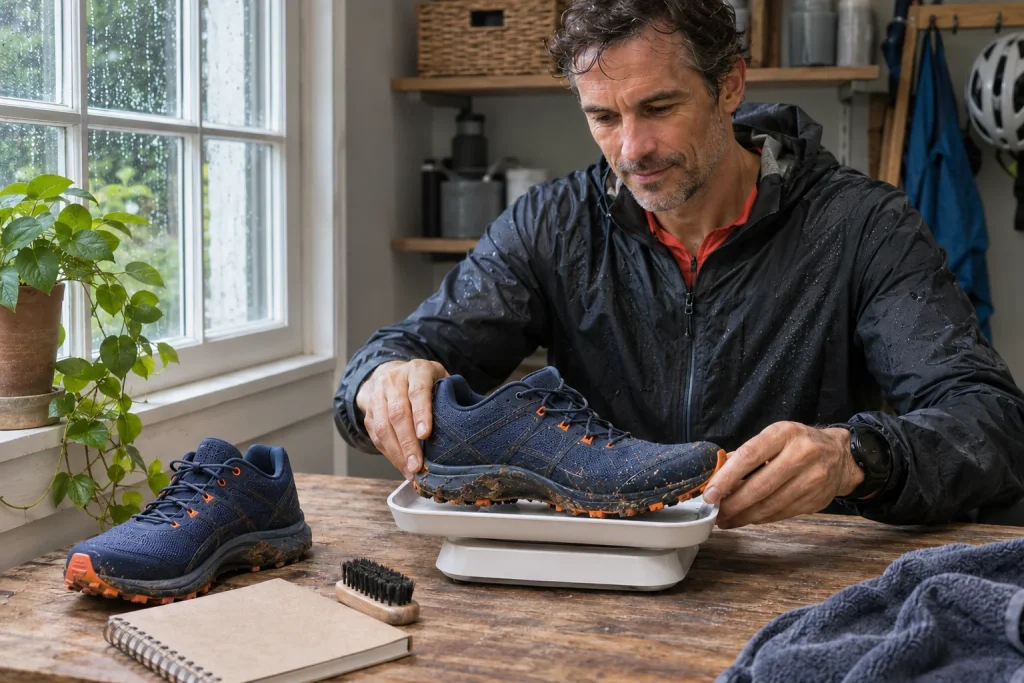
Use the scale on a stable, level surface according to its own instructions. If a tray is needed beneath the shoe, account for its mass through appropriate taring or a separate measurement. Do not let a different tray or accessory appear unnoticed between the dry baseline and wet follow-up. Display resolution is not automatic proof of accuracy: describe household data accordingly and do not claim laboratory calibration.
It is worth lifting the object off, replacing it and checking whether a simple reading is broadly repeatable. If the result jumps noticeably, first clarify positioning and scale use rather than selecting an attractive number. Your note can conclude that this equipment did not provide clear data this time. That is more honest than presenting a very precise-looking percentage from an uncertain display.
 Enlarge image
Timing and surface condition matter in wet weighing too
After running, prioritise your own condition and normal equipment care first. If you weigh the wet shoe later, note how long after removing it or finishing the outing this happened. Water dripping or escaping meanwhile may mean a different time produces a different mass. The data is then a snapshot of one condition, rather than an unchanged quantity applying retrospectively to the whole run.
Mud left on the sole and debris inside can be separate contributions. Describe what visibly remained on the shoe when weighed and which manufacturer-permitted step you performed beforehand. If one occasion involves a muddy shoe and another a cleaned one, do not merge the conditions. There is no need to handle the shoe extremely for measurement; documented everyday condition can be useful when named precisely.
Water dripping onto the tray can enter the reading too if it remains on the scale with the shoe. Observe both the object and the surrounding surface within your method. The aim is not building a complex laboratory, but removing simple misunderstandings. Your notes should reveal whether you compared the shoe’s particular condition or whether a wet container was part of the measurement object alongside it.
Numerical example: one shoe’s difference and the pair’s total mass
The following numbers are fictional editorial examples illustrating arithmetic only. Suppose the left shoe’s dry mass is 285 grams and the reading after wet use is 344 grams. The difference is 344 minus 285, or 59 grams. If the right shoe is 280 grams dry and 336 afterwards, its difference is 56 grams. You have separate data for each shoe, rather than one number used for a foot and pair at once.
| Object in the example | Dry mass | Mass after use | Difference |
|---|---|---|---|
| Left shoe | 285 g | 344 g | 59 g |
| Right shoe | 280 g | 336 g | 56 g |
| The pair together | 565 g | 680 g | 115 g |
The relative difference for the pair in this example is 115 divided by 565, multiplied by one hundred: approximately 20.4 per cent. This concerns the mass change of the example’s measurement object. It does not mean running became harder by that proportion or indicate the same percentage time loss. The denominator always defines the ratio’s meaning: here, the reference was dry shoe-pair mass, not your body or a race duration.
If dirt was also present in the later measurement, do not automatically call 115 grams pure water absorption. ‘Mass difference between observed conditions’ is more precise. This does not make arithmetic less useful; it keeps the conclusion tied to available information. Make the same distinction in your own measurement between simple subtraction and knowing every detail of the cause.
What does a running study with added foot mass say, and why is it not a time prediction?
In Franz and colleagues’ 2012 study, twelve men experienced in barefoot running ran on a treadmill at a specified speed barefoot and in lightweight shoes. In some trials, added mass was attached to the feet or shoes, and gas exchange assessed the metabolic response. Added mass increased measured oxygen use; the study reported approximately one per cent per hundred grams added per foot under its own experimental conditions.
This is important information on the research significance of shoe mass, but not an outdoor race test in wet running shoes. Water distribution, whole-shoe condition and actual running circumstances differ from the laboratory task with attached mass. Percentage change in oxygen use is also not the same quantity as percentage change in race time. We therefore do not calculate your personal rainy finishing time from a home measurement by simply multiplying the study’s result.
Your own scale data remains useful. It makes an equipment difference describable when you previously reported only a heavier feeling. Research reminds us that mass carried on the feet matters, but does not explain everything. Using both kinds of information together at their own levels avoids overvaluing grams or pretending they say nothing about your equipment’s current condition.
Mass, a wet feeling and drying belong on three separate lines
You can add your impression beside the scale result, but label it separately. Shoe mass, how wet a sock feels and comfort during movement are not the same measure. If you did not assess the latter appropriately, do not infer them from gram differences. Three brief diary lines may be enough: what the scale showed, what you noticed during use and the condition in which the shoe later began drying.
Research on textile drying also shows that the arrangement influences interpretation of the process. Do not derive home drying of different shoe parts from a general fabric sample. The upper, interior and removable insole have their own conditions, alongside specific care instructions. Normal care after measurement is not another performance test; you want appropriate condition for the next use.
If it is difficult to get the shoe back into usable condition within your routine, describe this as a practical task. How much time is available between outings, where can it dry according to instructions and which pair can you wear next time? The answer is not necessarily a new shoe with the lowest dry mass. First clarify the relationship between existing equipment and real care options.
 Enlarge image
When comparing two shoes, differences in conditions are data too
If comparing two models in your own use, first identify actual sizes and component combinations. Their dry masses may differ, so absolute increase and increase relative to the dry starting point can produce different rankings. Neither tells everything about usability. Choose and name the question that interests you rather than shifting the reference unnoticed to favour a result.
Two different rainy runs did not necessarily expose shoes to the same amount of water. Routes, puddles, rainfall and durations may differ. Your experience is still real, but not a controlled model comparison. Record this and you will know later that your data concerns two particular uses. You do not need to turn them into a laboratory ranking for them to teach something useful about your own environment.
When repeating measurements, identify changes in the method too. Another scale or tray, a later follow-up measurement or a removed insole changes the comparison. Organised notes prevent relying on memory. If too many circumstances differ, an honest conclusion can stay narrow: you observed these two masses on these two occasions. That can still provide personal background for your next clothing or equipment choice.
At the end, choose one question about the next use
A sound observation need not end by calculating a personal racing disadvantage. Your next question may be how moisture entered the shoe, or whether normal drying fits your running week. For recurring, unusual conditions, clarify appropriate checking or care with the particular manufacturer. Scale data adds detail but does not itself diagnose the water’s path or a possible fault.
For your own note template, use this sequence: exact shoe and components, dry starting condition, brief description of use, timing and condition of the later measurement, simple subtraction and a separate personal impression. Any line can use words if no measured data exists. Do not fill a missing detail afterwards with an assumed number. The result stays traceable and interpretable for your next decision.
Wet shoe mass then becomes a transparent equipment observation. You see what you actually measured, what you calculated and what remains a question. Grams can help you know your shoes better while comfort, care and a safe route retain their own importance. The useful lesson comes from managing a specific task more precisely, rather than translating everything into one finishing time.
Primary sources and the origin of the numerical example
The research background on added foot mass is Franz and colleagues’ study Metabolic cost of running barefoot versus shod: is lighter better?. The arrangement-related background to drying comes from the primary study Drying Performance of Fabrics on the Human Body. For care, alongside the particular model’s instructions, one example is the Gore footwear care description. Checked: 21 November 2026. The 285/344 and 280/336 gram figures are our own fictional teaching examples, not real measurements reported for a product; the observation sequence is our own editorial suggestion.
How Futószív articles are prepared: our editorial guidelines.