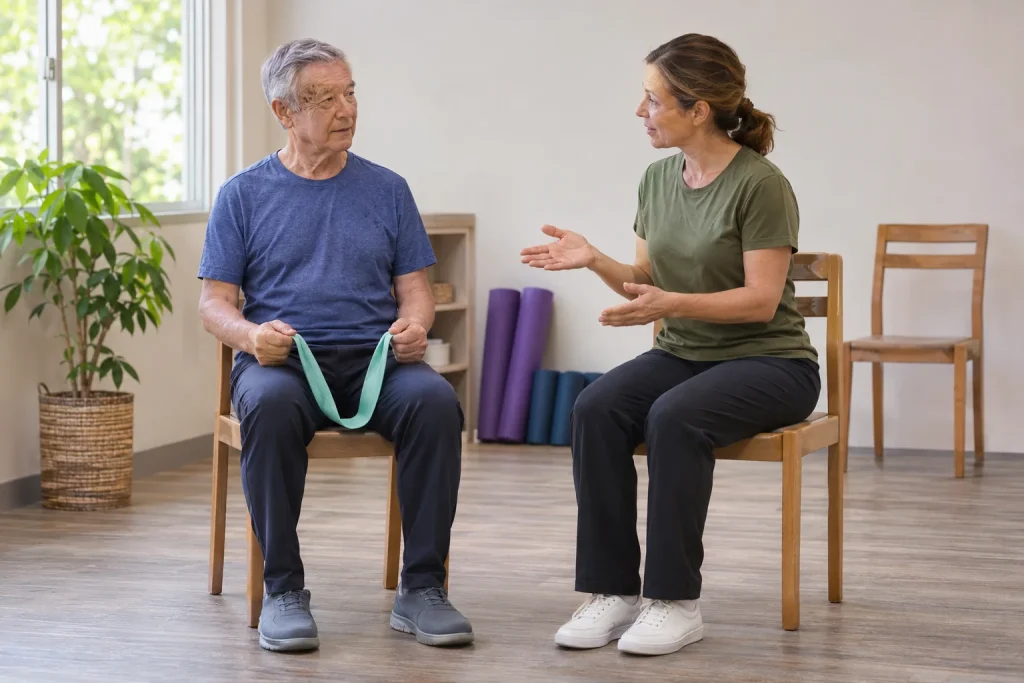
After your first strength sessions, it is easy to ask how many repetitions you managed. The number is tangible, quickly comparable and resembles the performance tracking familiar from running. Yet the same repetition count can conceal a different task. With another resistance, movement, assistance or tempo, you are no longer comparing the same thing. As an older beginner, repetition count is only one detail.
Learning does not aim to make you do as much as possible from the first session onwards. Understanding an appropriately selected task and carrying it out clearly is an outcome in its own right. Load can change later, but a bigger number alone does not tell you whether the programme changed in a useful direction. Interpreting success also needs your own goal and the task’s conditions.
Repetition count makes sense only alongside the task description
A resistance band’s colour, elasticity, length and grip can all change the task. Repetition counts from two different exercises cannot simply be placed side by side either. ‘I did more today’ becomes interpretable when you know what stayed the same and what changed. Every session need not become a competition result.
The NHS home strength exercise guide emphasises gradual progression and controlled execution for several tasks. Its general numbers do not describe every reader’s individual dose. Understand the appropriate framework from the particular task and your own condition, especially with injury, illness or uncertainty.
Do not discard the number, therefore; put it in context. You can record the assigned repetitions and how they went without treating this as the sole rating of all strength work. A clear record needs more information: the task’s name, resistance, necessary support or help and relevant personal experience. Without these, the meaning of greater volume is easily misunderstood.
Learning the movement is a real task for a beginner too
The National Institute on Aging description of strengthening also considers learning the movement important for beginners before working with resistance. This does not mean every older person starts at the same level. Being a beginner relates to the particular task. An experienced runner can be new to a strengthening movement too.
During learning, you understand the starting position, what should move, what the support is for and how to finish the task. If these remain uncertain, more repetitions do not necessarily provide a better answer. You might repeat the same misunderstanding more often. Appropriate demonstration and personal feedback are therefore not unnecessary detours before the real workout.
One sign of success may be following the assigned task more clearly and calmly next time. This is not a clinical measurement or guaranteed physical change, but an observable detail of learning. There is no need to immediately add weight or repetitions simply to make the diary line numerically bigger.
 Enlarge image
Manageable resistance does not mean remaining easy forever
Strength work can have a genuine loading goal. An appropriately designed programme does not necessarily remain unchanged and easy indefinitely. The question is how resistance, repetitions and the task are selected and modified for your individual situation. Gradual progression is not rejection of development, but a clear structure for change.
NIA’s guidance also discusses the role of greater muscular effort without disregarding excessive exertion or symptoms. The everyday phrase ‘I got tired’ and a professional programme’s loading concepts are not always identical. If you do not understand when and why to finish a set, clarify this with the programme leader rather than working it out by pushing to your maximum yourself.
‘I cannot do any more’ does not mean the same thing in every circumstance either. It may be an experience linked to the assigned load, a difficulty with technique or a symptom. Do not close all these with the same sporting praise. Naming the experience precisely allows the appropriate part to change: understanding of the task, support or the individual loading framework.
What was studied in strength training to failure?
In an original randomised study, Bergamasco and colleagues compared three low-external-load strengthening methods in 41 participants aged 60–77. There was a version performed to muscular failure, a voluntarily interrupted version and a fixed low repetition count. The programme lasted twelve weeks. No meaningful between-group differences were found in the reported outcomes across the methods examined.
Strength and some functional measures improved, while other measures did not change significantly. The study does not establish that every possible strength programme is identical or that load never matters. The important point here is that performing to failure offered no additional advantage in this particular trial. It does not justify a universal ‘always to the limit’ rule.
You do not need to copy the research programme at home either. Participants, equipment, tasks and measurements belonged to the study’s own framework. The useful conclusion for readers is not adopting a compulsory percentage or repetition count, but asking why they use this structure for their own goal. An understandable explanation of an appropriate plan offers more than a new universal recipe made from a study title.
A goal connected to daily function can reveal other kinds of success
You may want to manage an everyday task more easily or support your own activity with an appropriate strengthening programme. Naming the goal precisely helps interpret later change. Instead of ‘I want to be stronger’, identify the situation you want to make more workable. This does not make the programme less serious.
It also matters that improved daily function and a change in the number achieved in one exercise are not necessarily the same thing. If the programme relates to an individual goal, know how you will follow its development. Everyday observations do not replace necessary professional measurement, but help prevent the plan revolving solely around equipment or an exercise.
The WHO approach to functional ability highlights the opportunity to do activities the individual values. A movement programme’s purpose therefore need not be only a record achieved in a gym. Naming an important personal task helps connect exercise to everyday life rather than leaving it as a stand-alone completion duty.
The environment and equipment should be understandable too
NHS chair-based examples use a stable chair that does not roll or slide. Understand personally the support and positioning needed for the particular task. Do not remove support to make the result look harder. Changing a task’s conditions can be part of the programme, rather than a spontaneous chance to prove yourself.
If using a band, weight or other equipment, be clear about use and storage. Do not leave yourself guessing length, grip or position during the task. Damaged or unfamiliar equipment needs addressing with appropriate help. More repetitions do not resolve technical uncertainty, and concentrated attention does not make every object a suitable support.
Bags, cables and moving objects in the way of your feet matter in the activity space too. Appropriate preparation creates fewer spectacular results, yet helps you follow the assigned task. Every session need not be arranged under special conditions, but basic conditions should not be left to chance. A predictable environment makes learning clearer too.
 Enlarge image
Pain or feeling unwell is not a sign of effectiveness
Do not automatically interpret new pain, dizziness, chest symptoms or unusual breathlessness as strength training succeeding. Distinguishing sensations associated with exertion from symptoms needing care may be an individual question. Severe illness requires appropriate urgent help. Completing the assigned repetition is not more important.
The NIAMS injury guidance does not support working through injury pain. Do not try to prove a symptom will pass through more repetitions or stronger determination. If something is uncertain, modifying the task or assessing the condition has an appropriate setting. Asking for help can be part of a clear programme.
Next-day discomfort need not become a single success ranking either. A session leaving you very worn out does not itself establish that it fulfilled its purpose better. Tell the programme leader about your experience, particularly with new or persistent symptoms. The next step should clarify your individual framework rather than repeat the pain.
What should you write beside the bare count?
A brief note can preserve which task and assigned variation you performed, what was understandable and where help was needed. There is no need to create your own technical rating scale. A factual description is enough for you and the leader to see more than a bigger or smaller number next time.
| Note | What does it clarify? |
|---|---|
| Task and variation | Are we genuinely discussing the same movement? |
| Equipment and support | Under which conditions did execution occur? |
| Your experience | Where was there a learning question or a symptom needing separate assessment? |
Observation does not aim to analyse and find fault in every repetition. Preserve the useful detail. If logging becomes harder than appropriate activity itself, simplify it. You can also agree with the programme leader what they genuinely need for the next decision and which data does not help follow the individual goal.
A fictional older runner performs more repetitions in the first session but does not fully understand the movement. Later, they perform the same task with a clearer explanation and more appropriate surroundings, within the assigned framework. They do not independently add further repetitions. Improved learning is still progress even if the diary number is not bigger.
Success in strength training therefore becomes understandable through the relationship between number, execution and personal goal. A maximum can be a measurement concept defined in a professional setting, but need not become the basis of every beginner session. Understanding an appropriate task and making clear changes can provide a more lasting foundation than always seeking a higher repetition count.
Sources
NHS: home strengthening and gradual progression; NIA: strengthening, beginner learning and forms of activity; Bergamasco and colleagues: original randomised study of strengthening to failure and other approaches; WHO: functional ability and personal activities; NIAMS: injury pain and care; NHS: breathlessness. Checked: 21 November 2026. The example is not an individual strengthening plan or a protocol for measuring maximal performance.
How Futószív articles are prepared: our editorial guidelines.