A pleasant twelve degrees in the morning makes the marathon seem ideal. But what is expected four or five hours later, when you are still on the course? Rather than the start temperature, consider your own race window, hourly changes and the course environment. A fictional weather example and original studies show how to make a more useful weather plan.
Your race has a time window, not a single temperature
The value at the start is only the beginning of the story. If running lasts four or five hours, you may finish at another time of day and pass through different parts of the course. On a warming morning, a later finisher also experiences hours that no longer form part of a faster participant’s race. This is conditional: days do not all warm in the same way, so the actual hourly development matters.
Put your own starting time in the window, not merely the event’s main start. With wave starts, the two times can differ. If entry information mentions a nine o’clock start but you set off later, your planned finish shifts too. Waiting, bag drop and getting home are separate periods, yet remain part of the day’s environmental exposure. Read the forecast against this real programme.
The useful question is therefore: what weather is expected between my start and a realistically possible finish? Do not calculate only from your hoped-for best time. A broader finishing window helps you notice whether the later part of the day may differ substantially from the start. This is not a prediction of your personal slowdown, but an understanding of the environment in which your race may unfold.
One fictional morning produces two different races
Our next example is not an actual forecast. Suppose it is twelve degrees at eight, fourteen at nine, seventeen at ten, twenty at eleven, twenty-two at noon and twenty-three at one. Starting at eight, a three-hour runner finishes at eleven and a five-hour runner at one. They experienced the same start temperature, yet the same hourly sequence does not describe their races.
The numbers must not be used to calculate a personal time loss, and we do not claim this temperature pattern is typical of every event. The example illustrates only the difference between time windows. Cloud cover, a wind shift or cooling later could change the story. Reading the hourly sequence therefore offers more than a general statement that noon will be warm that day.
The daily minimum and maximum do not replace this view either. The minimum may have occurred at dawn, and the maximum after your finish. For running, you need to see which value is expected when, with what uncertainty and during which part of your own programme. Placing calendar and forecast times side by side can prevent many misunderstandings even on a simple sheet.
| Time | Air temperature | Point in the example race |
|---|---|---|
| 08:00 | 12 °C | Both runners start |
| 11:00 | 20 °C | The three-hour runner finishes |
| 13:00 | 23 °C | The five-hour runner finishes |
 Enlarge image
Temperature needs other weather factors alongside it
The research analysing 1,258 endurance races considered humidity, wind speed and solar radiation alongside air temperature. Temperature alone predicted the performance differences examined less well than the combined WBGT index. This does not make the degrees displayed on a phone irrelevant; it makes them an incomplete description.
WBGT is not simply another name for temperature and is not automatically identical to an app’s ‘feels like’ field. Different indices are produced from different inputs and for different purposes. If the organiser links information or measures to a particular index, read its specific meaning. Do not replace it with data from an arbitrary other screen simply because both show degrees Celsius.
Make room on your own sheet for expected cloud cover or sunshine and wind too. You do not need a homemade heat-strain formula. The aim is to notice that a long sunny stretch may follow a shaded start area, or stronger wind is expected during hours previously thought calm. The different factors together give a more interpretable environment.
A shaded start does not describe the whole course
The start zone is often quite different from later parts of the course. You may stand among tall buildings, beneath trees or in a more covered square, then run on an exposed embankment, bridge and long straight. Look for these changes on the course map beforehand. Every metre does not need a microclimate model for the large environmental differences to become visible.
Your own expected passage time also helps when reviewing the map. The same exposed section may reach you at a different time of day than a faster friend. Link hourly forecasts not only to the whole event but also to a few characteristic course sections. Keep estimates approximate: the aim is not a weather promise accurate to the minute along the route, but recognising likely situations in advance.
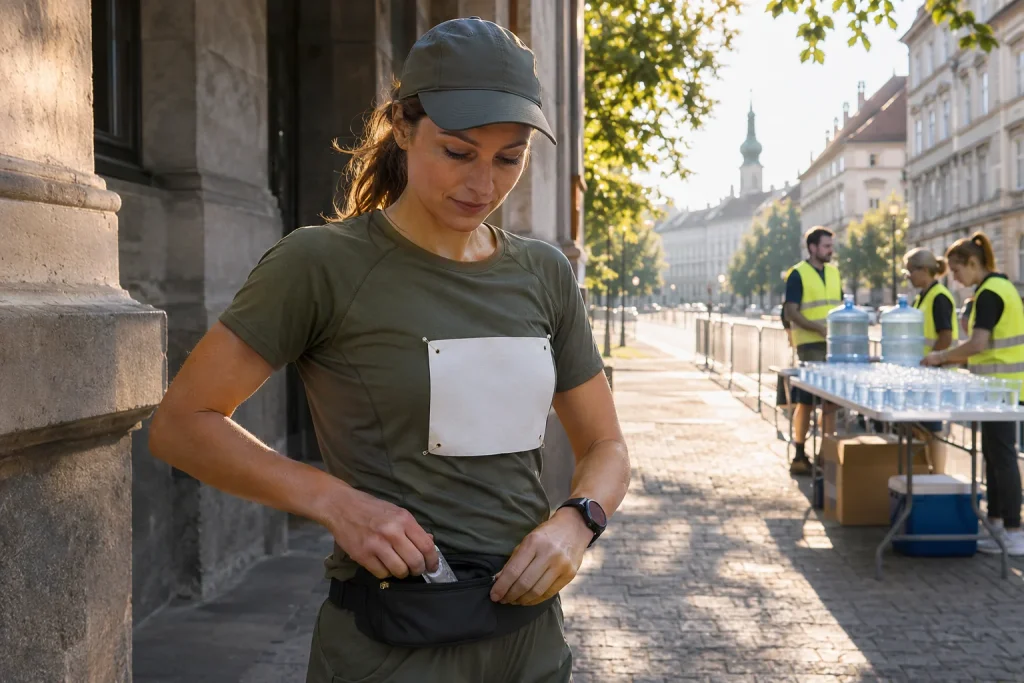
Put refreshment stations into this view too. Where are they, which officially announced services are available and what section precedes their approach? Stations do not resolve every environmental challenge, but are important reference points for organisation. Do not assume an extra station or unknown supplies, or rely on opportunities found by chance beside the course as though they were guaranteed parts of the event.
The weather station and the race course are not the same place
Meteorological data in large weather-and-results analyses generally comes from monitoring locations. The study combining races from several countries also linked data from nearby weather stations to races. This is a reasonable research approach, but does not mean every runner’s immediate course environment was directly measured at every moment. The station’s location and variety along the course are part of interpretation.
Check location in your own forecast too. A summary for a more distant city does not necessarily match data for the race town, and town-level data is not the exact environment of every bridge or park either. Do not expect spatial precision from a general app view that it does not promise. If the organiser provides on-site information, this may matter more for actual race arrangements than an earlier screenshot.
Measurement accuracy and forecast uncertainty are separate questions. A value measured accurately later does not automatically make the previous day’s estimate infallible. The weather plan should therefore be a document that can be updated. Note when you checked it and review it again before important organisational decisions, rather than clinging to a favourable icon from days earlier.
What does performance research say about slower runners?
The study comparing many years across several marathons found slower performance alongside warmer WBGT conditions and also indicated a more adverse effect in slower result groups. The research compared different placing groups. This is a group-level association, not a personal minute penalty fixed in advance for each degree.
The study analysing decades of Boston Marathon data examined weather variables during event hours alongside several other factors. This also shows the complexity of an event’s environment and the role of the course and particular field in interpreting effects. A location-specific association should not unthinkingly become your own personal correction formula.
A useful practical conclusion is instead to allow room in planning. If less favourable conditions are expected during your own window, a previously ideal goal does not automatically remain a task under equivalent conditions. Reconsidering the goal and pacing may be sensible, but the precise approach depends on the whole preparation and on-site condition. A research average does not know every detail of your situation that day.
 Enlarge image
Organiser information is a living part of the plan
In the days before the event, follow the organiser’s official announcements alongside the meteorological forecast. The start, route, services or how the race is held may change. A previously calculated target time does not override these. Know where current information appears in your plan, rather than relying only on a screenshot of an old social media post.
For an event in Hungary, the HungaroMet warning interface is another official reference point you can check. A weather warning is not an individual opinion on fitness to run, and the absence of a particular colour or alert does not guarantee comfortable race conditions for everyone. On-site organiser instructions and your own condition remain separate information.
A supporter or running companion can join the pre-start discussion too. Do you know where to meet if things change and which official message to follow? Preparing for a changing environment involves more than packing extra items. Sometimes it matters more that the day’s organisational plan still works when the original schedule is no longer feasible.
Your condition on site comes before the forecast
A forecast supports planning, but does not replace your condition during the run. The CDC heat guidance for athletes highlights stopping activity and finding a cooler place if you feel weak or faint, and recommends immediate medical help for symptoms of heat illness. This must not be subordinated to a split time still to complete.
The article does not give a universal drinking amount or temperature-based permission to start. Weather risk does not become zero because you checked a graph beforehand, and planned nutrition and hydration do not provide unlimited capacity for exertion. Feeling unwell needs to be taken seriously on site with the event’s medical staff involved, rather than explained away against the earlier forecast.
Keep your weather sheet short and useful: starting time, finishing window, a few hourly environmental values, characteristic course sections and where official updates appear. This already gives much more than one starting temperature. You are not trying to predict the whole day with certainty, but to be ready to notice if your race’s later hours call for another decision.
Adapt the post-finish meeting place to current conditions too. A long sunny queue or the walk to a distant bag store remains part of the programme even though your result is already recorded. Agree with your supporter on a place accessible under event rules and clearly findable even if arrangements change.
Sources
- Ely and colleagues: weather and different marathon result groups.
- Mantzios and colleagues: weather factors across 1,258 endurance races.
- Knechtle and colleagues: weather conditions at the Boston Marathon.
- HungaroMet: official warning interface.
- CDC: sport and heat illness.
How Futószív articles are prepared: our editorial guidelines.