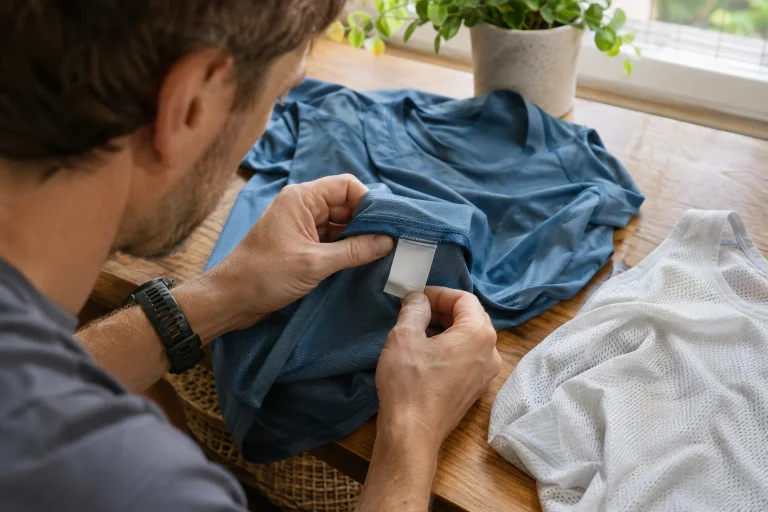
A UPF label is a useful reference when choosing a running shirt: it provides information about the material’s properties against ultraviolet radiation. Your running outfit, however, is not a single fabric sample. It has a neckline, sleeves and a hem; it may stretch or shift as you move, and areas of skin remain uncovered. It therefore makes sense to interpret the number alongside what the garment actually covers and the condition in which you use it. A good label is one part of the decision; a complete sun protection plan has more elements.
The following guide considers fabric labelling, stretch, moisture and actual coverage separately. Drawing on public health information and a specific sports textile study, it explains why understanding the conditions matters. We offer practical questions for checking your own clothing, without measuring UPF at home or calculating your personal time until sunburn. Seek individual healthcare advice if you have questions concerning photosensitivity, a skin condition or medication.
UPF describes a material property, not your whole running day
ARPANSA’s guidance relates UPF to the protection a material provides against UV radiation from sunlight. A higher rating means a smaller proportion of radiation passes through the tested fabric, within the stated interpretation. The consumer guide to the Australian–New Zealand system assigns protection categories to values of 15, 30, and 50 and 50+. This is an example of a specified system: check which standard and label the manufacturer cites for your own garment.
Do not convert the number into how many times longer you can run without consequences. Your personal UV exposure also involves time, location, current radiation levels and actual coverage. Information about the shirt’s fabric does not tell you how much radiation reaches your face, the backs of your hands or other exposed areas. UPF is therefore useful as a protective characteristic of the material, not as a time allowance for your running day.
When reading a product specification, note three things: the name of the particular garment and version, the stated UPF rating and its accompanying reference. If the shirt pictured and the named fabric version are not clearly identical, ask. Do not automatically transfer a claim from one design to another within the same product family. Precisely identified product information is a much better starting point than a general description of an entire brand as UV-protective.
Stretch can also change the state of the textile structure
ARPANSA lists fabric structure and stretching among the factors affecting protection. In a knitted fabric, stretching can change the spaces between the fibres, which may generally reduce UPF in that condition. This does not imply the same percentage reduction for every running shirt. The particular textile and test conditions matter. Look for any additional conditions relating to use in the manufacturer’s information.
When trying the garment on, do not only look at it while standing still. During comfortable arm movements and in your usual posture, notice where it stretches more. The chest, shoulders and elbows may behave differently depending on the cut. This observation does not measure UPF; it helps identify the conditions in which you use the garment. If you wear it in a strongly stretched position, do not automatically regard that as equivalent to an unstretched fabric sample.
At the same time, do not choose the right size solely on the basis of an assumed sun protection advantage. The garment should be comfortable for your planned activity, stay in the appropriate position and fit the manufacturer’s intended use. If you are unsure between two sizes, ask about the particular cut and stated protective property. Comfortable use and a sound interpretation of the label help you decide together; there is no need to invent one in place of the other.
 Enlarge image
Not every material changes in the same direction when wet
ARPANSA’s guide to Australian–New Zealand labelling warns that moisture, stretching, use or chemical exposure may reduce protection. ‘May reduce’ is important wording: it does not say the same thing happens to every wet textile. The particular material and test conditions matter. When running, therefore, do not invent a wet UPF value from the dry label in your head, or attribute the same change to every fabric.
A primary study examining 34 technical shirts made entirely from polyester adds nuance to this issue. The researchers assessed several UV-related protective characteristics and found increases in certain protective values in the sample tested when saturated with water or sweat. This is a fabric-sample finding, not an instruction to wet your shirt for sun protection. It cannot automatically be transferred to another fabric, condition or garment.
The practical conclusion is to look for documentation for the particular product. Does it state the condition in which it was tested, and are there separate warnings about use? A wet patch after your own run or the colour of the fabric does not produce a new protection measurement. If this matters to your choice, you can ask the manufacturer for specific data. Until then, retain the uncertainty in your decision, and do not abandon the other elements of sun protection because of an assumed improvement.
Clothing only covers skin where it actually stays in place
A neckline, short sleeve or hem that rides up does not automatically acquire the protection stated on the fabric’s label. ARPANSA specifically emphasises that clothing only protects the skin it covers. As a runner, therefore, check the coverage of your whole outfit, including during natural movements. The fabric’s rating and the geometry of the garment on your body are two different questions, both of which need a place in your planning.
During a calm fitting, look at your wrists, shoulders, neck and waist. What remains exposed when you raise your arm, adjust your vest or reach for a bottle? There is no need to make a body map measured in centimetres. The aim is to notice areas that a general impression of protection associated with the shirt might easily obscure in your thinking. You can then plan appropriate additional protection for the particular exposed area.
Pay attention to actual coverage with accessories too. The junction between an arm sleeve and the shirt sleeve may sit differently during movement than when you stand in front of a mirror. If a gap opens between the two pieces, do not regard it as an area jointly covered by their two labels. This is a simple practical check. A comfortable, familiar combination helps you restore the same coverage before setting off that you previously found appropriate.
Wear and care form part of the current condition
Alongside the garment’s label, look at its condition. Do not automatically regard a thinned, damaged or permanently stretched area as an unchanged example of the tested material. ARPANSA also mentions the role of use and changes associated with washing. This does not establish the same replacement interval for every garment: consider the particular manufacturer’s care and usage guidance together with the condition you actually observe.
When washing according to the label, also keep the product clearly identifiable. If questions arise about the durability of its protection, the model, version and history of use help you make a targeted enquiry alongside the fabric composition. Do not try to create a new UPF claim at home from an unknown chemical treatment. The procedure specified for the garment and the manufacturer’s information are the starting point; a general textile care idea is not equivalent to a verified sun protection property.
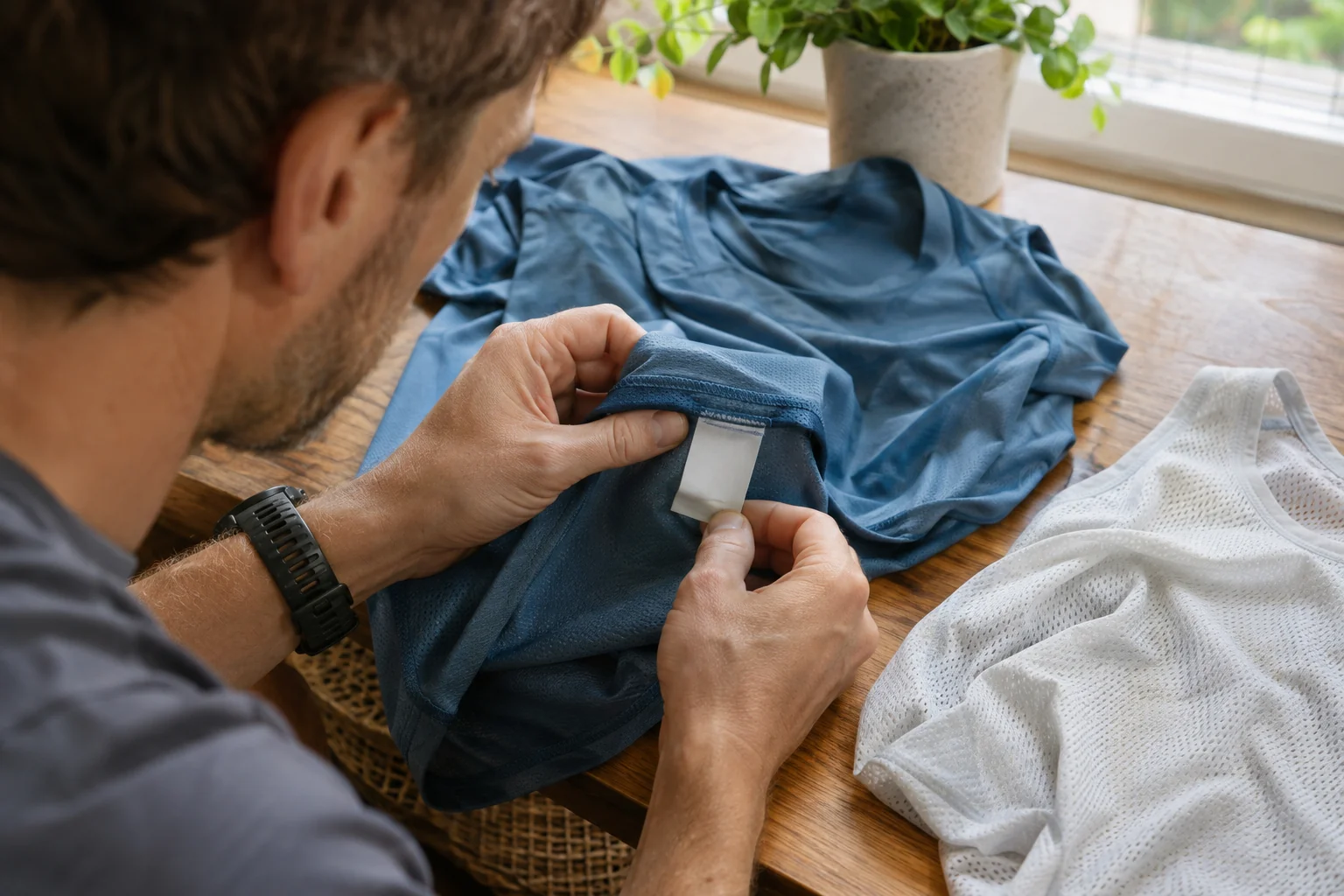
An everyday check can be simple: alongside the usual folds and seams, examine areas that frequently stretch or rub. If you notice a change, you can take your own photograph and ask about continued use. Visual inspection does not tell you the remaining UPF number. It helps you notice a change in condition rather than treating the whole garment as permanently unchanged on the basis of an old label you remember.
Adapt your complete sun protection to the UV Index
ARPANSA’s UV Index guidance recommends combining clothing, a hat, sunglasses, sunscreen and shade at an index of 3 or above. The index provides a reference for UV conditions; it is not another name for air temperature. Check current information for the location and time of your run. Do not read local data from Australia’s monitoring network as a current measurement for your route in Hungary; distinguish the general approach from actual local information.
As part of your own organisation, consider whether another time, a shadier route or appropriate protection for exposed areas is possible. Use the particular sunscreen according to its instructions, accounting for running and sweating. This article does not calculate a personal sunbathing time or time until sunburn by multiplying the shirt’s number by the sunscreen’s number. The two labels are not factors in a homemade time allowance of that kind.
If you have a condition or take medication that raises questions about photosensitivity, individual advice can supplement your usual general routine. A high UPF alone does not answer every question about individual risk. You can, however, collect your specific clothing questions in advance: what coverage have you chosen, where does skin remain exposed, and when would you run? A clearly described situation can make personal advice more precise too.
 Enlarge image
A brief personal check before your next sunny run
Before setting off, identify your chosen garment and inspect its visible condition, then check coverage with natural movement. You do not need to stand in sunlight to test this, and you do not need to wait for sunburn as feedback. Trying it on is a clothing task: do the sleeves, neckline and hem stay in place in your particular combination? From what you see, you can identify the additional protective element that needs attention.
Then check UV information for your actual route and time, and prepare your full protective routine. Sunglasses, headwear and care of exposed skin should not be overshadowed by the shirt’s good label. If you have added new arm sleeves or another accessory, try the meeting points too. This brief, repeatable check helps turn a plan into a combination you actually wear and can use comfortably.
UPF then retains its meaning: useful, specified information about a material that you read alongside its condition in use. Stretch, moisture and wear are not reasons to reject every label, but conditions to understand more precisely. Actual coverage and combined sun protection connect the label to your own running day. This can make your choice both informed and practical to follow.
Sources and the distinction concerning moisture
The main sources are ARPANSA’s guidance on sun protection clothing, the consumer guide to Australian–New Zealand labelling and the guide to using the UV Index. The specific polyester research is Aguilera and colleagues’ study of technical sports textiles. Checked: 21 November 2026. The clothing checks suggested here are editorial recommendations; they do not replace fabric testing or individual healthcare advice.
How Futószív articles are prepared: our editorial guidelines.