You would like to jog again, but deciding how to begin on your own is difficult. Perhaps your walking has become less steady, you are returning after a prolonged illness or you need to reconcile several professional recommendations. A supervised activity programme is not necessarily a detour before running. It can provide a framework in which you understand, practise and receive feedback on the task that actually matters.
In other circumstances, independent activity may be an appropriate and enjoyable choice. Age alone does not decide who needs supervision, and “instead of” in the title does not mean giving up permanently. The question is what support you need now, for which task, and how you can retain your own say in the programme.
When the situation needs clarification first
Repeated falls, noticeable functional deterioration or a new episode of feeling unwell call for more than finding a more motivating group. Symptoms and history may require appropriate assessment. Severe difficulty breathing, severe chest pain or fainting during exertion may need urgent help; having someone beside you at the next training session does not replace that.
The NHS information on falls also highlights injury after a fall and inability to get up independently. If such an event has occurred, appropriate help and clarification of the condition come before programme selection. A later class can build on the outcome, rather than act as an experiment to discover how serious the problem is.
Name a less urgent difficulty precisely too. Uncertainty about choosing a route, not understanding how to perform a movement and recent changes even in moving around at home are different situations. This specific distinction influences the type of support. The same group workout is not the appropriate answer to every obstacle.
What does supervision actually mean?
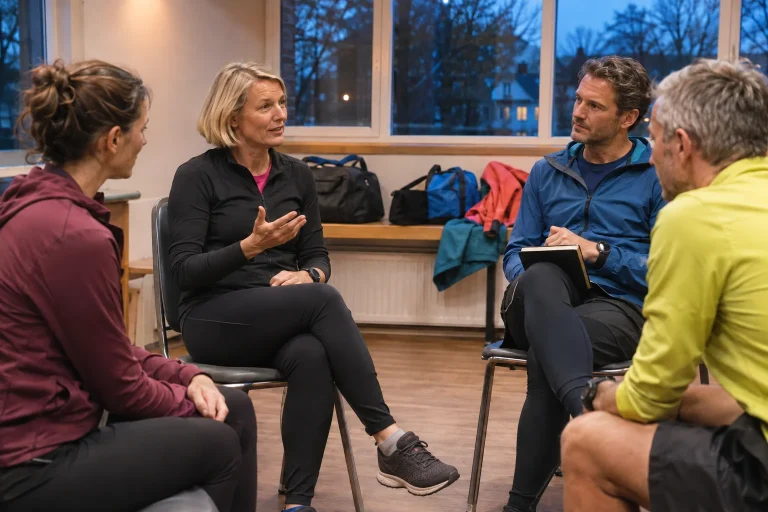
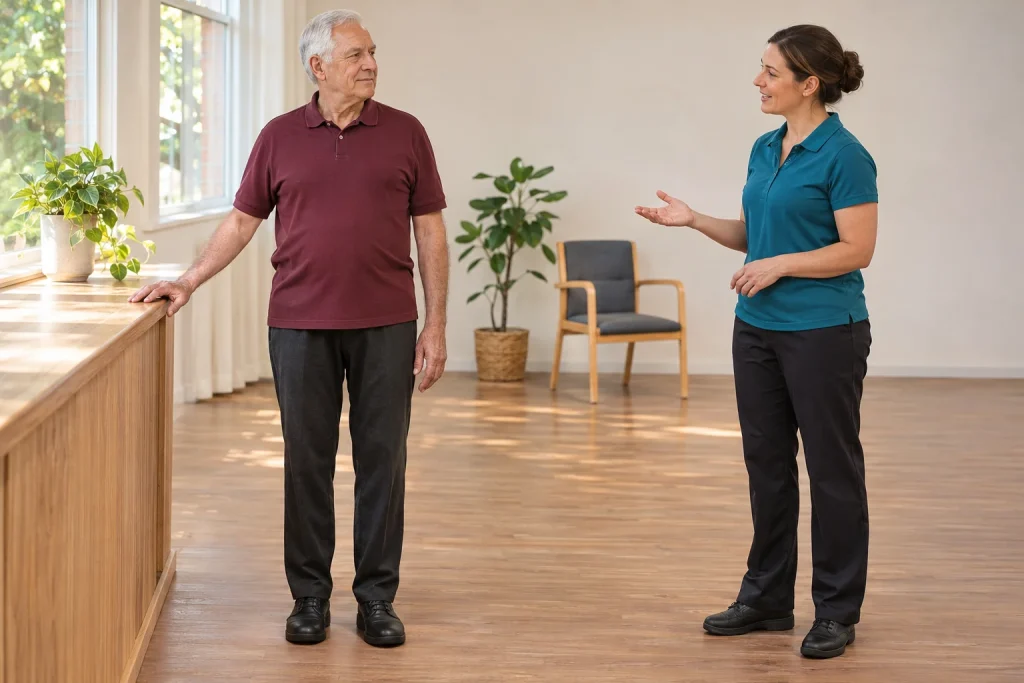
According to the definition in the NICE falls-prevention guideline, a programme may be supervised when a trained helper or professional has regular contact with the participant, assesses execution, corrects it and adjusts tasks when necessary. Every movement need not be directly observed. Individual, group, in-person and online arrangements may all have a role in the particular situation.
This is an important distinction for someone who fears support means losing independence. There can be independent parts clarified beforehand alongside recurring discussions. At other times, more direct help is warranted. Programme quality is shown not only by how many minutes someone watches, but by how new information shapes the next step.
Do not therefore automatically equate supervision with coaching encouragement or medical monitoring. A running coach, physiotherapist and other exercise professional may have different tasks, as may the service’s framework. At enrolment, make clear who is responsible for what, what they are qualified to do and whom they involve if the situation exceeds their competence. Actual operation matters more than the name.
 Enlarge image
Which help are you seeking for which obstacle?
If the main difficulty is learning a new task, demonstration and individual feedback may matter most. If everyday movement has changed, appropriate professional assessment and related goals may come first. If several conditions or care plans interact, coordination may also be part of creating any usable activity framework at all.
| What you experience | The question about support |
|---|---|
| I do not understand how to perform an assigned task. | Who can demonstrate it and check my own execution? |
| There is a new difficulty with everyday walking. | What assessment is needed before an appropriate programme? |
| Several recommendations are difficult to reconcile. | Who can help make one shared, understandable and manageable plan? |
The table is an organisational aid, not a referral algorithm. Real situations are more complex, and these areas can overlap. Still, starting with a specific obstacle is more useful than simply saying, “I am older, so I must need supervision.” Naming the personal problem also helps avoid paying for a service that does not provide the very support you need.
Everyday independence can be the programme’s goal too
Running can be a strong motivation, but every initial goal need not be expressed in kilometres. If safely leaving the house, reaching the usual shop or organising a longer errand is currently difficult, these are meaningful goals. They are not tasks of lower rank than sport, but movement situations important in your own life. A programme can offer measurable, understandable content connected to them too.
The NICE guideline considering multiple long-term conditions treats personal goals and the burden of care as parts of a plan. A new activity programme is not better simply because it adds another compulsory appointment to the calendar. It is useful when it supports important activities and remains manageable alongside travel, other treatments and family responsibilities.
Put into your own sentence what you would like to regain or make easier. Instead of “better fitness”, it may be more precise to say you want to reach a nearby park without rushing or understand how to perform a particular independent task. This does not mean abandoning a running goal. It shows which intermediate task has genuine meaning for you.
What can regular feedback offer?
Instructions remembered at home may differ from the movement actually performed. Regular contact provides an opportunity to notice this and avoid repeating a misunderstood task for weeks. Useful feedback is specific: what should change, why, with what help and how you will check whether the change works.
Making a task easier can also be progress in learning. If a complicated version leaves you rushing to follow instructions, a simpler option may make what needs practice clearer. Progress is not always another increase in difficulty. It can mean clearer execution, a more suitable environment or understanding when to stop and report something.
Feedback must also accommodate your experience. A new symptom after the task, or difficulty fitting everyday activities into a programme day, is relevant information. The aim is not to complete the plan at any cost. What matters is making an appropriate next decision from the difference between the plan and the real situation.
What does research on a structured programme show?
The original randomised trial called LIFE followed 1,635 less active participants aged 70–89 with functional limitations who could nevertheless walk four hundred metres at entry. The structured activity programme included both centre-based and home components. In the study, it was more favourable for preventing the development of major mobility disability than the comparison health-education programme.
The opportunity for organised support with several components is worth noticing in this study. It did not examine whether someone immediately after illness should begin jogging, and did not provide a running plan for every seventy-year-old. Participants’ starting condition and the programme’s own framework are important parts of the finding. Copying a few exercise names cannot turn the research programme into an individual prescription.
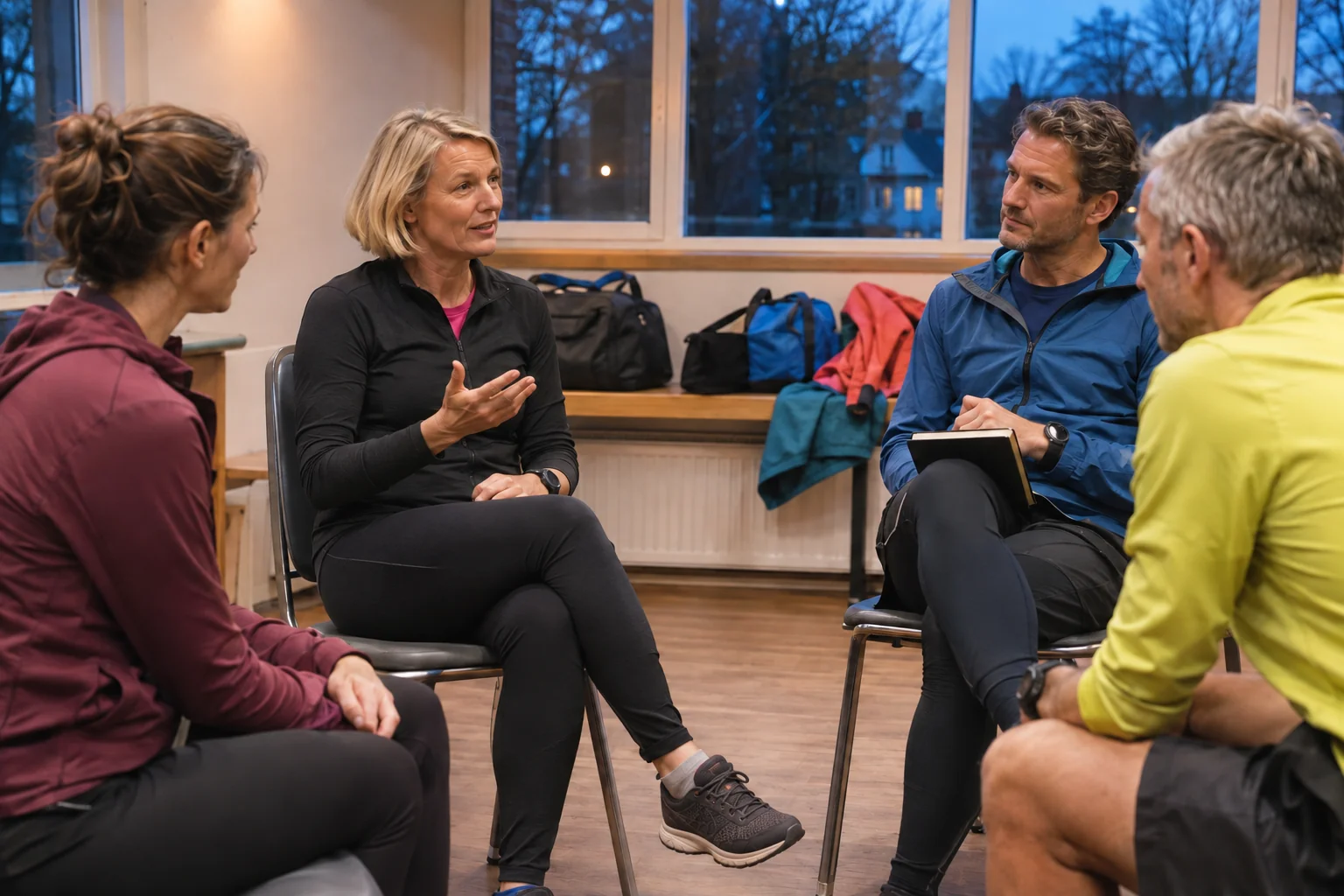
It is instructive too that support and independently performed parts could appear together. These are not necessarily opposites. The question concerns appropriate tasks, contact and review, rather than someone standing beside you every moment. Your own programme’s details must nevertheless be developed for your individual situation, not by following another group’s research timetable.
 Enlarge image
How can help fit into your day?
Consider the whole occasion when choosing. Travel, changing, waiting and returning home may take more time than the class itself. If you also attend other care that day, report that burden. A theoretically good time not working in your actual routine is not failure; the organisation needs adjustment too.
Online follow-up brings specific conditions: what can the professional actually observe, what is the space like and what happens if the connection fails or symptoms occur? A video call is not automatically suitable for every situation. Technical access and individual suitability are different questions. Understand the framework for screen-based support just as you would for a session in a room.
A family member or running companion can provide valuable help with travel, remembering and shared organisation. That does not automatically make them the programme’s professional leader. Clarify what you wish to share and which support you request. Help supports independence when it makes your own choices more feasible, rather than deciding everything for you.
Give the independent part a clear framework too
If the programme includes home tasks, know which you can do alone, in which environment and which need direct help. Half an instruction recalled from memory is an uncertain foundation. Ask for a clear, accessible description or a demonstration after which you can explain the task in your own words. Checking understanding is not an examination, but prevention of misunderstanding.
Also make clear what to do if something changes. When is the programme leader available, when will the plan be adjusted and which symptoms require another care route? Every everyday uncertainty need not become an emergency, but “We will discuss it next month” is not an adequate framework for every question either.
The path to independent jogging is not an automatic switch after one successful trial. If that remains the goal, clarify the specific content of the next step: which activity follows, with what support and which review? Another form of movement may become more useful along the way. Support’s value is not measured solely by whether running eventually results.
At the start of the programme, you can also agree when to review the amount of support. Independence need not be tied to a calendar deadline, but the framework should not remain unchanged without explanation either. Which particular task do you now understand and perform appropriately? Where is help still needed? What has changed in your own goal? These questions may show that less, different or continuing regular contact is useful. Reducing support is not a reward; maintaining it is not punishment. Review aims to match current need with the programme while leaving room for everyday independence.
Sources
NICE NG249: falls prevention, definition of supervised programmes and individual adaptation; NICE NG56: personal goals and care burdens with multiple long-term conditions; Pahor and colleagues: LIFE randomised trial, 2014; NHS: falls and seeking help; NHS: shortness of breath; NHS: fainting. Checked: 21 November 2026. The organisational questions are original illustrative aids, not an individual rehabilitation plan.
How Futószív articles are prepared: our editorial guidelines.