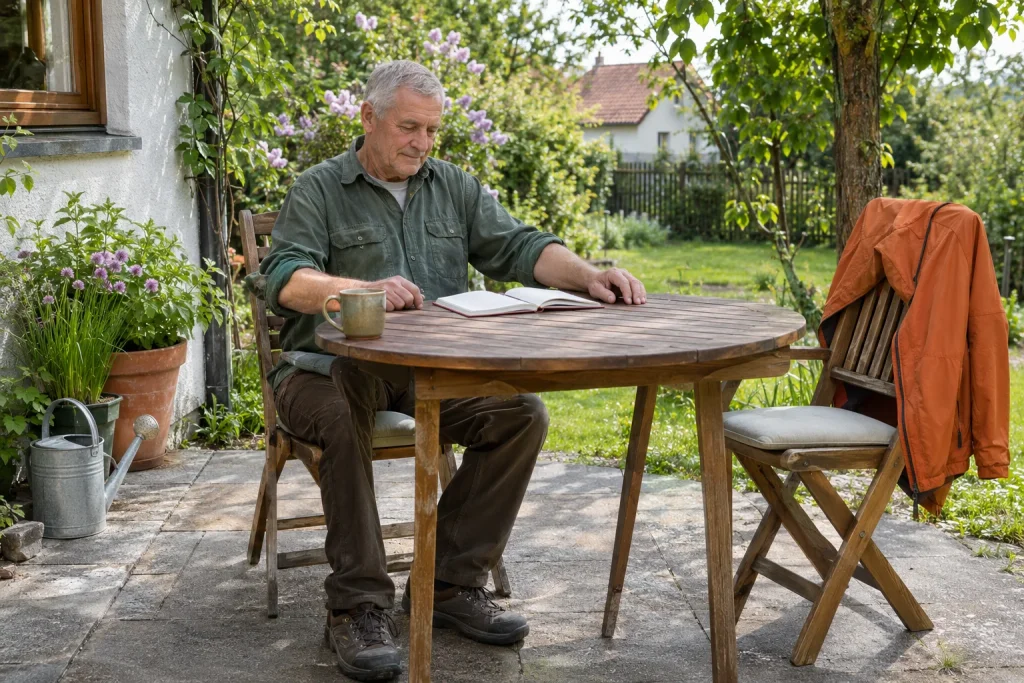
A morning in the garden can easily disappear from your running diary. You did not start a sport mode, stopped to chat during the work, and the planned jog is not until the afternoon. Yet you may have raked leaves, moved soil, made several trips with a watering can or worked in one position for a long time. Your physical day does not begin when you press start on the watch.
As an older runner, include garden work in your picture of the whole week. This does not mean every weeding session replaces running, or that gardening requires a rest day afterwards. More useful questions are how much work the particular task became, what kind it involved, the conditions and how the day’s activity goal fits alongside it. Start with the actual morning rather than a general gardening label.
Movement around the home is part of an active day too
The WHO overview of physical activity does not restrict movement to organised sport: household and other daily activities can also count. Running is therefore part of a larger picture. This matters particularly when the sporting calendar says easy day but several physically demanding tasks accumulate within it.
The difference becomes visible in planning. A morning watering a few pots on the terrace differs from moving a whole pile of branches between parts of the garden. Both can be worthwhile activities, but need not be assigned the same effect. The way the task unfolds says more about the day than its name.
If gardening brings enjoyment, order or company, that need not be converted into sporting value either. It can remain an activity with its own purpose. Weekly running arrangements simply need to know about it: when it happens, what work is expected and how flexible it is. You then avoid discovering afterwards that a supposedly spacious day became one of the week’s busiest.
Three separate questions: continuous movement, effort and tiredness
The CDC guide for older adults distinguishes several forms of activity and includes gardening examples. One activity can have several components. This does not mean all the time spent in the garden automatically provides an equivalent, complete programme of every activity type.
Raking may include longer periods of continuous movement. Moving a container full of soil is more of a separate task requiring exertion. Detailed work in an uncomfortable position for a long time can leave you tired without continuous, steady aerobic-type movement. You need not convert these into one another to take the day seriously.
The NHS includes digging and shovelling among activities requiring muscular strength. Nevertheless, we do not automatically call all gardening a strength programme covering every major muscle group. The task, resistance and way it is performed matter. Do not abandon an individual exercise programme simply because you did some work in the garden that day.
Hours in the garden do not convert into exact running kilometres
A simple conversion is tempting: a morning digging might equal a specified number of kilometres, and a watering can a few strength repetitions. Such numbers are easy to handle but misleadingly simplify your day. Stops between tasks, ground, tools, carrying and working posture do not form one shared route.
You can still add a brief note in your own words to the running diary. For example: “Longer garden work this morning, lots of moving around and several carrying tasks; reviewing the afternoon plan.” This is a practical reminder, not a physiological measurement. It requires no calorie estimate or assumed precision for a number whose personal meaning you do not know.
An incomplete watch entry does not erase the work either. A display showing little movement does not remove what happened in the garden from your day. Equally, a high activity total does not answer on its own how to handle the evening run. Allow your circumstances a place alongside device data.
 Enlarge image
Put the task in the calendar before it happens
Some seasonal work is foreseeable. You may know that help arrives at the weekend, fallen leaves need clearing, or tomorrow’s weather makes a larger task necessary now. Give garden work the same visibility in the weekly plan as shopping or a shared outing. It need not be glorified as training, but represented as real time and work.
| Planned task | What may matter for the running day | Possible practical arrangement |
|---|---|---|
| Brief watering on the terrace | Little travel and easily interrupted work | It can remain a separate daily task without a major conclusion. |
| Longer leaf collection in several garden areas | Frequent movement between places and longer time outdoors | Review the running plan and other tasks together. |
| Moving soil or large containers | Carrying and subtasks requiring distinct effort | Divide the work in advance or ask for appropriate help. |
The table is neither a workload classification nor a safety rating for the tasks. It shows that the same word can conceal different days. If no substantial adjustment is needed, do not manufacture a problem. If the two tasks are crowded together, however, the calendar gives you room to choose before setting out.
Let garden work change too, not only running
The sporting plan is often the only flexible element while household work appears an unchangeable duty. Examine the other side too. Must everything really be finished in one morning? Can the task be split across two days? Would part of it benefit from help, another tool or a separate time? These questions are not judgements on diligence.
The work sequence often contains simple organisational decisions. Do not let tools already laid out or the remaining pile automatically determine how long you stay outside. Identify a subtask that can be completed, then review the situation. Repeated interruptions need not spoil the morning: they can be a deliberate part of the original plan.
Putting equipment away is still work. If you define the morning’s end only as completing the main task, carrying things back, tidying and preparing for the next activity can disappear. On a shared gardening day, agree who returns what and how long they can help. The run then is less likely to begin after an unplanned final round.
Sometimes conditions change more than the work itself
The same task occurs differently on a cool morning and a hot afternoon. The CDC information on heat explains that older adults may be more sensitive to heat exposure, with illnesses and medicines also contributing. Gardening and running may both contribute to time in the heat on the same day.
Planning therefore includes shade, the possibility of returning somewhere cooler and the weather forecast. Work that ran long in the heat should not be followed by insisting the run must happen at its original time at all costs. Review the entire day. Individual fluid guidance, particularly with fluid restriction or diuretics, cannot be replaced by a general recommendation in litres.
An autumn garden may present other obstacles: wet paving, an unpacked hose or earlier darkness. Check the working environment and later running route separately. Equipment left in the garden need not become a movement challenge; tidying up or using another passage may be simpler. Adapting the environment often helps more than rushing.
What should happen to the planned afternoon jog?
First identify the run’s original purpose. A social meeting, calm outdoor movement or a specified training task? Knowing the purpose reveals several modifications. A shared meeting might remain a shorter, easily adjusted outing if appropriate to your condition. At other times, moving the sporting session fits the day better.
Both “I have already moved enough” and “I have not trained yet” may say too little. The first does not explain which movement is missing or what you want; the second overlooks the morning. Gardening need not be counted as running to modify the running plan. The activities can differ while being performed by the same person on the same day.
New pain, dizziness, illness or strikingly unusual breathlessness is a separate question. Do not relabel these as “pleasant garden tiredness”, or investigate their cause by running. Severe chest pain, fainting or serious breathing difficulty requires urgent help. General practical flexibility does not override the need for care arising from symptoms.
 Enlarge image
Two imagined Saturdays, two sensible decision situations
In the first illustration, the gardener completed the usual brief morning tasks, went indoors several times and still has unhurried time in the afternoon. There are no new symptoms, and the planned shared activity follows an easily shortened route. There is no need to cancel automatically simply because of the word gardening. The decision remains tied to individual circumstances.
In the second, also fictional example, tidying the yard unexpectedly ran long. Help left earlier, the person finished the rest alone and the weather became warmer. Preparing for the afternoon run would mean rushing, with little time before a family evening. Modification already has a practical reason; a sporting performance is not needed first to prove the day really became too full.
Neither example is a medical decision rule or universal time limit. The difference is that the second person’s day changed from the original plan. A flexible plan notices this. Every postponed run need not be made up the next day, since that can simply push crowding into the next part of the week.
Carry a few useful observations into next week
At the day’s end, you do not need a detailed household workload balance sheet. Retaining which tasks regularly ran long, what needed help and when unhurried space for sport remained may suffice. If the garden requires many tasks during a particular period, include this in next week’s arrangements beforehand. The aim is better timing, not retrospective self-criticism.
Share specifics with family or running companions too: “There is a larger gardening job on Saturday morning; let us confirm the afternoon time later.” This is easier to handle than last-minute uncertainty. Asking for help need not wait until complete exhaustion either. Dividing work is everyday cooperation, not a judgement on your achievements as a runner.
The garden thus becomes neither invisible background work nor a miracle workout replacing every sport. It gains its own place in the day: useful, enjoyable and physically meaningful activity whose varying demands you consider. Running remains part of a plan with room for your actual life as well as the kilometres entered in advance.
Sources
WHO: definition of physical activity; CDC: forms of activity for older adults; NHS: activities requiring muscular strength; CDC: heat and older adults. Checked: 21 November 2026. The daily-schedule examples are editorial illustrations.
How Futószív articles are prepared: our editorial guidelines.