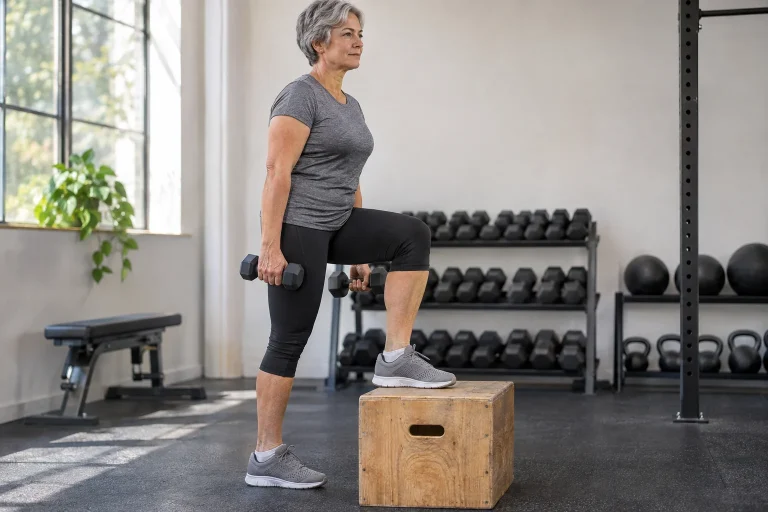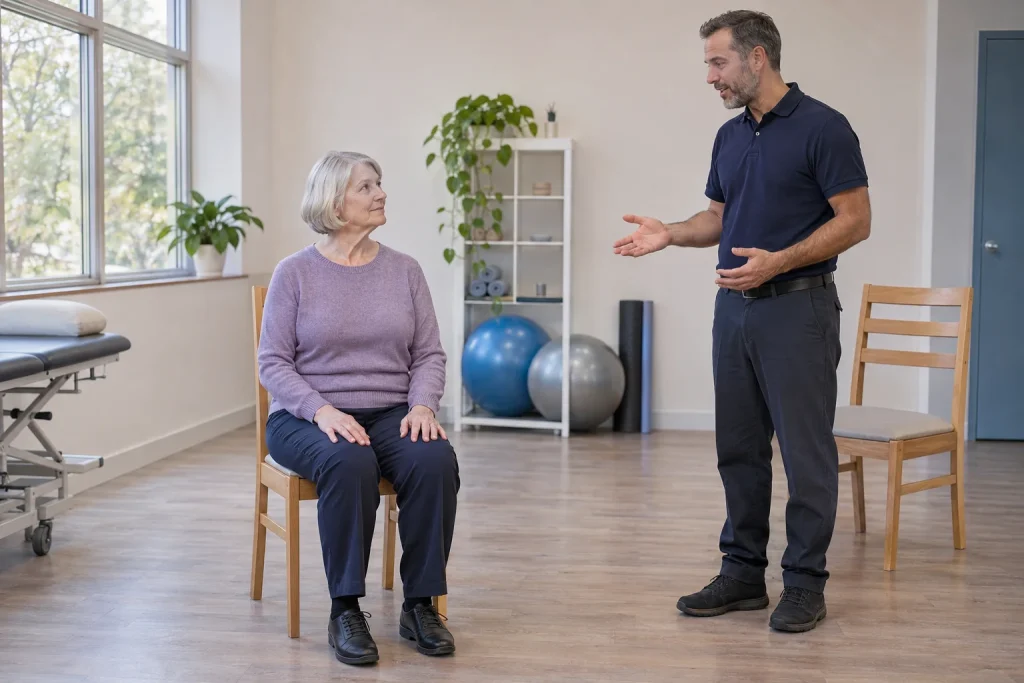
Getting up from a chair is an everyday movement: you rise from the dining table, leave a bench or stand in a clinic. Under specified assessment conditions, the same movement can also provide information about lower-limb function. This does not turn every chair-stand video into a healthcare assessment, and no single result summarises your abilities as a runner or in daily life.
An assessment’s purpose, execution conditions and professional interpretation together determine its value. You do not need to try it against the clock at home to place yourself in an age-group table. If getting up normally is painful, makes you dizzy or involves a new need for help, you can report that in its own right. The symptom’s importance does not require proof through a competitive test.
What is the purpose of the thirty-second chair-stand test?
The CDC STEADI 30-second chair-stand assessment sheet describes a specified procedure to assess leg strength and endurance. It is not a general sporting competition. The document specifies equipment, instructions, counting conditions and someone present for safety; the result must be interpreted with these.
The test’s name matters because the everyday observation “I stood up a few times” is not necessarily the same data. When a professional chooses this procedure, they seek information for a particular question. The result can be considered alongside other assessment and history information. It does not compress a judgement of the whole person’s worth, sporting past or independence into one number.
As a runner, it is easy to see every measurement as a performance indicator. Here, however, we do not assume that more repetitions mean a faster race time. Clinical and sporting purposes differ. The test may help understand a function without automatically answering whether a particular distance, route or type of exertion suits an individual.
The chair and surroundings are not incidental props
A soft sofa, low bench and stable assessment chair can present different tasks. The starting position and available support differ. Comparing numbers obtained in a kitchen, during a visit and in a clinic as identical measurements is therefore unhelpful. A difference may arise from conditions rather than a sudden change in ability.
The CDC procedure specifies a chair type and seat height. We mention this not to encourage constructing a replica course at home, but to show why standardisation matters. Assessment conditions are not an afterthought that can simply be omitted beside the number. For follow-up, the professional also needs to know under which conditions the result was obtained.
Environmental safety is also part of the situation. A moving chair, cramped space or slippery surface does not improve the assessment. In professional evaluation, difficulty is not valuable because as many obstacles as possible are added. The spectacle of an online challenge and the reliability of an interpretable measurement are different considerations.
Using your hands is not a moral issue
In everyday life, resting your hands on the arms or seat may be natural. A particular test version may instead specify how arms can be used and when to stop. The situations serve different purposes. A protocol not allowing the same help does not mean that everyday support use is a bad habit or something shameful.
Changing the original procedure’s conditions may produce different data. If standing involved assistance, record that as part of the measurement. Do not conceal the difference to obtain a better number. Equally, professional interpretation should gather appropriate information about real function rather than reward the person’s “cleverness”.
At home in particular, you need not remove your usual support for a video. If how you stand up has changed, discuss it within your actual circumstances: which chair is harder, when more help is needed, and whether pain or dizziness occurs. These are valuable observations even without timing.
 Enlarge image
What does a reliable assessment mean?
An original study from 1999 examined repeated measurement of the thirty-second chair stand and its relationship with another lower-limb strength measure in community-dwelling adults over sixty. The research provided information about the method’s usefulness in a particular participant group. It did not undertake to resolve every question of suitability for sport from one number.
In plain terms, reliability also concerns how consistent a measurement is under appropriately similar conditions. This differs from what we want to predict from the result. A measurement may help track a particular function while being unable to answer another, much broader question with certainty. Confusing these concepts produces exaggerated health claims.
An everyday analogy is simple: a tape measure accurately showing a chair’s height does not tell you whether you enjoy sitting on it. Clinical measurement is naturally more complex, but matching the question and tool is just as important. Relate the chair-stand result to what the assessment was actually used for, rather than every available sporting label.
A small change does not always mean an entirely new condition
If assessment is repeated later, the similarity of the chair, instructions and situation can matter. Results obtained under different conditions make it harder to identify what actually changed. Every difference need not immediately prompt a major explanation. One purpose of professional follow-up is precisely to interpret data alongside measurement conditions and daily function.
A study in participants with early knee osteoarthritis examined practice effects as well as measurement reliability. The lesson is not to repeat the task many times at home. Rather, the method’s characteristics matter when interpreting change; a larger number cannot always automatically be called an overall improvement in health.
We do not derive an improvement threshold for every reader from that particular study group. Individual assessment may also consider whether an everyday activity has become easier, whether symptoms have appeared or what help is needed. The measurement and changes experienced in life can sit alongside each other; neither must replace the other in every situation.
An age table is not a personal prediction of the future
Comparison values on assessment sheets relate to a specified procedure. Comparing them with a task performed differently means the basis already differs. The age row also does not encompass your entire medical history, daily function or conditions during assessment. Do not derive your own lifespan or sporting destiny from a table.
A good result does not override a new symptom either. If you become dizzy when standing, a previous favourable value does not remove the need to understand this. A lower number, conversely, does not mean seeking appropriate movement or help is pointless. The assessment aims to support a useful next decision, not rank participants permanently.
The NICE falls-prevention guideline builds on assessing several individual factors. A chair-stand result may be one piece of information among them in a particular situation, not the whole story. This professional perspective is easily lost if all that remains of the test is a shareable number and an age-group label.
You can describe specific examples of everyday standing up
Think about chairs you actually use. Is rising from the dining chair comfortable but getting out of a deep armchair harder? Do symptoms occur on starting, or more when you must hurry? Naming the difference does not replace assessment, but provides a clearer picture of your daily situation. The aim is not repeatedly to test every piece of furniture.
| An observation you can report | Why is it useful? |
|---|---|
| I need more support from certain seats. | It identifies conditions and a changing need for help. |
| New pain or dizziness occurs when I stand. | It keeps symptoms separate from repetition count alone. |
| Other tasks have become harder too. | It draws attention to broader changes in daily function. |
If you already avoid a task because of difficulty, that is important information too. You need not force yourself to perform it first before reporting the change. Individual assessment can clarify function and symptoms. An online competition, by contrast, often rewards precisely the disregard of limits.
 Enlarge image
An assessment may lead to an individual task, not one compulsory routine
If evaluation indicates movement or other help, understand the next step’s purpose. Do you want to rise more easily from your own chair, retain a daily task, or progress through broader rehabilitation? Different goals may involve different programmes. The same task need not be chosen for everyone simply because the assessment was shared.
Clarify the appropriate task’s conditions too: which equipment, what assistance and which symptoms require modification. These belong to an individual plan. The methodological background described here does not imply a home repetition count or loading prescription. Learning about a test is not the same as learning a treatment.
As a runner, improvement in everyday function can be valuable even without immediately appearing in sporting results. Goals may connect, but every change need not be redirected towards a start line or race time. Individual activity planning can include what simply makes your day more workable.
What should you retain from the result?
Alongside the number, keep clear the assessment’s name and purpose, important conditions and how it was interpreted in that situation. Ask for an explanation if something is unclear. You need not turn a short results table into your entire healthcare story on your own at all costs. Appropriately recorded data and personal background together provide a foundation for follow-up.
You do not have to join challenges shared on social media. You can still take your strength, daily function and health seriously without timing your chair stands. If a professional uses the assessment, it should have its own purpose. If you notice a change in daily life, you can report it without a test result.
The chair stand thus retains its useful place: information obtained from a movement under specified conditions. It is not a judgement on your age, a home competition or permission to run. Good interpretation helps identify what follows from the data in your situation and what they cannot establish.
Sources
CDC STEADI: 30-second chair-stand assessment sheet; Jones and colleagues: original study of the method; Gill and colleagues: reliability and practice effects in knee osteoarthritis; NICE NG249: multifactorial falls-prevention assessment. Checked: 21 November 2026. The article explains methodology; it is not home test instructions or an individual exercise programme.
How Futószív articles are prepared: our editorial guidelines.