Perhaps, since a previous fall, even the thought of setting out makes you uncertain. Or you have not fallen, yet avoid more and more situations: a crowded walk, an entrance with steps or your usual outdoor outing. You need not trivialise the worry, nor permanently hand every movement decision over to it. The aim is for appropriate information, surroundings and support to accompany your own choice.
Fear of falling and a new physical symptom can coexist. If dizziness, weakness, pain or repeated loss of balance occurs, do not automatically call it mere anxiety. Current illness or injury may require appropriate assessment. The following ideas concern organising everyday choices; they do not replace individual healthcare or psychological care.
Fear is easier to understand through specific situations
“I am afraid of moving” can conceal very different situations. A dark pavement unsettles one person; another worries that the group will keep going if they stop. You may move comfortably at home but fear being unable to find help somewhere unfamiliar. Naming the details is not about diagnosing yourself, but making the organisational question visible.
Choose an activity you would like to do but currently find difficult. What attracts you, and exactly which part do you fear? A location, a movement, being alone and meeting other people’s expectations are different answers. It is also acceptable not to be able to formulate it precisely yet. Your concern can be taken seriously without trying a dangerous situation.
The Leeds Teaching Hospitals NHS information describes how concern about falling may relate to avoiding previous activities and changes in confidence. Do not read this as the same story for everyone. It can instead help recognise that changes in participation and feeling safe are important experiences alongside the physical incident.
Reducing risk and retaining independence are compatible goals
The decision is often presented as two extremes: do everything exactly as before, or give everything up. Actual organisation can offer more options. Another entrance, a quieter time, appropriate help or a different activity may preserve something of the original purpose. Consider these alongside individual health circumstances, rather than turning them into a compulsory test of independence.
Independence does not mean having to solve everything without help. It can also mean deciding whom to ask and what support you want. A companion might help with access or clarify the outing beforehand. They do not then have to choose every route for you, and a general family rule need not replace your wishes.
If individual assessment indicates a restriction or need for help, choices can remain within those boundaries. Which suitable location do you prefer, whom would you like to go with, and what activity do you want to join? Not every detail is freely negotiable, but allow room for those that are. Support aims at meaningful participation, not fulfilling a sporty role imposed by others.
Do not tie the desired experience to one difficult route
If you want time in the park or a meeting with a friend back, name that separately from completing the old loop. You may miss only part of the previous outing. This makes it easier to find a present-day option that does not immediately demand accepting every former condition. Another entrance or a shorter time together can preserve an important part of the original intention.
Actually inspect the alternative or clarify it with appropriate help, however. Somewhere advertised as calm may still have steps, difficult access or a crowded entrance. Practical information has value when it relates to your circumstances. Another person finding the loop easy is not enough, and their experience need not be binding on you.
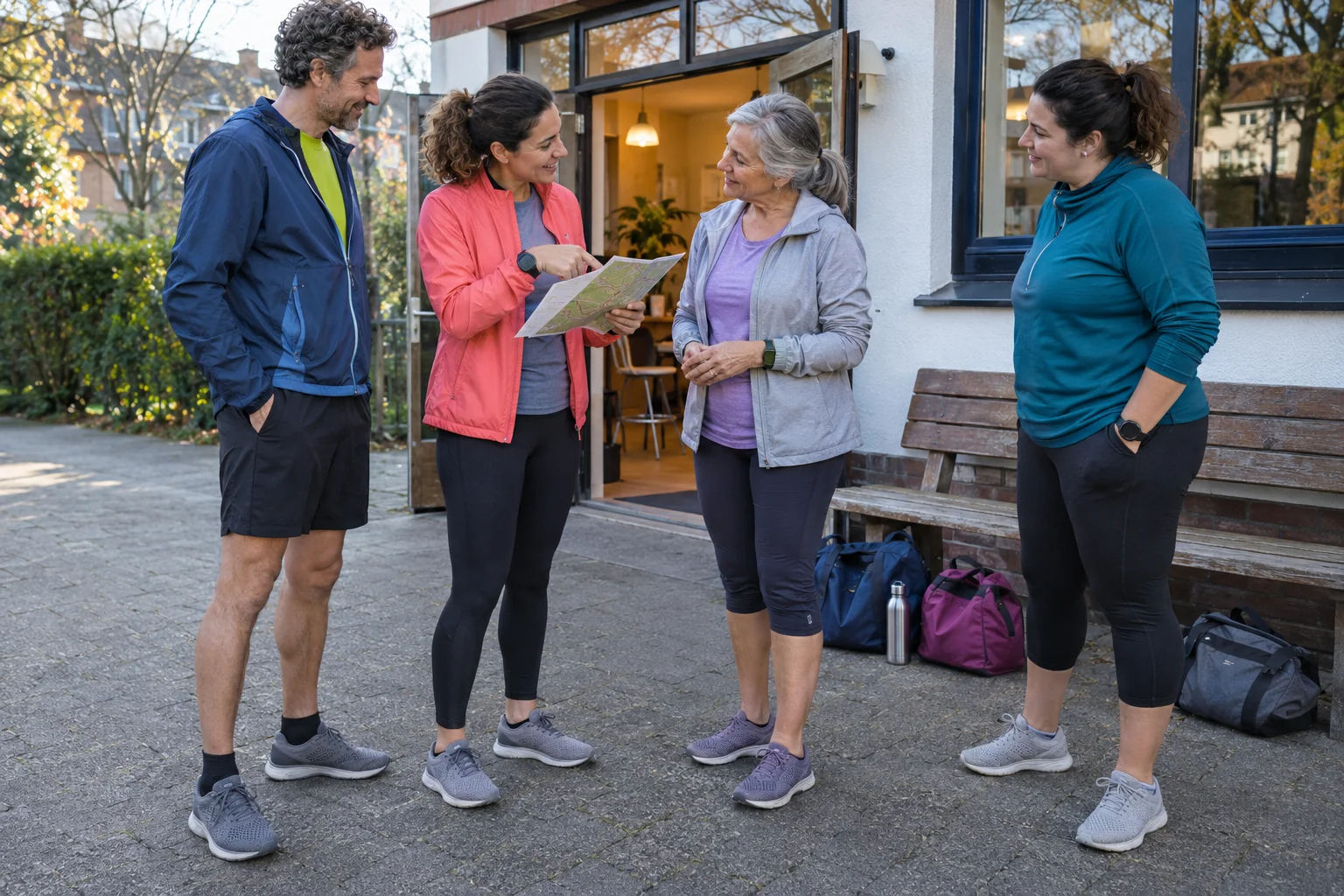
In an illustrative situation, someone wants to join a shared walk again, but the previous group always sets off in a large crowd. The purpose can remain if they first meet one familiar companion in appropriate conditions. This is not an anxiety-treatment protocol to apply at home. It is an organisational option beyond the entire old programme or complete cancellation.
 Enlarge image
Agree beforehand how the outing can change
Not everything needs a final decision at the start. It helps, however, to know how to stop, shorten the activity or continue meeting elsewhere. Clear advance arrangements can reduce pressure to catch up with others in an uncomfortable moment or unexpectedly explain your decision. The right to stop should be more than a theoretical concession.
| Detail to clarify in advance | Specific agreement |
|---|---|
| Access | Where will you meet, and can you reach the place calmly? |
| Stopping | How will you indicate needing a break or a change of plan? |
| Shortening | What happens if you want to finish earlier? |
| Getting home | Whom can you turn to, and what option is available? |
The discussion does not establish that every situation is harmless. It helps ensure that the current decision is not rushed. If serious symptoms appear, asking for help matters more than further organising the outing. If you simply choose a different way to participate, you need not turn it into a story of personal failure or permanent retreat.
A companion should ask before helping
Well-intentioned help can still feel uncomfortable if someone suddenly takes your arm or decides when you leave. Explain in advance what support would feel welcome. You may want nearby company but physical assistance only when specifically requested. In other cases, you already have an individual assistance or equipment-use plan that your companion also needs to follow.
Your companion does not need to repeat that you definitely will not fall. They cannot give that guarantee. A specific practical commitment is more useful: waiting, helping you reach the exit, or staying with you if plans change. Reassurance then consists of an understandable role rather than an unprovable promise.
Let both your concern and your independent intention be present in the conversation. Gratitude does not require accepting every offer of help, and a supportive person need not solve every health question alone. If the situation extends beyond organising an outing together, appropriate professional help can be involved. This does not mean family or friendly support has failed.
Appropriate help can be more than another exercise routine
Fear of falling may involve physical unsteadiness, a previous experience or an everyday obstacle that makes participation difficult. NICE NG249 supports an approach adapted to individual factors. The guideline also indicates that cognitive behavioural interventions may be considered in certain situations when exercise alone does not adequately help concern about falling.
This should not be interpreted as meaning the problem is only a matter of thinking. Psychological support does not exclude investigation of physical causes, and appropriately selected exercise does not replace every form of emotional help. Clarify the purposes and roles of possible support separately. You need not conceal one part of your story for the sake of a single explanation.
You can help planning by explaining what you have stopped because of the worry and what you miss about it. This could be travel, social meetings or sport. Naming the specific loss can provide a far more personal goal than generally being told to be braver. Appropriate help is not identical for everyone.
What does research on a supported programme show?
A randomised trial examined a multicomponent cognitive behavioural group programme in older people living in the community. Improvements were observed in some outcomes, but later follow-up did not show the same differences across every outcome studied. Fear, activity avoidance and actual daily activity are not the same measure.
This distinction matters in everyday life too: someone may feel calmer while the number of accessible activities has not yet changed; another resumes an activity while still needing support. The research does not establish that one online thinking exercise solves the problem for everyone. We provide neither a home-treatment protocol nor a promise of individual results from it.
The study instead shows that organised professional support can exist for this issue, and that goals deserve assessment from several perspectives. The complete disappearance of every worry is not the only outcome that matters. Which activity has become accessible again, how much help it requires and how everyday functioning develops can also be important. Interpret these alongside the individual situation.
 Enlarge image
Make saying no easy within the chosen activity
If you want to join a group, ask about arrangements for stopping, shorter participation and individual modifications. Seek specific practical answers rather than “Everyone is safe here”. Who makes sure participants can speak up, and what happens if someone chooses another activity today? Inclusion is visible in operational details.
You do not need to disclose your medical history publicly to discuss a practical need. Necessary professional consultation is a separate situation. Within a community, it may suffice to say that you currently seek opportunities to stop and an easily adjustable outing. What information you share, and with whom, remains part of your own decision.
Choice does not exist only before departure. What you want may change during the outing, and different participation may suit you another day. Do not attach every positive experience to one completed task. How a programme handles change can reveal more about its usefulness than the enthusiasm of its invitation.
Keep decisions about everyday movement personal
Maintaining activity does not necessarily mean running. It may mean appropriately arranged walking, another activity, or temporarily another way of spending time with people. Personal health circumstances and the desired experience shape the choice together. You need not respond to worry with pressure to prove sporting ability, but your own intentions need not automatically disappear because of it.
In a short review, identify what became more workable: reaching the place was easier, your companion’s role was clearer, or you could change the plan. These are real organisational experiences. If worry persistently restricts your life, or physical symptoms accompany it, appropriate professional support remains important. These are not alternatives to one another.
The aim is not to conquer fear at all costs in one outing. It is to have decisions in which you understand the conditions, can ask for help and retain independent choice. You can then think about movement through your own present life rather than a general role assigned to your age group.
Sources
Leeds Teaching Hospitals NHS: fear of falling; NICE NG249: assessing and preventing falls; Zijlstra and colleagues: randomised trial of a multicomponent group programme. Checked: 21 November 2026. The examples and practical questions are our own editorial tools, not anxiety-treatment or therapeutic return programmes.
How Futószív articles are prepared: our editorial guidelines.