A trail day’s environmental impact begins with route selection. Taking packaging home at the end is not the only thing that matters. Travel, parking, group size, stopping places and the route’s current condition all influence the trace you leave. Deciding these beforehand is generally simpler than finding a new solution to every awkward situation on site.
Thoughtful organisation does not require a detailed environmental balance sheet before every woodland run. A few concrete questions are enough: where and when can we use the chosen path, how do we get there, where does the group fit and what do we change if conditions are unsuitable? The aim is a workable activity suited to local rules and the area’s condition, not an unsupported green label in the invitation.
First check current visitor arrangements
A path shown on a map does not necessarily offer unrestricted access every day. Temporary closure, land-management work or conservation needs can change arrangements. Seek current information from the selected site’s manager and the relevant national park directorate. If several managers are involved, information for one part may not describe the whole route.
The Kiskunság National Park visitor regulations also emphasise designated paths and protecting wildlife. Follow the particular area’s own rules; this article does not provide one access system for every Hungarian woodland. The point is that a landscape appearing suitable for running and a path actually open to visitors are not always the same question.
If a rule is unclear, ask about a precise route and activity. The location, section concerned and planned use support a better answer than ‘can we go into the forest?’ A larger organised occasion may need further arrangements; calling it a friendly run does not replace them. Clarify the actual activity’s characteristics rather than relying on its label.
Match numbers to the place, not only interest
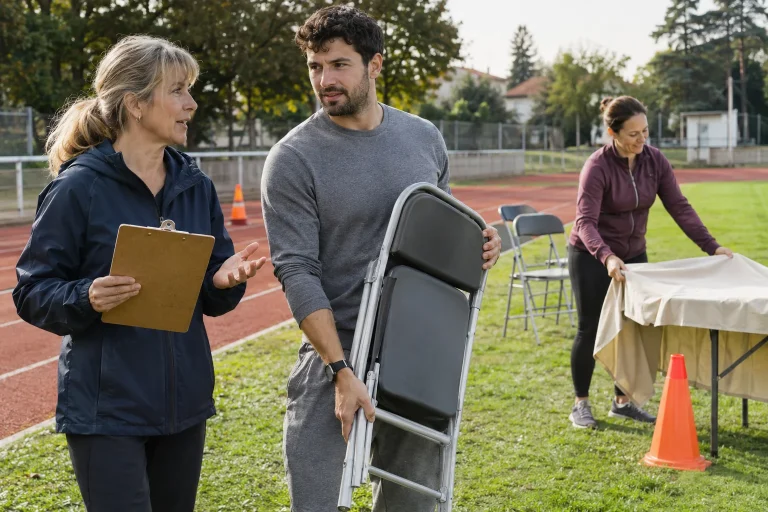
A narrow path, small meeting point or busy lookout may not work equally for two and twenty people. Group size changes waiting, side-by-side movement and stop duration too. If an invitation is open, explain the framework within which the activity can work. Unlimited interest does not automatically mean unlimited site capacity.
The Appalachian Trail Conservancy’s Leave No Trace guide for groups also discusses the connection between group impact and preparation. Detailed rules for the American trail cannot be transferred to a Hungarian area. The planning principle is useful, however: advance participant information works together with choosing a genuinely suitable place for the group.
Splitting into smaller units is not a general exemption from restrictions. Several groups reaching the same sensitive point within a short period still create a combined impact. Use local arrangements and route character as the basis, rather than an administrative solution making the same activity look smaller on paper.
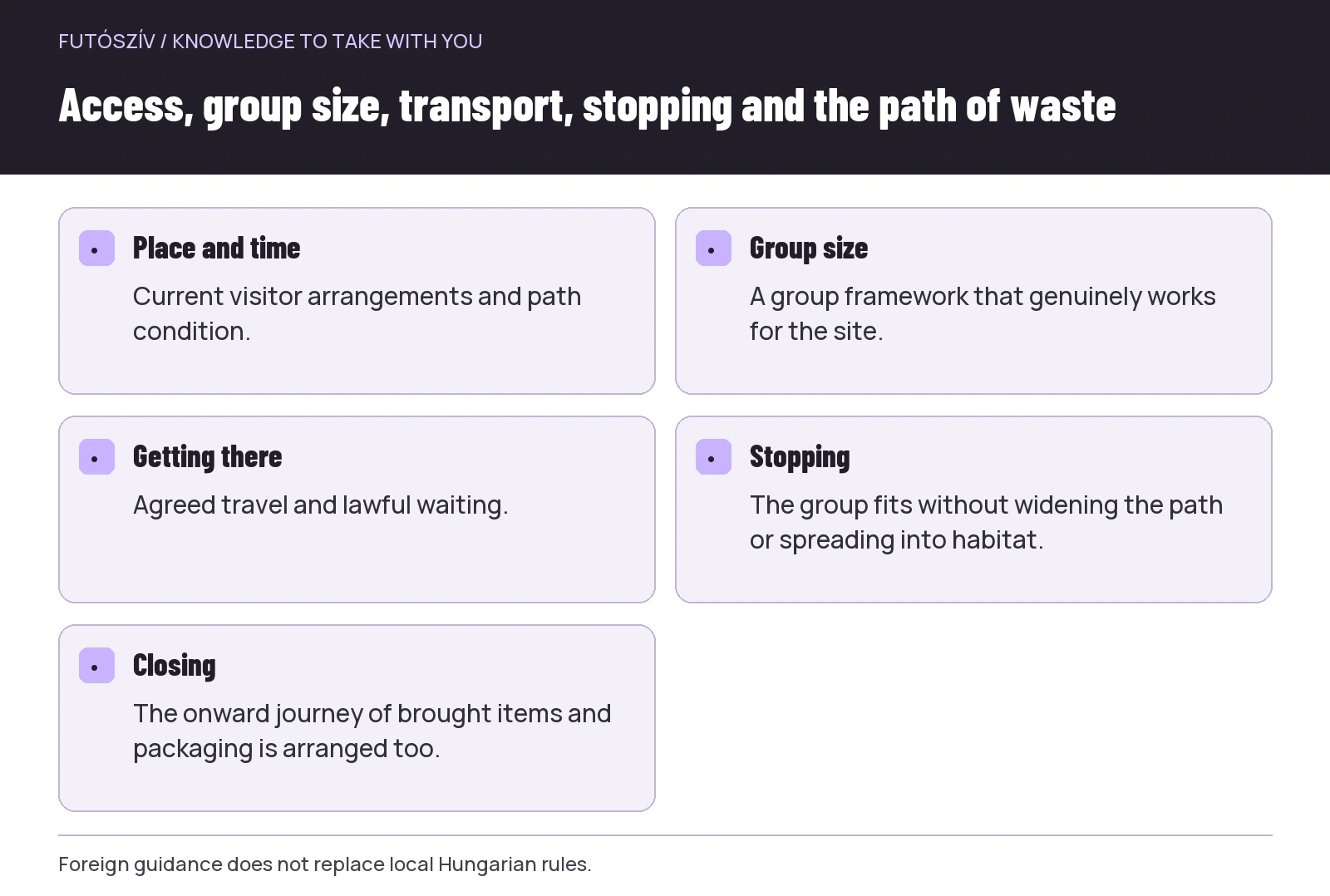 Enlarge diagram
Text version of the diagram
- Place and time
- Current visitor arrangements and path condition.
- Group size
- A group framework that genuinely works for the site.
- Getting there
- Agreed travel and lawful waiting.
- Stopping
- The group fits without widening the path or spreading into habitat.
- Closing
- The onward journey of brought items and packaging is arranged too.
Treat getting there as a shared organisational question
Check for usable public transport, shared travel or a locally accessible alternative. Availability differs between people, so do not judge participants by travel method. Seek concrete options reducing unnecessary journeys and congestion around the meeting point while considering people’s real circumstances.
If cars are necessary, clarify suitable lawful parking beforehand. A full car park does not automatically turn grass, an area in front of a barrier or a narrow roadside into suitable parking. Have another genuinely usable plan: a more distant designated point, different meeting or modified activity. Natural ground should not become an extension of missing parking capacity.
Agree the return journey for shared travel too. If someone wants to leave earlier, others should not discover that only on the trail. A good solution organises the whole day rather than only the number of cars visible on arrival. Without precise agreement, an apparently economical plan can create additional separate journeys.
Choose an activity suited to the path’s condition
On a waterlogged, vulnerable or temporarily unusable section, spreading onto the path’s edges should not be the default. Detouring can create new tracks and wider trampling. If a path is unsuitable for the intended use, choose another checked route or activity. Align the decision with local information and your own safety too.
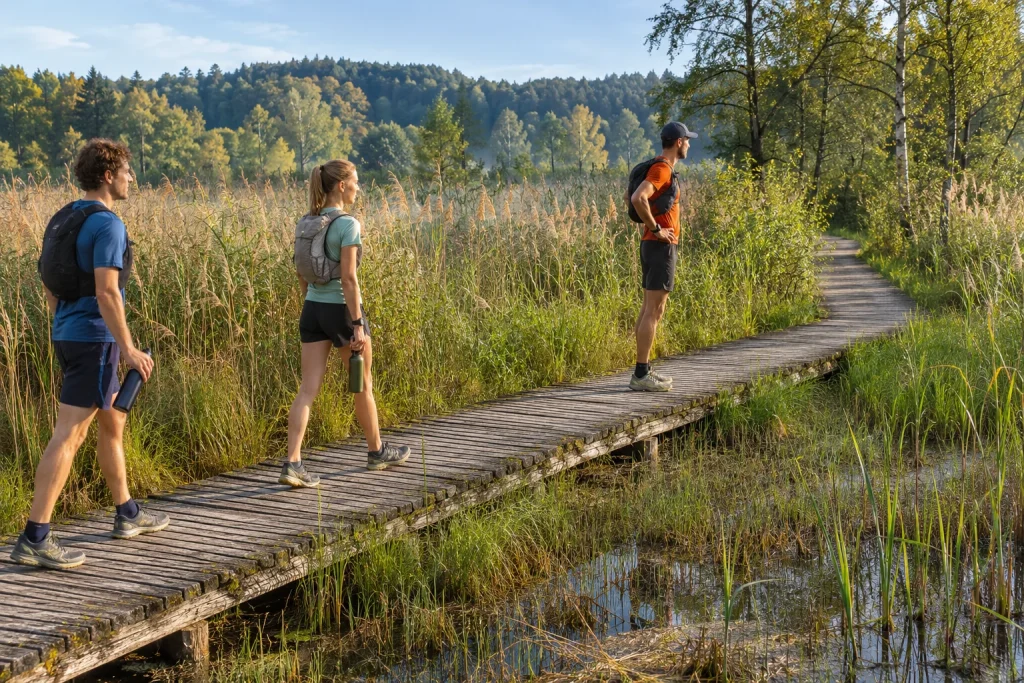
Shortcuts and cutting corners can easily appear while running. A shorter line on the map does not justify leaving the used path. Choose a course you genuinely want to follow and explain to participants why you stay on it. Route shape is more than a timing detail.
Frequent repetition over one small area can accumulate. If using short loops, inspect which sections you repeat and whether they suit that use. You do not need to seek a new untouched place each time; that can increase pressure too. Base decisions on an appropriate existing route and its current condition together.
Make stopping places part of the plan
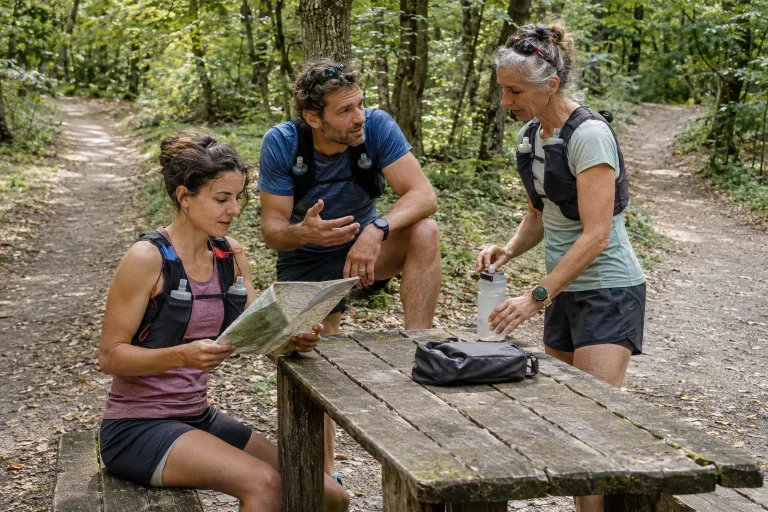
Waiting, photographs and arranging bags may need more space than moving continuously. Choose a point where stopping does not block the path or spread onto sensitive vegetation. The prettiest background is not necessarily the best group location. A more convenient existing rest point can be a better choice.
Arrange regrouping so you do not need to scatter for long periods at every junction. Precise junctions and agreed group movement can also protect the environment by reducing searching and unnecessary departures from the path. That is a practical benefit of orderly organisation, not a guaranteed effect in every situation.
Do not rearrange surroundings for a photograph. Plants, branches, stones and natural details are not personal props. A picture showing nature can work while accepting the place as it is. If a scene requires leaving the path or disturbing the area, choose another picture.
Do not make wildlife follow your own programme
If you see an animal, observe at a distance without disturbance. Do not approach for a better shot or lure it with food. Direct the group’s attention without creating a noisy circle or pursuit. An encounter’s value does not depend on bringing home the closest possible picture.
Vegetation and soil can conceal life not immediately visible. Apparently empty grass is not necessarily a freely available group gathering place. Local visitor arrangements can protect things participants do not know about beforehand. Following a rule does not require first seeing the protected species yourself.
Adapt volume and shared equipment use accordingly. Conversation differs from projecting a loud programme into the surroundings. Other visitors and wildlife share the place. Quieter movement is not a race-discipline issue but recognition that the area is not exclusively the group’s.
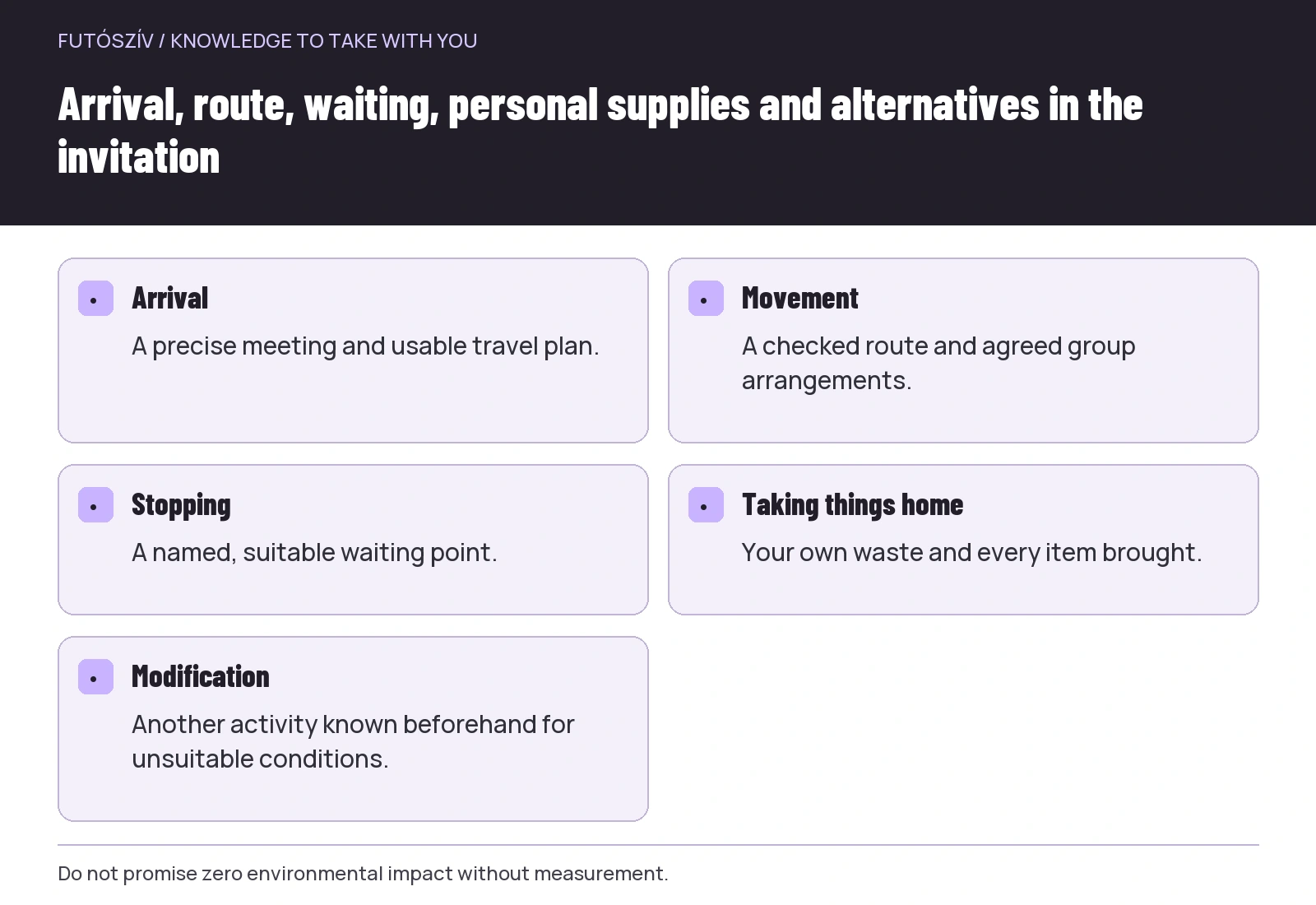 Enlarge diagram
Text version of the diagram
- Arrival
- A precise meeting and usable travel plan.
- Movement
- A checked route and agreed group arrangements.
- Stopping
- A named, suitable waiting point.
- Taking things home
- Your own waste and every item brought.
- Modification
- Another activity known beforehand for unsuitable conditions.
Think through packaging to the end
Choose personal storage that does not easily lose packaging and can close again for taking it home. Empty wrappers, caps and small papers belong to the activity just as much as what you carried full at the start. Instead of assuming ‘there will be a bin’, provide an actual place for your own waste.
Do not automatically treat food scraps as a natural part of the environment. Material you brought remains your responsibility and can affect animal behaviour too. There is no need to cite complicated decomposition times: the practical rule is simple, arrange the onward path of leftovers too. Local waste capacity is not an unlimited background service for a group.
Collecting other people’s waste can be a separate activity with an appropriate framework. Do not handle unknown or apparently hazardous materials through improvised cleaning. Organising your own run does not automatically prepare you to handle everything found. Report the location and problem to the appropriate manager while taking your own waste away.
A few concrete sentences in an invitation beat a green adjective
Describe meeting and travel arrangements, following the precise route, handling personal waste and the possibility of changing the plan. Let participants know beforehand if there will be no improvised external aid station or unlimited bag storage. A clear framework also helps appropriate personal preparation.
| Invitation question | Specific information to communicate |
|---|---|
| How do we arrive? | A usable meeting point, transport and parking framework |
| Where do we go? | A checked route and local visitor arrangements |
| Where do we wait? | A named point suitable for the group |
| What do we take home? | Personal packaging and other brought items |
| When do we change? | An alternative for unsuitable path conditions or restrictions |
Do not claim carbon neutrality or zero environmental impact without measurement. Concrete commitments are easier to verify: agreed shared travel, following an existing path and taking personal packaging home. If an aim is not met, improve the next occasion’s organisation. Precise description is more valuable than inflated promises in community communication too.
A fictional example of a modified trail day
A group plans a run to a popular lookout. Advance checks reveal the intended stopping point is narrow, one section’s current condition uncertain and parking at the meeting point more complicated than expected. They do not assume they will somehow spread out on arrival. They choose another verified route and a more spacious existing meeting point.
The invitation is updated, shared-travel options discussed and everyone knows they will carry their own waste onwards. The lookout is not compulsory, so omitting it does not make the activity unfinished. The social aim remains while the place better fits the actual framework.
Afterwards, they examine which organisational decisions worked. They do not claim the day had no impact. They can state accurately that checking helped them avoid an uncertain section and prevented waiting from spreading onto grass. Those lessons can become useful practice next time.
Make nature’s needs a basic part of the plan
At the end, briefly check for belongings or waste left behind, orderly departure and observations that need reporting to the manager. Retain specific experience for the next route rather than only that the landscape was beautiful. Stopping-place size, transport and path condition all provide usable information.
An environmentally considerate trail day is not a separate side programme. It appears in the same decisions that organise the group: place, time, numbers, route, supplies and alternatives. Planning those together from the beginning makes care for nature part of how the day actually works, rather than an afterthought.
How Futószív articles are prepared: our editorial guidelines.