
Several short loops can make an interesting trail day. You return to the same point, review the plan and only then decide on the next section. This can be particularly practical when group members want activities of different lengths or you want to get to know an area gradually. A central meeting point does not automatically simplify the whole day, however: each selected loop is its own route, with its own access and timing questions.
The guide below explains how to build a day around loops. It does not prescribe training volume or repetitions, or claim a shorter loop is easy in every circumstance. The aim is to make each section’s role, conditions for restarting and arrangements for waiting for others clear. Adapt actual demands and equipment to your circumstances, experience and terrain.
Clarify the central point’s role first
A loop system begins with a place every participant recognises and can lawfully access on the actual day. It might be a designated meeting point or another suitable junction, but do not automatically assume secure bag storage, an open toilet or covered waiting space. Verify any service you rely on separately.
Name the point precisely. People may arrive at different places in a large car park, while ‘the usual spot’ tells a new participant nothing. A human-readable description helps alongside a map link. Preferably use the same name for the start, return and waiting point in every shared message.
The central point is not necessarily a guarded base. Do not expect an unnamed passer-by to take responsibility for bags left there or orderliness in the area. If someone stays, make their commitment specific and voluntary. Others should not assume that skipping the next loop automatically means taking over every bag and organisational task.
Give each loop a separate role and name
Distinguish loops by more than length. One may be simpler to navigate, another contain more climbing and a third feature an interesting environmental detail. A role helps you decide which fits which point in the day. The shortest loop can still be more technical than a longer, wider path.
Use simple names of your own, such as meadow, below-the-ridge and streamside loop, if they genuinely fit the map. Avoid names that could be confused with official trail markings or other routes in the area. Always attach specific route data and a direction to your name. ‘Blue loop’ can mislead where several official blue markings exist.
The Forestry England trail-running guide also presents marked routes and different woodland surfaces. The general lesson here is that describing terrain involves more than one kilometre figure. For your own Hungarian route, check local signs, land-manager information and the actual course rather than adopting a foreign route’s colour code.
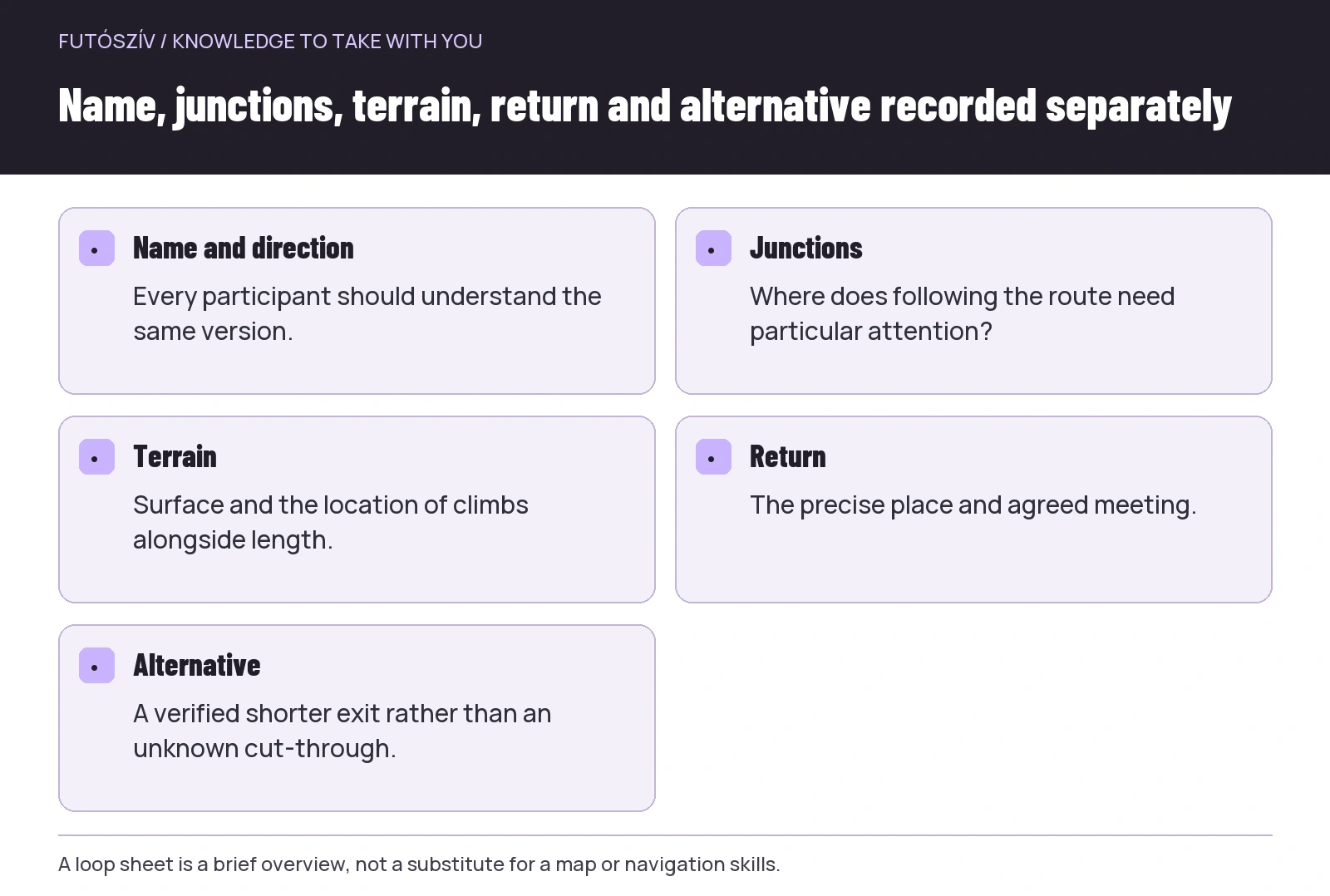 Enlarge diagram
Text version of the diagram
- Name and direction
- Every participant should understand the same version.
- Junctions
- Where does following the route need particular attention?
- Terrain
- Surface and the location of climbs alongside length.
- Return
- The precise place and agreed meeting.
- Alternative
- A verified shorter exit rather than an unknown cut-through.
Make a short loop sheet
For every section, record the starting point, direction, main junctions, terrain character and return. Include a shorter exit if one exists. The filename or map title should identify the version clearly. Do not send two different loops to participants’ phones under the same ‘trail-day_final’ name.
| Part of the loop sheet | What does it answer? | Why is it useful? |
|---|---|---|
| Name and direction | Exactly which loop will you follow? | Prevents different versions being mistaken for the same route |
| Main junctions | Where is extra attention needed? | Following the route does not depend solely on constant screen-watching |
| Terrain and climbs | What types of section should you expect? | The decision is based on more than length |
| Return | Where and how does the loop end? | The meeting and next departure connect to it too |
| Shorter exit | What is the actually verified alternative? | No need to invent an unknown cut-through on site |
A loop sheet does not replace a map and usable navigation skills. It is a short overview helping participants share an understanding. If someone does not understand where the loop goes at all, sending a file alone should not count as explaining the route. Review the important points together before leaving.
The sequence should not become an automatic checklist to complete
Plan a possible sequence beforehand if helpful, but separate the firmly agreed programme from optional continuation. The third loop should not seem compulsory merely because it appears on the map. Every restart is a new decision point: is the necessary time still available, is the situation suitable and is everyone concerned agreeing to the same thing?
A shorter loop is not a compulsory warm-up or automatic cool-down. Give it that role only within your own preparation framework, not because of its name or map length. Organisationally, the first loop may aim to introduce the area, but that is not a training prescription for everyone.
When choosing the next loop, review what remains of the whole day’s allowance. Returning, packing and travelling home take time too. If continuing would fit at the end of the day only with the most favourable progress, do not decide from the apparent closeness of the loop system. You will be moving away from the central point again.
The whole activity is more than the sum of loop distances
Include transitions between loops, regrouping and necessary discussion. These may repeat during a day returning to one centre. If the calendar shows only movement time, final departure can easily slip beyond what transport or commitments at home allow.
When adding distances, check what each loop includes. Separate saved files may include a shared approach section differently. Do not describe total distance as entirely new, distinct route coverage if repeated sections mean you used the same path several times. Your own log concerns actual movement, while a route description also needs information about repetition.
The official Hole Farm Woodland running-route page describes loops of different lengths and terrain character. In its November 2026 state, the page indicates a late-autumn opening, so it appears here as an example of route description rather than an immediately available destination. It clearly shows how shorter and longer loops at one site can differ by more than distance. Seek the same detail in your own planning.
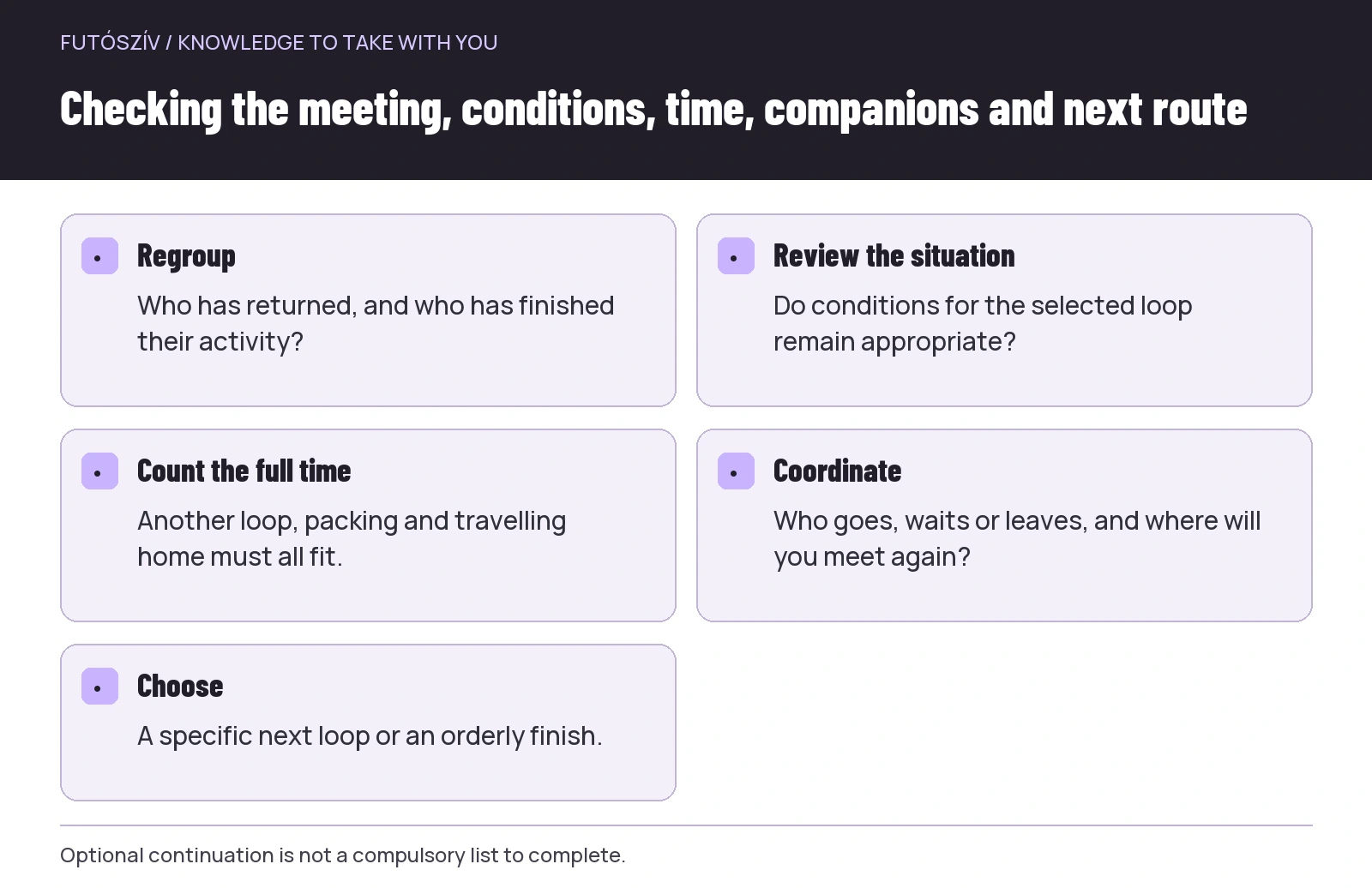 Enlarge diagram
Text version of the diagram
- Regroup
- Who has returned, and who has finished their activity?
- Review the situation
- Do conditions for the selected loop remain appropriate?
- Count the full time
- Another loop, packing and travelling home must all fit.
- Coordinate
- Who goes, waits or leaves, and where will you meet again?
- Choose
- A specific next loop or an orderly finish.
With activities of different lengths, do not leave waiting to guesswork
If the group does not run every loop together, specify who joins which departure and where they will meet others again. ‘We’ll meet at base’ is insufficient if someone heads elsewhere or has already gone home. The reunion window and onward travel should be shared information.
Someone skipping a loop should be able to decide how to use their own time. They do not have to wait in the car park without agreeing to do so. They should, however, announce leaving so others do not search for them. A simple arrival-and-departure signal in the agreed form can be enough. The method depends on the place and group; it does not need unnecessarily complicated race control.
If the group splits, both parts need an understandable route and adequate resources of their own. Review shared equipment at that point: all usable maps cannot remain with one group merely because everyone started the first loop together. Splitting changes organisational conditions too.
Returning to a central point does not justify leaving an unnecessary trace
Do not put your own markers or objects in the area on the assumption that you will collect them at the end. Local land-manager rules and access conditions matter. A friendly trail day may need no physical route marking at all. A followable map and junctions discussed together can provide a simpler solution.
Several loops can repeatedly affect the same section. If part is waterlogged or unsuitable for the planned use, repeating it does not solve the problem. Choose another accessible route or activity rather than trampling an ever-wider detour beside the path. Use the loop system’s flexibility precisely to avoid insisting on the same section at any cost.
Organise waste and personal belongings at the centre too. Calling a point a base does not automatically turn it into an event venue or dumping place. Plan to take away or appropriately dispose of what you bring. Short loops should not be convenient because the environment bears the cost of missing organisation.
A fictional example with three optional loops
Four friends identify three separate routes around a familiar meeting point at the edge of a wood. Loop A is easier to follow, B has more climbing and C leads to another landscape area. These are fictional roles, not a real-course recommendation or training plan. Each loop has its own map, direction and return description.
After the first loop, two finish their running activity while the other two decide on the next section within the time allowance agreed beforehand. Travelling home does not depend on everyone completing the same number of loops. Anyone leaving announces it and avoids accidentally taking shared equipment needed by those continuing.
The third loop is omitted at the end because the whole programme would fit too tightly into the remaining time. The day does not end as an unfinished task: loop C was optional from the outset. It remains an idea for another occasion, and participants know exactly why they chose to finish now.
Evaluate how the system worked at the day’s end
Check whether the centre was recognisable, loop names were clear and how long transitions took. If someone misunderstood a route, clarify the next description rather than merely recording that people should pay more attention. A junction name, direction or map-file version can be improved specifically.
The next trail day does not necessarily need more loops. The same two successful loops may suffice, or a different format may suit the new aim better than one central point. Building with loops is a tool useful when it provides real choices and understandable organisation. The number of loops alone does not show the day’s value.
In a well-planned system, each restart is a free, informed decision. There is a specific route, a clear return and an activity that can end. Short loops then form a trail day that accounts for the group, time and environment, rather than an endlessly expandable list.
How Futószív articles are prepared: our editorial guidelines.