There is no single ‘autism-friendly’ run
The same park session may feel pleasantly predictable to one runner and crowded and noisy to another. An autistic person may enjoy the atmosphere of a mass-participation race, while another prefers running alone at a quiet time. Some find reassurance in an exact schedule; for others, the feel of clothing or a loud announcer is the main difficulty. A diagnosis does not let us select the right route, pace, communication or equipment.
The useful starting point is the runner’s own experience. What do they enjoy about running? What tends to make getting started or being there harder? What help do they want, and what do they not want? Discuss this with them as an adult, with support of their choosing if needed. The aim is not to remove autism, force eye contact or reshape the runner to fit a club’s social habits.
Sensory differences form a personal pattern
The NHS Autism Central information explains that autistic people may process sensory information differently. There can be increased or reduced sensitivity, and needs may differ across sensory areas. This does not mean every autistic runner avoids the same stimuli or always tolerates the same amount.
The NICE guideline on autism in adults emphasises considering personal space, light, noise, visual cues and breaks when providing support. It was written for health and social care; a running club does not apply it as a treatment programme. Its organisational lesson is nevertheless clear: the environment can be modified, rather than placing every demand for adaptation on the participant.
Look at the whole event alongside the running effort
The five kilometres in the calendar represent only part of the activity. Beforehand, there may be crowded travel, queues, an unfamiliar changing room, new people and loudspeakers competing with one another. Afterwards, there may be photographs, an awards ceremony and another journey. Feeling physically strong during the run does not automatically reveal how demanding that entire process has been.
Consider arrival, waiting, movement and getting home separately. Which parts are familiar? Where do several new things happen together? Which elements can be skipped? A shorter course does not necessarily solve the problem if the hardest part is loud, uncertain waiting before the start.
You do not need to score every feeling numerically to evaluate it. A short personal note can help: arriving early was good, attaching the bib was uncomfortable, waiting farther from the speaker worked. Keep records only if they are useful to the person; self-observation should not become another compulsory performance task.
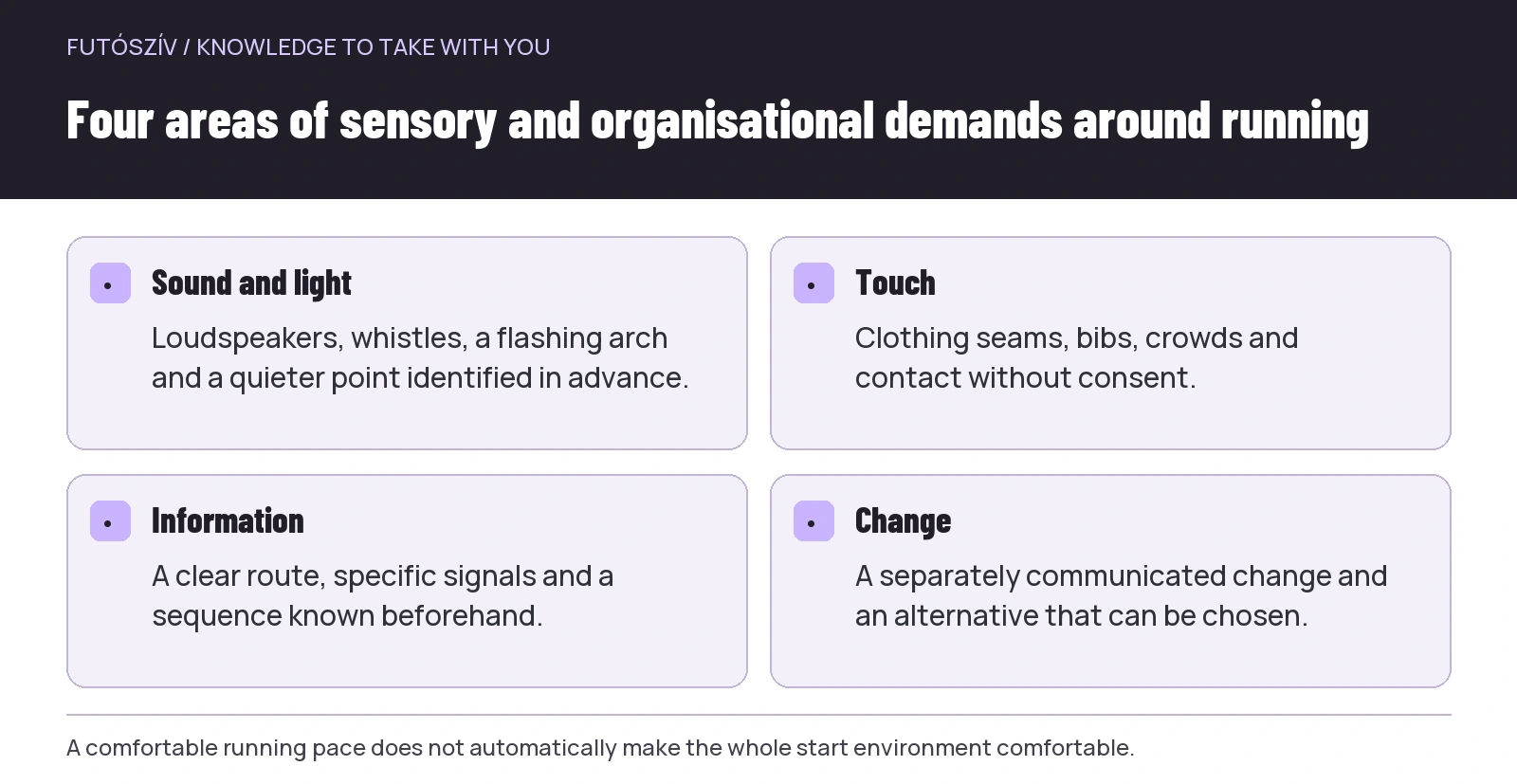 Enlarge diagram
Text version of the diagram
- Sound and light
- Loudspeakers, whistles, a flashing arch and a quieter point identified in advance.
- Touch
- Clothing seams, bibs, crowds and contact without consent.
- Information
- A clear route, specific signals and a sequence known beforehand.
- Change
- A separately communicated change and an alternative that can be chosen.
A predictable schedule and honest uncertainty
Organisers can help greatly with a short, concrete description of the programme. Where and when do we meet? Who will be there? How can the contact person be recognised? What happens at the beginning, and how does the session end? Will participants need to choose a partner, introduce themselves or join a group game? If these are optional, say so.
‘A friendly atmosphere’ or ‘nothing unusual’ does not replace details. Explain that music will play at the start, a short part of the route is busier and there may be waiting between the briefing and departure. Also communicate what you cannot know for certain, such as the number of other public-park users or noise from an external event.
If something changes, highlight the change separately. Do not expect someone to extract a new meeting point from a long social-media conversation. A clear message says what has changed, which parts of the plan remain and what choices are available if the new situation is unsuitable.
Sound: do not rely on one device for everything
Advance notice of a loud announcer, whistle or starting pistol can help. At a small club session, it is often possible to give the start signal differently or hold the briefing away from a loudspeaker. For a large event, ask the organiser for specific information: ‘there is a quieter area’ should identify both the place and the way to reach it.
Some people use earplugs or noise-reducing devices. Their comfort and the ability to notice necessary environmental signals must be considered together on the chosen route. Safe awareness is particularly important at road crossings or amid changing traffic. Do not claim that a particular technology solves this in every environment.
A simple group rule can help too: one person gives important information while everyone is stopped, and it is also available in writing if needed. Removing constant shouting and jokey instructions on the move does not make a session less athletic.
Clothing, touch and the small details of a race bib
A label, tight strap, wet sock or bib attachment may matter more to usability than the equipment’s brand. Let the runner try comfortable solutions in a calm setting based on their own experience. Wearing the T-shirt supplied in a race pack is not compulsory unless event rules require it; check the rule beforehand, however.
Ask for consent to social touch too. A hand on the shoulder, an unexpected hug or a high five at the finish is not pleasant for everyone. Declining is not rude. If a coach wants to assist a technique demonstration through touch, they should explain what they intend to do and ask permission first; the person can choose another way of receiving the explanation.
A comfortable arrangement does not need justification in front of the entire community. Runners can decide how much to share about their sensory needs. There is no need to request a medical history or diagnosis for someone to wait farther from a loudspeaker.
Communication without having to perform a social role
A running group can speak clearly and directly. ‘Today we’ll just go by feel, but still give it some’ may be difficult to interpret; explain the task, where to turn and how to request a change. Not every conversation has to become formal, but information affecting training safety should be unambiguous.
Ask whether a spoken briefing works or whether receiving the main points in writing beforehand is better. Allow time for an answer. Do not infer a lack of interest from silence, different eye contact or short replies. Running alongside someone does not require constant conversation.
Belonging to a community can take several forms. Someone may enjoy running together but decline the shared coffee afterwards. Another person may enjoy conversation but prefer being independent on the track. These choices can coexist; do not make participation in the entire social programme a condition of inclusion.
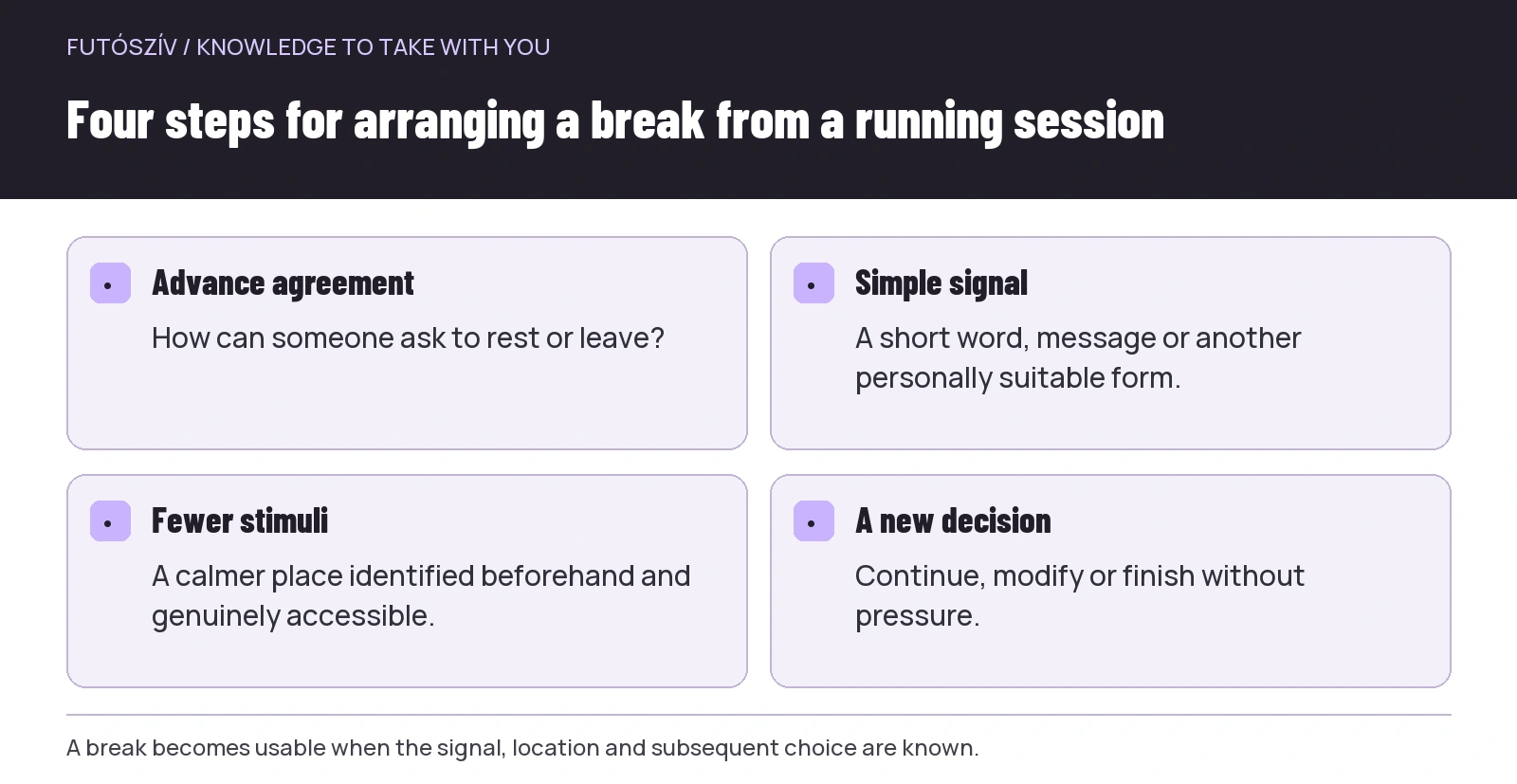 Enlarge diagram
Text version of the diagram
- Advance agreement
- How can someone ask to rest or leave?
- Simple signal
- A short word, message or another personally suitable form.
- Fewer stimuli
- A calmer place identified beforehand and genuinely accessible.
- A new decision
- Continue, modify or finish without pressure.
When there is too much input, provide a usable break
The National Autistic Society’s practical guide recommends understanding individual sensory differences and adapting the environment accordingly. For a running session, agree beforehand how to request a break, where to go for a calmer space and who can help with finding the way if needed. Do not start working this out only when communication has already become difficult.
If someone indicates it is too much, do not persuade them to do another lap. Reduce unnecessary questions, avoid surrounding them or touching without consent, and offer the support agreed in advance. Do not demand an immediate detailed explanation or eye contact. The personal support plan takes priority over general suggestions.
At the same time, do not automatically label new or severe physical illness as sensory overload. Chest pain, severe breathing difficulty, collapse or another urgent condition requires medical help; in immediate danger, call 112. A diagnosis does not replace an appropriate assessment of the situation.
What should you ask a race organiser?
A short message can ask about specific circumstances: can someone wait outside the start zone until departure, can the start procedure be explained in advance, is there a less crowded time for bag collection, and who can help if something changes on site? The particular event’s answer matters. Photographs from previous years do not prove that speakers will be in the same places or entry procedures will work the same way this year.
Ask for a usable description of the quieter area: is it actually separated from the main sound sources, is it open when needed, and can someone leave and re-enter the event area? If no such option exists, accurate information is still valuable. The runner can then decide using real conditions rather than relying on a general promise that ‘we look after everyone’.
Getting home and the following day are part of the plan too
More tasks can follow the event: a queue at bag storage, finding the way, eating and travelling home. Consider beforehand which option is familiar, whether a companion is needed and what happens if participation ends earlier than planned. Taking the finish photograph does not mean all questions about organisational support disappear.
Runners can plan quieter time around an event based on their own experience. Do not prescribe a separate rest day for everyone simply because they are autistic, and do not deny its value to someone who needs it. Feedback may be as simple as saying that the movement felt good but the later programme was too packed. Use that to improve the whole day’s schedule next time, rather than judging the runner’s willingness to adapt.
Building a personal trial session
If the runner wishes, the first meeting can involve getting to know the route and organiser without a performance goal. Agree beforehand which sections to see, how long the meeting lasts and how it ends. A short shared activity may follow later, but there is no obligation to turn this introduction straight into training.
For the next session, trying one organisational change can be enough: a different arrival time, quieter waiting or a written route. That can reveal which helped. This is neither a rigid progression programme nor therapy. If the new solution is worse, return to the previous one or look for another option.
Let the runner choose the goals. They may want a good experience in a familiar park, a weekly session with a friend or eventually to race. Taking part in a mass event is not a higher form of success than a quiet independent run. Good organisation enables the athlete to decide between more genuine possibilities.
Sources
- NICE CG142: personalised support and environments for autistic adults.
- Autism Central: sensory differences.
- National Autistic Society: practical sensory support.
How Futószív articles are prepared: our editorial guidelines.