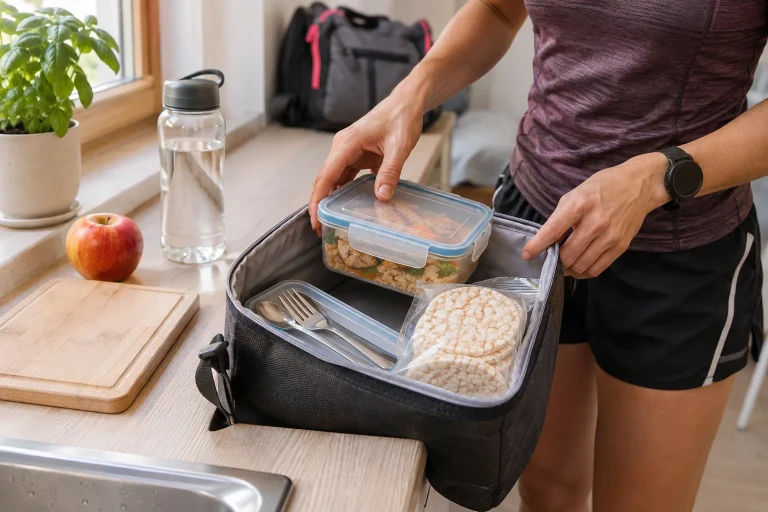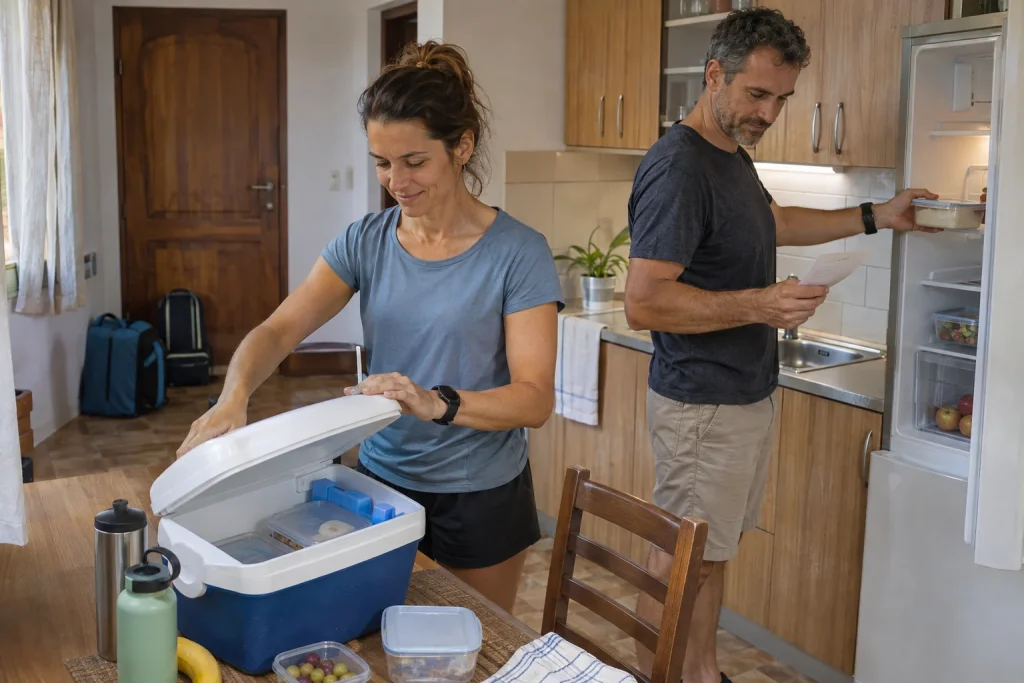
It is easy to reduce race-weekend eating to one important moment: breakfast before the start. That can leave out arrival on Friday evening, a Saturday afternoon extended by race-pack collection, or a long wait between finishing and travelling home. A useful food plan therefore follows the entire journey. Rather than prescribing a series of special dishes, it organises where and when the conditions needed for your own suitable meals will actually be available.
This guide provides an organisational framework for adult recreational runners. It is not a personalised race diet, a carbohydrate-loading or fluid-dosing protocol, and it does not promise the same timing for every race distance. The amounts and composition needed belong in an individual plan. Allergies, illnesses and prescribed dietary requirements still apply while travelling. The weekend and times mentioned here are fictional planning examples.
Write down the events first, not the foods
Start with departure, expected arrival, checking into your accommodation, race-pack collection, pre-race preparations, the start, finishing and the return journey. Add the times when things will actually be accessible: when can you get to your own bag, when is the dining room open and when do you leave the room? This reveals where a real eating opportunity fits and where there is only an assumed possibility.
Replace ‘we’ll eat when we get there’ with specific questions. Where, during which opening hours, and with what choice of food? The race-centre snack bar may not be operating when you arrive, and the hotel restaurant may be a different service from the breakfast included in your room booking. Ready-made food, shopping and cooking for yourself have different prerequisites. It is fine for the first version of the plan to contain several question marks, provided you resolve them later.
Needs and access are two separate layers of the plan
The British Dietetic Association’s overview of sports nutrition relates diet to individual sporting demands and considers a nutrition plan in terms of competition, recovery and health together. Establish what you need first, then organise access to meals accordingly. A restaurant’s opening time or the accommodation’s selection cannot determine your personal requirements.
Your food plan can have separate fields for ‘a suitable meal for me’ and ‘available to me at the venue’. A food might fit your own plan well, yet you may have no way to prepare or store it at that point in the weekend. At other times, the available dish may not meet your dietary requirements. Change the logistical layer in that case: choose another place, bring an appropriate food pack or use a different schedule, rather than abandoning the necessary condition.
Do not leave an eating stage out of the journey
The NSW Institute of Sport’s travel guide highlights changes to familiar routines away from home and the role of advance planning. Close to competition, it suggests finding familiar options similar to normal meals. That is practical preparation, not a ban on every new food. For your own weekend, consider how to fulfil the role of a familiar meal appropriately during the journey and on arrival.
If you travel in the afternoon, allow more than the scheduled journey time before your arrival meal. Collecting luggage, parking, checking in and local transport can also take time. A backup is there to handle such realistic delays, not to justify carrying prepared food stored under uncertain conditions for the entire weekend. You must meet the particular food’s storage requirements throughout. Calling it a ‘race pack’ does not preserve the meal inside.
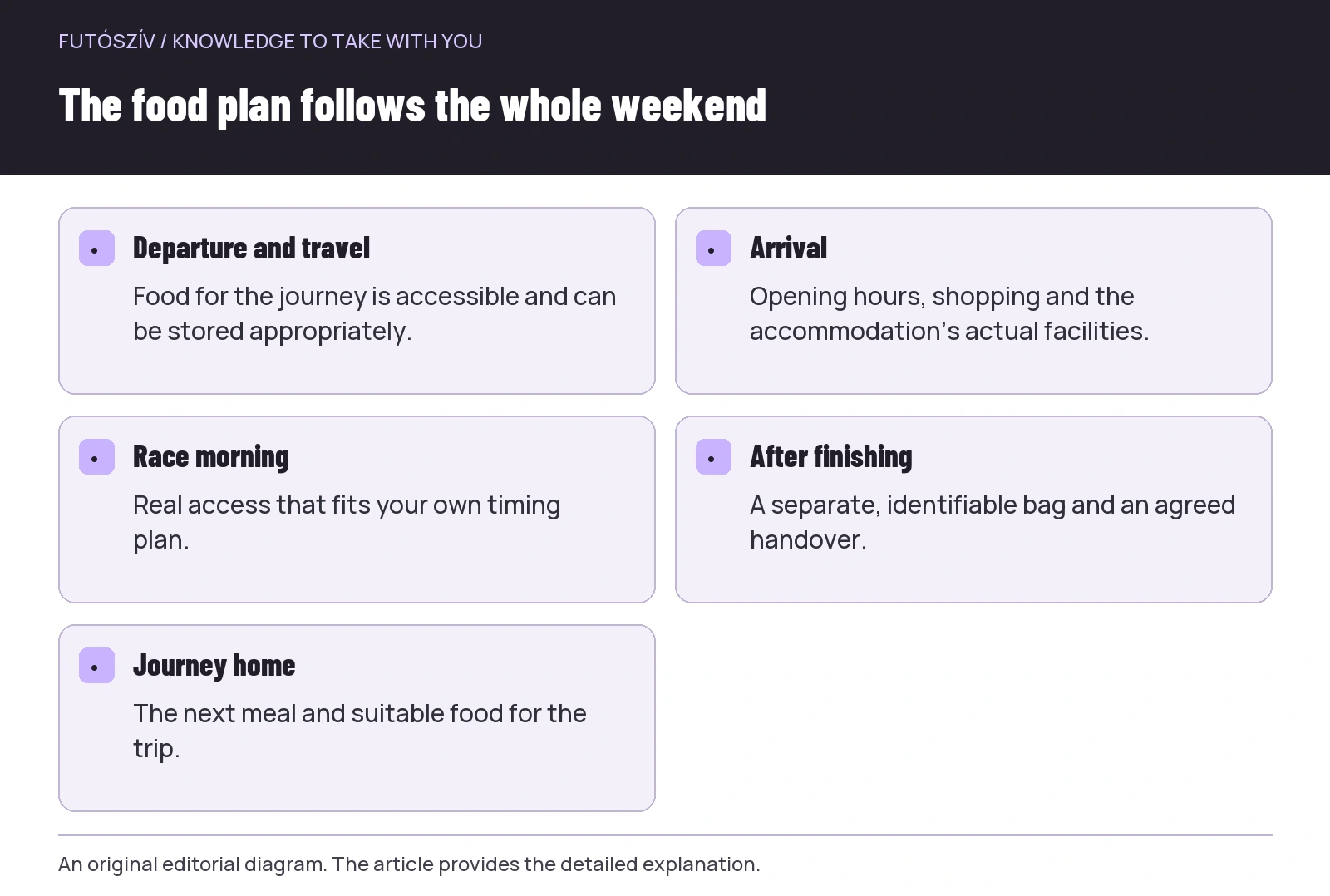 Enlarge diagram
Text version of the diagram
- Departure and travel
- Food for the journey is accessible and can be stored appropriately.
- Arrival
- Opening hours, shopping and the accommodation’s actual facilities.
- Race morning
- Real access that fits your own timing plan.
- After finishing
- A separate, identifiable bag and an agreed handover.
- Journey home
- The next meal and suitable food for the trip.
Make the sequence for your arrival meal workable
In our fictional example, you reach an apartment on Friday evening. You can check in first and shop only afterwards. If the shop closes close to your arrival time, those two steps may not be possible in that order. Clarify this before leaving home and identify another suitable solution. If you plan to cater for yourself, ask about actual equipment rather than relying on the word kitchen: you need suitable storage, clean utensils and the necessary preparation facilities.
The first evening should not require preparation whose conditions are still unknown. Even a supposedly quick recipe may need a larger pan, a chopping surface or adequate refrigerator space. Choose a meal that fits your own plan and can be made in the available setting. If the accommodation’s advance reply is uncertain, do not treat it as a firm promise. Checking again on arrival can show whether you need to switch to the backup.
Race-pack collection can easily rearrange the day
A more distant race centre, queues or changed collection arrangements can make Saturday’s programme take longer. In your own food plan, that should not automatically mean missing a meal. Know where eating fits before or after collection and what appropriate backup you can carry. Food in your bag helps only if you can access it, rather than leaving it at the accommodation while you wait at another event location.
Coordinate companions’ and family members’ plans too. Shared sightseeing, restaurant reservations or shopping may follow a different schedule. Everyone does not have to eat the same thing, but it helps to spot timing clashes beforehand. Avoid trying to accommodate people’s individual meals by hurriedly splitting up afterwards. An agreed meeting and accessible food of your own offer more flexibility than imposing one rigid menu on the whole group.
The evening before the race needs more than a restaurant name
If you rely on catering, check actual opening hours, food-service times and the possibility of discussing arrangements in advance. A menu image may be old or relate to a different service at the venue. The specific ingredients and your individual dietary requirements are separate questions. If part of a dish needs changing, clarify that beforehand and confirm it on arrival. Your plan should not depend on a busy dining room being able to change everything on request.
A familiar-sounding name does not prove that a dish uses the same recipe as at home. Ask about what genuinely matters to your personal decision, but do not expect the kitchen to determine your sports-nutrition needs. The provider can explain its own dish and what adjustments it can make. Your task is to match that information to a suitable individual plan. If that is not possible, you need a backup whose ingredients, storage and availability have all actually been clarified.
Work backwards through race morning
Start with the time you need to reach the start, then work backwards through local travel, dressing, bag drop and eating arrangements. This shows whether the dining room’s opening time fits your own schedule. ‘Breakfast included’ does not establish that you can access suitable food at the right time. An early breakfast pack works only if its specific contents and collection arrangements are appropriate.
Your own backup breakfast also requires space and equipment. If preparing a food needs water, a suitable container or refrigeration, clarify those beforehand. Use equipment in the room only as intended and follow the accommodation’s rules. Avoiding improvisation also helps with timing: race morning should not be when you discover that an ingredient bought in advance cannot be prepared appropriately there.
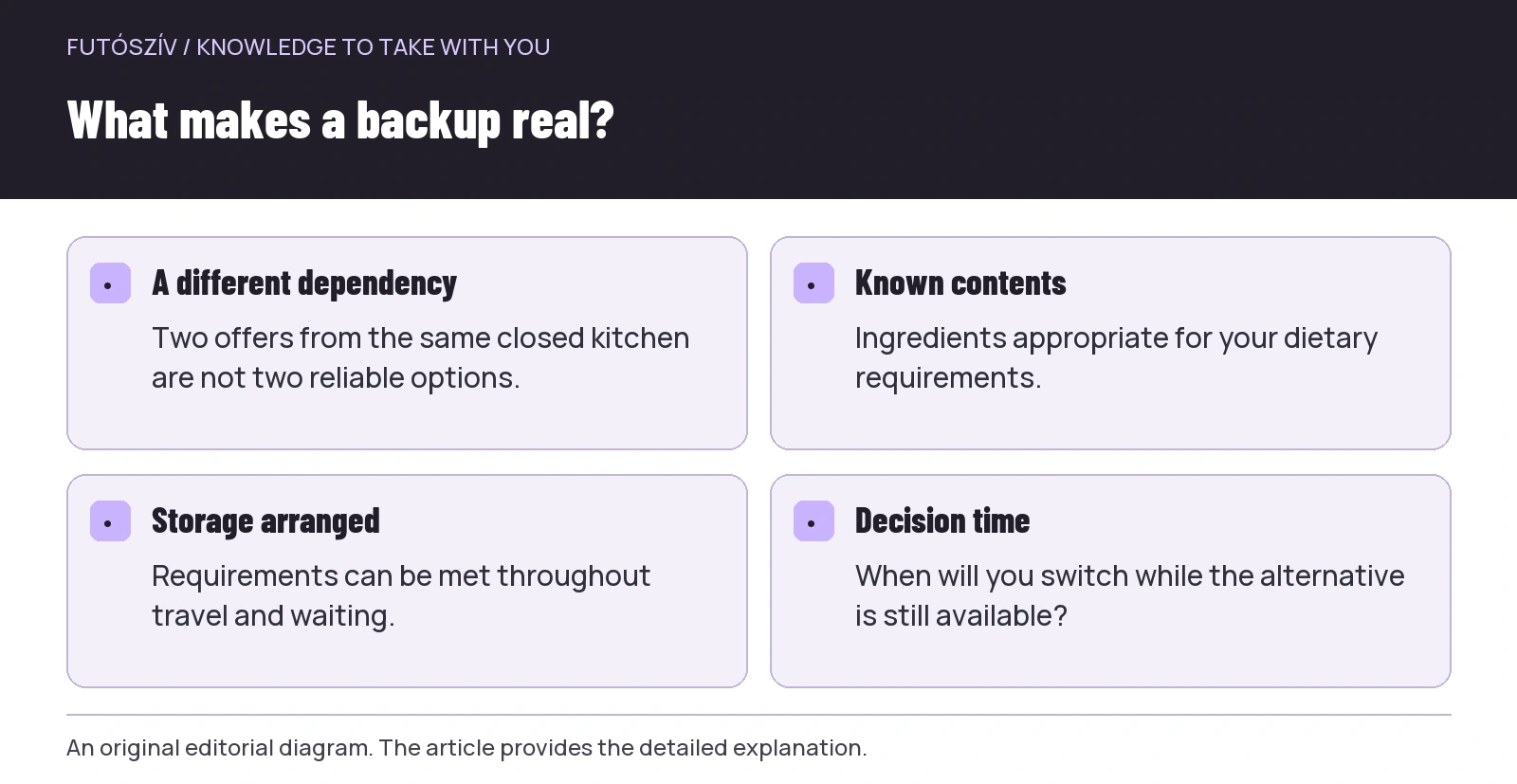 Enlarge diagram
Text version of the diagram
- A different dependency
- Two offers from the same closed kitchen are not two reliable options.
- Known contents
- Ingredients appropriate for your dietary requirements.
- Storage arranged
- Requirements can be met throughout travel and waiting.
- Decision time
- When will you switch while the alternative is still available?
Separate food for the race from the post-finish bag
Organise the food, drink and equipment you use during the race according to your own plan and the event’s rules. Food intended for after the finish may have a different route of access: bag storage, a companion or your accommodation. Do not put everything in one bag that you cannot take with you during the run. Check the drop-off and collection points and times as well. Give your companion brief instructions identifying which bag you need, when and where.
A finisher’s pack or food offered at the finish may be part of the programme, but do not base your personal plan on a gift with unknown contents. Decide what to rely on using the actual service and your individual requirements. Consider waiting after the finish, the awards ceremony and showering too. You do not need to compress the whole task into a single moment at the finish line; what matters is access to an appropriate meal of your own.
Keep storage appropriate throughout the journey
The food-safety advice from Nébih also stresses appropriate handling of foods requiring refrigeration, a refrigerator range of 0–5 degrees Celsius checked with a thermometer, and protection of ready-to-eat food from contamination. When packing for travel, you must meet the specific food’s requirements during transport, waiting and at the accommodation. Cool air in a room or a shaded parking space does not automatically provide suitable refrigerated storage.
Requirements after opening must remain traceable too. Handling a portion taken from a large weekend pack and the remainder can be separate tasks. Do not lose track of preparation or opening time because the food has moved to another container. Keep expiry and storage information on the original label or in a legible, identifiable copy. If its handling history is uncertain, quickly eating it on the way home should not become the rescue plan.
| Weekend stage | Specific access question | Role of a usable backup |
|---|---|---|
| Arrival | Is a suitable meal or shopping still accessible? | Handle a realistically foreseeable delay. |
| Activities and race-pack collection | Can you access your own bag at the venue? | Suitable food should not exist only at the accommodation. |
| Race morning | Do opening and collection times fit your own plan? | Known contents and a real way to prepare the food. |
| Waiting after the finish | Who will hand over your bag, and where? | Resolve uncertainty about the gift pack. |
| Journey home | When and where is the next appropriate meal? | Fit the timetable and storage conditions too. |
The backup should not depend on the same provider
If your first option is the hotel dining room and the second is an uncertain early pack from the same kitchen, you have not necessarily planned two independent solutions. A later opening time or a missing ingredient could affect both. Look for an alternative that genuinely resolves the underlying uncertainty. That could be suitable food you bring yourself or another verified way of accessing a meal, but its own storage and preparation requirements must also be met.
Give the backup a decision time as well. Do not wait until the last minute before the planned meal to clarify opening hours or ingredients if other options will no longer be accessible then. When preparing for the weekend, mark what needs confirmation before departure and what you must check on arrival. A few clear deadlines help more than a long list of saved restaurant names. Uncertain information can then lead to a specific change in time.
The plan lasts through the journey home
Finishing does not end the task of organising meals. There may be a long interval between collecting your bag, changing, departing and reaching the next actual place to eat. If your own appropriate plan requires food and drink for the journey, keep them accessible and manageable under suitable conditions. Do not automatically regard an unused race pack as a complete meal for the journey home. Assess your own needs and the condition of the leftovers separately.
After the weekend, identify where a real gap occurred: did the dining room open too late, did cooking for yourself become too complicated, or did the post-finish bag fail to reach you? Adjust your next travel plan to address that specific problem. A useful food plan is not a rigid rulebook but a map of the route to meals that suit you. It helps when it shows a workable option at every important stage from leaving home to returning.
Sources and further reading
- British Dietetic Association: Sport and exercise
- NSW Institute of Sport: Trips and travel
- Nébih: Preventing foodborne illness
How Futószív articles are prepared: our editorial guidelines.