An annual running calendar is useful when it helps you decide before the next entry too. A colourful event list alone is not a plan: ten exciting weekends can quickly accumulate without showing the travel, organisation and discussions at home each requires. A good calendar makes uncertainty visible. It includes decided events, interesting possibilities and periods you deliberately leave free.
This guide concerns the organisational side of the year. It sets no compulsory race count, training load or medical interval between longer runs. General calendar boxes cannot determine these. The aim is a running year built from fewer, more thoughtful commitments, without a discounted entry deadline automatically overriding every other plan.
Map the year before adding races
Open an annual view that can include commitments beyond running. You do not need a detailed family diary: simply show periods genuinely affecting participation. These might include a busy work deadline, exams, moving home, a shared holiday or a weekend when you accepted a task important to someone else. An event can conflict with life even if you happen to be free at the exact start time.
Distinguish three types of time. Fixed time already has a commitment. Flexible time can be discussed, but not unilaterally. Time left free is an intentional reserve, not an error to fill in the spreadsheet. Removing that reserve with every new advertisement soon leaves no room for everyday changes. The number of logos entered does not measure an annual plan’s quality.
Do not include other people’s sensitive information in entries. ‘Family commitment’ or ‘busy work period’ is enough in a shared calendar. Detailed private matters need not be linked with a running club group or friends’ invitations. Planning needs availability, not every piece of background information.
Give every event a purpose
On the list of interesting races, mark what you seek from each occasion. It may be a focused race experience, a day with friends, discovering a new location or simply a fun costume outing. This does not make social running less valuable. It creates different expectations from an event requiring a longer dedicated period of organisation.
State the purpose in one sentence. For example: shared participation matters at this relay, so we will arrange the team accordingly. Or: I want this city weekend to be part of a trip with my partner, so I will choose only a race that leaves room for our shared activities. These statements lead to real decisions later. ‘It would be nice to be there’ does not yet reveal what you need to protect.
| Role in your own year | What is worth clarifying? | What need not be added automatically? |
|---|---|---|
| An important personal event | How much time and money will you commit? | Booking every surrounding weekend |
| A shared team day | Who participates, and what is the shared goal? | Identical individual pace or expectations |
| A fun run | Which part appeals: location, lights, costume or company? | A compulsory finishing-time goal |
| Trying a new location | How much travel and uncertainty are involved? | An immediate non-cancellable booking |
| A reserve option | Under which conditions might you choose it? | Parallel entries as insurance |
 Enlarge diagram
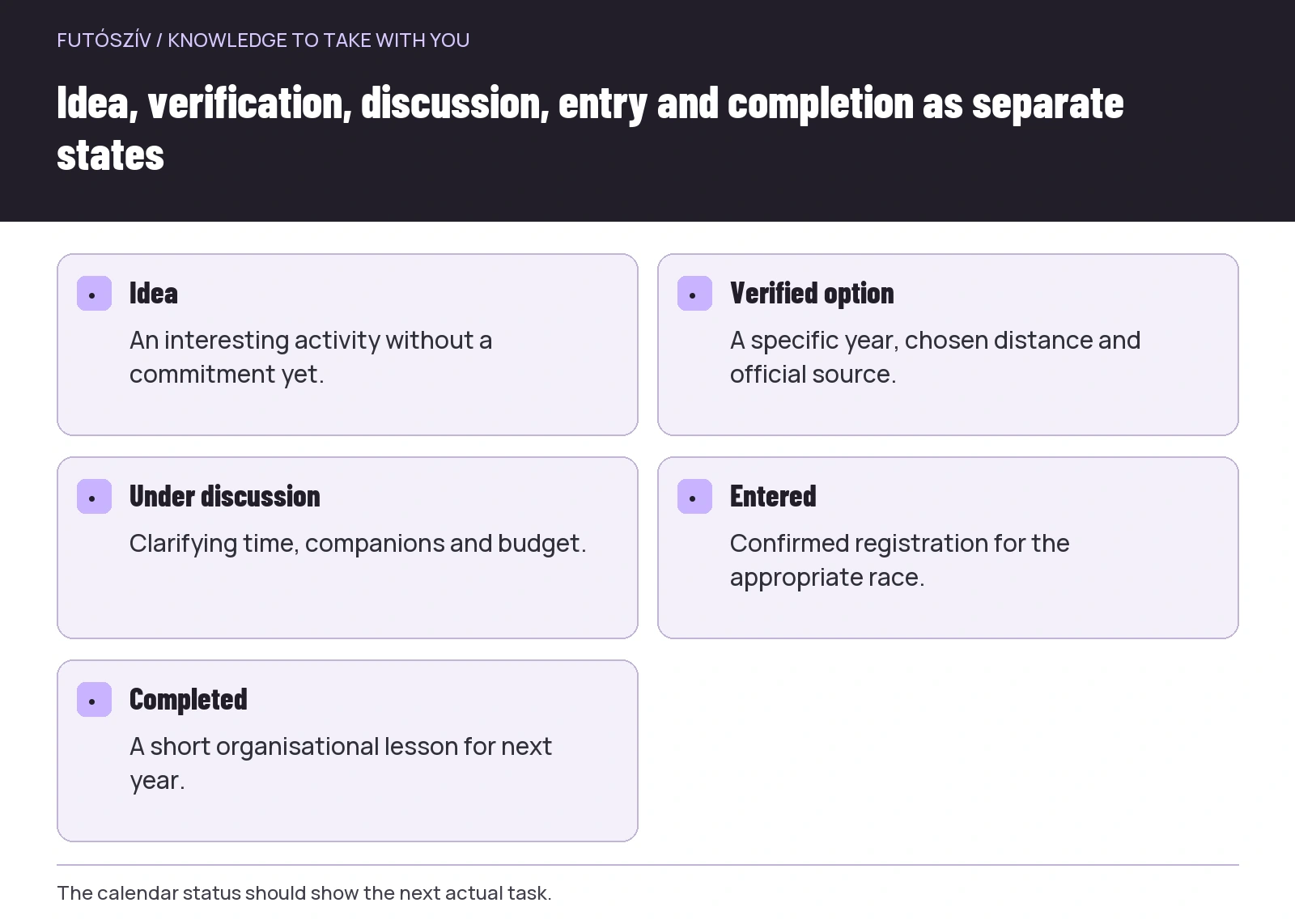
Text version of the illustration
- Idea
- An interesting activity without a commitment yet.
- Verified option
- A specific year, chosen distance and official source.
- Under discussion
- Clarifying time, companions and budget.
- Entered
- Confirmed registration for the appropriate race.
- Completed
- A short organisational lesson for next year.
Interest should not look like a firm commitment yet
Use simple statuses: idea, verified option, under discussion, decided, entered and completed. An idea needs only the event name and official-page link. A verified option means you know which year’s details you read, which distance interests you and which basic organisational questions remain open. Do not call something a finished plan when you have seen it only in a social post.
Let the labels have consequences. Do not tell the team you are definitely coming when an event remains under discussion. Use ‘entered’ only after confirmed registration, not merely starting a form. If payment or acceptance of team details remains pending, add a separate note. The calendar then continues showing what comes next.
Always put a written status beside colour coding. Pale blue and green may not mean the same to everyone on another device, in print or in a shared extract. Make status readable by itself: ‘idea, date not yet confirmed’ says more than an attractive marker.
Check the specific year separately
An organiser’s calendar is a good starting point, but look for the year and chosen race on its detailed page too. On BSI’s official homepage, several 2027 events were already listed on 18 November 2026, including Fut a Ring on 6 March and Vivicittá on 10–11 April. That does not mean every subpage, service or earlier programme booklet has been updated to the same year. Store the source of the particular information in your calendar, not merely the organiser’s name.
Series pages need particular attention. The Félmaratonmánia information describes a system based on completing four consecutive seasons. Do not simply treat an earlier year’s event list as the next year’s dates. If a series appeals, check current conditions and each selected event’s own details separately. Its structure can organise plans without replacing checks of individual events.
Record a checking date too. This does not guarantee information has remained unchanged, but accurately shows when you looked. If someone later gives another date, you need not argue from memory: reopen the source and establish whether it is a new announcement or an old post. Keep uncertain information uncertain meanwhile.
Put the full participation time in the calendar
A Saturday race does not necessarily mean Saturday morning only. It can include Friday travel, pack collection, checking into accommodation, getting home and rearranging household tasks beforehand. These are not training loads, but still require time from the same life. Marking only the start can make two consecutive weekends look free when little reserve actually remains.
A fictional example shows the difference. At event A, you would spend an hour on the course but need accommodation and parts of two travel days because of distance. Event B has a longer programme but is local, leaving the rest of the family day available. Neither is inherently better. A calendar helps when it shows the whole commitment rather than comparing only running duration.
Discuss shared time with the people actually affected. ‘We will sort it out’ does not mean someone has accepted childcare, rearranging car use or providing cover. Mark the need for agreement in the annual overview, with the detailed arrangement kept separately somewhere easy to find.
 Enlarge diagram
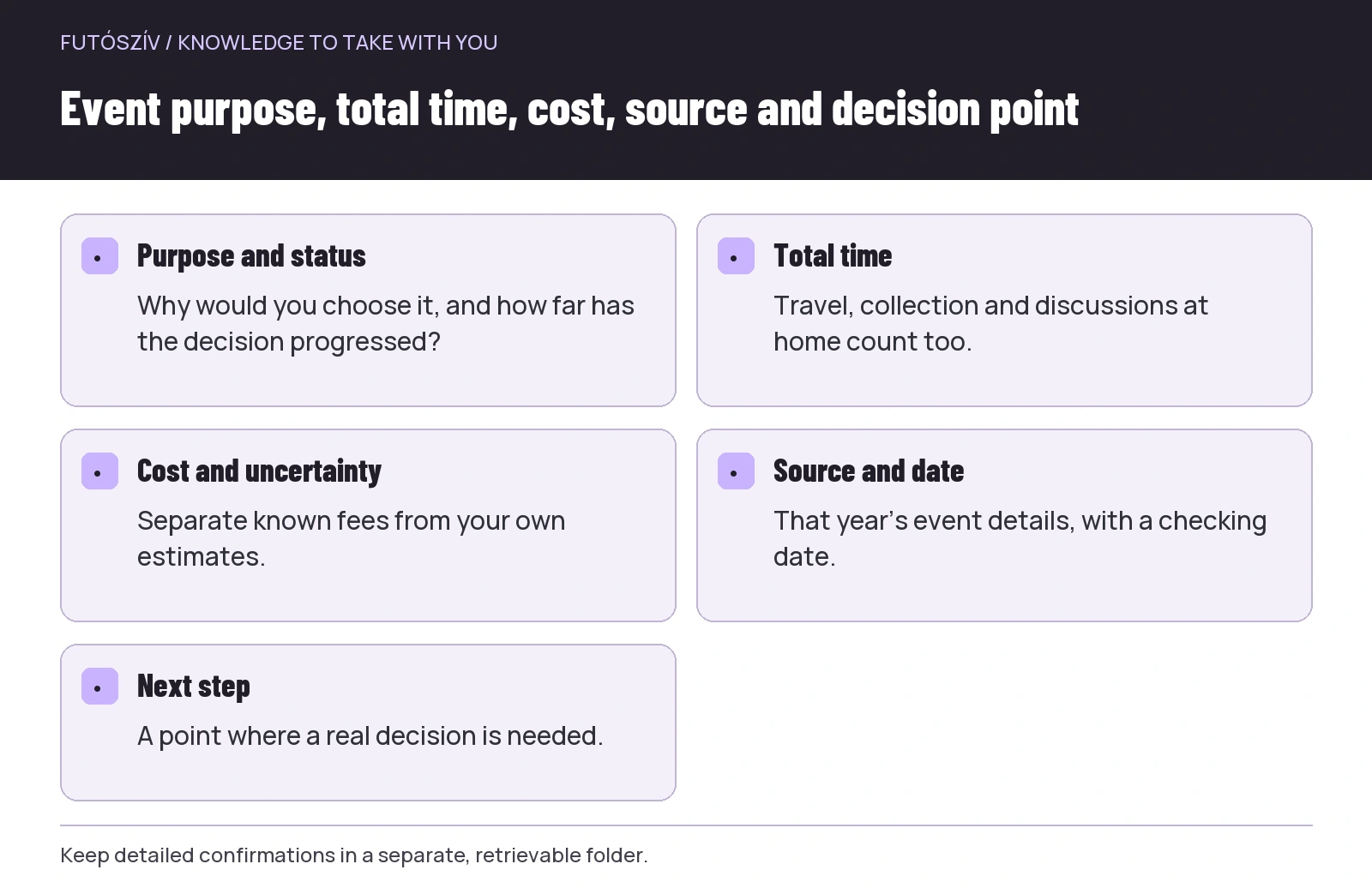
Text version of the illustration
- Purpose and status
- Why would you choose it, and how far has the decision progressed?
- Total time
- Travel, collection and discussions at home count too.
- Cost and uncertainty
- Separate known fees from your own estimates.
- Source and date
- That year’s event details, with a checking date.
- Next step
- A point where a real decision is needed.
Without a budget, a calendar can remain a wish list
Do not derive annual running expenditure simply by adding desired events. First decide what amount fits your circumstances. Then divide it between entries, travel, accommodation and other necessary costs. Existing usable equipment does not automatically need replacing for every new goal.
You can estimate a total for each event, but distinguish known fees from your own cost estimates. An earlier accommodation price or a friend’s parking cost last year is not a current offer. If the whole picture is incomplete, uncertainty belongs to the decision. Do not hide unchosen travel or lodging behind an apparently precise total.
Discounted entry is not necessarily a saving if it makes you pay for something you would not otherwise attend. Your own rule might be to enter before a price deadline only when purpose, time frame and major costs are clear. This is not financial-product advice, but a simple brake on rushed commitments. A cheaper entry and a good choice are separate questions.
See the whole commitment for a series beforehand
A multi-event challenge can give the year an appealing framework. The difficulty is seeing only the first weekend when purchasing the first entry. Add every necessary stage to the year and identify which already has reliable information. If a period remains uncertain, do not act as though your later life has already adapted in every detail.
Give the series its own purpose statement too. Wanting to experience the seasons differs from wanting to explore particular cities. Choices may vary, and not every distance at every event necessarily counts. The organiser determines precise conditions. In your spreadsheet, attach source links and open questions rather than a yes supplied from memory.
Experiences already gained do not oblige you to every later commitment. If your schedule changes, you can replan the series or let go of completing it. Earlier runs still happened. A calendar should show current possibilities rather than bind you to previous decisions at any cost.
Think in decision points rather than monthly reviews
You need not recolour the whole year every week. Mark points where new information genuinely requires a decision: entries opening, team members confirming, booking accommodation or family discussions affecting participation. A reminder should concern the task, not merely repeat that an event approaches.
A useful checking question is what changed since the last review. If nothing did, there is no need to manufacture another decision. If a work deadline moved or travel options changed, review affected activities. One change need not automatically trigger a chain reaction across every event: adjust what it actually affects.
Keep completed events in a separate view. A short note suffices: what worked organisationally, what took longer than expected and what you would handle differently. Do not retrospectively invent lessons unsupported by observation. ‘Friday travel was too tight’ is useful for next year; a vague ‘I need to prepare better’ is harder to turn into action.
A sufficient annual entry has eight fields
Your system can be paper, a spreadsheet or a calendar app. It works if you can update it and find the next task. Each event row should contain name and year, chosen distance, personal goal, status, total time, estimated total cost, official source and next decision point. Detailed confirmations can go in a separate folder.
Leave at least a few weekends without a running event assigned beforehand. Not because spontaneity must itself be regulated, but to leave space for a local activity discovered later, a friend’s invitation or simply a different day. A running year consists of more than starts. Everyday life between entries also shapes how liveable the plan is.
Finally, look at the whole year with one question: if no new event were announced, would I still gladly accept this plan? If yes, you have a usable starting point. If only the next novelty keeps it exciting, leave fewer firm commitments and more open options. The annual running calendar then remains a decision aid that has room for your life too.
How Futószív articles are prepared: our editorial guidelines.