As a spectator, it is easy to focus on your own friend’s arrival: when they will appear, whether you will recognise them and whether the photo will work. Meanwhile, many other runners pass with different goals and paces. Thoughtful encouragement does not need everyone’s full story. It is enough not to judge participants, disrupt their progress or pretend you can tell from the roadside exactly what they need.
This guide concerns spectator behaviour and using shared space. It offers our own example phrases and situations, not a guaranteed motivational method. Different people may prefer different encouragement, and spectator arrangements can vary between sections of a race. Always follow the organiser’s information for the particular location.
Support should not invent someone’s life story
The pace, body shape, age or equipment you see in the field does not reveal why someone entered. One person pursues a personal goal, another accompanies someone, and another follows a chosen run–walk approach. As a spectator, you do not need to turn these into a story. ‘You must have just started’ or ‘At your age, this is quite something’ can impose an unwanted label even when well meant.
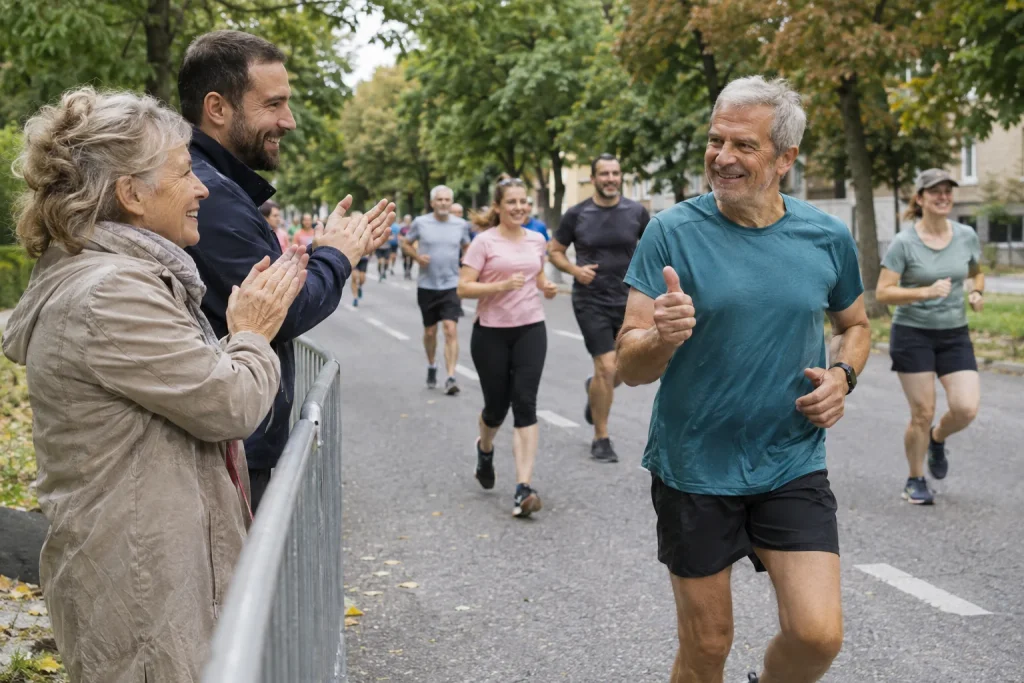
Use simple phrases about the occasion: ‘Go well, enjoy your run!’ ‘We are glad you are here!’ ‘Have a great day on the course!’ These will not please everyone equally either, but do not try to decode someone’s whole sporting history. Quieter applause or a smile can show presence too; you need not shout a personalised remark at every person passing.
Do not publicly compare participants running at different paces. ‘You are the only ones left’ or ‘The leaders finished ages ago’ offers no useful information for their task. If working at an official organiser post, give accurate information within your assigned role. As a private spectator, do not take over results announcements or closing duties.
An instruction about performance is not always encouragement
‘Faster’, ‘do not walk’ or ‘do not stop now’ may seem simple from the roadside. Yet you do not know the participant’s chosen programme or current situation. Supporting them does not require directing their sporting decisions. The movement you see is not an invitation for unsolicited coaching.
With a friend, agree beforehand what encouragement they would like. They may enjoy hearing their name, while someone else may want only a brief signal that you saw them. The request should not become a compulsory wave back or stop. Passing without a response does not necessarily mean they failed to notice or appreciate your presence.
| A phrase easily misunderstood | An alternative making fewer assumptions |
|---|---|
| ‘Do not walk; it is nearly over!’ | ‘Go well on the next section!’ |
| ‘You can finish even at that pace.’ | ‘We are glad you are here!’ |
| ‘The others are already ahead of you.’ | ‘Good luck to everyone on this section!’ |
| ‘I can see you are suffering now.’ | Brief applause or encouragement the runner requested beforehand. |
The examples do not mean everyone wants the same sentence. They help you notice when a spectator imposes their interpretation on a participant. A joke between close friends may have its own history, but do not automatically extend it to strangers passing beside you.
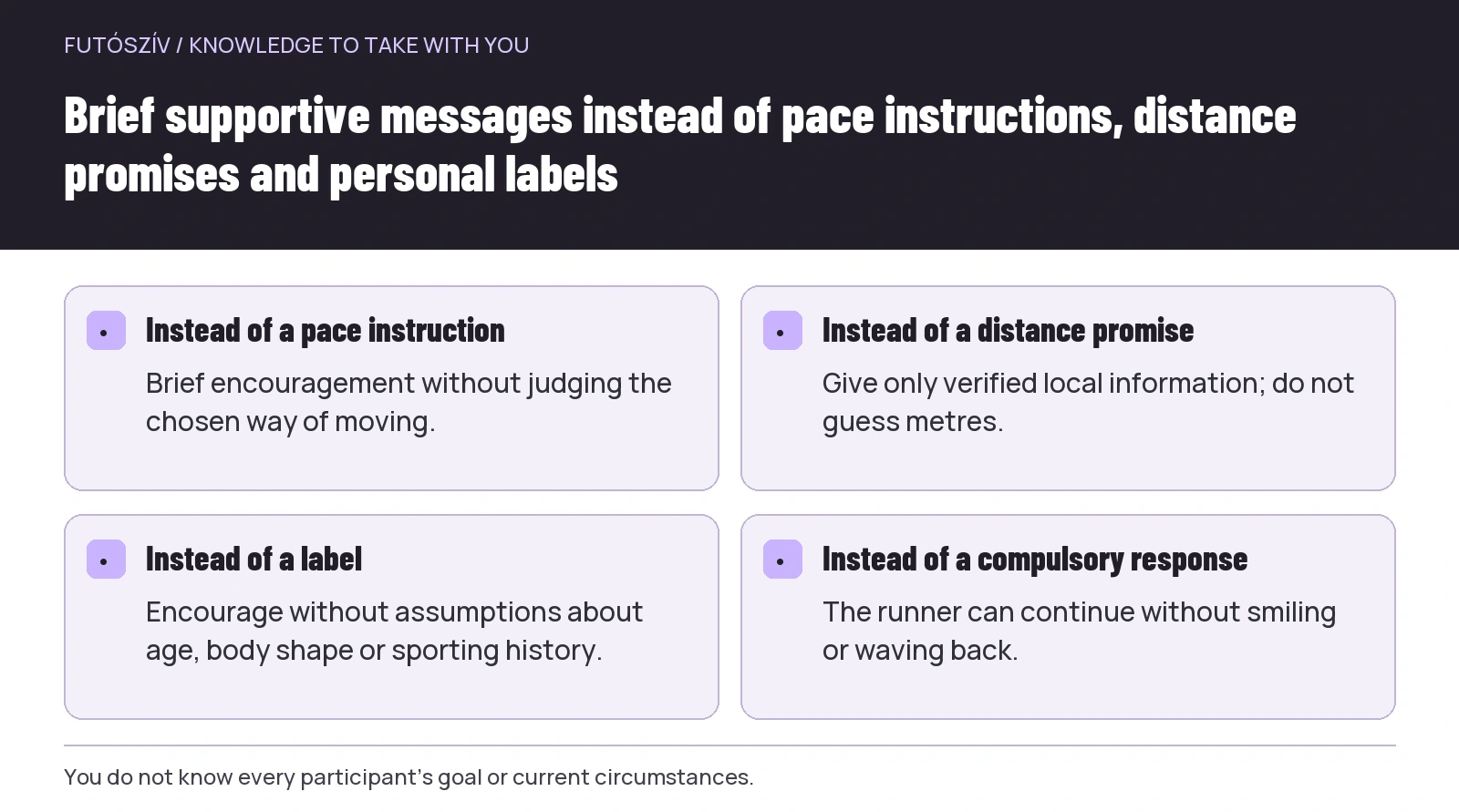 Enlarge diagram
Text version of the illustration
- Instead of a pace instruction
- Brief encouragement without judging the chosen way of moving.
- Instead of a distance promise
- Give only verified local information; do not guess metres.
- Instead of a label
- Encourage without assumptions about age, body shape or sporting history.
- Instead of a compulsory response
- The runner can continue without smiling or waving back.
Do not promise an inaccurate distance or time
‘Only a hundred metres left’ is easily said when considerably more remains. Do not guess the remaining distance as a spectator, particularly where several laps or races share a location. At the same point, one runner may be heading towards the finish and another towards another lap. Incorrect information is misleading even in an enthusiastic voice.
If you definitely know an approved organiser sign, you can point to it appropriately, but do not add your own time prediction. ‘You will definitely make your target from here’ is not a promise you can responsibly make from the roadside. Spectators do not need to override a runner’s own watch, plan and decisions. Accurate enthusiasm does not require a numerical forecast.
If someone asks a question you cannot answer, say so and point out the relevant organiser post if you know it. ‘I am not sure’ does not spoil encouragement. Wrong directions, however, can cause more difficulty. Being present as a spectator does not automatically make you a local information point.
Choosing where to stand is part of consideration
The closest spot for the best picture is not necessarily a good cheering position. The route, designated crossings, participant services and spectator movement together determine where you can wait. Do not stand where a runner or another spectator must detour around you. Your bag, sign and belongings also occupy space.
London Marathon Events’ spectator advice specifically asks people not to enter the course to take photos or run alongside participants, and to follow designated crossing arrangements. This is a particular organiser example, not the same site plan for every event. The practical principle here is respecting participants’ route. London Marathon Events: Six Essential Tips
If your chosen spot becomes overcrowded, adjust your own plan. You need not take a photo from the exact position imagined beforehand at any cost. Others in the spectator area are there for the same reason: to see and support someone. A good spectator plan leaves room to choose another location the organiser identifies as usable.
Leave attention for the field after your own friend passes too
You are not obliged to stand beside the course all day, and must organise your own time too. If you stay for a while, however, you need not reserve enthusiasm only for the fastest runners or people you know. Later arrivals are just as much part of the event. Support should not turn into pitying commentary because the time is later.
‘Even you are doing really well’ may be intended kindly, yet place the person addressed in a separate lower category. It is simpler to applaud or encourage as naturally as before. You do not need a different adjective for every pace. Recognition does not require an explanation based on comparison.
When moving on, follow spectator arrangements without obstructing others. The end of your own cheering shift does not signal the event or route closing. Do not begin removing organiser signs or using the course for something else. Spectating and organising remain separate roles.
A sign’s humour should not be at the runner’s expense
A good cheering sign can be creative and playful without ridiculing a participant’s body, age or presumed suffering. Your own humour may work among close friends, but many strangers also read it beside a public course. Choose a message that does not require inventing personal background.
The sign’s physical design matters too. It should not hide organiser information or other spectators’ views, or extend into participants’ path. Carrying, positioning and taking it away remain your tasks. Do not leave the organiser to deal with the remnants of creative cheering. Check decoration and noisemakers against the event’s local conditions too.
A message is not a command. ‘Smile for the camera’ or ‘Everyone high-fives here’ can create pressure even when intended cheerfully. A runner should be able simply to pass. Spectator interaction is considerate when the other person is not obliged to prove appreciation through a response.
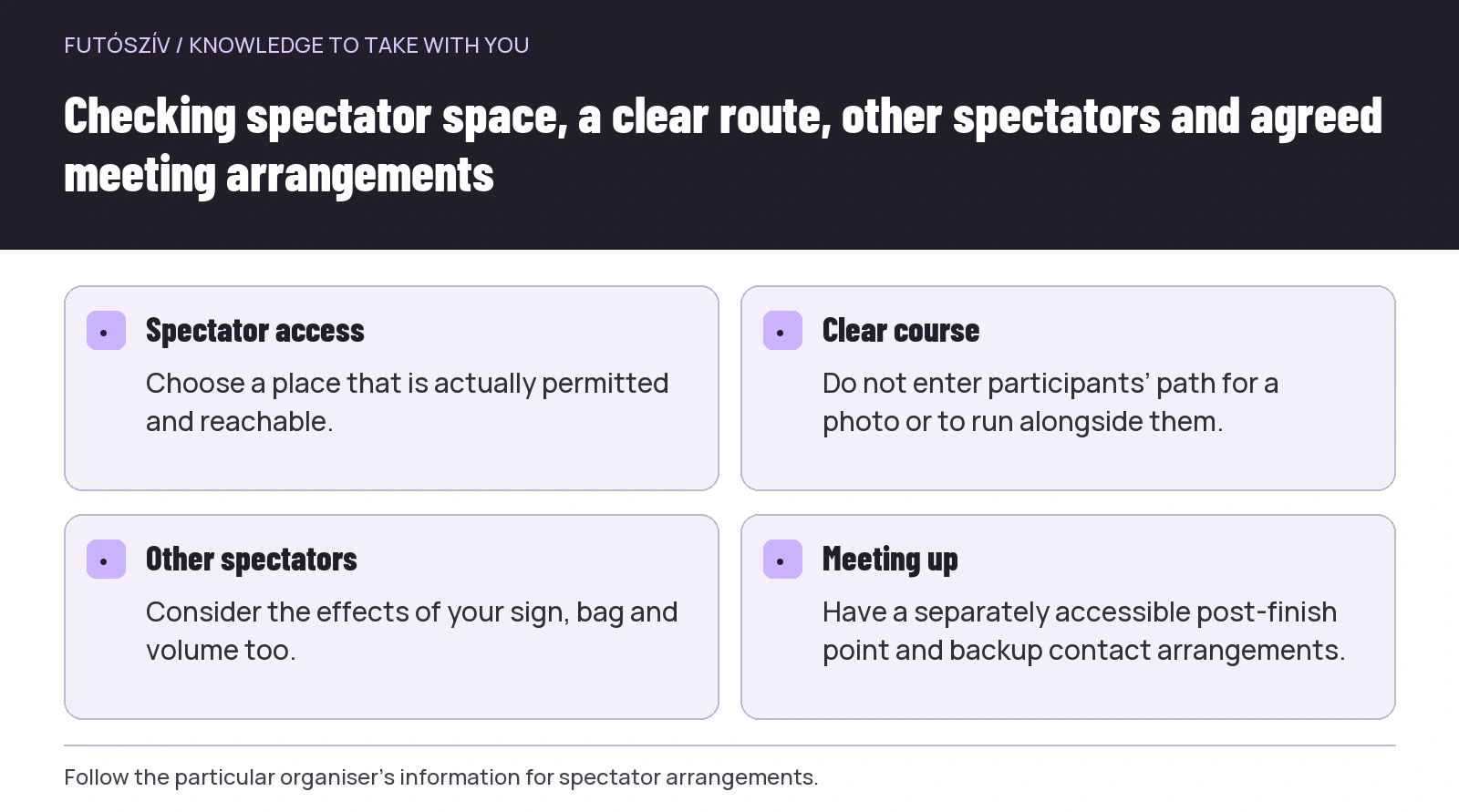 Enlarge diagram
Text version of the illustration
- Spectator access
- Choose a place that is actually permitted and reachable.
- Clear course
- Do not enter participants’ path for a photo or to run alongside them.
- Other spectators
- Consider the effects of your sign, bag and volume too.
- Meeting up
- Have a separately accessible post-finish point and backup contact arrangements.
Do not let the atmosphere drown out important signals
Music, applause and noisemaking may form part of an event, but consider nearby spectators and participants too. Follow the location’s rules and do not try to become the most noticeable supporter through volume. Pay particular attention when organisers give information or someone asks for help. A good atmosphere is no reason to ignore important communication.
LME spectator advice also mentions the effect of signs and noisemakers on other spectators. We use the source here for its perspective on shared spectator space. We do not claim that a particular Hungarian event permits or prohibits the same equipment. Your own event’s information and on-site staff guidance take precedence.
If a friend requests quieter support, do not call it a lack of enthusiasm. It could be an agreed hand signal, a brief call of their name or simply being present. Not every good spectator moment is dramatic. Adapting may mean more than a prepared surprise that the participant finds uncomfortable.
Providing assistance may have separate conditions
While cheering, do not assume you can hand over any food, drink or equipment, or accompany someone on the course. The event’s current rules may determine outside-assistance conditions. Even a request agreed beforehand with the participant does not override them. If accepting an actual support task, clarify its location and method separately.
A spectator’s role is not necessarily the same as that of an officially designated guide or helper. Do not start running beside someone because you think they would appreciate company. Respect the route for other participants and the competition conditions too. Friendly support may have an appropriate, agreed form, but on-site enthusiasm does not decide it.
If a runner requests help, pay attention to the specific request. Do not automatically substitute encouragement for something requiring organiser or medical assistance. Follow arrangements for contacting appropriate on-site staff. This article does not provide healthcare instructions; recognising and seeking appropriate help is an important boundary of the spectator role.
Meeting after the finish should not become another obstacle
The finish line is not a spectator meeting point at every event. A runner may have a required onward route, baggage collection or another organiser process. Do not enter a closed area simply because you spotted your friend. Choose a meeting place beforehand that spectators can actually reach too.
The official London Marathon spectator page recommends a meeting point agreed in advance and a backup beyond phone contact. We cite this as an organisational example without copying London locations or time estimates to Hungarian events. Learn your own event’s post-finish route and spectator access separately. London Marathon Events: Spectator Guide
When you first meet, do not immediately begin analysing results if the runner wants something else. You can ask: ‘What do you need right now?’ They may first want to change, find somewhere quieter or put their bag down. Agree the timing and detail of their account together. Finishing is not a compulsory interview.
Replanning a fictional afternoon of spectating
Two friends originally want to see the same runner at three locations, take photos and reach the finish. Organiser information shows that crossings and spectator movement make this uncertain. They choose one reliably accessible point and a separate meeting afterwards instead. The runner knows in advance where to look for them and that stopping is unnecessary.
At the chosen place, the spectators briefly encourage other participants too, and their sign does not obscure course markings. When their friend passes, they do not follow onto the course for a better picture. They take the designated spectator route to the meeting point and use the agreed backup if phone tracking is delayed. Details are fictional; the organisational logic matters.
They do not capture every moment by the end, yet the support works. The runner knew what to expect, spectators did not obstruct others and meeting up did not become a rushed search. The value of considerate cheering is not the length of a recorded video. It lies in precise, freely welcomed presence that respects participants’ own plans.
How Futószív articles are prepared: our editorial guidelines.