
When organising a small running event, it is easy to trust that a team of friends will sort everything out. Small numbers do not, however, clarify who decides on the venue, sends participant information or closes the day. Roles are needed even when one person accepts several tasks. The aim is not to imitate a large organisation, but to avoid unowned and conflicting work.
This article offers our own editorial framework for planning how work is shared. It is not a complete event-management manual and does not authorise use of public space, roads, protected areas or other locations. Specific Hungarian legal, land-use, insurance, medical and safety conditions must be clarified separately with the relevant authorities and appropriate professionals. The example below shows only organisational tasks for an imagined activity.
First describe the programme on one page
Before assigning work, make clear exactly what you are organising. A gathering of friends, an open community run, an event requiring registration and a timed race are different programmes. Describe the location, expected participants, planned duration and services offered. A name alone does not decide legal classification; the actual operation needs clarification.
Also state what the programme does not include. If there is no organised transport or baggage storage, do not let participants infer otherwise from an appealing invitation. Knowing which details they must arrange themselves helps them decide appropriately. A missing service must not later be silently assigned to an enthusiastic volunteer.
The British HSE event-planning guide lists an event’s type, location, size and duration among the starting information for planning. We use this as an organisational perspective, not as an application of the British law it cites to Hungary. Make the appropriate local enquiries for your own circumstances. HSE: Getting started
Do not confuse doing a task with making a decision
Someone may be able to send an invitation without being authorised to change the programme’s time. Another person can install an approved information sign without independently deciding the participant route. In the division of work, record both questions: who carries out the task, and who approves the associated decision?
This matters particularly when several volunteers help. ‘Responsible for communication’ may be too broad: does it mean participant emails, on-site information or press coverage? A role’s tasks need a beginning, an end and an outcome. Someone who agreed only to design the poster has not thereby become the contact for the entire event.
Do not reserve decision-making authority only for exceptional situations. An everyday change can affect several areas: a later start may change venue availability, helpers’ shifts and participants’ journeys home. The decision-maker should see those connections. Local convenience for one subtask is not necessarily a good decision for the whole programme.
Identify who coordinates the organising team
Not everyone needs to ask the same person about every small detail, but the whole event needs an identifiable system of responsibility and decisions. A participant’s question should not circulate among three friends who each believe another is handling it. The internal team should also know where final decisions are made and how information reaches them.
The HSE guide to roles emphasises clearly assigned tasks and coordination between those involved. Here we use the organisational principle that connections between tasks need to remain understandable alongside their handover. Specific legal responsibility does not depend on the labels in our own spreadsheet. HSE: Set clear roles and responsibilities
Contact arrangements can be simple: a named person responsible for each area, one shared source of current information and known cover arrangements. But people must actually accept their tasks. Entering a name in a column does not mean they have accepted the role or demonstrated the necessary knowledge or time.
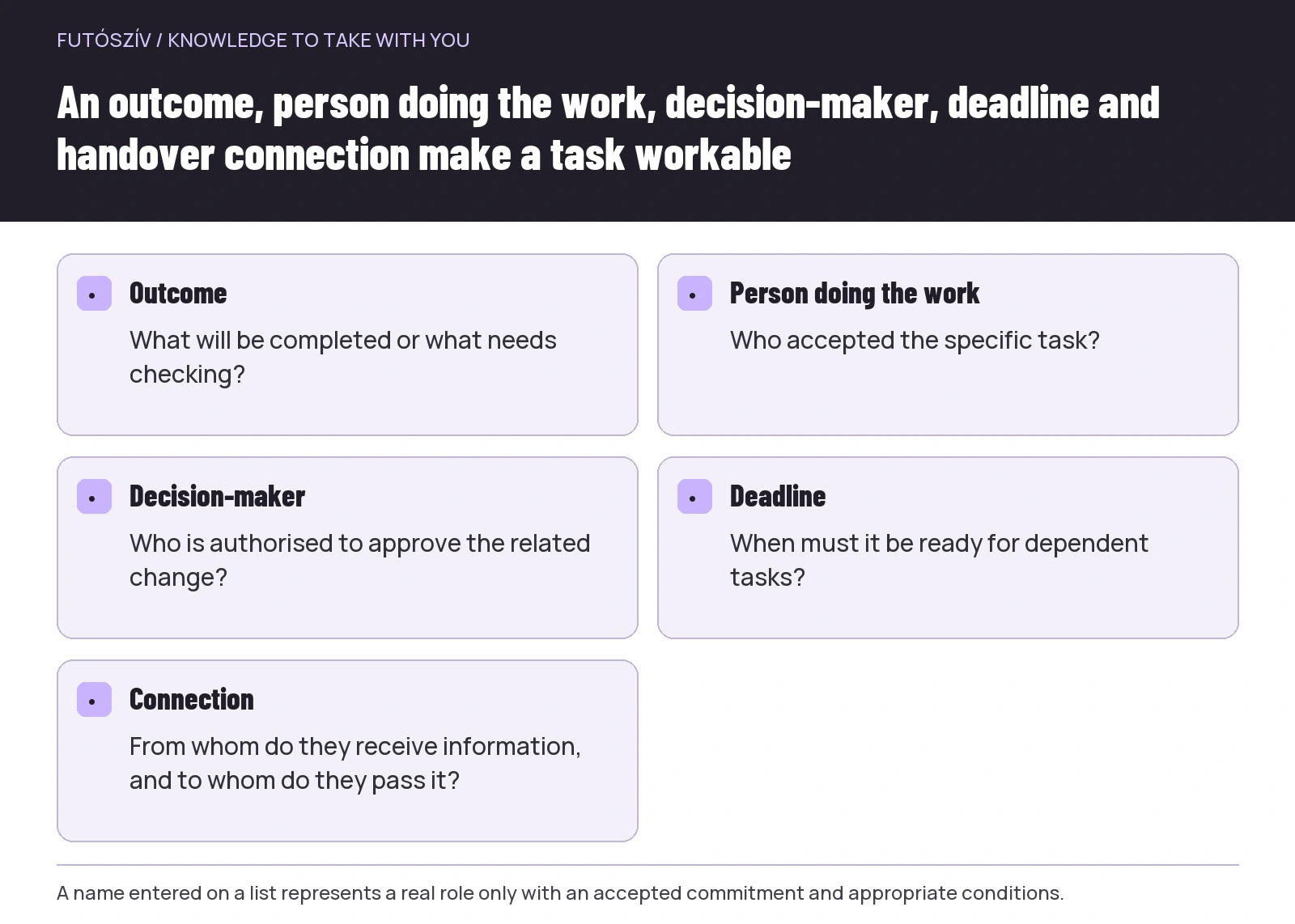 Enlarge diagram
Text version of the illustration
- Outcome
- What will be completed or what needs checking?
- Person doing the work
- Who accepted the specific task?
- Decision-maker
- Who is authorised to approve the related change?
- Deadline
- When must it be ready for dependent tasks?
- Connection
- From whom do they receive information, and to whom do they pass it?
Include the outcome in a task table
‘Venue: Anna’ does not say what counts as completed work. A task becomes more useful when accompanied by its expected result, the person doing it, the approver and the deadline. Adapt the table to the actual programme, and do not substitute enthusiasm for necessary professional roles.
| Task area | Expected outcome | Who needs to be connected? |
|---|---|---|
| Venue and access | Verified, documented conditions of use | Owner, operator and relevant organisational and professional contacts. |
| Participant information | Current, consistent information | Programme lead and every relevant service area. |
| Volunteer assignments | Accepted roles, shifts and briefing | People responsible for directing the particular tasks. |
| Equipment and services | Confirmed delivery, use and return arrangements | Appropriate supplier and the person receiving items on site. |
| Completion | Handover of the site and equipment, plus a list of open issues | Venue operator, suppliers and organising-team coordination. |
This is not a complete list of necessary tasks. A specific event may need further areas, while legal or professional requirements must be established separately. The template prevents work-sharing from becoming a mere list of names. Every row should show what actually needs creating or checking.
Mark dependent tasks separately
An invitation can be accurate only when essential venue and programme conditions are clear. Volunteer shifts can be planned only when tasks and time windows are known. A supplier’s delivery can happen only if someone can receive the equipment. These are not independent ticks, but connected steps.
A fictional example: the invitation for a community morning is planned for Friday, but venue availability will be confirmed only on Monday. The communication lead’s task is not to conceal uncertainty. The organising decision may be to postpone the invitation or seek another genuinely confirmed arrangement. Finished artwork does not make an unconfirmed venue more certain.
Give dependencies a decision point. ‘If confirmation has not arrived by this time, we will not advertise this version of the programme.’ Choose the specific limit for your own circumstances. This is not a bureaucratic obstacle, but a check on promises made to participants. Do not try to conceal a missing condition with extra work for a later volunteer shift.
One person can hold several roles, but cannot be in two places at once
In a small team, the same person naturally accepts several tasks. The question is whether they conflict in time or attention. Someone welcoming participants may be unable to receive a distant equipment delivery at the same moment. Someone supervising an assigned post cannot automatically leave it for another question.
Check combined roles against the day’s timeline too. Which task is continuous, which has a fixed time and which can be completed beforehand? Overlapping peaks may require another person or a simpler programme. Reducing participant numbers alone will not necessarily resolve a geographical or professional conflict.
Cover is a specific role too. Know who can step in, what information and training they received, and which task they leave behind when taking something over. ‘Someone will help’ is not a cover plan. A backup person also needs to know precisely what to prepare for and freely accept the commitment.
Give volunteers tasks they can carry out
A good role description includes location, time, specific work, necessary equipment, responsible contact and how to report changes. Training depth should match the task’s requirements. Work needing qualifications, experience or particular authority cannot be covered by a brief friendly message. Consider this when assembling the team.
A new helper should be able to say when something is unclear or the commitment differs from what they expected. Reliability does not mean saying yes to everything without questions. A clarifying question may reveal an error in the organisational plan too. The team leader should correct information in the right place, rather than whispering an exception only to that person.
Plan helpers’ basic on-site conditions too: arrival, breaks, toilets, personal belongings and departure. These are not incidental matters left over after participant services. If a shift extends, related conditions may change too. You are organising a whole day for the team as well, not merely a few minutes around the start.
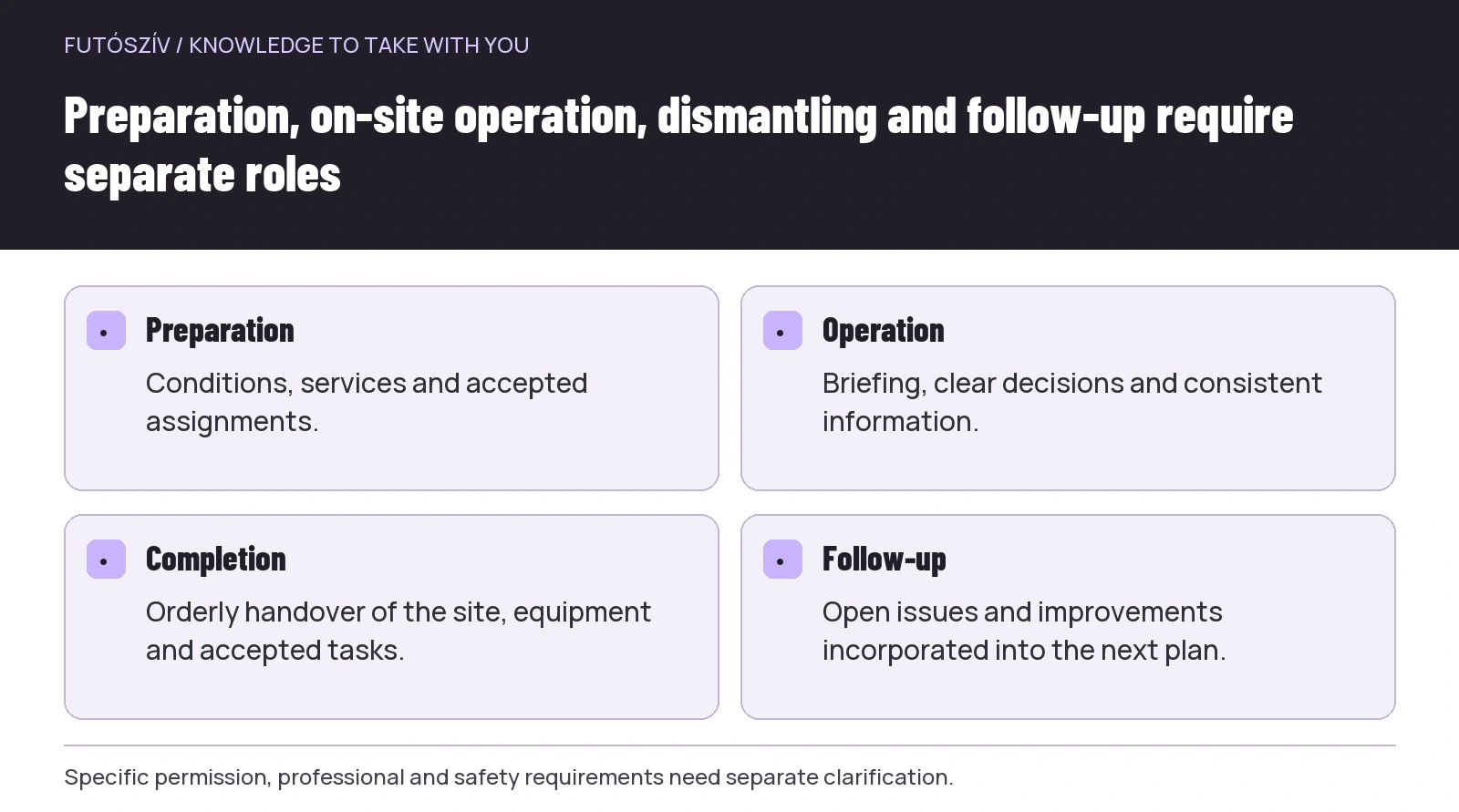 Enlarge diagram
Text version of the illustration
- Preparation
- Conditions, services and accepted assignments.
- Operation
- Briefing, clear decisions and consistent information.
- Completion
- Orderly handover of the site, equipment and accepted tasks.
- Follow-up
- Open issues and improvements incorporated into the next plan.
Give every phase of operation an owner
An event does not begin at the start or end with the last finisher. Preparation, on-site operation, dismantling and follow-up may involve separate tasks. During planning, already record who receives and returns the venue, when equipment arrives and who stays for closing tasks. Enthusiastic attendance in the morning is not an automatic commitment to dismantle in the evening.
The HSE event-management page also specifically emphasises coordinating construction and dismantling stages. Here we use the principle of considering the entire lifecycle from the British document. We do not present its regulatory or employment rules as Hungarian requirements. Appropriate professional conditions for your own site and services need separate arrangements. HSE: Managing an event
The day’s timeline helps reveal gaps. Every running-time post may have someone assigned while nobody has accepted the morning handover or returning remaining equipment. Do not assign these afterwards in front of an exhausted team. Match the size of a manageable programme to resources for the entire operation.
Do not spread changes through several parallel groups
If the start, meeting point or a participant service changes, maintain one approved version of the information. A chain assembled from separate conversations easily becomes contradictory. After the responsible decision, identify who updates public information, who informs helpers and how receipt by those affected is checked.
Mark a version or at least the last update time on the internal task list. An elaborate system is unnecessary: one clear document may be better than several screenshots at different stages. The important point is that the team knows where to find current information. Do not leave old versions circulating as though they are still usable.
Tell participants the verified change and their next task. Do not burden them with the entire internal organisational debate, but do not promise certainty where a decision is still needed either. Clear communication also includes saying when further official information is expected. Give an uncertain issue an owner and deadline.
A fictional small event: identifying three unowned tasks
The organisers of an imagined local running morning compile a list of names. Someone is assigned to welcoming, participant information and the closing meet-up. During the shared review, however, they discover nobody has confirmed the venue handover, nobody is designated to receive the equipment delivery and final tidying remains only a general promise.
The team addresses these gaps rather than adding another attractive activity. Venue conditions are clarified with the relevant people, equipment gets a named recipient and completion receives a separately accepted time window. If a condition cannot be secured, they change the programme or do not hold it in its original form. This example does not claim these steps are sufficient to organise a complete real event.
The lesson is making tasks visible. Work can remain unowned despite a list of names, and expertise can still be missing despite many helpers. The plan improved when specific outcomes, commitments and connections were checked. A small event’s simplicity can then become a real organisational choice rather than hidden uncertainty.
Carry at least one improvement forward after completion
At the shared review, ask more than whether the atmosphere was good. Which role remained too broad, which information arrived late and where did two tasks conflict? Discuss facts with the appropriate people, keeping necessary personal details within a limited circle. The purpose is improving the next operation, not retrospectively finding someone to blame.
Give an improvement a specific owner and next decision point. If return transport was delayed, ‘we will pay attention next time’ should not be the only lesson. Include advance confirmation and a named, committed recipient in the plan. A small change has value when it appears in both the next occasion’s document and practice.
An event with well-shared work does not function because everyone does everything. Those involved understand their own commitments precisely, professional tasks reach appropriate people and changes follow a clear path. A creative programme can build on that foundation. Shared enthusiasm then rests on work that can be done and a system of responsibility that can be brought to completion.
How Futószív articles are prepared: our editorial guidelines.