In a small kitchen, preparing food often stalls not because you do not know the recipe, but because there is nowhere to put the next ingredient. The chopping board, saucepan, washing-up and finished food compete for the same limited space. A good workflow can therefore be particularly helpful on busy running days. Knowing in advance where preparation will happen, where the finished food will go and when equipment will become available can mean less searching and rushing as you cook.
This article offers ideas for adults organising their home kitchens. It does not replace manufacturers’ instructions for equipment or appropriate food preparation and storage conditions. Adjust the amount and composition of your meals to your diet, needs and training demands. Allergies, limited mobility or other individual circumstances may call for personalised arrangements for the workspace and tasks. The layouts described are ways of thinking, not identical floor plans for every kitchen.
Look at your kitchen in terms of four tasks
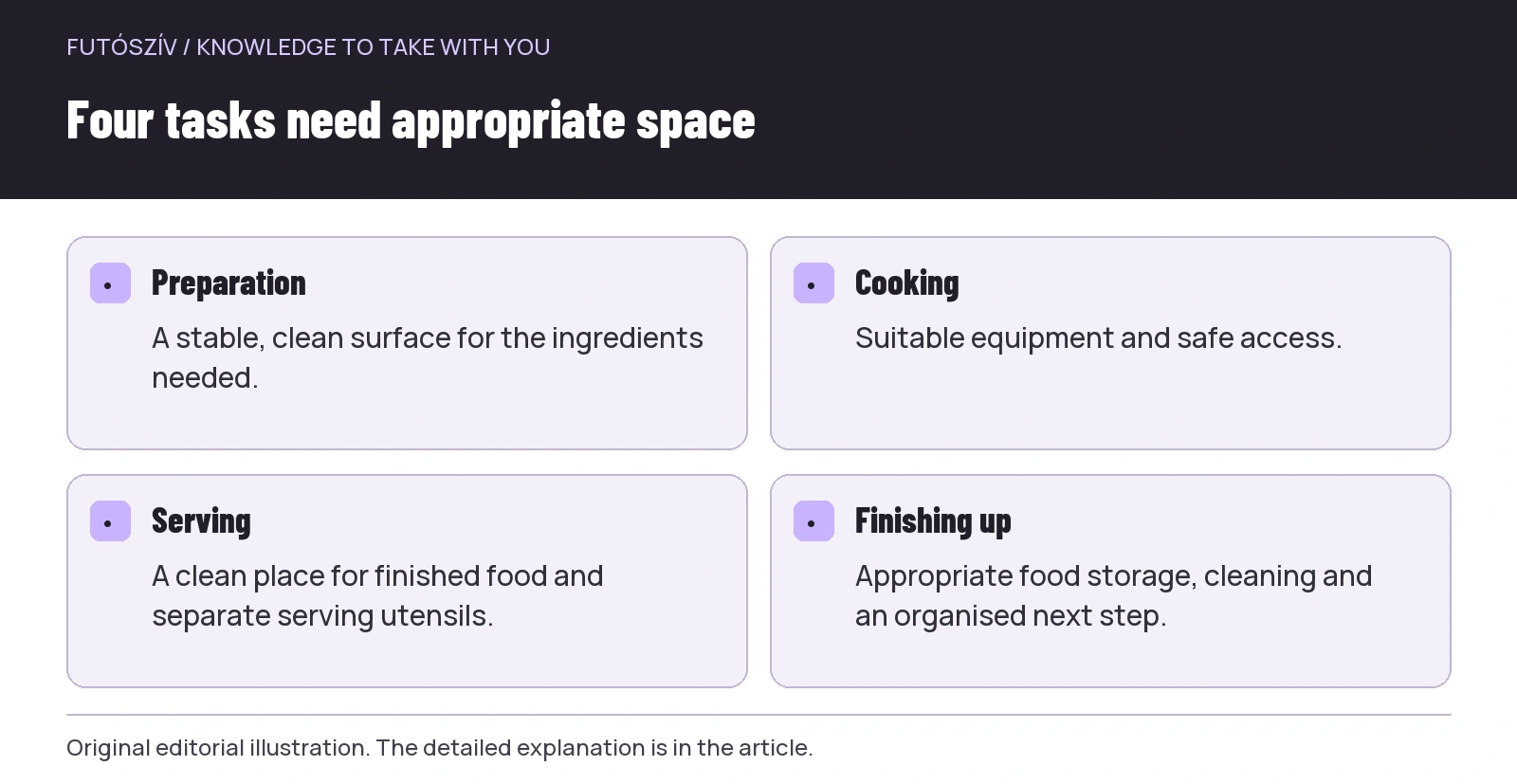
The first task is appropriate preparation, the second is cooking, the third is serving finished food cleanly, and the fourth is cleaning equipment and completing the process. In a small space, each cannot necessarily have its own permanent worktop. Their roles still need to be understood separately. The same surface can serve different purposes at different times, provided appropriate cleaning and any necessary separation take place in between.
Do not put out every piece of equipment you own at once. Keep the things needed for the next stage of the particular recipe within reach, leaving room to work safely. For example, a clean serving plate should not wait underneath a bowl that touches raw ingredients. A hot pan needs a stable, suitable place, rather than the top of a package that happens to be there. The spatial side of cooking can be planned just like the order of ingredients.
A short space check before your next cooking session
Check where the chopping board fits securely, where you can access the sink and wash your hands, and where a clean dish for the finished food can go. Then check the space around the cooking appliance and the route for moving safely. You should not have to reach over another person or an object while carrying hot liquid. Your equipment and kitchen determine the solution; the worktop in an impressive recipe video may look very different from yours.
Write down one recurring obstacle. Are you always searching for the lid? Is the clean dish out of reach? Is there no space to handle raw ingredients properly? A specific obstacle allows a targeted change. Buying another appliance is an answer only if it actually solves that task and can be positioned appropriately. Another object on the counter does not by itself simplify cooking if it leaves even less workspace.
Preparation order is part of hygiene
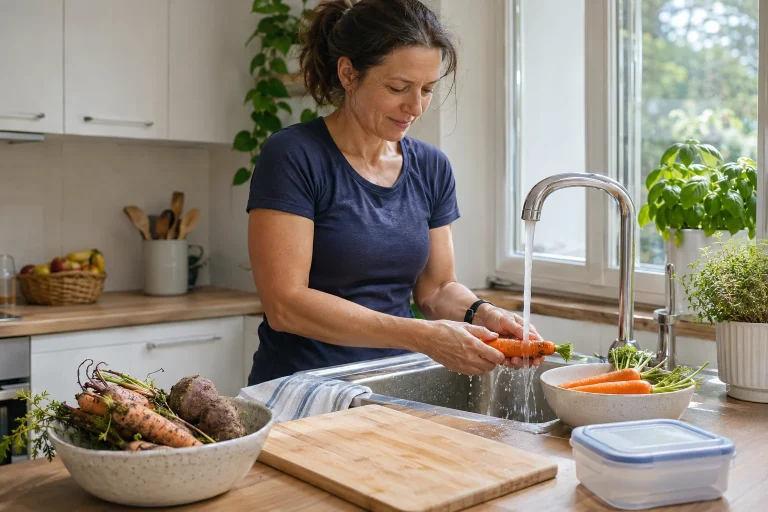
The BfR food preparation guide recommends preparing items that will later be eaten without heat treatment first, followed by ingredients that require cooking, provided adequate refrigeration capacity is available. If this order cannot be followed, appropriate cleaning of work surfaces, equipment and hands is needed in between. Deliberately planning separation in time can be particularly important on a small worktop. Limited space does not remove the need for a necessary hygiene step.
The Food Standards Agency guide to cross-contamination discusses preventing pathogens from passing from raw ingredients to other food, hands and equipment. In your own kitchen, be clear about when a surface or utensil has touched raw food and when it is properly clean again. Ready-to-eat salad or bread should not go on the same uncleaned area used for the previous task.
| Task | What needs space? | When can the space change roles? |
|---|---|---|
| Preparation. | A stable board, appropriate ingredients and clean utensils. | After the necessary cleaning and separation. |
| Cooking. | Suitable cooking equipment and safe access. | According to the equipment’s conditions of use. |
| Serving. | A clean plate and utensils for finished food. | While maintaining protection for the finished food. |
| Finishing up. | Washing-up, a suitable container and any necessary refrigerator space. | Every next step is organised by the end of the process. |
 Enlarge diagram
Text version of the illustration
- Preparation
- A stable, clean surface for the ingredients needed.
- Cooking
- Suitable equipment and safe access.
- Serving
- A clean place for finished food and separate serving utensils.
- Finishing up
- Appropriate food storage, cleaning and an organised next step.
Read the whole recipe first
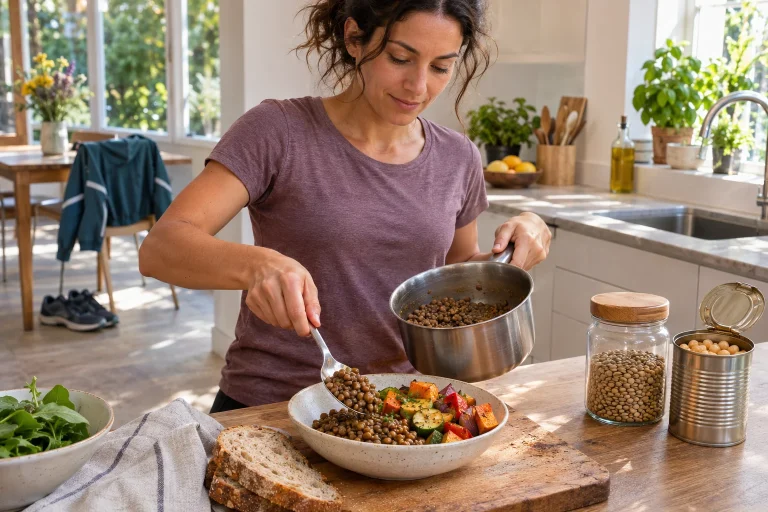
Look for any step requiring another dish, a lid, an ingredient that is already cooked or a finish in the oven. A short ingredient list can still involve several operations. If a recipe calls for ready-to-use pulses or a precooked accompaniment, you need to provide them in the appropriate state. Discovering missing preparation halfway through cooking is particularly inconvenient in a small kitchen. Knowing the complete sequence makes both space and time easier to plan.
Interpret the equipment list in relation to your own kitchen. The size and material of a pan in a recipe can matter, and not every dish is suitable for the oven or another appliance. The European Commission information on food contact materials includes kitchen utensils and containers within this area of use. Choose a product intended and suitable for the particular operation, and follow its own manufacturer’s instructions.
Prepare enough, without creating more than you can manage
There is no need to leave every ingredient in separate little bowls on the worktop for a long time. Make the items needed for the next stage accessible, while products requiring refrigeration remain stored according to their own conditions. Taking out too many ingredients in advance occupies space and creates handling issues. Good preparation means doing only as much work beforehand as genuinely helps with that particular recipe and its safe preparation.
If ingredients need cutting, aim for the size required by the recipe and the appropriate state of the ingredient. Do not choose an uncertain cutting technique or an unstable surface for the sake of speed. A shape you can cut safely with your own equipment matters more than a movement seen in a video. More elaborate decorative cuts can be omitted from many everyday dishes if proper preparation and the intended usability are maintained. Simplify the work to suit the actual food.
Build around a main component you can prepare properly
Choose a dish that does not require many operations needing continuous attention at the same time. A familiar sauce with a separately prepared accompaniment, a suitable one-pan dish or another simple format can provide a starting point. Complete the meal according to your own diet and needs. Fewer pans do not define your personal nutrient balance. Simple cooking can still produce a meal of an appropriate size with several thoughtfully chosen components.
If every recipe step demands attention at once, first look for stages you can safely complete in sequence. The completion and appropriate serving of the different components need coordinating, but everything need not happen in parallel. During some waiting periods, you can organise equipment if supervision of the particular operation allows it. Do not leave an appliance that needs watching unattended for a lengthy task in another room.
Make cleaning part of the transition between stages
If the same surface is to serve another task, do the necessary cleaning before placing the next food on it. Follow the cleaning product’s label, including suitability for the surface and the required method of use. Keep cleaning products appropriately separate from food, and do not mix different chemicals at random. The aim is appropriate removal of the particular contamination and the necessary hygiene, not constantly making the kitchen smell fragrant.
Consider frequently touched points too: a handle, tap, phone or spice container may be touched while handling raw ingredients. Reading a recipe on a phone is practical, but reaching for the device should not make it impossible to keep track of cleanliness between hands and food. Reading the recipe in advance helps with this too. If needed, make a short, clearly visible list of steps so you do not have to search again at every stage.
 Enlarge diagram
Text version of the illustration
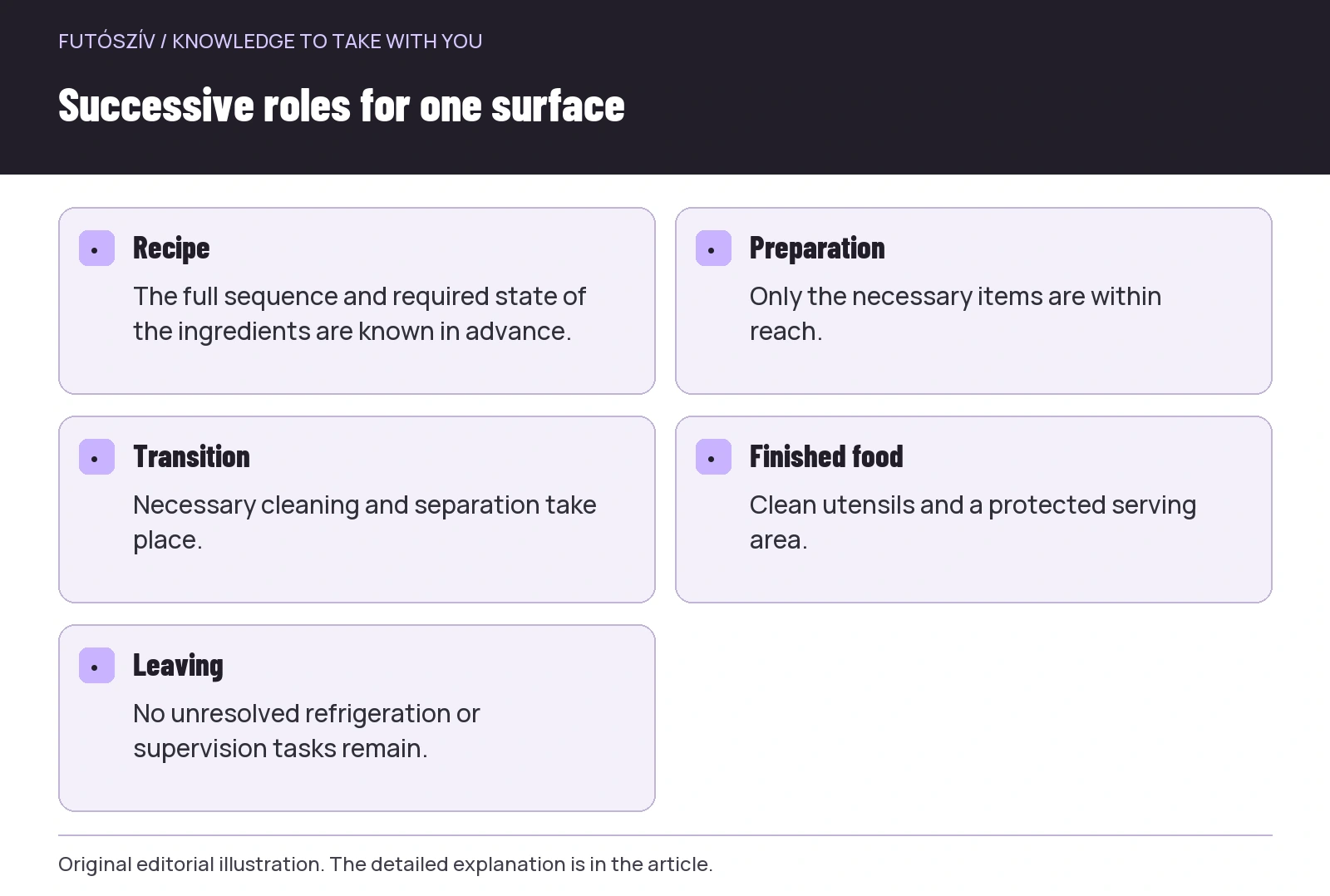
- Recipe
- The full sequence and required state of the ingredients are known in advance.
- Preparation
- Only the necessary items are within reach.
- Transition
- Necessary cleaning and separation take place.
- Finished food
- Clean utensils and a protected serving area.
- Leaving
- No unresolved refrigeration or supervision tasks remain.
Clear a place for finished food before cooking
Have a clean plate or suitable bowl for the finished dish, with serving utensils accessible. The original unwashed plate used for raw ingredients should not become the finished food’s next destination. If several people are eating, plan space for their appropriate separate portions or toppings too. Serving is not a leftover task after cooking; in a small kitchen, this stage can quickly fill the worktop.
If you are also making a portion for later, plan the necessary clean storage container and appropriate refrigeration arrangements in advance. Leaving a large saucepan unresolved does not become simpler because you are already heading out to train. Match the amount you cook to what you can handle appropriately. The kitchen plan ends when the food is properly served or stored, with no abandoned operation requiring supervision.
A specific workflow example
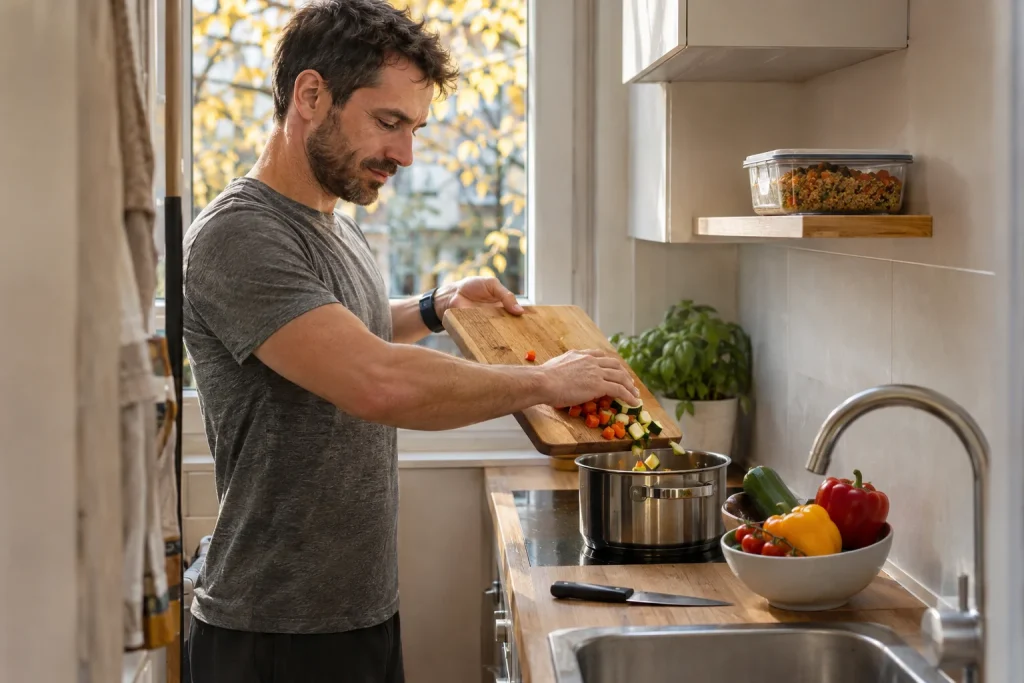
Imagine an evening when you are making a familiar vegetable sauce with an appropriate accompaniment. First secure a clean serving area and the equipment you need. Next, prepare the vegetables according to the recipe and hygiene requirements, then move on to the sauce. Start cooking the accompaniment in line with the recipe and your own equipment. A surface that becomes available during cooking, once properly cleaned, can later serve as the serving area.
This example gives no general timings, because the particular product and equipment determine the preparation required. The important point is the change of role: a preparation area becomes a place for finished food only after appropriate cleaning. At the end of the kitchen process, any remaining food also needs appropriate handling and the equipment needs cleaning. Adapt the amount and composition of the whole meal to your needs, rather than to the size of the worktop.
In a shared kitchen, agree on when people use each space too
If several people are cooking, sharing the work surface and cooking area may require a specific discussion. Who uses the board, sink and refrigerator at which stage? Everyone involved needs to know the necessary cleanliness requirements and any individual allergen conditions. A quick handover must not mean declaring a contaminated surface ready for use. Shared equipment should be used only in an appropriate condition and as intended.
A short shared recipe worksheet can help: the next operation, the space needed, the responsible person and how the stage is completed. Whoever takes over should know the state of the food. Distinguishing ingredients that are already cooked from those still requiring preparation is especially important when someone joins in after a run. Good kitchen cooperation does not give everyone the same activity; it gives each person a clear, manageable task that can be carried out appropriately.
Improve one sticking point for next time
After cooking, think about where the process stalled. Did the recipe fail to suit the equipment? Did the clean serving area become available too late? Was there no refrigerator space for the portion intended for later? Choose a specific improvement for the specific obstacle. Rearranging a shelf, using another familiar recipe or handing over tasks more clearly can help more than collecting yet more general kitchen tricks.
A small kitchen becomes useful on busy running days when the next operation always has an appropriate place and tool. A thoughtful sequence maintains hygiene requirements, protection for finished food and personal dietary needs. The result is a repeatable workflow: from ingredients to clean serving and an orderly finish, each stage connects clearly to the next.
Sources and further reading
- BfR: Pre-cooking for several days — what should I bear in mind?
- Food Standards Agency: Why avoiding cross-contamination is important
- European Commission: Food contact materials — general information
How Futószív articles are prepared: our editorial guidelines.