
Congratulations feel good after a successful race. When you miss a target time, however, it can easily seem as though you are worth less in the eyes of your group as well. There is an important distinction: a result is a piece of information about a particular sporting task, while your friends’ respect is part of a relationship. You can take your running seriously without confusing the two.
This article is a community guide for male runners. It does not suggest that every man bases his worth on his results, and it does not treat mental health problems. We look at ways to discuss results, disappointment and recognition more precisely within a running group. The examples are editorial constructions; the questions are not diagnostic tests.
Do not answer three separate questions with a single number
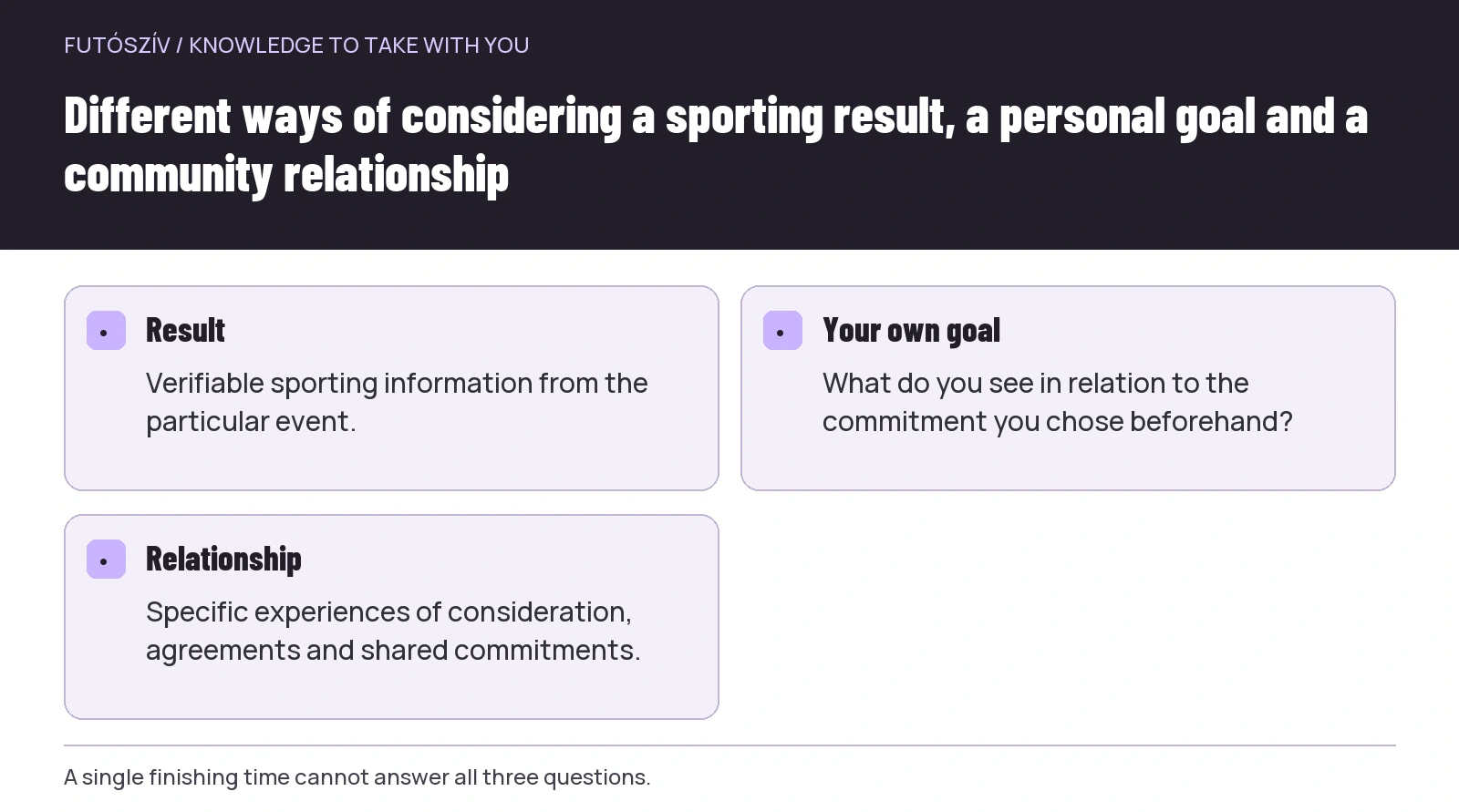
The first question is: what result did you achieve at this event? The official result, distance, time and race conditions help answer that. The second is: how closely did you meet your own earlier goal? Answering this requires knowing what you had set out to do. The third is: what kind of companion are you within the community? That cannot be calculated from your finishing time.
A fast runner can be a considerate or inconsiderate teammate, just as a slower runner can. Arriving on time, keeping a shared agreement, listening to another person and completing an organisational task you accepted are separate behaviours. They can be recognised specifically. There is no need to attach either a better or a worse race time to them.
UK Coaching’s guide to understanding individual participants pays attention to the person alongside their performance. Here we draw only on the coaching principle that a participant’s perspective and individual needs also matter. The social examples below are our own editorial applications, not conversation techniques prescribed by the organisation. UK Coaching: Understanding the Individual Guide
You can take a target time seriously without judging your entire self
You do not have to say that finishing times mean nothing if you have put a great deal of work into a specific goal. You can enjoy improvement and feel disappointed when something does not work out. Being precise helps prevent one result from becoming an all-encompassing judgement. ‘I did not achieve my chosen time on this occasion’ is a different statement from ‘I cannot do anything properly.’
Specific questions also make sporting reviews more useful. Which details can you establish confidently from the available information? What remains uncertain? What needs discussing with the appropriate professional? The group does not have to produce a complete analysis immediately, and you do not have to explain everything at the finish line.
You can say simply, even in front of your male friends: ‘This goal mattered to me, and I am disappointed right now. I am not looking for advice yet; I would rather we just met up.’ That does not diminish your sporting goal, nor does it automatically invite the group to criticise all your decisions. You can choose the form of the conversation at that moment too.
 Enlarge diagram
Text version of the illustration
- Result
- Verifiable sporting information from the particular event.
- Your own goal
- What do you see in relation to the commitment you chose beforehand?
- Relationship
- Specific experiences of consideration, agreements and shared commitments.
Keep hidden rankings out of congratulations
‘You finally ran a decent time’ or ‘Now you are one of us’ may be intended as praise, yet they suggest that the participant was worth less before. It is more precise to respond to the goal achieved or the particular work involved: ‘I am glad you achieved what you trained for.’ If you do not know what the result meant to them, ask first.
You do not have to praise everyone with the same sentence. One person wants to talk about their placing; another wants to discuss a well-managed journey or their first time taking part independently. A good question leaves room for what they consider important. ‘Which part stayed with you most?’ allows more answers than ‘What was your time, and why was it not better?’
| A limiting remark | A more precise response from a friend |
|---|---|
| ‘Finally, a result worth mentioning.’ | ‘Was that your goal? I am glad it worked out.’ |
| ‘You no longer need to be embarrassed by that.’ | ‘You put a lot of work into it; what would you like to tell us about?’ |
| ‘That is the minimum for our team.’ | ‘Let us discuss the requirements for our shared activity separately.’ |
| ‘Quite good compared with the others.’ | ‘How do you see it in relation to the goal you set beforehand?’ |
The table is not a list of banned words. It shows that praise can also leave room for choice and specificity. The aim is not to learn polite stock phrases, but to keep another person’s story from disappearing behind your own comparisons.
Do not respond to disappointment with compulsory reassurance
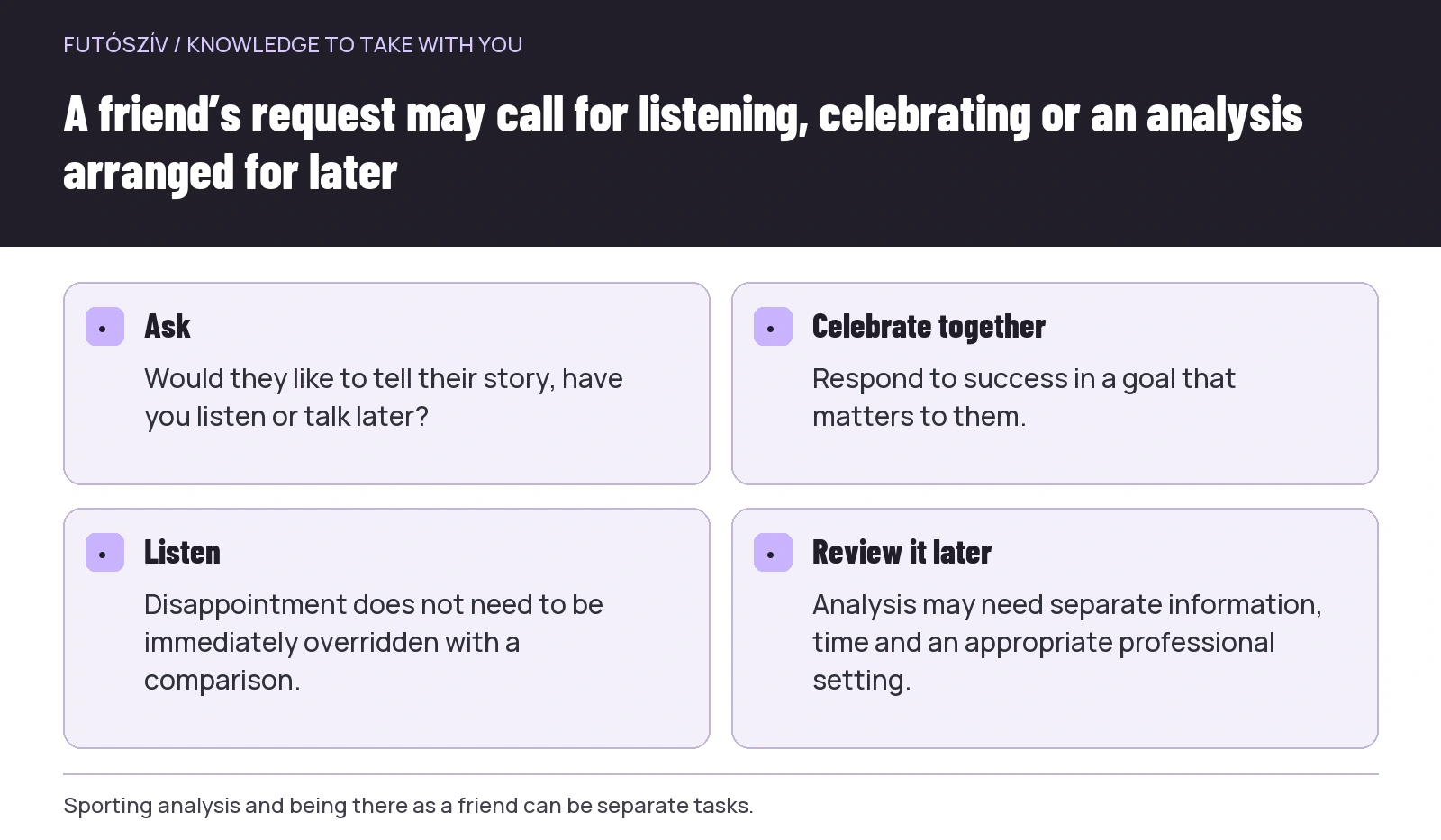
If your friend is disappointed, they may not immediately need to hear ‘But that is fantastic.’ They may really have wanted something different in relation to their own goal, and want to explain that first. You can ask: ‘Would you like me to listen, or would you like to look through something together?’ Their answer makes it easier to offer the right kind of company.
Announcing one of your own old results does not always help either. The fact that you ran a different time over the same distance does not make their current situation any clearer. If they ask for a comparison, you can discuss the figures, but it should not be the automatic first response. Listening does not mean agreeing with every conclusion they draw.
Respect the limits of a conversation between friends too. If difficulties connected with a race result persistently extend beyond what a conversation together can address, seeking appropriate professional support may also be warranted. This does not require a running friend to make a diagnosis. Community care and professional help have different roles.
Notice specific contributions to the community
Someone checked a route, helped newcomers, passed on relay information accurately or accepted a volunteering role. These are contributions in their own right. They need not be handed out as consolation prizes to someone who did not run fast. Recognition is credible when it relates to a task actually completed, without assuming that the person now needs a substitute for their result.
The parkrun milestone system, for example, recognises participation and volunteering occasions separately. This is an international programme’s own system, not a general rule in Hungary. The example shows how a running community can make clearly defined contributions beyond finishing times visible too. parkrun Support: Milestones
Your own group does not have to copy this system. You can simply thank someone for organising something or providing reliable help. Make sure that taking part without running does not become a compulsory service in return: someone who is not racing at the moment cannot automatically be expected to take on every supporting task. Contributions should remain voluntary too.
Put community leaderboards in their proper place
A chosen challenge can have scoring rules known in advance, and participants can enjoy their placing. It is a different matter if someone retrospectively turns every shared outing into a ranking. Saying yes to a group run does not necessarily mean accepting constant comparison. The rules should belong to the particular challenge.
Shared app data do not tell the whole story either. They do not show why someone went out, which parts they recorded or how the activity fitted into their day. They do not need to make all of that public for you to respect their participation. Do not invent personal explanations on someone else’s behalf from missing background information.
If you do not want to appear on a leaderboard, you can say so separately: ‘I am happy to join in with organising the meet-up, but I am not taking part in the weekly comparison at the moment.’ Others can still hold a separate challenge if its commitments are clear. A running friendship does not have to gather every activity into one scoring system.
 Enlarge diagram
Text version of the illustration
- Ask
- Would they like to tell their story, have you listen or talk later?
- Celebrate together
- Respond to success in a goal that matters to them.
- Listen
- Disappointment does not need to be immediately overridden with a comparison.
- Review it later
- Analysis may need separate information, time and an appropriate professional setting.
A conversation after a fictional target time
A runner wanted to complete ten kilometres in fifty-five minutes, but finished in fifty-eight. These figures are invented; they do not represent a training plan or a general standard. One group member might immediately say: ‘It is fine; I am slower than that.’ This may be well meant, but it says nothing yet about the runner’s own goal or feelings.
A more precise opening is: ‘I know fifty-five mattered to you. Would you like to talk about it now, or later?’ If the runner wants to tell their story, the others listen. If they would prefer to postpone the analysis, the social meet-up can still continue. Their friends’ attention is not a reward for achieving the target time, and disappointment need not be required to fill the entire afternoon either.
Later, the result can be reviewed separately with the appropriate information and professional context. The relationship involves another conversation: did they enjoy meeting, did the arrangements after the finish work, and what would each person like next time? Keeping these two questions separate means the runner does not have to earn their friends’ company by entering another race or improving immediately.
Your introduction can include more than a personal best
In a new running group, favourite distances and sporting backgrounds naturally come up. But you do not have to use your best result as a permanent addition to your name. You can say where you enjoy running, why you came today and what sort of shared activity you are looking for. There can be several ways into a relationship.
This matters even if you have strong results. You need not worry that you must constantly prove your previous level on a relaxed group outing. A personal best is a specific performance you can celebrate; it is not a permanent promise to perform for the group. Share your experience when it is actually requested and fits the situation.
If another goal takes priority for a while, you can state that simply too: ‘I am interested in group outings at the moment; I am not planning a race time yet.’ You do not need to choose a new identity label for this. Your relationship with sport can change without your having to withdraw every old result or justify every new meet-up.
Small decisions can shape a group’s habits
If the first question in every introduction is about someone’s best marathon time, the group is showing, intentionally or otherwise, what it considers most important. You can choose different questions: which route interests you, how did you find us, what shared activity are you looking for? Anyone who wants to can talk about their personal best later. A broader welcome does not exclude a real interest in results.
A group account of an outing can also include several perspectives. Alongside results, discovering a new route, managing a relay handover well or taking on a first shared role can all be stories. You do not have to give everyone an equal amount of praise every time. What matters is that the group’s attention is available beyond occasions when someone runs faster than the others.
A group leader can do a great deal by avoiding the use of performance as a ranking of people’s worth. The requirements of an advertised sporting activity can be stated precisely while respecting another person and their choices. Suitability for an activity is a specific organisational matter, not a general judgement about anyone’s worth.
A short personal review sheet
If the questions become tangled after a result, write three separate lines. Put the verifiable sporting information on the first. On the second, note your own earlier goal and what you would like to review later in relation to it. On the third, record specific events from the social outing: whom you met, which agreement worked, what help you received or gave. This is an aid to organisation and conversation, not a therapeutic exercise.
Do not try to turn every uncomfortable feeling into something ‘positive’ immediately. The aim is not to make everyone call an unsuccessful race good. Drawing precise distinctions helps keep the result in its proper place, so that the relationship does not have to be rebuilt from a single number.
You can be an ambitious runner and a considerate companion at the same time. A good result can be celebrated, disappointment can be heard, and a contribution to the community can receive separate recognition. When these do not compete for one single label, running friendships remain meaningful on both faster and more difficult days.
How Futószív articles are prepared: our editorial guidelines.