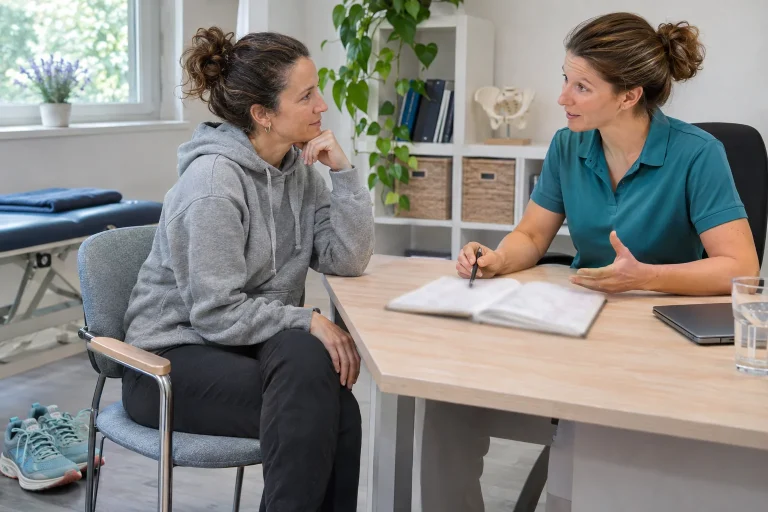
After an osteoporosis diagnosis, runners often hear two apparently opposing messages: move for your bones, but be careful with impact. The uncertainty is understandable because general benefits and individual fracture risk are different questions. A useful answer needs findings, fracture history, current symptoms, balance and sporting experience together.
Running with postmenopausal osteoporosis cannot be decided through one online yes or no. This article explains the information needed to discuss it, how to request more precise guidance and what preserving movement opportunities means. It offers neither personal clearance to run nor a bone-loading programme for everyone.
The findings need their history alongside them
The NHS explains that osteoporosis may remain without obvious symptoms for a long time. Feeling well or running without pain therefore cannot rule out a bone condition. Equally, a diagnosis alone does not describe previous activity, fractures or the goal you want to prepare for.
Bring complete reports, previous investigations and fracture history to the consultation. Where, when and under which circumstances an injury happened matters, rather than only the number of bones fractured. If an old diagnosis is unclear, ask for help gathering the background.
The NOGG risk-assessment recommendation considers several clinical factors together; a previous low-trauma fracture provides significant information about future risk. Bone-density results matter but are not the whole story. A running watch or endurance test does not replace this assessment.
Three different starting situations
In the first, someone has run for years, has no known fracture or new symptom, but is diagnosed with osteoporosis. The second includes a previous vertebral fracture or several low-trauma fractures. The third involves a recent injury, new back pain or another unexplained symptom. The same question, ‘Can I run?’, does not necessarily lead to the same next step.
These examples illustrate differences rather than provide home risk categories. The first does not automatically permit unlimited loading, and the second does not permanently prohibit all movement. In the third, clarifying symptoms and healing takes priority.
Tell the professional which type of running you mean too. A short easy flat loop, intense intervals and technical trails create different situations. A precise description can help produce specific guidance rather than general caution.
A vertebral fracture requires separate loading advice
The Strong, steady and straight consensus gives a more cautious impact framework after vertebral or multiple low-trauma fractures: without individual professional guidance, it recommends no more than impact equivalent to brisk walking. This is not a beginner running programme, but an important indication that history changes activity choices.
The Royal Osteoporosis Society explains that later higher-impact options can depend on factors including fracture circumstances, pain and fitness. Do not infer permission to start running from one symptom-free day or an acquaintance’s experience. Seek advice specific to your condition.
Make clear which movement can be performed meanwhile. If you have heard only prohibitions, ask about manageable options, preparation and reassessment timing. Reducing uncertainty can preserve confidence in movement.
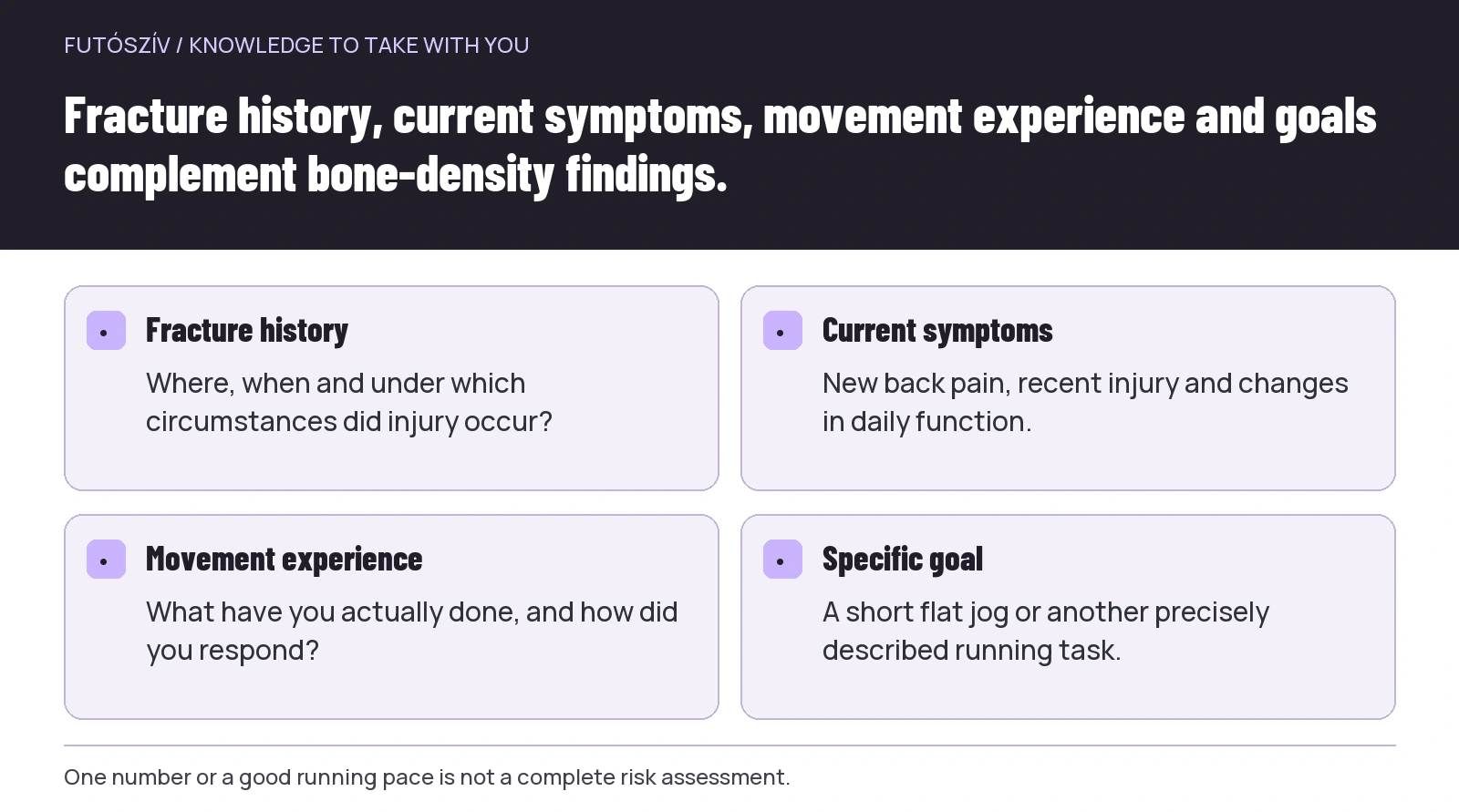 Enlarge diagram
Text version of the illustration
- Fracture history
- Where, when and under which circumstances did injury occur?
- Current symptoms
- New back pain, recent injury and changes in daily function.
- Movement experience
- What have you actually done, and how did you respond?
- Specific goal
- A short flat jog or another precisely described running task.
Do not automatically treat new back pain as muscular
The NOGG guideline identifies acute back pain alongside osteoporosis risk as a situation where investigation for vertebral fracture may be appropriate. Not all back pain is a fracture, but known bone problems change how the symptom should be assessed.
Describe onset, any fall or lifting, location and changes. Noticed changes in height or posture may matter too. Do not repeatedly jump or bend painfully to decide how serious the situation is.
The NHS recommends urgent help for severe pain after injury. Calling 112 may be appropriate for severe illness or serious injury. The task then is arranging care rather than changing the running plan; do not try to run home yourself.
Movement can have several components
The NOGG guideline recommends weight-bearing and muscle-strengthening activity adapted to needs and abilities, with balance work when appropriate. Place running within the whole programme. It is not the only valuable movement and does not automatically replace other tasks.
Lower-impact activity supporting endurance can also feature. The Royal Osteoporosis Society distinguishes impact loading on bone from activities in which a bicycle or water partly supports body weight. Their roles differ, so simply calling them good or bad is unhelpful.
Personal goals may include independent daily functioning, more confident walking, fitness or later some running. Different tasks can support them. Ask each exercise’s purpose so the programme does not become an incomprehensible compulsory list.
Strength-training technique needs learning too
Known osteoporosis is not a reason to fear all resistance, but exercise selection and instruction matter. Clarify range, resistance and progression conditions with a professional. Particularly with a recent fracture or other symptoms, do not copy another person’s ready-made programme.
The UK consensus also highlights modifying high degrees of spinal flexion, especially under load. This should not imply that every part of everyday movement is dangerous. Ask instead for practical lifting and exercise guidance appropriate to your individual condition.
Equipment is not safe or risky in itself. Weight, position, movement, experience and supervision matter together. If uncertain, the next step is demonstration and feedback rather than judging yourself as too weak or too capable for it.
Assess circumstances around falls too
The environment outside the running track matters. Recurring instability, previous falls, poor lighting, slippery surfaces or awkward equipment are details to discuss. Balance and safe surroundings are practical parts of a bone-health plan.
If running is an option, choose routes matching ability and individual advice. A predictable surface and visible surroundings may be a simpler starting point than uneven trails in darkness. Suitable shoes and visibility do not replace assessment, but have a real role in daily decisions.
A balance exercise should not become a voluntary fall hazard. Use professional-recommended support or assistance where needed. Its aim is developing ability and confidence, rather than tolerating the most unstable situation possible.
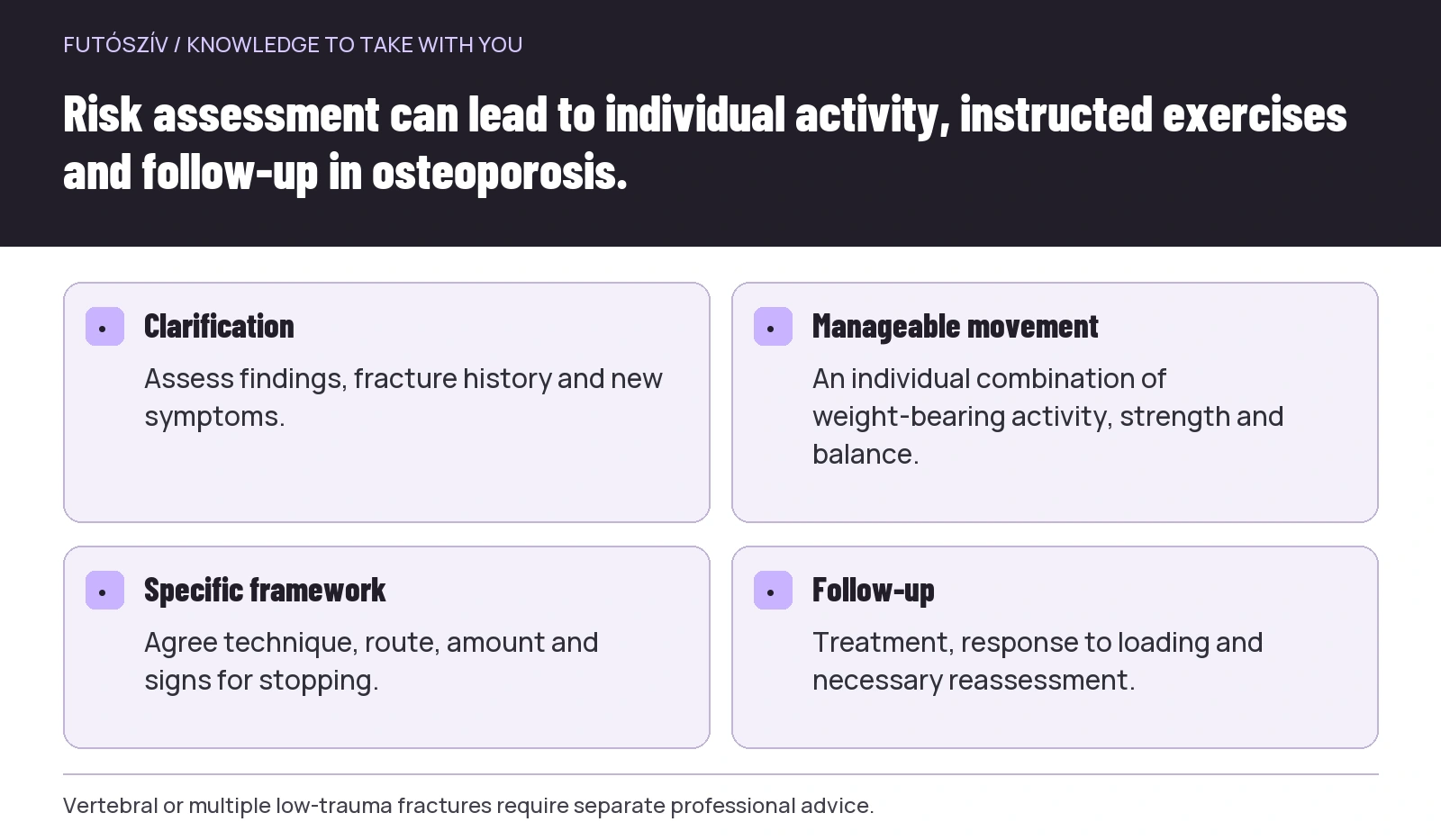 Enlarge diagram
Text version of the illustration
- Clarification
- Assess findings, fracture history and new symptoms.
- Manageable movement
- An individual combination of weight-bearing activity, strength and balance.
- Specific framework
- Agree technique, route, amount and signs for stopping.
- Follow-up
- Treatment, response to loading and necessary reassessment.
If running is appropriate, define the starting framework
Individual guidance should establish the suitable task now and signs for change. Clarify ‘you can exercise’: which distance, surface, intensity and follow-up does it mean? A short session that can easily be stopped may provide more understandable experience than completing an old loop.
Do not change duration, speed and terrain together. New strength training or other loading alongside running counts too. Evaluate recurring localised pain, new back symptoms or another change before progression rather than treating it as part of getting used to exercise.
Agree the framework with a partner too. They should understand that slowing, walking or stopping is possible, rather than encouraging you through uncertainty. Shared activity supports you when it adapts to your individual plan.
Good training data cannot replace bone treatment
The NHS discusses treatment alongside lifestyle measures. Better endurance, strength or wellbeing does not justify independently changing medication. Discuss continuation and review with your clinician, including side effects or questions.
The same applies to nutrition and supplementation. Appropriate intake matters, but more products do not automatically provide better bone protection. Seek advice based on your diet, known deficiencies and other conditions. Supplements do not grant permission for harder training despite symptoms.
At follow-up, describe actual activity rather than simply saying you are active. This can connect care and movement plans more closely. Bone-density checks should not automatically be timed to a training-diary milestone either.
Make caution specific rather than constant fear
After diagnosis, every movement can begin to feel risky. Writing a few manageable tasks and clear stopping signs with the professional may help. Precise boundaries can offer more reassurance than all-encompassing but unclear warnings.
Mention if fear has led you to avoid everyday movements too. Rebuilding confidence can be part of your plan. You do not have to independently prove you are unafraid or match other people’s faster returns.
Sporting goals can change while movement retains its value. More strength work, another route, shorter running or temporarily another activity may fit. A good plan supports life in current circumstances and can be reassessed.
Questions for the next review
- Given my full history, what is the main risk, and are any symptoms unresolved?
- Has there been a vertebral fracture or another injury requiring separate loading boundaries?
- Which activities can I do now, and what could prepare the next step?
- Which exercise needs instruction or modification?
- Which symptoms mean stopping and contacting you again?
- How does movement connect with treatment, nutrition and monitoring?
The answer about running with osteoporosis comes from individual risk and specific loading together. The aim is not circumventing a general prohibition or obtaining a sports permit. Build movement opportunities that are understandable, manageable and consistent with long-term care.
Sources
- NHS: Osteoporosis, updated October 2026
- NOGG: Fracture risk assessment and case finding
- NOGG: Non-pharmacological management of osteoporosis
- Brooke-Wavell and colleagues: Strong, steady and straight – UK exercise consensus, 2022
- Royal Osteoporosis Society: Impact exercise to help make your bones stronger
How Futószív articles are prepared: our editorial guidelines.