If you cook before running, finishing food handling properly belongs in the departure plan. A large pan left on the counter until you return is not a solution. Safe cooling at home requires knowing in advance which food will be eaten when, which container it needs and how appropriate chilling will happen within the necessary time. In an organised system, leaving for a run does not interrupt an unresolved food-handling process.
This guide provides general household support for adult runners. It is not a catering procedure or an identical storage-life table for every food. Follow specific labels, the food’s handling guidance and any individual healthcare instructions. Clarify additional requirements for particularly vulnerable people’s meals with the appropriate provider. The system offers practical support for clear, appropriate handling.
Distinguish four pieces of information
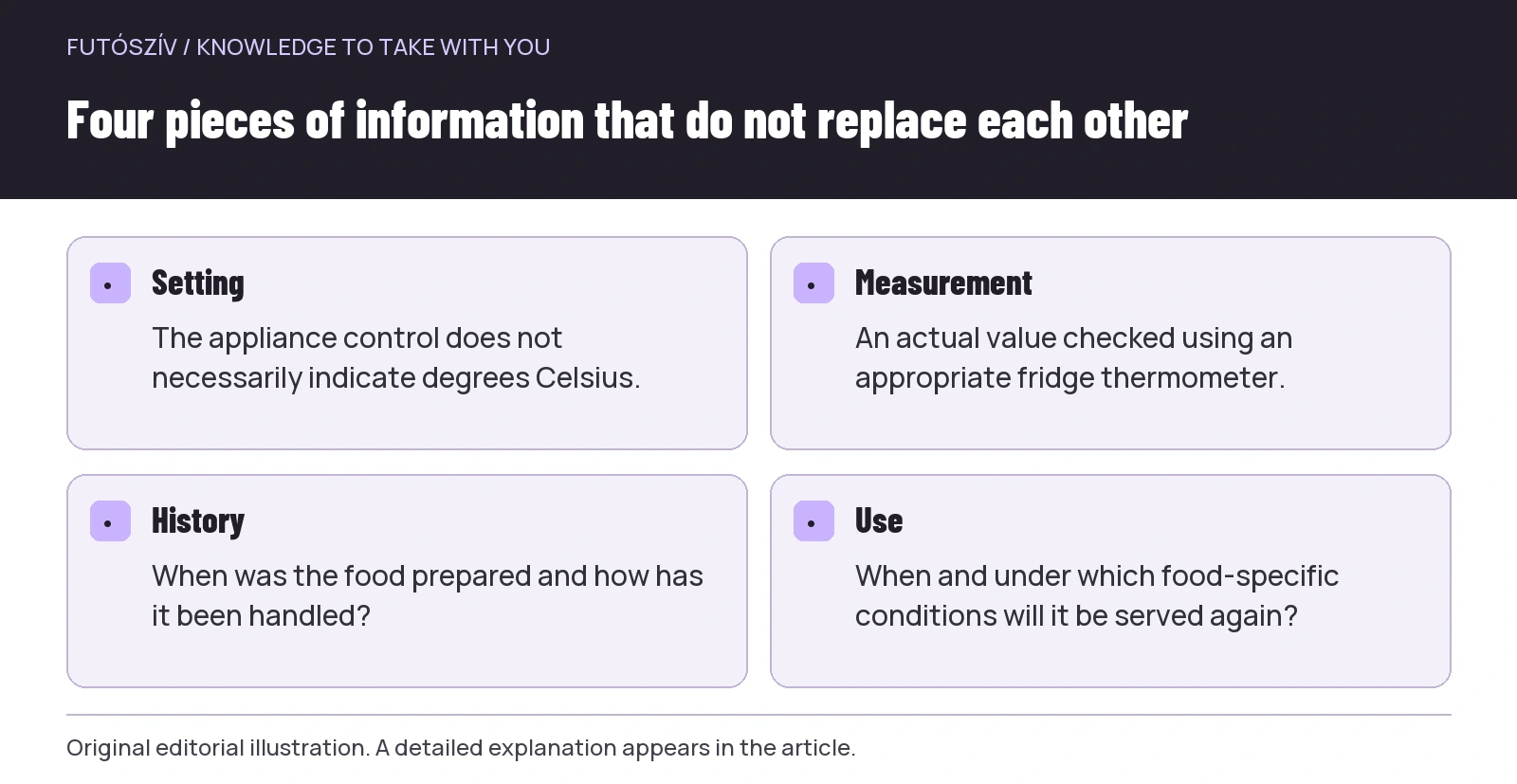
The first is the fridge setting, the second the temperature actually measured. The third is the food’s preparation and storage history, the fourth its planned use. They relate but do not replace each other. A fridge at the correct temperature cannot make previously mishandled food suitable. Freshly cooked food does not remain safely stored simply because the dial appears to be in a suitable position.
Do not record only that food is in the fridge. If later use matters, know its preparation time and exact contents too. Memory may work for one box but becomes unreliable across several dishes and family members. Simple identification helps retain the history while proper chilling remains a separate requirement.
The dial’s number is not necessarily degrees Celsius
The Food Standards Agency consumer information points out that a built-in control scale does not necessarily show actual degrees Celsius. Set operation according to the appliance manual and check conditions using an appropriate fridge thermometer. A dial set to three does not automatically mean an internal temperature of three degrees.
The Nébih Wasteless programme advice on fridge use describes a fridge temperature between zero and five degrees Celsius and checking with a thermometer. Follow any stricter product storage instructions too. Use your fridge and position the thermometer according to their instructions. Reading a device helps when you understand what it shows and the conditions measured.
Do not automatically treat a momentary reading after prolonged door-opening as a description of the whole day’s operation. Equally, do not ignore an unfavourable reading by assuming the fridge must work. Check settings and operation according to appliance and thermometer guidance, and arrange a suitable solution for persistent problems. This article is not a repair guide and gives no universal waiting time for every appliance.
Plan the cooling route for freshly cooked food beforehand
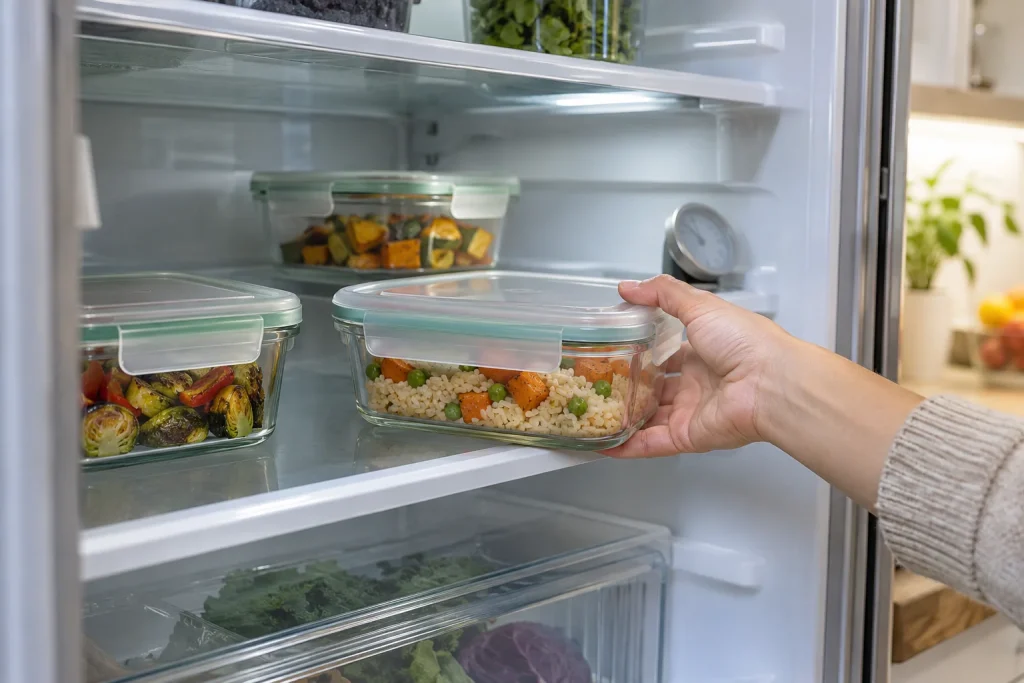
Before cooking, check where the portion intended for later will go. Are clean, suitable containers and enough storage space available? If the fridge is already packed, do not start seeking a solution over the finished pan. Match cooking quantities to handling capacity too. Preparing several meals together is practical only when appropriate cooling and storage are feasible.
Nébih guidance also mentions dividing food into smaller amounts and using cold water to cool the container more quickly. Food requiring refrigeration should not remain at room temperature for more than two hours; do not wait until the end of that limit to start active cooling. Choose a method suitable for food and container, using clean equipment. Simply placing a large hot pan into an already full fridge can affect other foods’ temperature too.
 Enlarge diagram
Text version of the illustration
- Setting
- The appliance control does not necessarily indicate degrees Celsius.
- Measurement
- An actual value checked using an appropriate fridge thermometer.
- History
- When was the food prepared and how has it been handled?
- Use
- When and under which food-specific conditions will it be served again?
Smaller batches do not necessarily mean smaller meals
A smaller storage unit for cooling and your meal portion are different concepts. A complete meal can come from several properly handled containers. Portioning here supports manageable cooling and later use, rather than prescribing consumption amounts. Do not quietly change an adequate diet based solely on new box sizes. Personal needs concern the whole meal.
Choose a container compatible with the food and necessary temperature process. Manufacturer conditions matter: not every box suits hot food, freezing or later microwave reheating. Lids and seals may have different handling requirements too. Do not choose packaging solely by which empty container fits your bag. Appropriate food handling begins with the container at home.
| Task | What to clarify beforehand | Why does it matter? |
|---|---|---|
| Food intended for later. | When will it be prepared and used? | Its history and next step remain known. |
| Cooling. | A clean, suitable container and a quick method appropriate to the food. | A large container should not wait unresolved on the counter. |
| Fridge space. | Appropriate temperature and placement. | Putting a box inside is not a complete guarantee on its own. |
| Identification. | Exact contents and preparation time. | Later decisions should not begin with guesswork. |
| Use. | Food-specific limits and necessary steps. | Do not apply one general time limit to every dish. |
Keep raw and ready-to-eat food separate in the fridge too
Arrange storage so raw ingredients and their juices cannot contaminate ready-to-eat food. Closed or appropriately covered storage and an arrangement suited to the appliance can help. The outside cleanliness of a lid matters when containers are stacked too. A lid cannot resolve every cross-contamination issue if raw-ingredient handling remains disorganised.
Use clean utensils for cooked food during cooling and transfer too. Cooking does not automatically protect against later contamination. Wash spoons, boards or bowls used with raw ingredients before using them with cooked food. When preparing several dishes, create a simple, clear workspace. Separating clean and raw stages remains necessary in a small kitchen.
A completely full fridge is not a better reserve
The Food Standards Agency chilling guidance discusses suitable appliance temperature and following labels. Arrange storage according to your fridge’s conditions of use. Do not cover or obstruct areas the manufacturer requires clear, or make the interior unmanageably full. Space needed for food belongs within cooking and shopping plans.
If preparing ingredients or meals for several days, identify a realistic use for each. Many boxes do not prove every meal is resolved. Alongside suitable storage, consider your diet, planned amounts and food-specific use limits. Do not merely push unused stock backwards when another box arrives. Start the next meal with an identifiable item that is actually suitable.
General chilling systems coexist with food-specific requirements
Do not give rice, egg dishes, cooked meat dishes and chilled spreads one storage-life number intended to cover everything. Follow their own guidance. Adding a fresh ingredient to a mixed dish does not automatically extend an older component’s storage time. Freshly served food, a safely retained portion for later and leftovers with an uncertain history are three different situations.
Reheating is not a general repair for earlier incorrect storage. If the history is unknown or necessary handling did not happen, do not decide from smell or the promise of boiling later. A currently good fridge-thermometer reading does not prove suitable storage during earlier hours either. Measurement checks one level; history remains separate information.
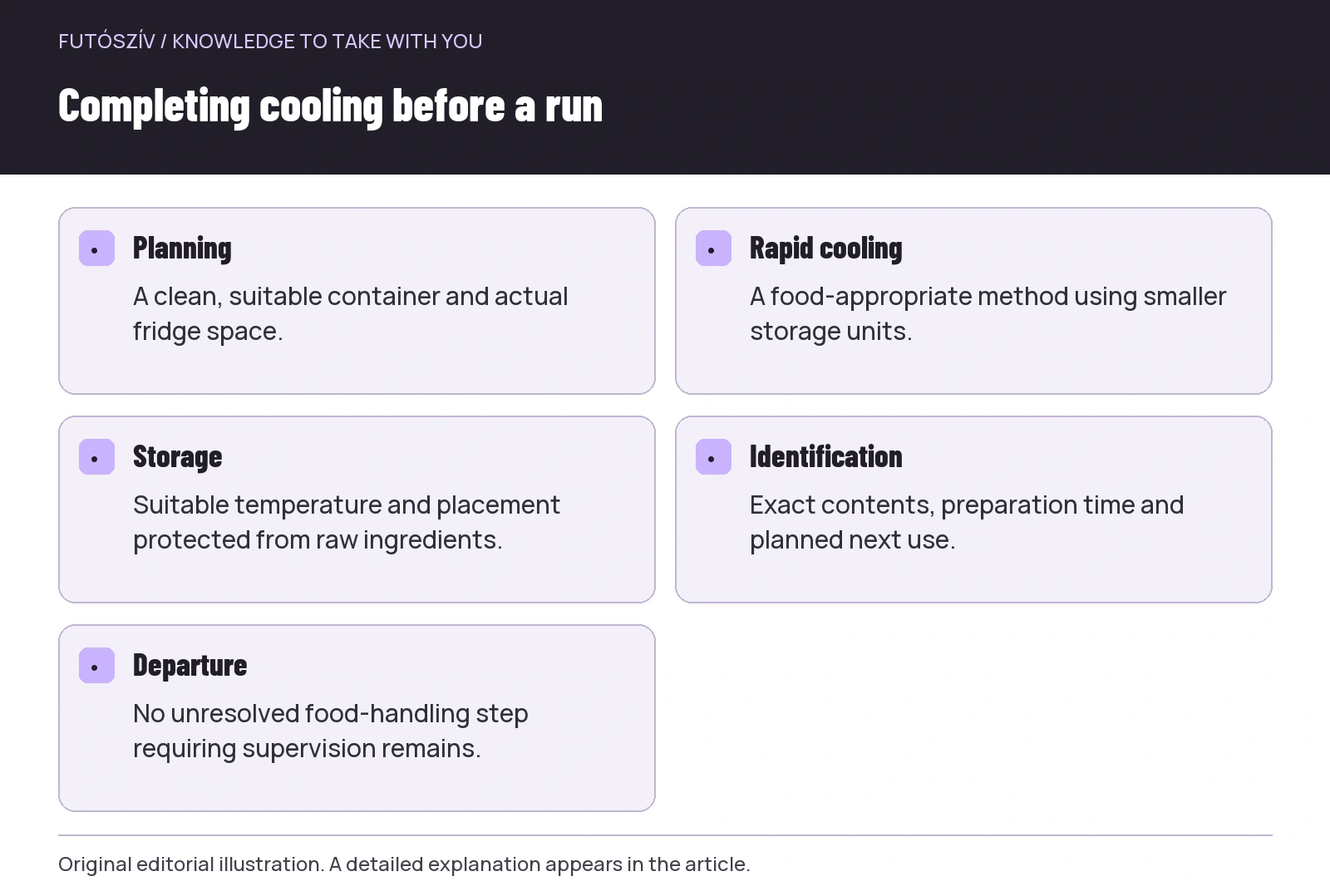 Enlarge diagram
Text version of the illustration
- Planning
- A clean, suitable container and actual fridge space.
- Rapid cooling
- A food-appropriate method using smaller storage units.
- Storage
- Suitable temperature and placement protected from raw ingredients.
- Identification
- Exact contents, preparation time and planned next use.
- Departure
- No unresolved food-handling step requiring supervision remains.
Complete the kitchen process before running
Check appliances and food before leaving. Is any cooking still in need of supervision? Is food awaiting chilling on the counter? Is it clear who finishes appropriate handling? Do not rely on a vague promise that somebody will put it away. If another adult takes the next step, specify task and timing and ensure they know the necessary procedure.
If cooking and cooling cannot fit before the run, choose another sequence. The meal might be prepared fresh later, or another suitable dish may be more practical. Saving time cannot mean leaving a critical stage unattended. A realistic departure plan allocates time to finishing in the kitchen just as to changing clothes or preparing keys.
Three common cooling errors need different solutions
If actual fridge temperature is unsuitable, address operation and settings according to the manual. If cooling always starts late, plan containers and the work sequence beforehand. If box contents and times are unknown, identification and household handover are missing. Do not use the same solution for all three. New storage boxes, for example, do not repair a faulty fridge.
A simple personal check can record actual thermometer readings and problems if useful for improving the system. Every meal does not need a complicated home quality-assurance log. The aim is recognising and fixing actual gaps. When conditions change, such as more food being prepared or another person taking over, rethink the work sequence accordingly.
Five fields on your cooling sheet
Record the specific food, preparation time, appropriate cooling method, storage place and planned use. Add any food-specific guidance. Personal portion and cooling unit can appear separately if needed. The sheet helps when others in the household understand it too, not only the cook. Keep handovers brief, precise and linked to actual food.
Safe cooling at home is thus a clear transition from cooking to appropriate later use, rather than one action. Measurable fridge temperature, suitable containers and known food history together create the system. The kitchen is ready before a run when the next necessary step is arranged too, rather than food remaining at home as an uncertain decision postponed until later.
Sources and further reading
- Nébih Wasteless: Christmas without stress or waste — the refrigerator takes centre stage
- Food Standards Agency: How to chill, freeze and defrost food safely
- Food Standards Agency: Food safety in a heatwave — advice for consumers
How Futószív articles are prepared: our editorial guidelines.