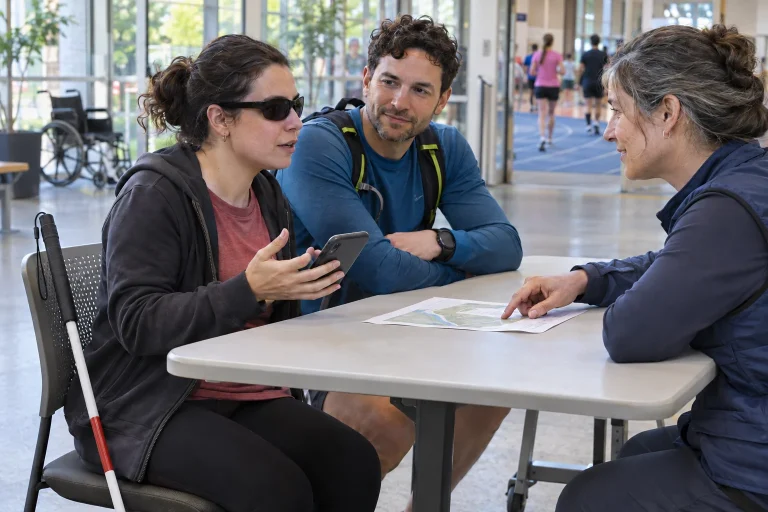
During a longer running project, it is easy to see help as evidence of inadequate preparation. Yet a lift, another pair of eyes on practical plans or a clarifying question to the organiser does not take away your own work. Help is useful when its purpose, the person accepting it and its limits are clear. Vague promises to ‘sort everything out’ can create as many problems as trying to carry everything alone.
As a male runner, you need not equate independence with doing every task yourself. This is not a claim about gender traits, but an option: you can organise cooperation around your sporting goal. The article concerns practical assistance, rather than healthcare or individual training guidance. Every situation described is fictional.
First name the missing task
‘Help with my race’ is a large, uncertain request. The other person cannot know whether you mean a half-hour conversation, all-day company or months of organisation. Divide the project into actual tasks: reading information, planning travel, a shared trial on a known route, collecting a package or meeting after the finish. Different tasks need different people and expertise.
Missing information and missing hands are different too. If you do not know whether someone else may collect your race pack, first establish the rule. A willing friend cannot make an arrangement possible if conditions prohibit it. Once the rule is known, ask for the specific commitment: when, where, with which document and for how long.
| What do you need? | Appropriate next step | What not to expect automatically |
|---|---|---|
| The organiser’s rule is unclear | Official information and a focused question to the organiser | A friend guessing the organiser’s decision. |
| There are many small practical tasks | Hand over one clearly defined task | The helper becoming the entire project’s director. |
| You want someone to review your plan | A short checking question sent beforehand | The other person guaranteeing everything is error-free. |
| A professional decision is needed | An appropriate specialist in that field | An experienced running companion knowing everything. |
The table does not rank helpers. A dependable lift may be as useful as a knowledgeable professional conversation, but serves a different purpose. Cooperation is fair when the other person knows the role requested and can choose freely.
Give the request a beginning and an end
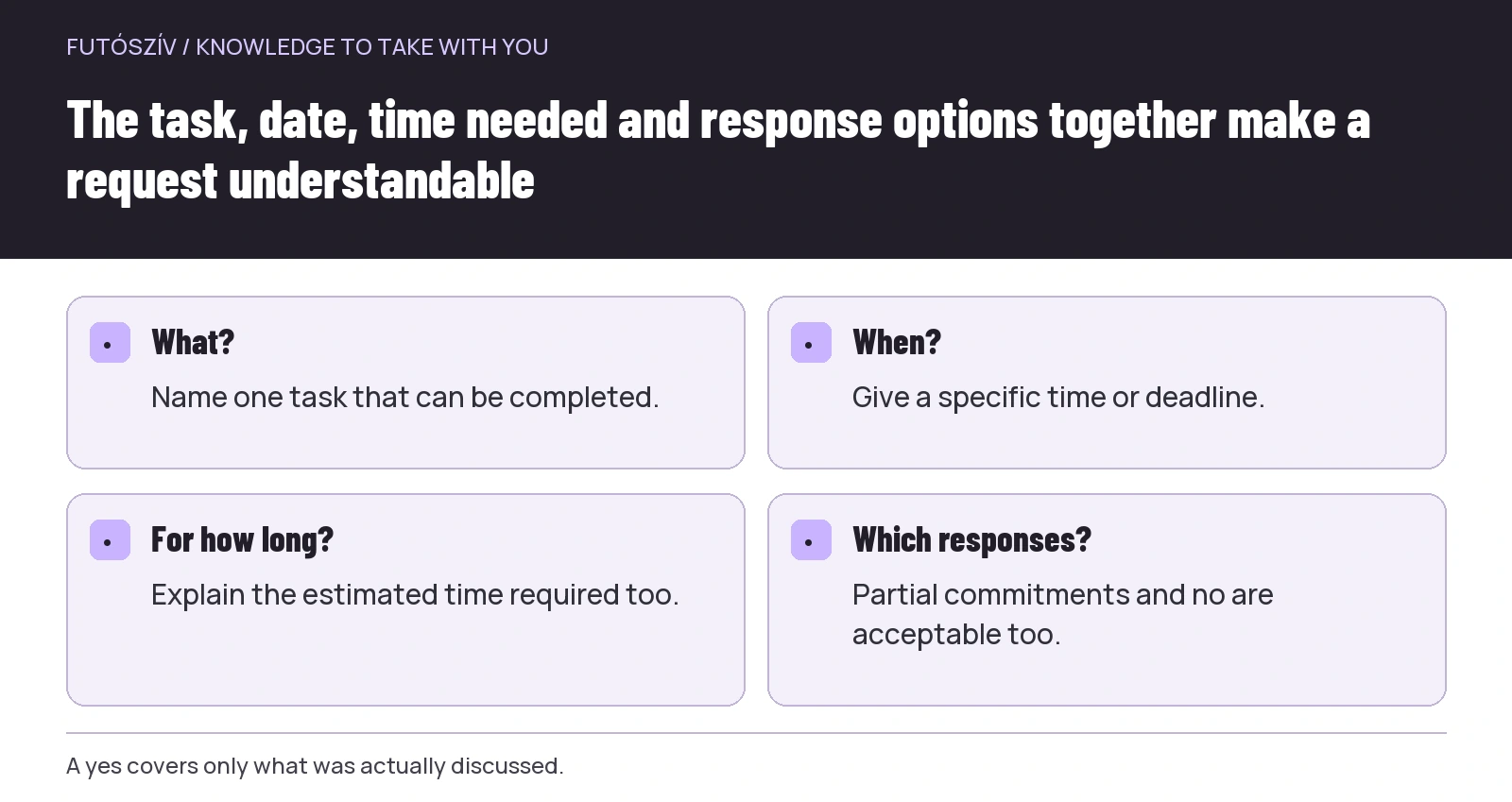
A manageable request explains four things: the task, when it would happen, approximate time needed and the feedback wanted. A fictional sentence: ‘Could you spend twenty minutes on Wednesday reviewing the travel plan with me? Mainly I want to check whether I’ve left too little time between pack collection and the train.’ The person can then say yes, no or suggest an adjustment.
‘Whenever you have time’ can sound considerate, but makes a deadline-based task uncertain. Instead: ‘I’d like to decide by Friday; if it doesn’t fit now, I’ll look for another option.’ Here the deadline is information rather than pressure. Do not circumvent a no through repeated smaller requests.
Briefly confirm the commitment: ‘So we’ve agreed only on the lift to the station; I’ll arrange my afternoon journey home.’ This prevents the same yes representing two different plans. The conversation can stay friendly without becoming formal.
 Enlarge diagram
Text version of the illustration
- What?
- Name one task that can be completed.
- When?
- Give a specific time or deadline.
- For how long?
- Explain the estimated time required too.
- Which responses?
- Partial commitments and no are acceptable too.
Accept partial help too
One person can look for accommodation but cannot travel with you. Another will listen to your questions without taking an organising role. A partial contribution is not less valuable because it does not solve the whole project. Build the help into the plan with its actual boundary and find a separate answer for the remaining task.
If a friend is available until half past nine, that does not mean the last long conversation can start then. Meeting at the finish is not automatically all-day standby either. A precise boundary is not a lack of enthusiasm, but a condition for cooperation. The other person has a day of their own.
Among male friends too, you can simply thank someone without joking it away or immediately treating it as a debt to repay. Supporting each other’s projects can be mutual without an unspoken unlimited price. If you offer something in return, make that a specific task freely agreed as well.
Official event information is support worth using
Every question need not become speculation in a community group. Many organisers provide preparation information, question sessions or detailed packs. Using them does not prove inexperience. Organisers also want participants to understand how their event works.
One specific historical example is the Ultrabalaton Trail first-timer helpdesk announced for 9 September 2026: its notice included logistical, navigation and equipment questions. This is a past, date-specific example, rather than a newly available recommendation. It shows that an official opportunity to ask questions is a distinct form of support. Ultrabalaton Trail: First-timer helpdesk
Find the current information before asking and identify exactly what is unclear. Instead of ‘Could you explain everything about the race?’, try: ‘I read this condition for pack collection; is this document sufficient in my situation?’ Do not post unnecessary personal information publicly, and tie the answer to that event’s rules for that year.
Friendly assistance on the course may be subject to rules
Everyday support and outside assistance during a race are different concepts. A friend may help with preparation while being allowed to assist on the course only at specified places or in particular ways. Good intentions do not replace knowing participation rules. Current organiser information determines permitted accompanying and handovers.
For example, the Ultrabalaton Trail rules for 3 October 2026 restricted outside assistance for individual competitors to within fifty metres of relay exchange points and listed assistance outside this rule as grounds for disqualification. This is a documented rule of that 2026 event, rather than a general Hungarian racing rule or an automatic requirement for the following year. Ultrabalaton Trail: 2026 race rules
The restriction matters because ‘we’ll meet somewhere and you can help’ may not be workable. Helpers need to know the relevant on-site conditions too. They should not have to discover on race day whether they can enter a point, where they may stand or what they can hand over. Share permitted-assistance details before leaving.
A helper should not become a remote race director
Someone knowing where and when to expect you can help, but does not make them responsible for your sporting decisions on the course. Tracking data, a delayed notification or a short phone message cannot fully describe local conditions. Do not burden a friend with guaranteeing from afar that continuing is appropriate.
Agree beforehand which information you want. Finding a published transfer point differs from deciding whether you should tackle another long section. The first can be practical assistance; the second may require knowledge they lack. In medical or urgent situations, follow the event’s official on-site help procedures rather than a distant friend’s guess.
For meeting afterwards, a specific place and a rule for changes are better than ‘you’ll see in the app’. Tracking can supplement information, but should not be the only connection if technology fails or updates are delayed. Helpers should know when to wait for another message and when their agreed attendance ends.
 Enlarge diagram
Text version of the illustration
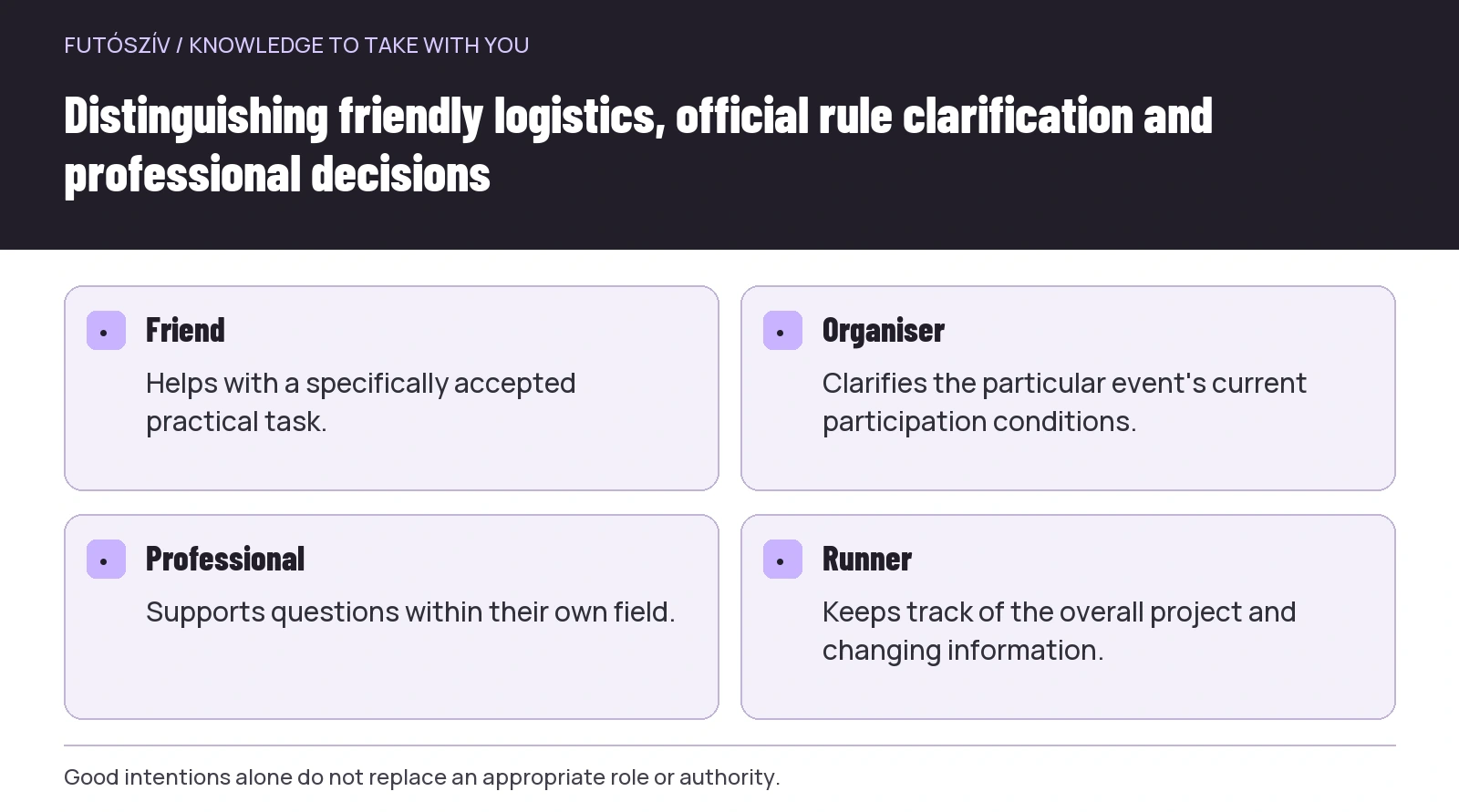
- Friend
- Helps with a specifically accepted practical task.
- Organiser
- Clarifies the particular event’s current participation conditions.
- Professional
- Supports questions within their own field.
- Runner
- Keeps track of the overall project and changing information.
Handing over a task is not disappearing from it
If someone agrees to collect your package, give them the information and documents genuinely required. Do not let them discover while leaving that authorisation is missing or collection is elsewhere. Equally, send no more personal information than the task needs. The aim is an achievable task, rather than sharing a complete personal archive.
A simple task sheet may suffice: what to collect, where and when, proof of entitlement, where official conditions are published and how completion will be reported. Include the backup too. If information differs on site, the helper should not have to guess which compromise they may make in your name.
You need to report changes too. If you choose another collection day or complete the task yourself, tell the helper in time. An unnecessary journey wastes time even when offered out of friendship. Keeping information current remains part of your contribution to cooperation.
A fictional project with three clearly bounded roles
Suppose a runner is preparing for their first longer race in a distant city. An acquaintance knows the city, a friend would review the event information and a family member could help with meeting afterwards. This need not mean three companions booked for the whole day. Each person participates only in the part actually accepted.
The local acquaintance suggests two ways to reach the venue, and the runner checks current transport. During a short conversation, the friend identifies an unclear rule; the runner requests the answer. The family member agrees on a known post-finish place and time window, with a separate plan for later travel home. Everyone contributes without receiving unlimited responsibility.
If one contribution falls through, first ask whether the task is essential to the project. Another train, collection day or simpler companion programme may work. If a necessary condition cannot be met, changing the project is a real option too. The helper does not have to save the original plan at any cost.
Treat changes and no as part of the plan
An enthusiastic yes can change after illness, work or another unexpected situation. Important practical tasks therefore need a known confirmation point: when to reaffirm the commitment and when to choose a backup. Every favour need not have a complicated insurance system, but do not base critical conditions on one uncertain message.
Do not use paid entry fees or work already invested as arguments against a helper withdrawing. They are facts about your project, rather than the other person’s unlimited obligations. Ask about alternatives if appropriate, but do not automatically transfer responsibility for solving the problem. Friendship remains free when no can be a real answer.
If you realise you asked too much, adjust simply: ‘The whole day would have been too much. Instead, I’m only asking about this short part; I’ll arrange the rest differently.’ Clarification is not failure. It resolves more uncertainty than everyone politely maintaining an agreement that no longer works.
Thank the person for the specific contribution
After the project, talk about more than your result. Explain what their work helped with: reaching collection on time, clarifying travel or making the finish meeting easier. You need not diminish your achievement. Your running and the assistance around it can both be real contributions.
Ask what was difficult for them too. The task may have been short while uncertain waiting took a long time. This can produce a more precise window next time. Thanks do not automatically finish outstanding tasks: returning borrowed items, settling agreed costs and handling unnecessary personal data may remain.
Accepting help is easier when no hidden expectations need to be imagined. A good request is specific, the commitment free, event rules known and project direction still yours. Your next longer goal can then be a personal undertaking in which others participate in clearly understood ways, rather than a test of knowing and doing everything alone.
How Futószív articles are prepared: our editorial guidelines.