After moving to a new city, missing your old running group can mean more than missing shared kilometres. You do not know the park entrances, familiar meeting points or whom to ask whether Tuesday’s loop is actually happening. A running community can help you learn the area and meet people. Still, one attractive group photograph is not a sufficient basis for the search.
As a man, you can also arrive in a new group knowing nobody and without a ready-made introduction. You do not have to earn admission through results. The first task is to find a group that is genuinely accessible within your everyday life and understand what participation it offers. The following approach is our own editorial search process, rather than a rating of clubs in every town.
Put your own week on the map first
Write down two or three realistic meeting windows, including travel there and back. A city-centre group reachable from work offers a different opportunity from weekend company near home. If you need forty minutes of travel to attend, do not hide it behind the label ‘just an hour’s run’. Even a good community is hard to attend regularly when fitting it in requires separate arrangements every week.
The search area need not be a circle around your home. It may follow your commute, a park on a direct transport route or a weekend meeting point. In a new city, map distance and actual travel time are especially easy to confuse. Leave extra time at the first few sessions to find entrances, connections and the meeting place.
Describe your needs in one paragraph: ‘I’d like a shared urban run after work once a week. I need a named contact for the first session and a known finishing point. I’m not looking for a race-preparation group yet.’ Someone else may prioritise regular professional coaching; the point is to make your search terms follow your needs.
Use three different starting points
A national programme, a local institution and the group’s own channel can together provide a better picture than a long but outdated recommendation list. BSI’s official Running Ambassador page lists a community network searchable by town or district. It is a useful starting point, but confirm the particular session’s time through the local contact. Not every Hungarian running community belongs to this programme. BSI: Running Ambassadors
The community page of a local council, sports centre or cultural institution can be a second route. For example, Baracska’s municipal website has a separate introduction to its local running group. This shows that a town’s own website can help find running companions; the weekly schedule there does not automatically establish that the group will start in the same way on your chosen day. Baracska: Baracska Running Group
The third step is always the community’s own current communication. Is there a recent invitation, an update about changes or an organiser you can reach? A photograph from years ago is a valuable memory, rather than next Tuesday’s timetable. Do not enter a definite session in your calendar from a search result or old local news item without checking it.
 Enlarge diagram
Text version of the illustration
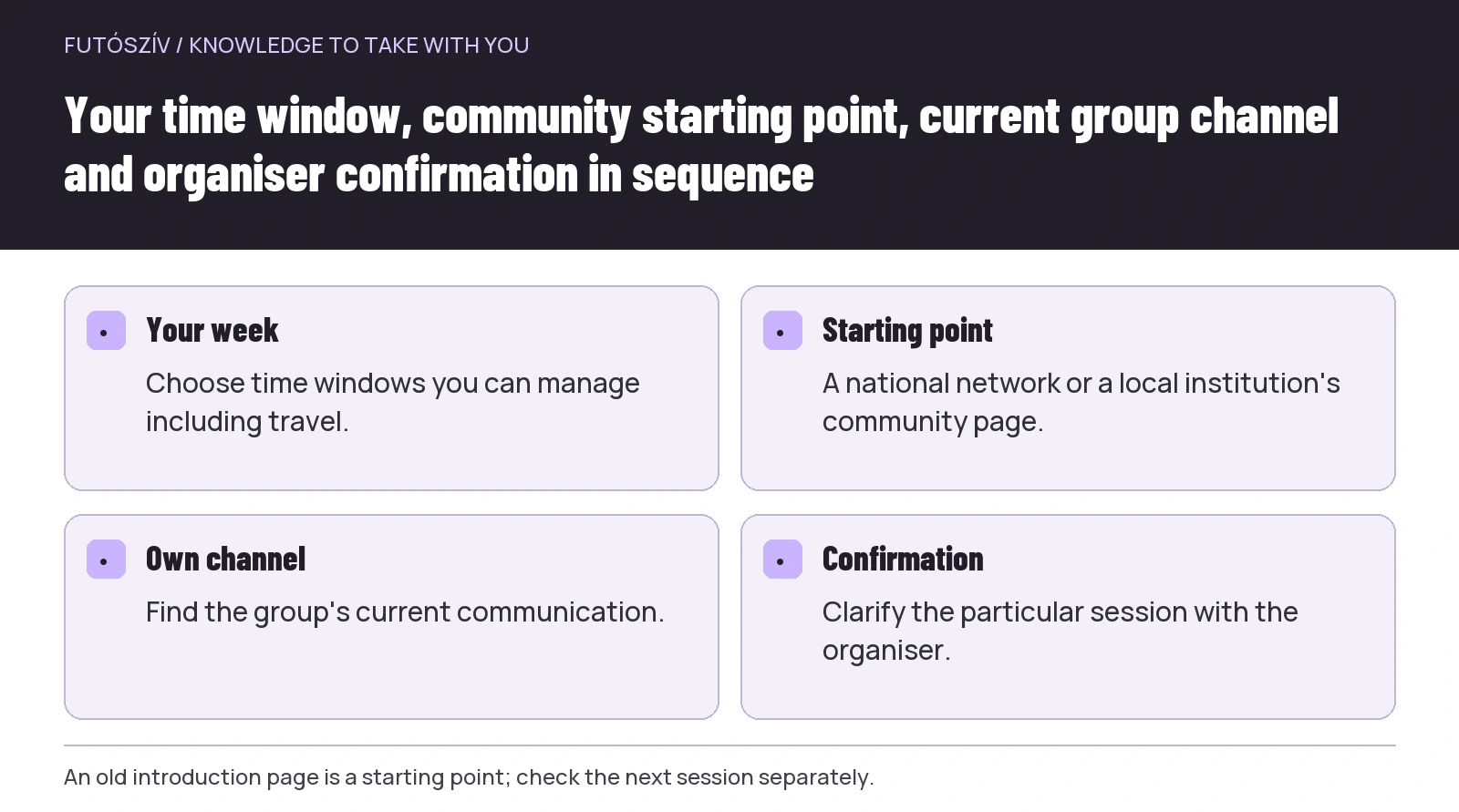
- Your week
- Choose time windows you can manage including travel.
- Starting point
- A national network or a local institution’s community page.
- Own channel
- Find the group’s current communication.
- Confirmation
- Clarify the particular session with the organiser.
A running track is not yet an organised community
The location of a running loop can be a useful lead, but does not prove that a guided or jointly organised run takes place there. The SZEOSZ running-track construction programme lists completed tracks with locations and technical details. Use it to find places, rather than as a club calendar. Check access and current rules separately with the operator. SZEOSZ: Running-track construction programme
Seeing many runners on a nearby track does not establish that they all belong to one group either. Start a conversation at a suitable moment, but do not interrupt someone’s task or expect an immediate personal invitation. A short question is enough: ‘Do you know of regular open group sessions here?’ If a public organiser contact exists, continue through that channel instead.
Several groups may meet at one venue at different times or for different purposes. The track’s name is therefore insufficient: you need the organiser, time and participation arrangements for the specific session. Do not wait until another group has left to wonder whether they were the people you contacted.
Keep a short search log
Many open tabs quickly become confusing. List four or five candidates and check the same questions for each. The table is not a ranking; it shows where information is missing. You do not need to score a community’s atmosphere from its website.
| Record | What should it contain? | How should you use it? |
|---|---|---|
| Source and date checked | The group’s own page or an organiser’s reply | Distinguish current information from old information. |
| Accessible session | Day, meeting and finish | Compare it with your real weekly time window. |
| Activity format | Staying together, several groups or a training task | See whether it fits the participation you want. |
| How to join | Registration, trial session and contact | Do not assume you can automatically join. |
| Open question | For example, storage or a shorter option | Ask through a focused message. |
Mark definite answers separately from assumptions. ‘There are lots of people in the picture’ is not the same as knowing Tuesday’s session has a large turnout. ‘Beginners welcome’ alone does not describe duration or whether the group stays together. Do not fill in missing information out of goodwill; ask instead.
Make the first message short and answerable
There is no need to send your full sporting biography. Say you recently moved nearby, what kind of session you want and which advertised activity interests you. Choose only a few genuinely important questions. A long questionnaire may overwhelm someone organising in their free time, while obscuring the most important answer.
A fictional example: ‘I’ve just moved to the city and am interested in Thursday’s shared loop. Whom should I look for at the meeting point on my first visit? Does everyone stay together, or are there several pace groups? Is advance registration needed?’ Add other important needs specifically. Precise contact helps the organiser provide a useful answer.
Do not immediately take a lack of reply personally. The inbox may be checked rarely or the link may be outdated. See whether another official channel is listed and enquire once there. With uncertain communication, however, do not arrange a difficult-to-reverse journey solely for an assumed session.
Clarify cost and membership separately
Free shared runs, membership-based clubs and paid coaching sessions are all legitimate formats. A name does not always reveal which applies. Ask exactly what you are joining, what participation includes and when payment becomes due. An open trial does not necessarily make every later service free.
BSI describes its own Running Ambassador programme as free of charge. Do not extend this to every other group in a city or to associated race entries. A race organised together after a club run may have separate requirements and costs. Record the programme name and exact service in your search log, rather than only the word free.
Ask for clear distinctions in equipment expectations too: is an item compulsory safety equipment, recommended personal kit or club merchandise available to buy? You do not need to shop before the first meeting as though long-term membership were already decided. First establish what you are attending.
 Enlarge diagram
Text version of the illustration
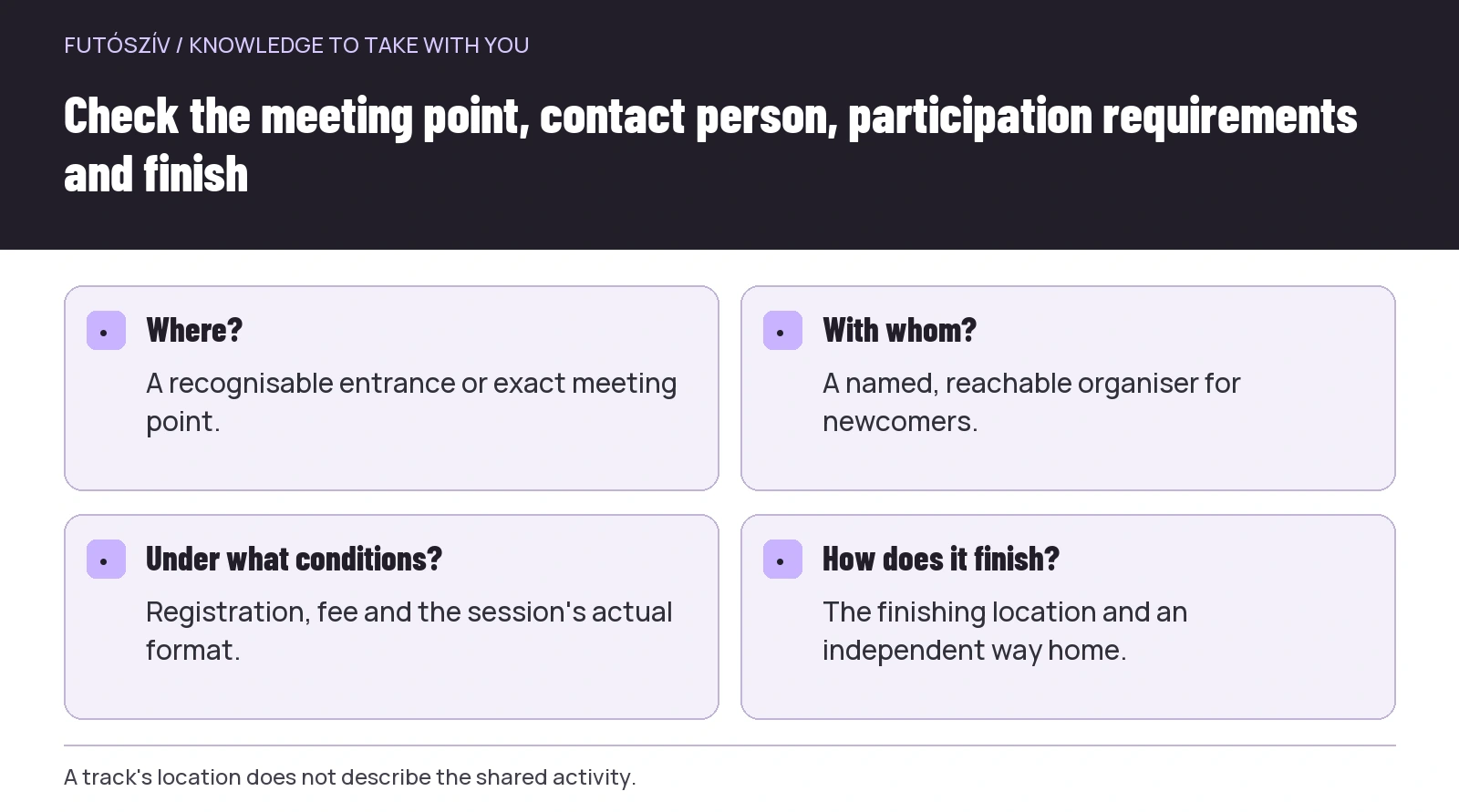
- Where?
- A recognisable entrance or exact meeting point.
- With whom?
- A named, reachable organiser for newcomers.
- Under what conditions?
- Registration, fee and the session’s actual format.
- How does it finish?
- The finishing location and an independent way home.
The logistics of the first meeting
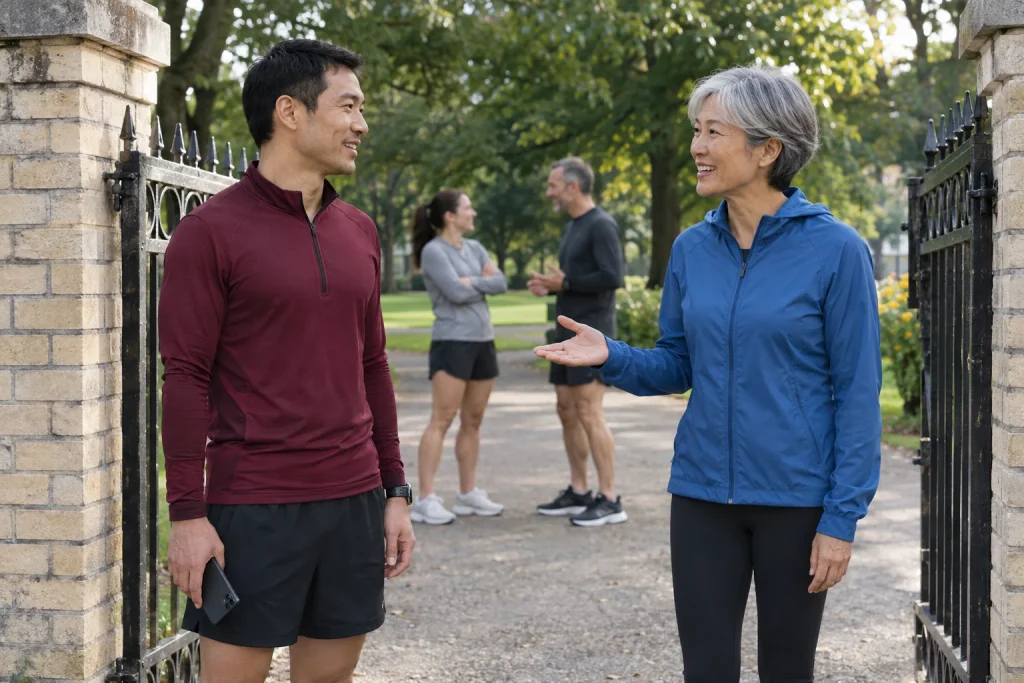
At a new place, identify a recognisable meeting-point detail. Rather than ‘in the park’, specify an entrance, building, gate or another clear landmark. Check which side to approach from and how to get home if the activity ends elsewhere. Only keep the leader’s phone number if it was provided for contact; there is no need to search for private information.
Arrive with time to introduce yourself and hear the pre-run information. Your first information about the group should not be which jacket to chase. One sentence is enough: ‘I’m the person who wrote about joining for the first time; could you show me which group I’m with today?’ This also tells the organiser a newcomer has arrived.
Keep your own journey home manageable. With unfamiliar company, do not assume someone will drive you, look after valuables or show you the whole area. These are favours to agree separately. Learning about that particular activity and a few names can be enough for the first visit.
Assess the welcome through specific experiences
A good first evening need not be loud or immediately intimate. More useful questions are whether you received necessary information, could ask questions and found that the real programme matched its description. You do not need to meet everyone straight away. It is natural to observe and have brief conversations at the first session.
As a man, do not treat joking tests of performance as compulsory if that is not a comfortable introduction for you. Equally, one clumsy sentence need not define the whole community. Notice how people respond to a clear request or clarification. Actual adaptation reveals more than a general promise that ‘everyone is family here’.
An organiser cannot know every participant’s needs in advance either. If something was unclear, say specifically: ‘I understood the post as promising a shared finish, but we returned separately today. How should I prepare next time?’ The reply helps distinguish a fixable misunderstanding from a programme with a different purpose.
If the first group does not suit you
The search has not failed because the first community’s timing, atmosphere or sporting goal does not fit. Thank them for the occasion and choose another format. You do not need a public comparison review, or a declaration that you are not a social person. A particular programme and a particular life situation simply did not match.
You may want relaxed weekend company alongside coached training, or prefer two or three regular companions to a large community. Local connections have several levels. Occasional volunteering, a public club event or a shared walk may offer a chance to meet people if the organiser actually offers it; do not invent the opportunity on their behalf.
You can ask the next candidate a more precise question. If the previous programme finished too late, ask about the finish beforehand. If the pace-group system was unclear, clarify it now. The search then builds useful local knowledge rather than an increasingly long list of self-criticism.
Building a sustainable local connection
Once you find a suitable session, consistent small commitments can help in the first weeks: confirm attendance, arrive on time and report changes to agreed participation. You do not need to start organising or enter every shared race immediately. Feeling at home in a new city can develop gradually.
Keep your own choices. A community can provide useful local connections, but you are not obliged to fit all your free time around it. It becomes a real part of your week when travel, purpose and social arrangements work together. The best search result is not joining the most groups, but finding a next session you know how to attend and why you want to return to.
How Futószív articles are prepared: our editorial guidelines.