
Stating a pace can feel more uncomfortable than the meeting itself. Someone asks for a number and you are already listing reasons it is not better: you have just restarted, work is busy, you got home late yesterday. Meanwhile, your companion may only want to know whether running with you will leave time for dinner. An accurate answer needs less self-judgement and more context.
This community guide is written for male runners, but its situations are not traits determined by gender. You do not have to accept that speed earns your place among male friends. The purpose is to arrange a compatible shared outing, rather than classify you as a person. The sentences and situations below are editorial examples, not accounts from real participants.
First clarify which number you mean
‘Six and a half’ might mean minutes per kilometre, the time for a particular section or a rough memory. Your fastest kilometre of the week, the average for Sunday’s whole run and your chosen pace for tomorrow are three different pieces of information. None automatically establishes another. If the question concerns tomorrow’s meeting, answer with what you actually intend to do there.
For example: ‘Tomorrow I’d like to run on flat ground for about forty minutes, at roughly 6:30–7:00 min/km. I’d walk across the bridge.’ This gives more useful information than ‘I’m not very good, but maybe around six.’ The range is fictional, not a recommended training zone. You do not need to choose such an exact number if you do not know it; the route and time window can still be agreed.
Check what the app’s data means too. Strava’s own help distinguishes moving time from elapsed time, with stops included in the latter. A shared average alone therefore does not establish how long the outing lasted. This describes how the service works, rather than grading every watch’s measurement quality. Strava: Moving Time, Speed, and Pace Calculations
A colon prevents a whole misunderstanding
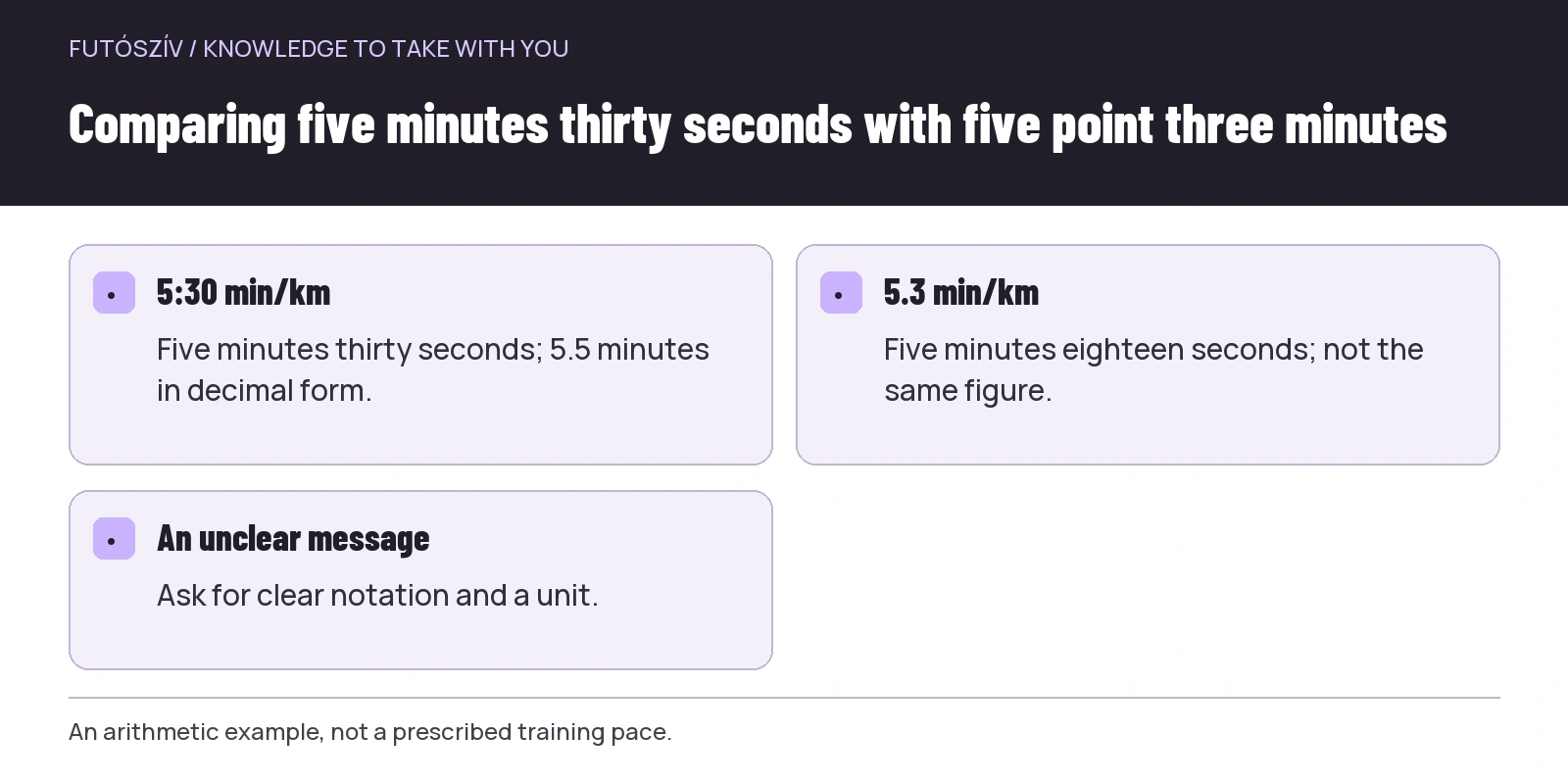
Do not confuse minutes:seconds with decimal minutes. A pace of 6:30 min/km means six minutes and thirty seconds, or 6.5 minutes. By contrast, 5.3 minutes is five minutes and eighteen seconds. If a message says ‘5.3’, do not guess which meaning its writer intended. Ask for an unambiguous format and unit rather than relying on the full stop.
| Notation | Time for one kilometre | Theoretical moving time for ten kilometres at the same pace |
|---|---|---|
| 6:00 min/km | Six minutes | Sixty minutes |
| 6:30 min/km | Six minutes thirty seconds | Sixty-five minutes |
| 7:00 min/km | Seven minutes | Seventy minutes |
| 5.3 min/km | Five minutes eighteen seconds | Fifty-three minutes |
The table is simple arithmetic. It does not predict what distance anyone can complete or provide a training plan. Its ten-kilometre figures omit every stop, wait, junction and detour. Allow separate time for these when arranging an outing. A number helps when both people understand it in the same way.
A brief follow-up is enough: ‘Do you mean five thirty, or five point three minutes?’ This is not nitpicking: the two interpretations differ by two minutes over ten kilometres. An even larger misunderstanding can arise if one person looks at moving average and the other at total door-to-door time. One clarification is usually worth more than arguing afterwards about what each person meant.
 Enlarge diagram
Text version of the illustration
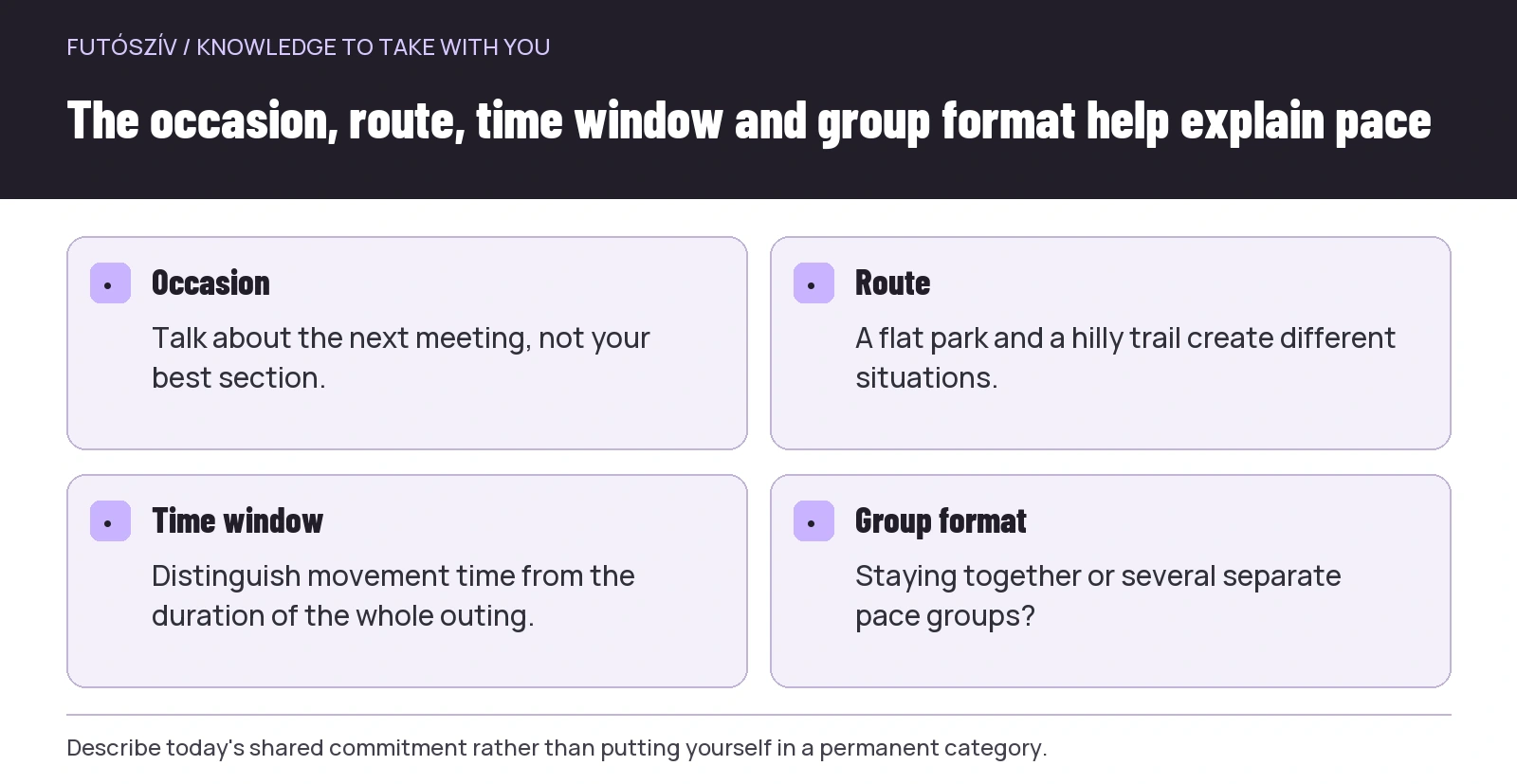
- Occasion
- Talk about the next meeting, not your best section.
- Route
- A flat park and a hilly trail create different situations.
- Time window
- Distinguish movement time from the duration of the whole outing.
- Group format
- Staying together or several separate pace groups?
Describe your pace as a situation
‘I am slow’ judges a whole person. ‘This is the rhythm I am choosing today’ describes a particular occasion. The latter allows later changes without defending an old adjective. You do not need to assign yourself a permanent performance category in front of a running companion.
Choose from four details: the day and activity concerned, the environment, the time you have and the shared format that fits. Not all four are needed in every conversation. A regular partner may only need that day’s change, while a new group benefits from a more precise description. Match the length of the message to the information missing.
‘I have thirty minutes today and would stay on the park’s flat loop. I’m looking for a run where we stay together throughout.’ There is no pace number, but the request is clear. Someone with a specific training task can decide whether it fits. Your job is not to guarantee every unknown circumstance beforehand, but to state your present commitment honestly.
The UK Coaching relationships guidance discusses clear communication and listening as parts of cooperation in sport. Here we use one narrow practical principle: after expressing your need, leave room for the other person’s response. The sample messages below are our own editorial examples, not the organisation’s instructions. UK Coaching: Relationships Guide
Do not build your introduction around your best screenshot
Sharing a successful short section can be enjoyable. Whether it helps organise the next shared run is a different question. Knowing that you once ran two kilometres quickly does not tell a friend what you want to do for an hour tomorrow. One sentence beside the picture is enough: ‘This was a short separate section; I’m planning a different rhythm for tomorrow’s shared loop.’
Auto-pause settings, route characteristics and the selected section can also affect the impression the data gives. You do not need to explain every measurement detail or check your friends’ figures. When describing your own activity, state whether a shared number concerns the whole session or one part. You are helping interpret the information, rather than making excuses.
If you have no watch or do not want to share data, say so briefly: ‘I don’t measure exact pace. A short trial loop may show whether we find a shared rhythm, but let’s agree beforehand how to finish if we don’t.’ A trial is not an unlimited promise to adapt. Know the place and finishing arrangement, especially with new company.
What does an advertised pace range mean?
A group post saying 6:00–7:00 min/km can describe several arrangements. There may be two separate groups, one group staying together or an average that includes stops. Mentioning the slow end does not prove that company is guaranteed at that pace throughout. Ask the organiser.
| Question for the organiser | Which misunderstanding does it prevent? |
|---|---|
| Will there be several pace groups, or will everyone stay together? | Individual movement is not confused with the group’s commitment. |
| Does the figure refer to continuous running or an average including stops? | You avoid trying to fit a screenshot to a live activity. |
| What happens if someone needs another rhythm that day? | The practical approach to adaptation is clear beforehand. |
| Is there a shorter version finishing at a known location? | Shorter participation does not become an improvised disappearance. |
You do not need to ask these as though examining someone. ‘I’d like to choose a suitable first outing, which is why I’m asking’ is enough introduction. If a programme is built around a specific sporting task, an organiser can reasonably suggest another occasion. This is useful coordination rather than personal rejection. If answers are unclear, however, do not accept unknown arrangements solely because the invitation sounds appealing.
 Enlarge diagram
Text version of the illustration
- 5:30 min/km
- Five minutes thirty seconds; 5.5 minutes in decimal form.
- 5.3 min/km
- Five minutes eighteen seconds; not the same figure.
- An unclear message
- Ask for clear notation and a unit.
Three answers without putting yourself down
In the first situation, a friend asks: ‘What pace do you usually run?’ You can answer: ‘It depends on the outing. For Saturday’s shared loop, I’d choose this rhythm and this time window.’ This brings the question back to organisation. You do not have to average every previous run or describe your whole sporting life in one number.
In the second situation, someone says: ‘You can run faster than that.’ One answer is: ‘Possibly, but this is the shared outing I agreed to today.’ If you genuinely want a faster task another time, discuss it separately. Capacity is not an obligation, and a previous result does not override today’s agreement. The sentence does not need a lengthy justification to weaken it.
In the third situation, as a newcomer you might apologise to everyone in advance. Try replacing that with a specific question: ‘I’m looking for company for this advertised version. Who can I agree the finishing arrangements with too?’ This makes the practical need visible. You are not promising that nothing will ever differ, or declaring yourself the group’s problem.
What you do not need to justify publicly
Why you choose a different rhythm may be personal. You do not need to publish work circumstances, family conflict, health history or other sensitive details in a group message merely to have your time window accepted. You can provide the information needed for the shared outing without explaining your entire life.
This does not mean concealing important safety circumstances. Necessary arrangements should have an appropriate contact and channel; on health questions, do not treat a pace group’s opinion as a professional decision. This article concerns social communication rather than advice on physical capacity. ‘I’m choosing a shorter version today’ is a meaningful practical statement on its own.
A group chat may need no more than: ‘I’d rather not discuss the detailed reason here. This is what I can commit to today, and I’m looking for an arrangement that fits.’ You can separately decide to share more with someone personally. Interest may be friendly without requiring equally detailed answers to every question.
If clarification is needed during the run
Do not leave the change for an explanation after finishing. When you notice a different outing has developed, use a simple, immediately understandable sentence: ‘This is faster than I agreed to; I’d like to return to what we discussed.’ Choose a place to talk without obstructing others. A junction or narrow trail is not the place for a lengthy group debate.
If the others want something different, clarify the conditions for splitting up: do you know the way back, where will you meet, and how does the time window change? Do not chase a faster group to prove you originally gave the right number. An earlier message is not a contract covering every detail of an unpredictable day. Clarifying the actual situation is responsible communication too.
Afterwards, briefly improve the next description: ‘Last time the number was understood as including stops, but I meant a continuous section. Let’s clarify that beforehand now.’ This is a specific lesson rather than a general accusation. If the difference recurs, choosing another format or another group is acceptable too.
Check an invitation before sending it
Before sending a message, check whether it includes the information actually needed. Is it clear when you are available and for how long? Are the route and shared format understandable? If you included a number, does it have a unit and clear notation? Is your request visible, with room left for the other person’s response?
A complete fictional version might read: ‘I’d meet at the park entrance at six on Thursday. I have forty minutes for a shared loop on flat ground, staying together throughout. I’m looking for the 6:30–7:00 min/km option today; stops add separate time. If you have a different task today, let’s choose another occasion.’ These details are examples; adapt your own message to your own activity.
The important outcome of the reply is whether you have reached a shared agreement. You do not need praise for your number, and everyone need not join the same rhythm. If the other person understands the invitation precisely and can choose freely, the pace conversation has done its job. You can choose again next time; today’s number is not a label attached to your name.
How Futószív articles are prepared: our editorial guidelines.