
If you regularly run with male friends, this situation may sound familiar: you agree on a conversational outing, then on the first hill everyone is already watching someone else’s stride. You return much faster than planned together, and nobody has said when spending time together turned into a race. This is not an inevitable part of running with friends. A shared purpose and a few simple agreements can make things clearer.
This article is about making arrangements within groups of adult friends. It does not claim that all men relate to competition in the same way, and it does not provide a training programme. The aim is for a particular outing to mean what its participants chose beforehand. Conversation and a deliberate sporting challenge can both be good purposes, provided one does not quietly replace the other.
Instead of saying ‘it will be easy’, name the shared activity
The word easy can mean different things to different people. One person means their usual pace, another wants plenty of conversation, and someone else only means that you have not entered an official race. Without clarifying the expectations behind the word, everyone may be right within their own interpretation while preparing for a different outing.
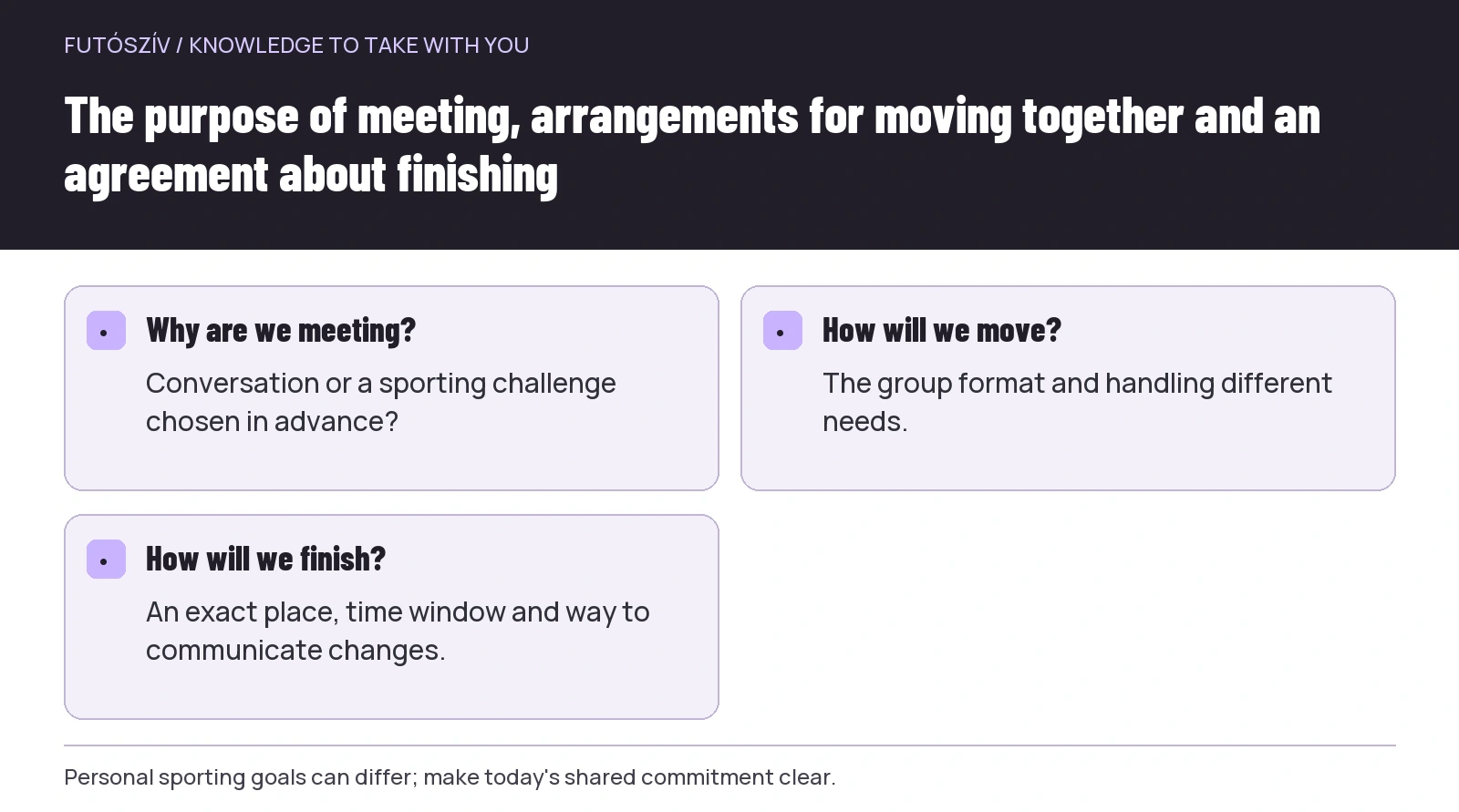
Three questions are enough before leaving: why are we meeting, how will we move together, and how will we finish? If conversation is the first answer, the route and group arrangements should serve it. Anyone wanting to test a time should say so separately. A challenge becomes a shared choice when the others genuinely know about it and agree to it.
The UK Coaching participant-centred framework emphasises individual needs and different purposes for development. A simple practical equivalent among friends is not letting one person’s habits automatically set the standard for everyone. Agree the purpose of your own outing together.
A shared purpose does not require identical personal sporting goals
Your group may include someone preparing for a marathon, someone building a routine and a friend who simply wants to get out with you. Personal projects can differ while you make a shared commitment for that day. Problems arise when one person silently treats their current plan as applying to everyone.
Make the distinction clear to yourself: my own goal is mine, while today’s shared activity is what we chose together. Every social run does not have to match every detail of your preparation. If you need a different type of session today, say so and look for an option that is genuinely compatible. Stating different needs is clearer than changing everyone else’s day halfway along the route.
If someone has a set coaching programme, the group should not invent or rewrite it for them. The question to discuss is which shared section that person can join under their known conditions. Supporting a friend does not necessarily mean covering the same distance at the same pace. It can mean meeting before or after two different activity plans.
 Enlarge diagram
Text version of the illustration
- Why are we meeting?
- Conversation or a sporting challenge chosen in advance?
- How will we move?
- The group format and handling different needs.
- How will we finish?
- An exact place, time window and way to communicate changes.
A fictional example: four friends, four hidden expectations
Ádám wants to chat, Bence would run his usual loop, Csaba is preparing for a faster section, and Dávid has limited time. These names and situations are fictional. All accept an invitation to ‘go for a run on Saturday morning’, but the sentence reveals none of these differences.
A brief discussion before starting may show that the full outing cannot meet everyone’s expectations at once. They can choose a shared conversational section with a defined finish, after which Csaba continues his own programme independently if appropriate arrangements are in place. Alternatively, they can organise the challenge on a separate day. There is no need to label the whole group competitive or non-competitive: they are deciding about this particular occasion.
| Participant need | What should be stated? | What should you not assume? |
|---|---|---|
| I would like to talk | The shared activity should support that. | That every faster friend automatically interprets easy in the same way. |
| I have my own sporting task | Which part I can genuinely join. | That everyone will follow my plan. |
| I have limited time | When and where I need to finish. | That everyone has time for an extra loop. |
| I would like a challenge | Exactly who chooses it and under what arrangements. | That everyone’s silence means agreement. |
Recognise when the outing changes
Turning into a race does not necessarily come with a starting signal. It might involve gradually speeding up, repeatedly catching up after corners, an unplanned uphill sprint or chasing an app’s segment result. These actions alone do not describe the group’s intentions. The question is whether they belonged to the chosen outing and whether others retained a real choice.
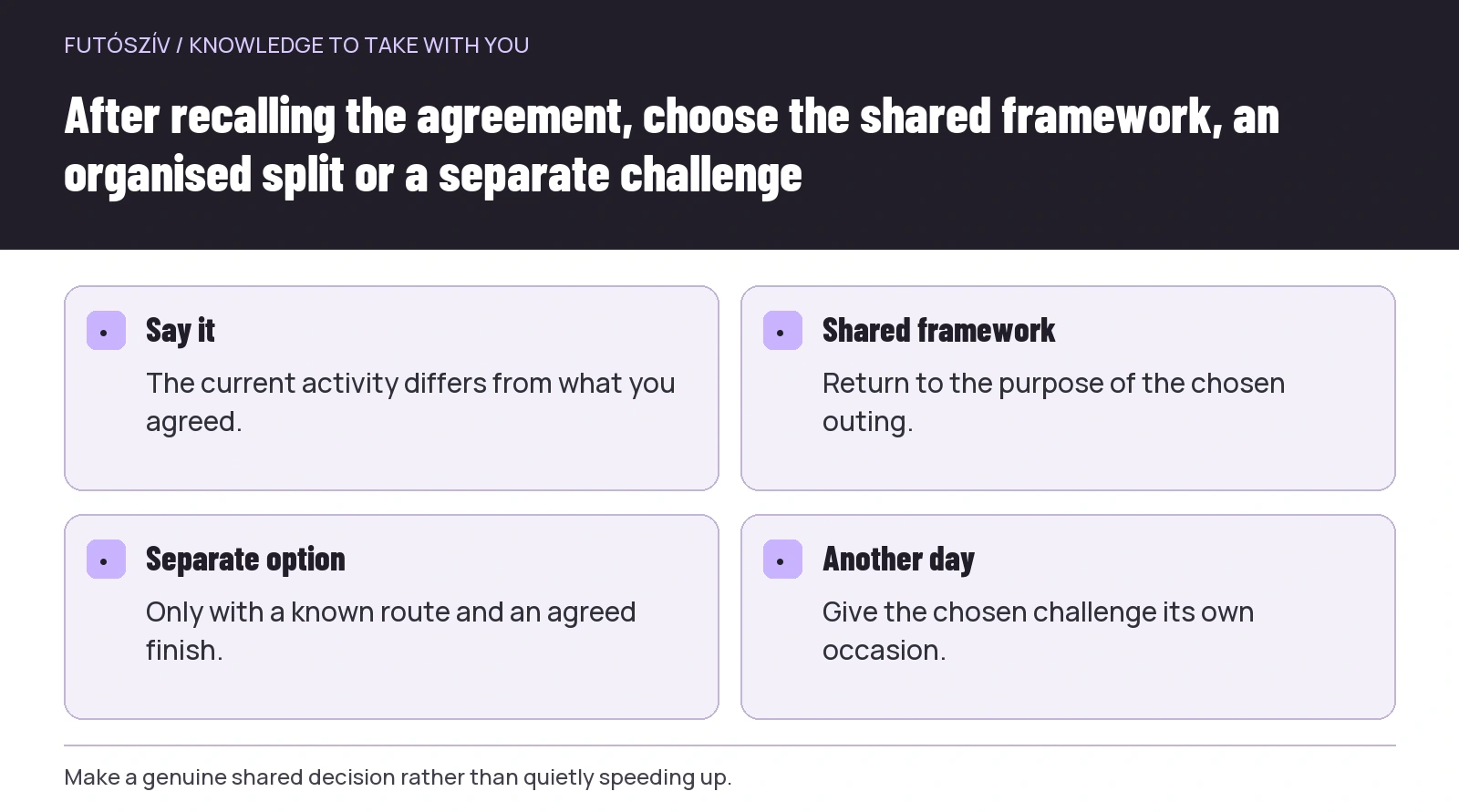
Give brief feedback early: ‘We agreed on a conversational run, and this is no longer how we’re running.’ This is a specific observation rather than a judgement of someone’s personality. It sets the current activity beside the original agreement. The next question is whether to return to the shared framework or make an adjustment everyone understands and can accept.
Do not wait for everyone to notice the same thing spontaneously. One person may enjoy the change, another may not want to speak, and another may think they alone misunderstood the invitation. A short sentence creates an opportunity to clarify. A shared outing stays shared when changes can be discussed too.
The other person’s response helps define the joke
Friendly teasing is natural in many groups. Good intentions, however, do not mean every comment lands the same way with everyone. If someone says they do not want jokes about their pace, accept this as a specific boundary. They do not need to prove that their reason is good enough.
A useful sentence might be: ‘I don’t want to turn today’s run into a test of strength.’ Or: ‘I’m happy to discuss my pace, but let’s leave out the jokes about being weak.’ These state a personal choice and a specific request. They do not require a long explanation of your entire training history or settling every previous comment at once.
What matters most is the response. If the group can adjust, an ill-judged joke can be cleared up. If a stated request is repeatedly ignored, you can rethink the format of the shared outing too. You can choose another social run or a different activity. Friendship is not measured by how many comments you accept while running.
A challenge can have its own clear place too
Competition does not need to be removed from the group’s life. If several people enjoy it, it can have a clearly named occasion with appropriate conditions. The important distinction is whether participants choose it and know what they are joining. A conversational day together should not silently become preparation for a compulsory friendly test.
One overseas example is RunTogether Canterbury’s own programme description in England, which presents several group sessions and different types of runs separately. Read this as an organisational example, rather than a current programme recommendation in Hungary. The lesson is that a community can accommodate several activity goals when the invitation makes the differences understandable.
Two clearly named activities can work among friends too. One focuses on time together, the other on a chosen challenge. Someone who chooses only the first can still be a full member of the group. Someone who also enjoys the second does not need to pull every other outing in the same direction.
 Enlarge diagram
Text version of the illustration
- Say it
- The current activity differs from what you agreed.
- Shared framework
- Return to the purpose of the chosen outing.
- Separate option
- Only with a known route and an agreed finish.
- Another day
- Give the chosen challenge its own occasion.
Splitting up works when it is genuinely organised
If you choose different sections, do not simply announce halfway along that everyone should go wherever they can. Know the location, route and finishing arrangements. Anyone continuing independently needs a manageable plan of their own. Those remaining in the shared section should know whom they are with and for how long.
Specify the meeting point more precisely than the name of a large park. If you have plans together afterwards, agree when and where to meet again and how to communicate changes. Do not base everyone’s arrangements on an unknown return time for a faster runner. Discuss shared keys and bags too if separate activities affect access to them.
A separate programme is not a punishment. It can preserve a shared point of connection while allowing friends different goals. An agreed split often creates fewer misunderstandings than a run that is together in name but constantly breaks apart in practice. The arrangement works when more than the most confident participant understands it.
Do not turn the shared outing into a compulsory competition in the app either
After running a route together, people find different data interesting. One wants to examine splits; another came for the company. Discuss what you want to share together. A group photograph or a memory of the route does not automatically require a public ranking of friends’ paces.
If you enjoy numbers, discuss them separately and with curiosity. First ask whether the other person wants to analyse their data. Unsolicited performance assessment can easily change the meaning of an outing chosen as a social activity. Available data and another person’s wishes are different things.
Someone who does not upload their run still took part. Someone who does not want to compare their time with the fastest group member is not abandoning improvement in general. They simply want to use the shared time or their diary differently. A group stays flexible when these choices fit naturally too.
A community atmosphere depends on practical arrangements
The England Athletics introduction to RunTogether describes group running opportunities suited to different needs. A community session does not necessarily mean one pace level. In your own group of friends, turn this outlook into a specific agreement: whom the outing is for, its purpose and how different needs will be handled.
An invitation saying ‘everyone is welcome’ makes sense when its details do not contradict it. If the actual outing always follows only the fastest members’ preferences, others receive a different experience from the one promised. More cheerful general descriptions do not resolve this. Distance, how pace is agreed and finishing together are part of how it works.
The group can also have a recurring question: did we get the shared time we met for today? Conversation, finishing on time or welcoming a new friend can be valuable alongside sporting data. Every outing does not need a formal evaluation; brief, honest feedback may be enough to make the next invitation clearer.
Three sentences before the next shared run
‘Today the purpose is conversation, and that is the framework I am choosing.’ ‘If someone wants another activity, let’s arrange it separately beforehand.’ ‘We will meet here at this time afterwards and tell each other if anything changes.’ Adapt these sentences to your group’s natural language. You are writing an understandable invitation rather than regulations for your friendship.
If every outing quietly becomes a race, the solution usually begins by naming the actual activity again. Make room to express the desire for conversation, a separate goal or a different pace. Running with male friends can then keep sporting challenges optional, while belonging to the group does not depend on reaching the next corner first.
How Futószív articles are prepared: our editorial guidelines.