Ten thousand metres and ten kilometres are equal lengths, yet not necessarily the same athletics event. Track 10,000 metres and road 10 kilometres take place in different environments as differently organised events. Understanding the distinction helps with reading results, watching broadcasts and planning your own first participation.
Track and road running need no hierarchy of value. Both can be serious sporting challenges and enjoyable community activities. Fundamental differences concern race space, how distance is defined, movement organisation and information presentation. Looking at these separately helps avoid automatically applying a familiar rule from one setting to the other.
The unit is equivalent; the category may differ
The World Athletics 10,000 metres page explicitly distinguishes the track event from road 10 kilometres. On a standard 400-metre track, ten thousand metres means 25 laps. The mathematical relationship is simple: 25 × 400 = 10,000. This does not make a road race the same event with a different background, however.
Unit descriptions can therefore carry meaning in athletics databases. A metres-based event and a kilometre-based road result may appear in separate sections. Event names and advertising do not always follow database abbreviations precisely. Establish the actual event type from regulations and the official result category, not one number on a poster.
A road race finishing in a stadium does not itself change the whole race’s nature. The full route and applicable rules matter. Likewise, a running loop in a park is not necessarily a certified athletics track merely because it looks oval. Shape, use and sporting classification are separate concepts.
The standard track is a repeating space
The current World Athletics competition and technical rules describe the standard outdoor oval’s nominal length as 400 metres. Track measurement and marking have separate rules. What is called a lap and the line along which it is measured therefore matter.
For a runner, repeating space provides recognisable reference points. The same finishing straight, bend and stand section reappear. A spectator may find it easier to see the same person several times, while a participant can follow race progress lap by lap. These are possibilities arising from space, not automatic promises about every track’s access or services.
Repetition brings a task too: knowing your progress within your distance and understanding official race information. Laps and places do not always present the same apparent order to an observer, particularly with participants on different laps. A broadcast viewer should not establish race position merely from who appears ahead in one camera shot.
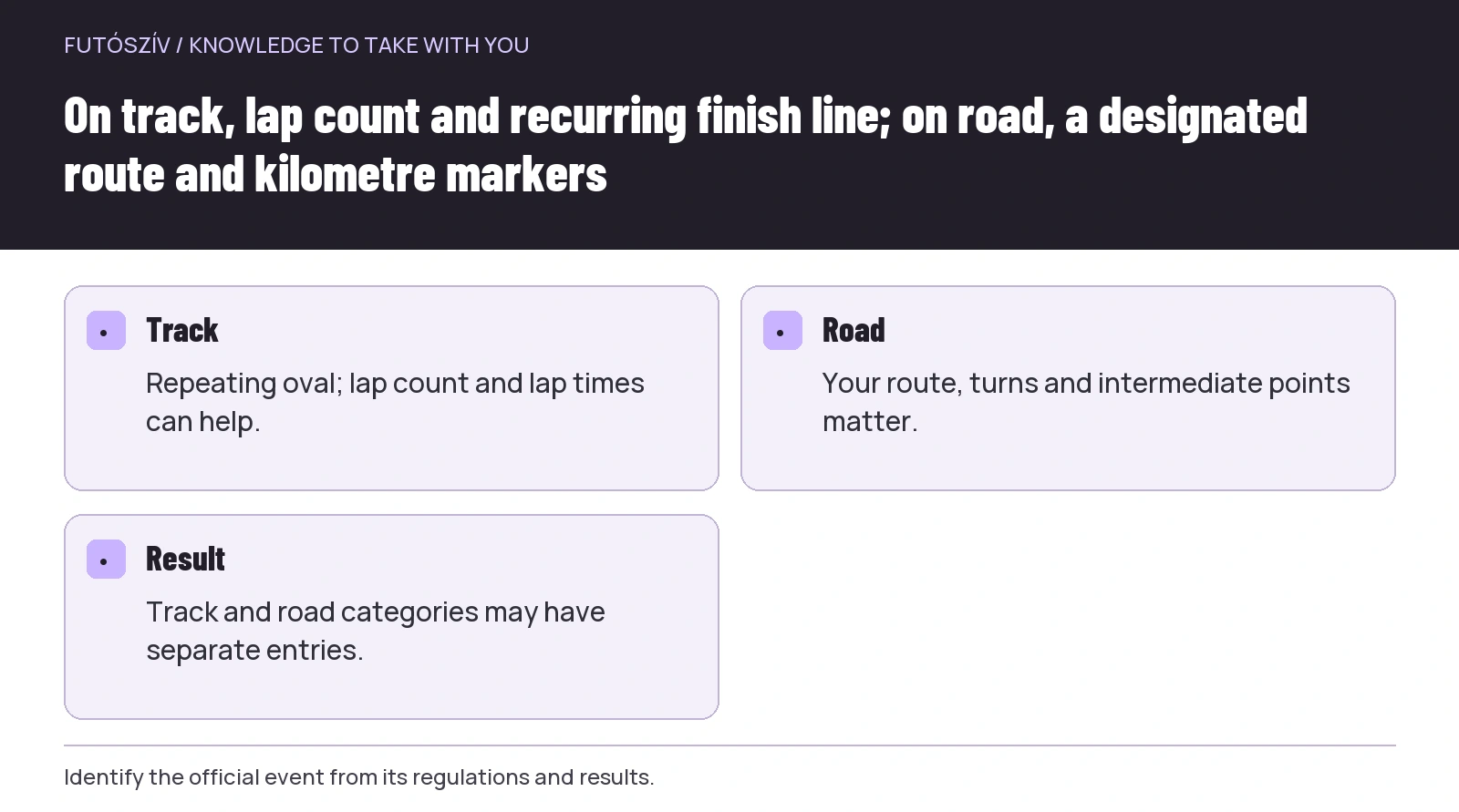 Enlarge diagram
Text version of the diagram
- Track
- Repeating oval; lap count and lap times can help.
- Road
- Your route, turns and intermediate points matter.
- Result
- Track and road categories may have separate entries.
A road course is a route and a designated space for use
In road running, distance belongs to a specific route. It may be a large loop, an out-and-back section or several laps. Being a road event does not require an entirely straight, one-off journey. Urban space, turns, traffic management and start–finish layout belong to the race.
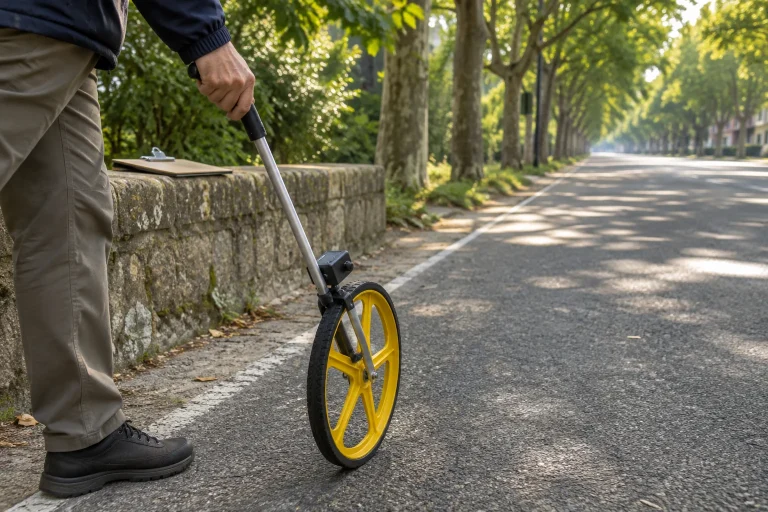
The AIMS course-measurement page presents the calibrated-bicycle method jointly accepted with World Athletics. This is an official task in defining the course, not a participant watch’s individual track. The detailed technical procedure deserves a separate topic; the important distinction here is tying road distance to the particular permitted route.
Participants need to know which route and turns belong to their race. If several distances share an event, automatically following surrounding runners is insufficient. They may be completing another event. Rather than repeatedly returning physical points on a track, a road event requires interpreting several different on-site references.
Even at the same nominal distance, information differs
In a track race, lap counts and lap times can easily become the basis for following progress. In a road race, kilometre markers and intermediate timing can help. A personal watch may provide additional information in both but does not replace official results and event information. Usable data depends on the question.
If you want to know race progress, look at official positions and completed distance. When assessing your own movement, personal observations can also be interesting. Do not confuse the tasks: a watch split and an official intermediate result may concern different locations or events. Clarify meaning before drawing conclusions.
In a results list, event name, venue type, date and how the official result is presented together create an interpretable entry. Preserve this context in a personal diary too. Ten-kilometre personal best may be understandable in conversation, but knowing whether the time came on track or road helps later comparison.
A calculation example: one kilometre is not a whole number of 400-metre laps
Using a standard 400-metre lap, 1000 metres is two and a half laps. Five laps is 2000 metres; 25 laps is 10,000 metres. Simple arithmetic nevertheless shows why the rhythm of data differs between settings. Familiar road-based kilometre thinking does not always coincide with passing the same track point.
Imagine a purely illustrative constant speed: five minutes per kilometre. At the same speed, this would mean two minutes over 400 metres. The calculation is 300 seconds × 0.4 = 120 seconds. The example is neither recommended pace nor a training plan; it shows how the two split descriptions relate.
This cannot promise a precise track-race result from your road performance. Calculation links units only. Race circumstances, route and daily conditions may differ. The useful conclusion is being able to read splits appropriately for the setting, not that the two races are interchangeable in every respect.
| Question | What do you examine on track? | What do you examine on road? |
|---|---|---|
| Where am I? | Your distance, lap count and official signals. | Your route, distance markers and intermediate points. |
| What does the split mean? | Time for a specified lap or measuring point. | Data for the designated intermediate section. |
| Where do I go next? | Track use applying to the particular race. | The designated route and turns for your distance. |
| What does the result concern? | The official track event. | The official road event. |
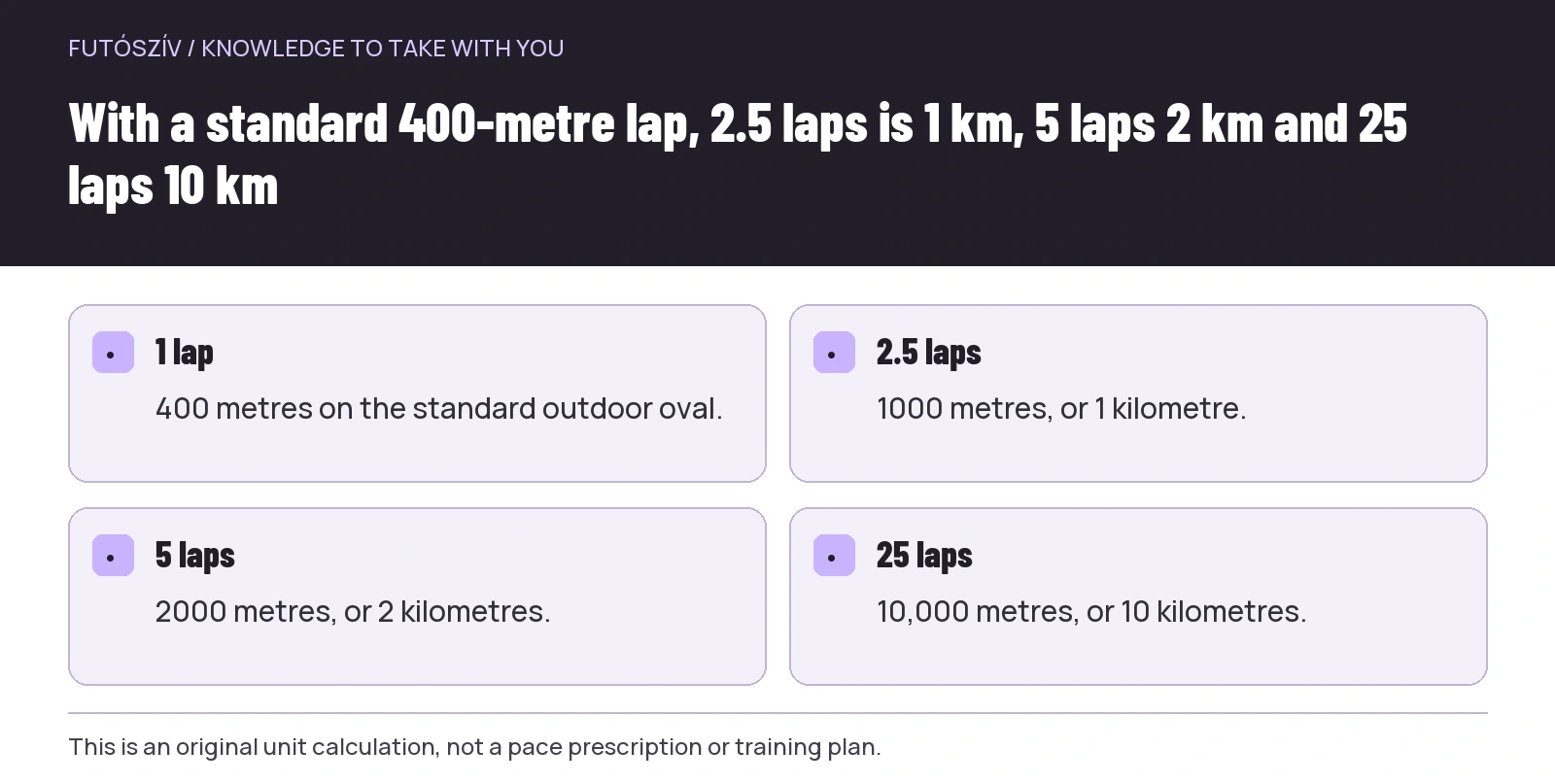 Enlarge diagram
Text version of the diagram
- 1 lap
- 400 metres on the standard outdoor oval.
- 2.5 laps
- 1000 metres, or 1 kilometre.
- 5 laps
- 2000 metres, or 2 kilometres.
- 25 laps
- 10,000 metres, or 10 kilometres.
The aims of placing and time shape the race situation
As a spectator, distinguish situations focused on time from those focused on place. The same distance may show different pacing when leaders prepare for the final order versus an event centred on a fast time. This supplies no single tactical recipe for every race. Watch how the particular event develops.
The repeating track space can make position changes and lap-by-lap developments vivid. On road, cameras and intermediate points tell a different story: the field spreading, turns and different route sections help interpretation. A broadcast frame is always only a detail, so attend to the source of timing and commentary too.
As a participant, choose goals together with regulations and actual possibilities. Seeing others more directly on a track does not require following every move. On road, a large field does not make every nearby runner’s pace personal guidance. Understanding the sporting environment supports decisions rather than automatic imitation.
Not every track race is a sprint in separate lanes
Televised short-distance racing can easily create a general picture: everyone starts in a separate lane and remains there throughout. This cannot be extended unchanged to longer track events. Learn that race’s start and track-use rules from current technical rules and organiser information.
Local arrangements for recreational track use are another question. No competition in a stadium does not guarantee any lane can be used at any time. Training, reserved time or another activity may be underway. On a first visit, learn actual entry and usage conditions. A familiar runner’s video does not grant track access.
When organising the first visit, begin with a specific question: when and how may I use the facility for running? Then learn local lane use and arrangements respecting others moving there. Understanding shared space belongs to track-running culture just as respecting start zones and the designated route belongs to road events.
The story comes together differently for spectators
On track, remaining in one place can let you see the same runner repeatedly. This offers a good opportunity to watch changing places and splits together. Know which race you are seeing and how much remains. An athlete visually ahead may be on another lap; spatial order alone can mislead without official standings.
At a road race, moving between viewing points needs a separate plan. To support at several locations, check your route and closures too. The route secured for runners does not let spectators cross there without restriction. Agree the final meeting independently of intermediate viewing points.
The two spectator situations may offer different experiences, but neither requires constant time calculations. You can enjoy movement, community and atmosphere too. When making a specific athletics conclusion, use the actual meaning of the information. Do not turn a momentary image into certainty about the entire race.
Five questions help before first participation
Which exact event am I entering? At what venue and along which route does it take place? How does the organiser indicate completed distance and finishing? Which entry, start and equipment requirements apply? Where is the official result published? Your event’s information answers these, not a general comparison article.
If discovering track running, you need not abandon every road-running habit. Examine which experience transfers and which needs new knowledge. Travel, organising personal belongings and precise orientation help in both. Venue use and the event’s information rhythm may create separate learning needs.
Equal nominal length therefore presents two distinct athletics situations. The standard oval and repeated laps organise track space; the designated route and its particular environment organise road running. Reading entry details, results and your own programme accordingly makes both easier to understand and comparison more precise.
How Futószív articles are prepared: our editorial guidelines.