It is easy to begin a city running weekend with sightseeing: accommodation is chosen, you have found a restaurant and the race will fit somewhere into Sunday. If you place tasks needed for your race only afterwards, fixed commitments may collide. In Debrecen too, start by creating your own participation plan from organiser information. Fit leisure activities around it.
The following method demonstrates the process using checked information for the Debrecen Marathon announced for 4 April 2027. Sources were checked on 18 November 2026; review current rules and transport changes again before departure. Fictional situations help explain decisions rather than offering real bookings or timetables.
Identify your own race category first
The official race regulations cover several separate races and locate the event centre at HALL Debrecen, by Nagyerdei Stadium. Planning is therefore more than reaching Nagyerdő on Sunday. Coordinate collection, start-area opening, start closure and departure for your own entry.
Do not start from a friend’s distance or a general event calendar. Write the exact race name from your entry confirmation. This is particularly important when an event offers similarly named distances of different lengths and relays. Find your relevant row under the organiser’s name rather than familiar shorthand.
Put the date, your race, collection location and closing time, start location and required confirmation on one sheet. These are not yet a complete daily timetable, but the plan’s checked foundation. If a detail is missing, mark the gap instead of filling it from the same event in another year.
General opening hours are not your personal deadline
The current rules allow advance race-pack collection, while Sunday collection for each race closes 45 minutes before its start. The organiser also requires the QR code received in confirmation. These brief conditions affect the whole weekend: the end of general Sunday opening is not every runner’s last possible arrival time.
Copy more than one time into the calendar. Add why you need to be there and what must be completed by then. If returning to accommodation after collection, include another journey too. If you want to leave luggage there, first check whether a service genuinely usable for your participation exists, under which conditions and where to access it at the end.
Prepare the QR code so you can actually retrieve it. Do not keep essential information solely deep in a message list to search while queuing. Preparation does not mean printing everything or sharing all data with the team. Documents needed for your own identification are your responsibility; send companions times necessary for the shared outing.
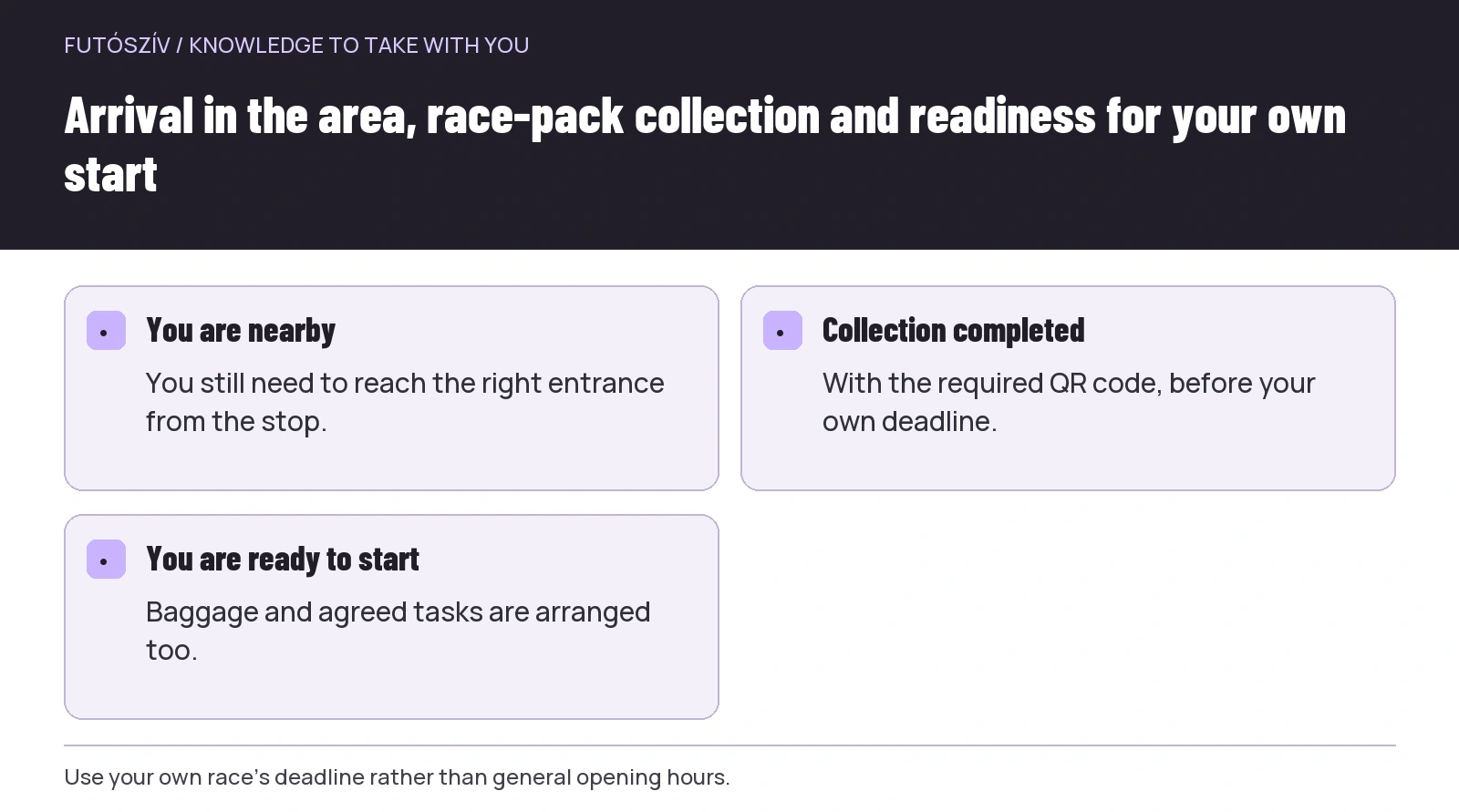 Enlarge diagram
Text version of the diagram
- You are nearby
- You still need to reach the right entrance from the stop.
- Collection completed
- With the required QR code, before your own deadline.
- You are ready to start
- Baggage and agreed tasks are arranged too.
Plan a task chain rather than three Sunday times
Arriving, obtaining the race pack and standing at the start are different states. A journey planner’s arrival time informs the first; you need to think through the others. Check the plan backwards from your own start too. Which tasks must finish beforehand and which have organiser cutoffs?
| State | What does it mean in practice? | What makes it checkable? |
|---|---|---|
| I have reached the area | I have left the vehicle or stopped at the arrival point. | I know the place and onward access route. |
| I have completed collection | I have the number and information needed for my own race. | I have the required code and collected before my deadline. |
| I am ready for the start | Baggage and tasks agreed with companions are arranged. | I follow my own race’s arrangements at the organiser’s specified place. |
The table prescribes no identical time margin for everyone. Collecting the day before and arriving by train on Sunday create different starting situations. What matters is not compressing every task into “I will get there”. Where personal experience or venue information is absent, do not treat the fastest possible administration as certain.
Check the Nagyállomás–Nagyerdő connection for the specific day
The official route of DKV tram 1 includes Nagyállomás and stops around Nagyerdő. This can be a good starting point for local planning, but the currently visible timetable is not a promise for every circumstance on the 2027 race day. Check Sunday service and any changes when information relevant to your journey becomes available.
Count more than time aboard. After interurban arrival, reach the correct stop, wait for local transport and find the race entrance after getting off. Being near the stadium is not the same as knowing the precise collection gate. If a general map shows several entrances, the organiser’s site plan identifies which to use.
Examine the return route separately too. With a loop-like service or a stop on another side, reversing the morning’s actions is insufficient. Your starting location after finishing may differ from morning arrival too. If luggage still needs collecting from accommodation, make that a separate intermediate stop.
The year matters in choosing accommodation too
The event’s accommodation recommendations still showed a 2026 date in the page title at the November 2026 check, while main regulations already described the 2027 edition. This does not mean every listed option is unusable. It does mean an earlier recommendations page cannot establish a 2027 discount or service condition with certainty.
If accommodation interests you, request confirmation for your own booking. For exactly which dates, room and conditions does the price apply? What happens if you arrive at another time? Booking changes and baggage after checkout should be clear from your confirmation. An event-page logo cannot replace it.
Assess geographical closeness through your own programme too. Proximity to the centre may matter most to one person; connection with the arriving train and later sightseeing to another. There is no single best area for every runner. Suitable accommodation has understood conditions allowing fixed tasks to be completed, within your budget.
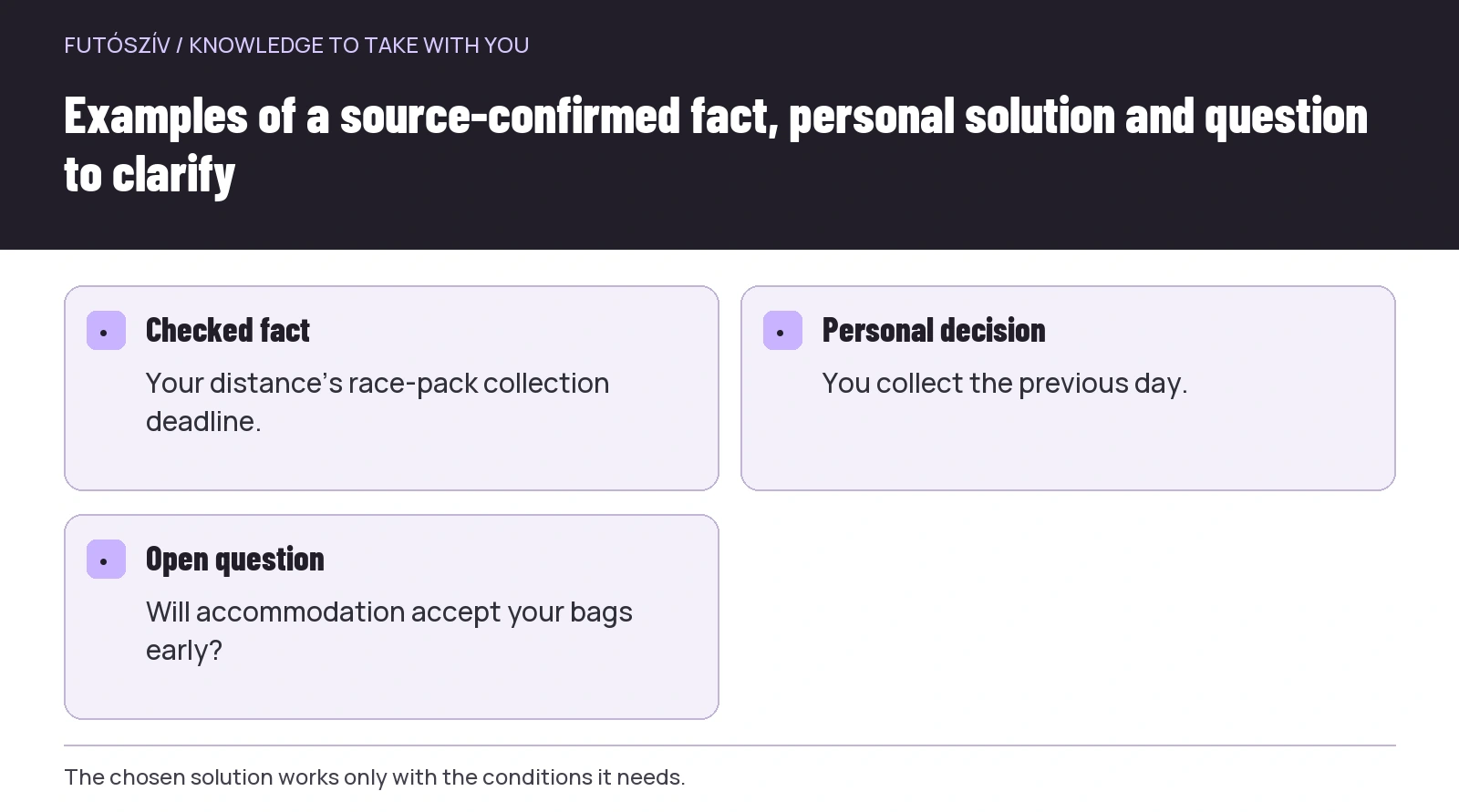 Enlarge diagram
Text version of the diagram
- Checked fact
- Your distance’s race-pack collection deadline.
- Personal decision
- You collect the previous day.
- Open question
- Will accommodation accept your bags early?
Previous-day collection: when does it genuinely simplify things?
Advance collection can reduce Sunday tasks but does not fit every arrival plan. First check whether usable time remains after your actual arrival. If interurban travel, check-in and local connections together make it uncertain, do not automatically regard it as completed.
Then consider where the collected pack and number will go. If you cannot check in yet, handling the task with a suitcase may require more travel. With companions, everyone need not benefit from going simultaneously. Shape the shared programme knowing prior rules rather than assuming anyone can collect everything for anyone else.
A useful decision question is what Saturday collection frees in Sunday’s schedule. Removing a fixed deadline and local trip can offer a tangible advantage. If it merely creates another rush on Saturday arrival, consider the other legitimately available version. Your whole weekend answers, rather than what runners generally tend to do.
An imagined example: two people, two different Sundays
Two friends book a weekend in Debrecen together. One enters a longer distance starting earlier, the other a later short race. The example fixes no accommodation, service or completion time. It shows why writing one shared “race-day programme” for both is unhelpful.
For the first runner, advance collection and the route to an early start determine the plan. The second may have more free time in the morning but still must observe their own collection deadline. If they want to watch the other’s start, they need to check compatibility with their own administration. Well-intentioned support should not become a missed personal task.
Nor are they necessarily free together immediately after finishing. One may still be on the course when the other has finished. Agree a meeting point accessible to both, and avoid putting the shared accommodation key somewhere that unnecessarily leaves one without access. Finalise shared travel home only after considering both complete programmes together.
Two separate task sheets do not work against the social experience here. They reveal what is genuinely shared: a Saturday walk, an agreed meal or meeting after races. Different start times are not organisational failure; tension arises when a plan pretends they do not exist.
A supporter needs a complete independent route too
If someone travels to support you, give them more than one point on the course. They need to know how to get there, where they can legitimately wait and how to find you afterwards. Runner routes and spectator travel options differ. Around closures in particular, do not rely on an imagined shortcut through the race course.
A supporter’s programme should not depend solely on your estimated splits. You can agree a shared meeting while they choose a walk or another activity meanwhile. If they miss one viewing point, make clear they need not rush to the next. Include expected availability and what to do if you do not answer the phone in the communication plan.
Do not dismiss companions arriving with children, different transport needs or large luggage with “meet there”. Adapt their route to actual access. Make assumptions about organiser services only from official information; a general urban venue description does not promise access for every event.
Keep the weekend plan readable
Separate established facts, chosen solutions and open questions. A source-checked personal collection deadline can be an established fact. Collecting the previous day is a chosen solution. Whether accommodation will accept luggage before check-in may remain open. These have different natures; one notes field can easily mix them up.
Put the source and checking time beside every important organiser fact. The shared sheet needs only essential information: your race, arrival and meeting points, common activities and who handles which detail. Do not copy the entire regulations or promise companions a service read about only on an old page.
Before the weekend, read the plan once as a journey story: I arrive, access my belongings, complete collection, reach my start, meet companions after finishing and reach the journey home. Wherever the story says only “we will sort it out”, a connection may still be missing. Clarifying those points makes the Debrecen outing both flexible and manageable.
How Futószív articles are prepared: our editorial guidelines.