
The pre-start question: what do you want the medicine to achieve?
If you already feel before the start that you could not run normally without a painkiller, reconsider whether starting is safe. Treating a condition under a doctor’s instructions differs from taking a tablet “just in case” while preparing for a race. Routine preventive use is not a harmless equipment trick.
Different active ingredients and risks sit behind medicine names. This article mainly addresses non-steroidal anti-inflammatory drugs, or NSAIDs, and questions around independent use near races. Ibuprofen is one such ingredient; not every painkiller belongs to this group. Choosing another product, however, does not by itself make racing through pain safe.
You will find no race-specific dose, timing or medication switch here. Clarify these with a doctor or pharmacist according to medical history, regular medicines and current symptoms. The aim is for pre-start decisions not to be determined by a teammate’s habit or the word “strong” on packaging.
Why does over-the-counter availability not establish safety in sport?
The NHS information on ibuprofen describes individual consideration with previous stomach ulcers, kidney, liver or heart disease and certain drug interactions, among other situations. A medicine can have a place in appropriate treatment without being suitable for everyone in every circumstance.
The FDA medication guide on NSAIDs warns of gastrointestinal bleeding, ulcers and cardiovascular risks too. The US information does not replace the leaflet of the particular product used in Hungary. It does show why equating availability with absence of risk is inappropriate.
A race is a distinct situation: prolonged exertion, changing weather, possible nausea and uncertain fluid intake can combine. Earlier experience of no problem using a product for a headache at home did not test that same situation. “It has always worked for me” often means only that you have not noticed a side effect so far.
What did research on use before a marathon show?
A 2013 cohort study at the Bonn marathon and half marathon analysed relationships between pre-race painkiller use and reported health problems. Users reported more adverse events. This is an important warning about routine practice, but its method is not equivalent to a randomised experiment.
Participants answered questionnaires and not every entrant responded. Medicine users may have differed in other characteristics, such as previous symptoms. This does not mean a particular runner will definitely experience the same event or every studied ingredient has identical effects over every distance.
The practical conclusion is nevertheless not that uncertainty permits anything. With a preventive habit, ask which proven benefit you expect and which possible risk you accept. If the medicine’s purpose is merely to avoid taking pain into account, the decision problem is visible before research percentages are even considered.
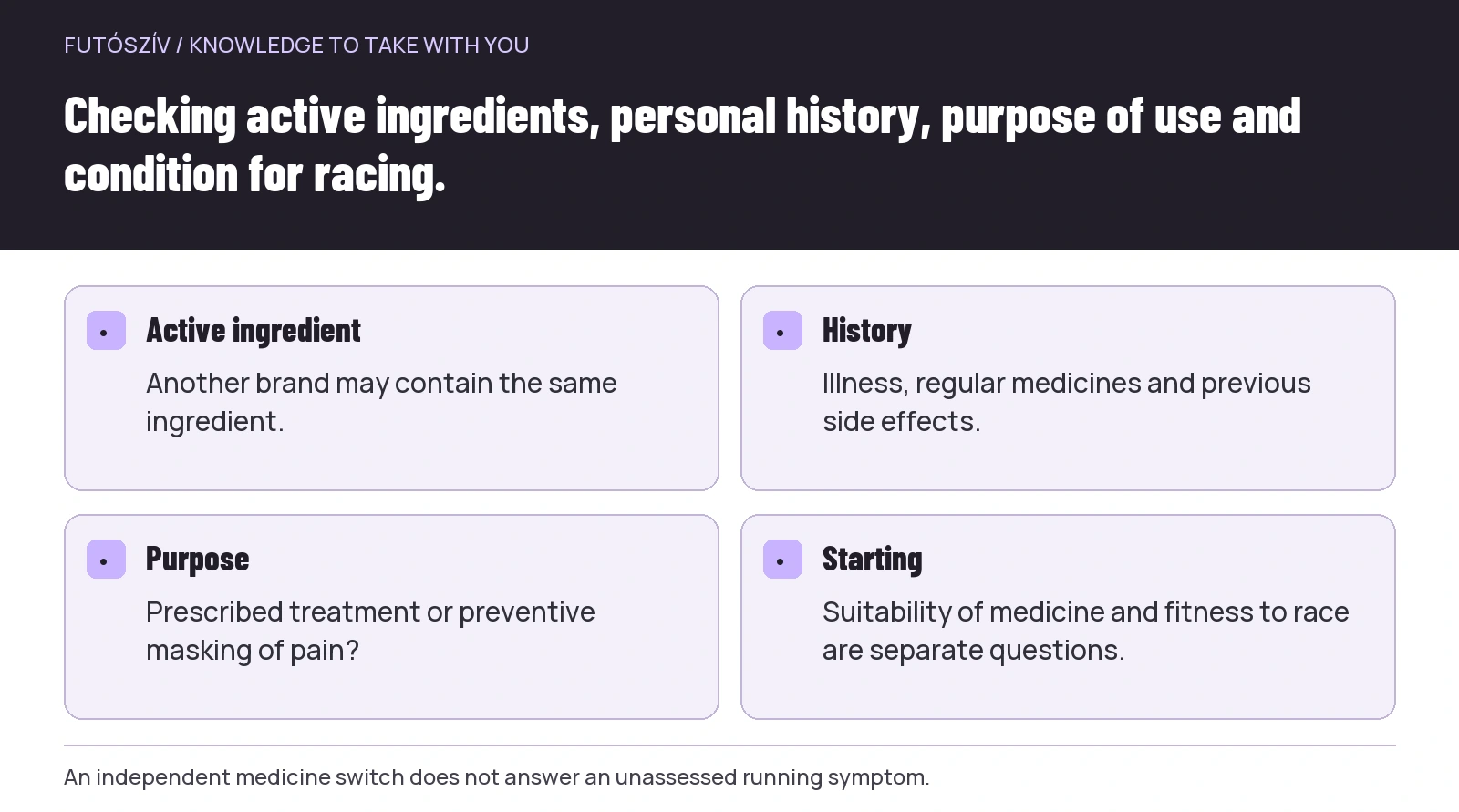 Enlarge diagram
Text version of the diagram
- Active ingredient
- Another brand may contain the same ingredient.
- History
- Illness, regular medicines and previous side effects.
- Purpose
- Prescribed treatment or preventive masking of pain?
- Starting
- Suitability of medicine and fitness to race are separate questions.
The ultrarace experiment: an important finding with an important limit
In a 2017 placebo-controlled ultrarunning trial , the ibuprofen group had more laboratory events meeting acute kidney injury criteria than the placebo group. The sample was small, and the difference’s uncertainty range included a value compatible with no difference. This is not a result from which one simple, certain risk number should be assigned to every runner.
The setting was a section of a long ultrarace completed in a particular environment. It differs from a short urban run, but that is no reason to assume independent use is automatically safe at other distances. The experiment did not provide general permission for preventive medication.
Accurately describing uncertainty avoids two exaggerations. It does not say one tablet definitely causes kidney injury in everyone, or that statistical uncertainty removes grounds for caution. Alongside the trial, known medication risks, personal health and expected benefit belong in the decision.
Why might a newer study show a different result?
A laboratory experiment published in 2025 involving eleven physically active people examined several kidney and intestinal injury markers during a one-hour run in heat. In this setup, ibuprofen did not increase post-exercise changes in the kidney and intestinal markers studied. The study did not establish general safety for every race situation.
Participant selection, activity duration, environment and measured endpoints differed from the ultrarunning research. A laboratory biomarker change and a clinically important health event are not exactly the same concept either. Do not select the one sentence from two different studies that justifies medication use already decided upon.
Together, research provides a more nuanced picture: risk around sport cannot be described by one finding for every situation. Confident community advice is therefore a particularly weak basis. With personal symptoms and medication use, appropriate professional discussion is worth more than a pre-start recipe made from a small study.
Suppressing pain is not the same as resolving an injury
With a painful knee, foot or muscle, the question is not only whether a race is bearable, but what causes symptoms and which load fits alongside them. Feeling less after medicine does not necessarily mean the cause has resolved. A forced technique change, limping or progressively worsening symptoms cannot be addressed merely with stronger determination.
Do not use unusual pain during running as a signal to take another product. Stop and seek help at a medical point according to severity. Tell event staff what happened, what you took and when, rather than only “my leg hurts”.
A general article does not override an earlier individual medical plan. But clarify that plan’s scope: is racing recommended alongside this treatment, which symptoms mean stopping and do any circumstances require another discussion? Permitted medication use and being in a condition to race are separate questions.
What should you check beyond the product name?
Check the active ingredient, because different brands may contain the same one. A product for colds, headaches or several symptoms may contain something you already took in another form. Reviewing packages together with a pharmacist is simpler and more reliable than counting brands from memory.
The NHS highlights avoiding independent combination of ibuprofen with another NSAID because side-effect risk may increase. This does not mean an article automatically permits adding any other product. Combinations, regular medicines and your conditions need checking together.
Keep medicine packaging or an active-ingredient list accessible. Specific information matters when seeking medical help: which product, when and under which instructions? Do not conceal use for fear of an uncomfortable comment. Healthcare staff need to know for accurate care.
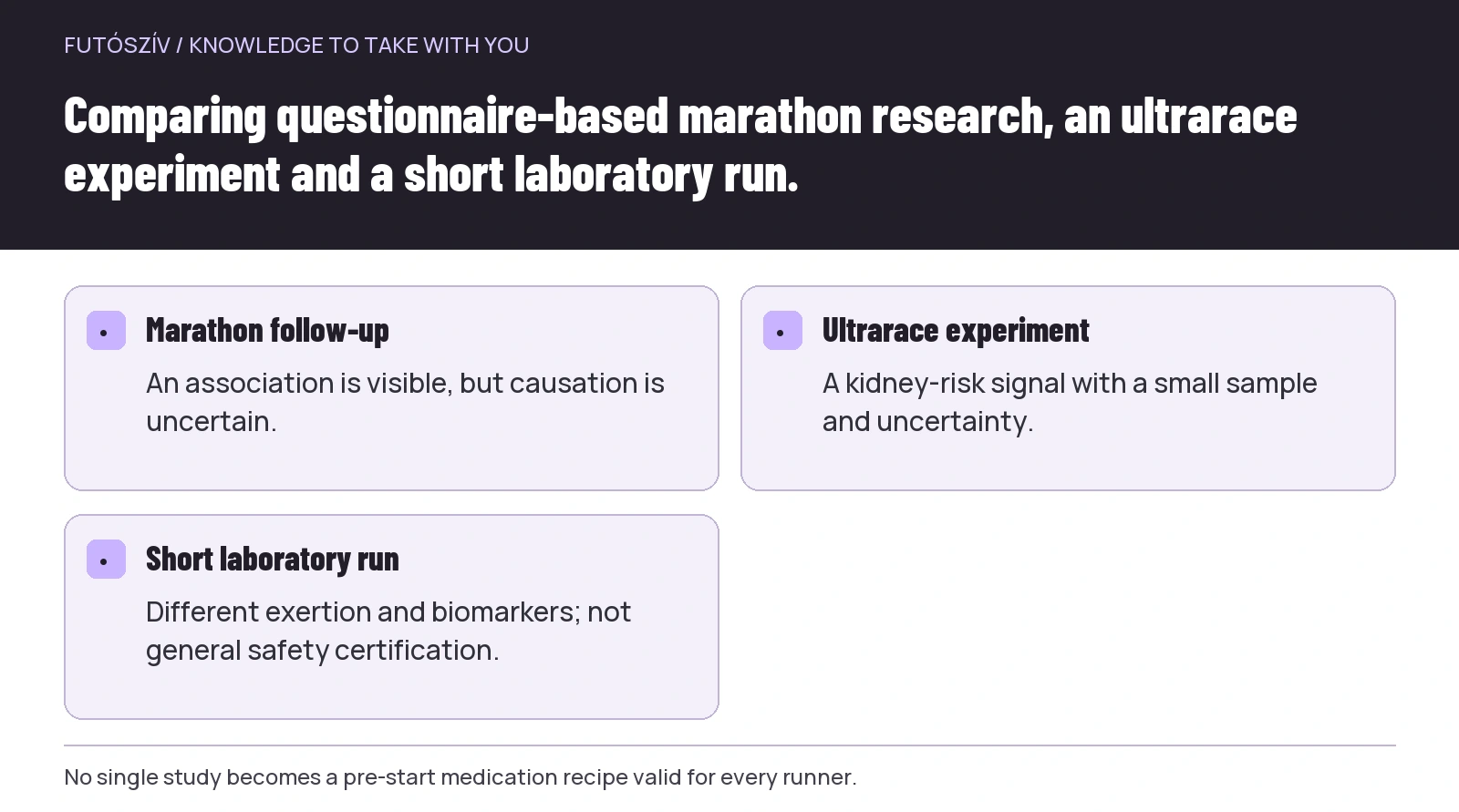 Enlarge diagram
Text version of the diagram
- Marathon follow-up
- An association is visible, but causation is uncertain.
- Ultrarace experiment
- A kidney-risk signal with a small sample and uncertainty.
- Short laboratory run
- Different exertion and biomarkers; not general safety certification.
Four common “safety solutions” that do not resolve the question
- “I will drink more with it.” Fluid intake alone does not neutralise medication risks. Do not turn forced overdrinking into a protective strategy either.
- “I will eat first, so it must be fine.” Instructions on taking medicine do not establish the safety of the whole race situation.
- “It will be only once.” One-time use does not remove contraindications, interactions or the question behind pain.
- “Everyone else takes it.” You do not see other people’s illnesses, medicines or side effects. A group habit is not individual advice.
The aim is not fear of every medicine. What matters is not treating something as sports equipment when use needs adapting to health. Appropriate treatment can help, but an independently created preventive start routine does not replace clarifying causes.
Which symptoms mean seeking help?
Vomiting blood, black tar-like stools, severe abdominal pain, blood in urine or a marked fall in urine output require prompt medical assessment. Chest pain, severe breathing difficulty, collapse, confusion or severe allergic symptoms require urgent care. Do not automatically call them usual aspects of racing.
The NHS medicine information also lists signs of serious side effects. A symptom’s cause cannot, however, be established safely simply from whether you took medicine beforehand. The same symptoms can matter without use too. The first task is help rather than finding causes at home or reaching the finish.
If you receive medical care during or after the race, ask about further activity and follow-up too. Brief symptom relief does not necessarily close the matter. Base a later return on the provider’s plan and your condition, rather than the original race calendar.
A pre-start decision you can make in advance
It is useful to state beforehand: if symptoms would require medicine to mask an obstacle to normal running, I will seek professional advice before the race. If this cannot be arranged in time, changing distance or starting is a real option. Entry cost and preparation value do not reduce the significance of an unassessed symptom.
Instead, keep accessible health information, contacts and a thought-out stopping plan in the race bag. You can agree with your supporter that withdrawing is not failure they need to talk you out of. A responsible decision is easier when those around you regard more than finishing as an acceptable outcome.
Pain relief has a medical role. But habit and good intentions are insufficient for routine preventive use before a running race. The better question is not how to suppress a signal, but in which condition and with which plan starting now would be sensible.
Sources and further reading
- Küster and colleagues: Consumption of analgesics before a marathon and adverse events, 2013
- Lipman and colleagues: Ibuprofen versus placebo effect on acute kidney injury in ultramarathons, 2017
- Specht and colleagues: Effect of Ibuprofen on Markers of Acute Kidney Injury, Intestinal Injury, and Endotoxemia after Running in the Heat, 2025
- NHS: Ibuprofen for adults
- FDA: Medication Guide for Nonsteroidal Anti-inflammatory Drugs
How Futószív articles are prepared: our editorial guidelines.