Many new food ideas can appear in the days before a race. A running companion recommends something, a sample arrives in the race pack and an impressive breakfast buffet awaits at your accommodation. Novelty is not necessarily bad, but predictability has value in its own right before an important event. A trial beforehand gives you specific personal experience of your choice, so packaging, preparation or timing are not first discovered on race morning.
This guide is for adult recreational runners and does not provide a personal race diet. A known allergy, condition or prescribed diet also needs considering when judging a new food. “I will try it before training” is not suitable for testing food allergy or intolerance at home. Seek appropriate professional help with new or recurring symptoms. An everyday trial can inform practical use of foods already suitable for you; it cannot diagnose.
What actually counts as a new food?
A completely new dish is obviously unfamiliar, but circumstances can change behind a familiar name too. A different-brand cereal product, changed topping, new bread or a much larger portion than usual means a different combination. A café drink ordered under the same name may also be prepared differently. In race planning, refine “I have eaten this before”: which precise version, how much and under what circumstances did you get to know it?
A homemade recipe is not necessarily identical because its name stays the same either. Different proportions, new seasoning or an extra addition changes the actual food. This is not a judgement, simply important information. If you want to repeat your familiar breakfast, briefly note essential details. Your own recipe card can help stop the established version being made from memory a little differently each time.
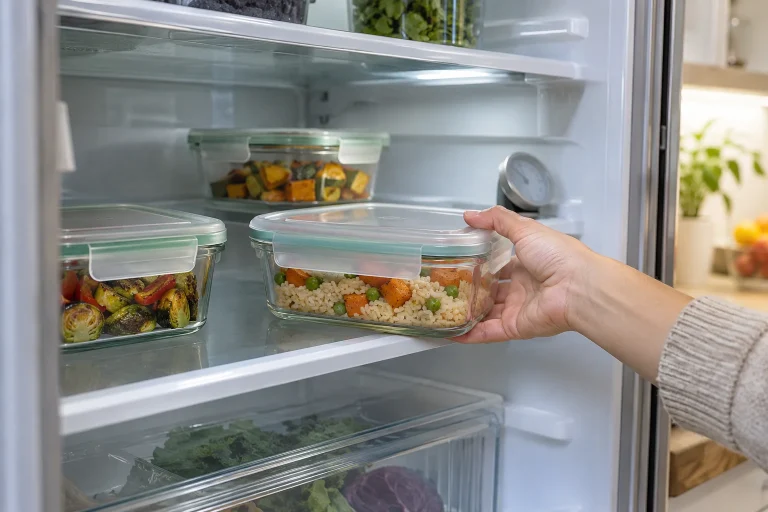
Novelty has an organisational side too. You may know the food from eating calmly at home but not have tried it after travelling, at another temperature or from a different container. A spoonable combination needs suitable utensils and a clean place; the whole journey of chilled food needs arranging. A practical trial therefore checks the way of using food as well as the food itself. Predictability before a race means more than a familiar ingredient being present.
Why is a familiar choice an advantage at an important event?
The Johns Hopkins Medicine information on pre-competition nutrition emphasises sticking with familiar, well-tolerated foods and planning ahead while travelling. This does not mean every new food necessarily causes symptoms. Rather, leave fewer uncertain factors for the important day. A new venue and the race situation can already require many decisions.
Personal experience helps with practical details too. You know how long breakfast takes, whether reheating is needed, whether the bowl’s texture works and where toppings are stored. These small decisions add up on race morning. An established process is easier to use than interpreting a new recipe in an unfamiliar kitchen. Predictable food can therefore free some attention for getting ready at the venue.
A friend’s recommendation is a good idea but insufficient as a personal guarantee. An enthusiastic account alone does not tell you the other runner’s whole diet, load or tolerance. Product advertising is not your own experience either. If the recommendation interests you, keep it for a calmer trial later. You do not have to prove openness to every novelty on race day. A familiar choice can be a deliberate decision.
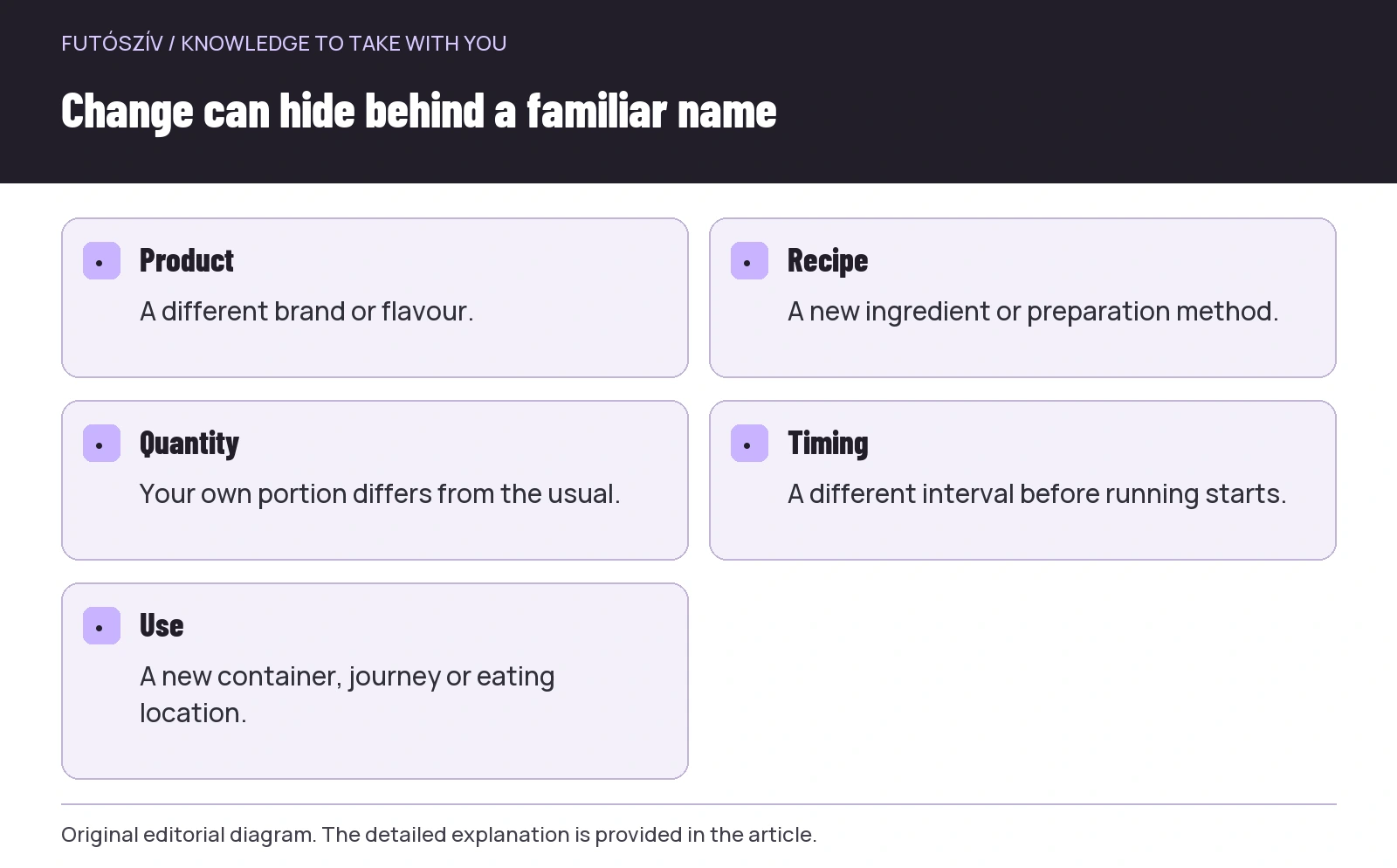 Enlarge diagram
Text version of the diagram
- Product
- A different brand or flavour.
- Recipe
- A new ingredient or preparation method.
- Quantity
- Your own portion differs from the usual.
- Timing
- A different interval before running starts.
- Use
- A new container, journey or eating location.
The first check is the label and ingredients
For packaged food, check the exact description, ingredients list, allergen information and storage requirements. For a sports product, check any caffeine and the precise version as well. Different flavours in one family need not have identical ingredients. Note whether label figures apply to a serving or the whole pack. Familiar packaging does not replace checking the actual product you have.
A “new recipe” notice may signal a genuine change, but the absence of a special notice is no reason to skip the label. With a known allergy, consistently check according to your own professional guidance. A sample of uncertain composition is not suitable for a guessed decision before running. You do not have to eat food because it was a gift or is offered at an event. A sample pack can remain an option for later, after appropriate checking.
The Food Standards Agency guide to allergen information highlights the combined role of accurate, current information and conversation with staff for non-prepacked foods. This is British catering guidance, rather than Hungarian legal advice. The consumer perspective is still useful for your own meals: with a known allergy, seek appropriate information about today’s particular food rather than deciding from an earlier memory.
Tasting and pre-run use are two steps
With a new food suitable for you, first getting to know its everyday flavour and texture can itself be a task. Do you enjoy it? Is preparation manageable? Does the packaging work? You need not immediately place these questions before an important session. Practical use around a particular run can be the next step if it fits your personal plan. Separating the two steps avoids discovering amid pre-start haste that you do not like the chosen version at all.
The Sports Dietitians Australia guide to pre-exercise eating considers individual timing and tolerance together. In your own trial, therefore, identify eating time and training circumstances alongside the food. A dish enjoyed at a relaxed dinner is not automatically usable in the same way immediately before running. Develop experience tied to the specific situation rather than simply a general opinion of a product.
If the product or food does not fit your prescribed diet, a trial does not override that limit. The same applies if a known discomfort or health question already leaves you uncertain. Gathering personal experience does not mean seeking risk. The goal is to check workable use of an appropriately selected food. Clarify questions needing professional help first, then look for a practical version within that framework.
| Step | What are you checking? | What does it not establish? |
|---|---|---|
| Checking composition | The exact product and dietary suitability | A personal guarantee of digestive comfort |
| Everyday familiarisation | Flavour, texture and practicality of preparation | Every pre-run situation |
| Practical trial | A particular timing and way of use | A medical diagnosis |
| Repetition | A repeatable process | A certain outcome at every race |
Focus on one new detail in a trial
Choose an occasion fitting your training plan, without increasing load for the trial. If the food is new, keep other important circumstances familiar where possible. New coffee, new breakfast, an unusual drink quantity and a new sports product together produce experience that is hard to interpret. State the purpose of the change in one sentence. For example, you are checking whether a cereal combination intended for travel is as comfortable to eat from the chosen container.
Record the actual food version, your approximate quantity, and eating and departure times. Briefly add important circumstances: session character, weather and unusual food or drink in between. You need not analyse every minute. The goal is to describe a useful, recognisable situation. If your notes cannot later tell you which version you ate, transferring the experience to race day becomes harder too.
If the trial was comfortable, repeat the process later in a similar situation. You need not add another ingredient immediately simply because time remains before the race. A reliably usable version has value itself. The aim is not testing every available product, but having your own appropriately familiar solution. Repetition can also expose hidden preparation and packing difficulties.
Describe a trial’s outcome narrowly and precisely
Instead of “it was good”, describe what worked. It took ten minutes to prepare, did not leak from the container, you liked the texture and it felt comfortable before that session. These are several different outcomes, not all nutrition questions. Break down what did not work too. A meal missed because a container was too small or a spoon absent need not be called an unsuitable ingredient.
Do not automatically infer allergy or intolerance from one uncomfortable experience, or independently remove several food groups. Record the symptom and circumstances, then seek professional assessment if needed. A comfortable trial is not a guarantee valid in every situation either. Personal experience is most useful when you know the specific version and circumstances it concerns. Naming uncertainty is part of accurate evaluation.
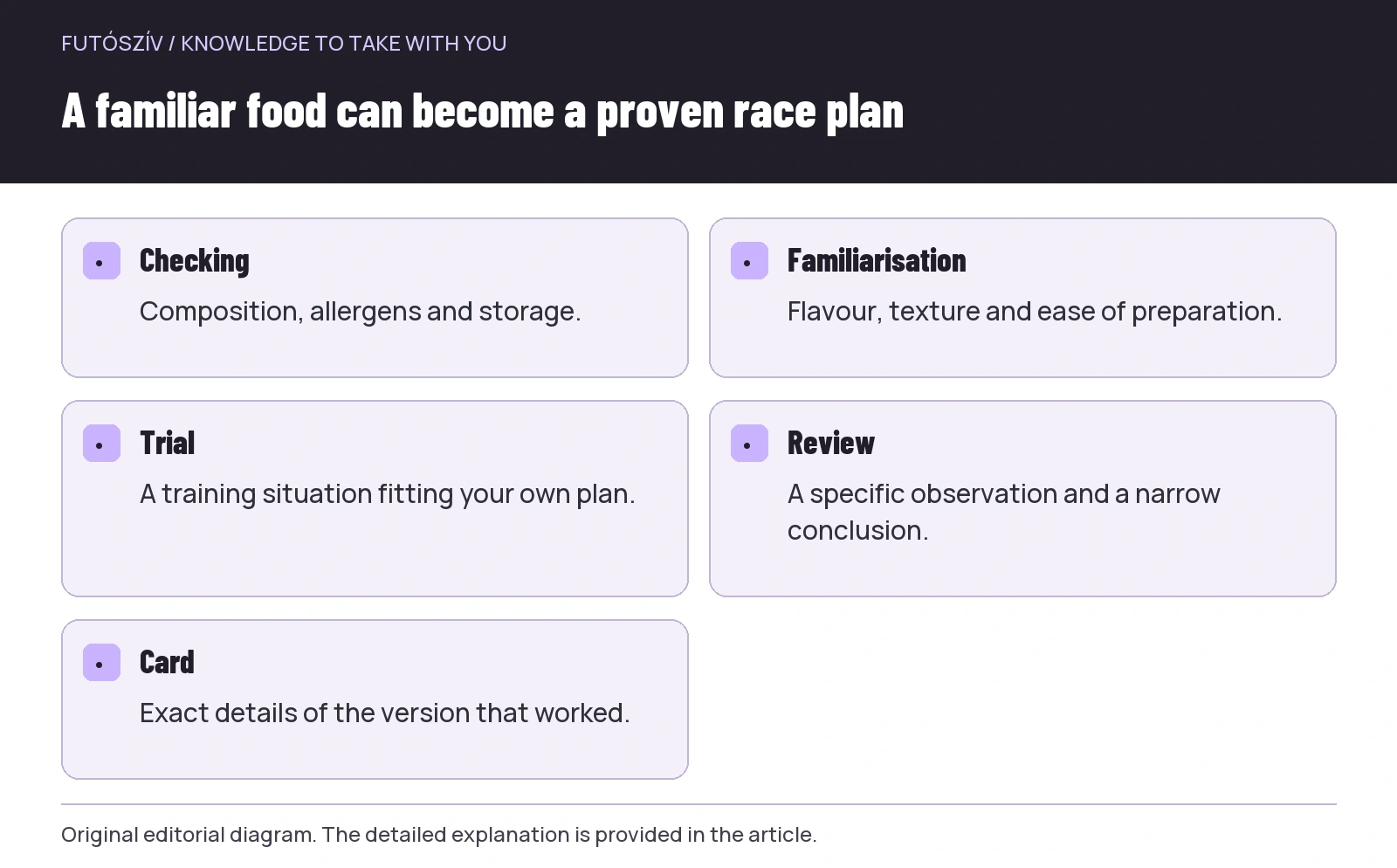 Enlarge diagram
Text version of the diagram
- Checking
- Composition, allergens and storage.
- Familiarisation
- Flavour, texture and ease of preparation.
- Trial
- A training situation fitting your own plan.
- Review
- A specific observation and a narrow conclusion.
- Card
- Exact details of the version that worked.
Accommodation and restaurants: check familiar food too
Even a breakfast sounding familiar from its menu description can use a different recipe. Ask about important ingredients, particularly with an allergy or prescribed diet. A buffet sign and the food’s actual location should be clear too. If composition cannot be adequately clarified, choose a checked alternative. You still have the right on race day to request accurate information and decide on another food.
Check breakfast timing beforehand. Familiar food is of little use if it becomes available only after your start. Your own backup that can be stored appropriately, or a local option agreed in advance, can reduce uncertainty. Food carried while travelling needs the same storage conditions as at home. A familiar recipe does not make food suitable for unlimited transport. Composition and logistics together produce a usable pre-race eating plan.
What should you do with samples and gifts?
Set the sample aside until you have read its label and established whether it suits you. Check the date, intact packaging and storage instructions. If you want to try it later, keep it under appropriate conditions. A race-pack product is not a personalised suggestion; many participants receive the same pack despite differing health and dietary needs.
Separate marketing claims from what you genuinely know. Offering something specifically to runners does not mean you need it before your own race alongside your particular combination. You can decide about trying it on a calmer day. Good preparation also includes not accidentally replacing a familiar plan with an appealing gift on the important morning.
A short card for the version that worked
Make a few-line card for pre-race food: exact version, quantity according to your own plan, preparation, storage, eating location and necessary utensils. Add the circumstances in which you tried it. The card does not replace a nutrition table; it preserves the process you have learned. Update details if the product or recipe changes. “Familiar breakfast” then becomes a repeatable, checked choice instead of a vague memory.
A trial beforehand is useful when it leaves fewer questions for race morning. You need not turn it into experiments filling every weekend. Choose food fitting your diet, check its specific ingredients and learn practical use in good time. On race day, you can rely on that established routine. Novelty can retain a place in varied everyday eating while your own proven solution takes priority before an important event.
Sources and further reading
- Johns Hopkins Medicine: Nutrition for Athletes: What to Eat Before a Competition
- Sports Dietitians Australia: Pre-exercise fuelling
- Food Standards Agency: Allergen Information for Non-Prepacked Foods Best Practice
How Futószív articles are prepared: our editorial guidelines.