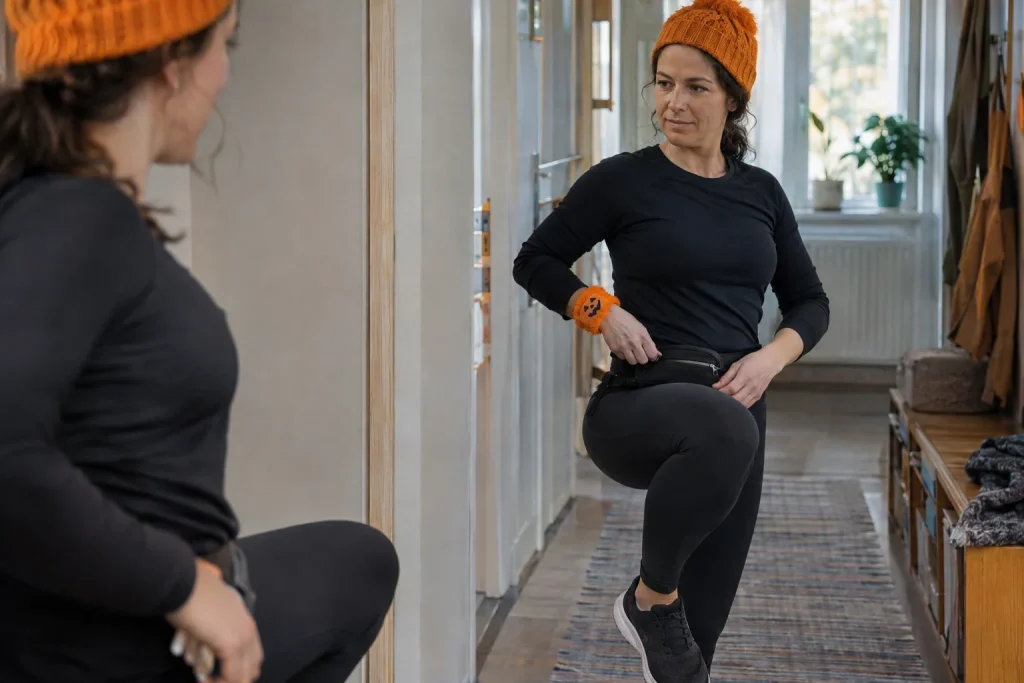
A good running costume lets you pay attention, move and access your own equipment just as you would in your basic running clothes. The biggest prop does not necessarily create the best effect. A colour, simple symbol or securely attached detail can convey a recognisable idea while leaving you with fewer things to manage throughout the event.
Start your choice with the event rules and your own plans. Different things work for a short shared city event, a longer race, narrow passages or an evening start. The following method is a practical checking system of our own. It is neither a ranking of costume products nor a health fitness assessment: it helps you examine how the idea connects with actual participation.
Costume rules come before your own idea
A themed event’s name alone does not tell you what you may wear. There may be a specified compulsory outfit, free costume choice subject to conditions, or a race where large props are incompatible with the course. Find the sections of the current event information covering costumes, race numbers, entry checks and prohibited items. Clothing seen in earlier photographs is not automatic permission for the next occasion.
The official 2026 PENNY Santa Run event page , for example, requires participants to wear the Santa outfit supplied by the organiser. This is that particular event’s condition, rather than a general rule for Santa runs. Do not prepare a substitute outfit on the assumption that red alone is enough; start with the organiser’s current requirement and ask if anything is unclear.
The official runDisney frequently asked questions also direct participants to specific costume requirements within their own event system, with consideration for other people’s uninterrupted participation. This is an example from an American organiser, rather than Hungarian race rules. The general lesson is that permission to wear a costume can always come with detailed conditions.
Separate the core idea from the large prop
Define what would make the chosen appearance recognisable. A pair of colours, a geometric pattern, a hat or simple lettering can carry the theme. If the costume works only with a large object carried in your hands, think through whether it is really needed for the whole race. A look chosen for a photograph at the event can differ from equipment wearable around the entire course.
Keep a base outfit that you know for your own movement and have chosen for the conditions. You can design restrained decoration around it if the event permits. You do not need to buy everything from a costume shop. An existing item in a new colour combination or with removable decoration can be imaginative without requiring you to start in unfamiliar clothing.
Leaving things out is part of design too. If a detail blocks your vision, takes too much space or is difficult to manage, a smaller version is not an unfinished costume. A simple idea that works throughout the event often serves the day better than an outfit that looks impressive in the mirror at home but constantly needs adjustment while moving.
 Enlarge diagram
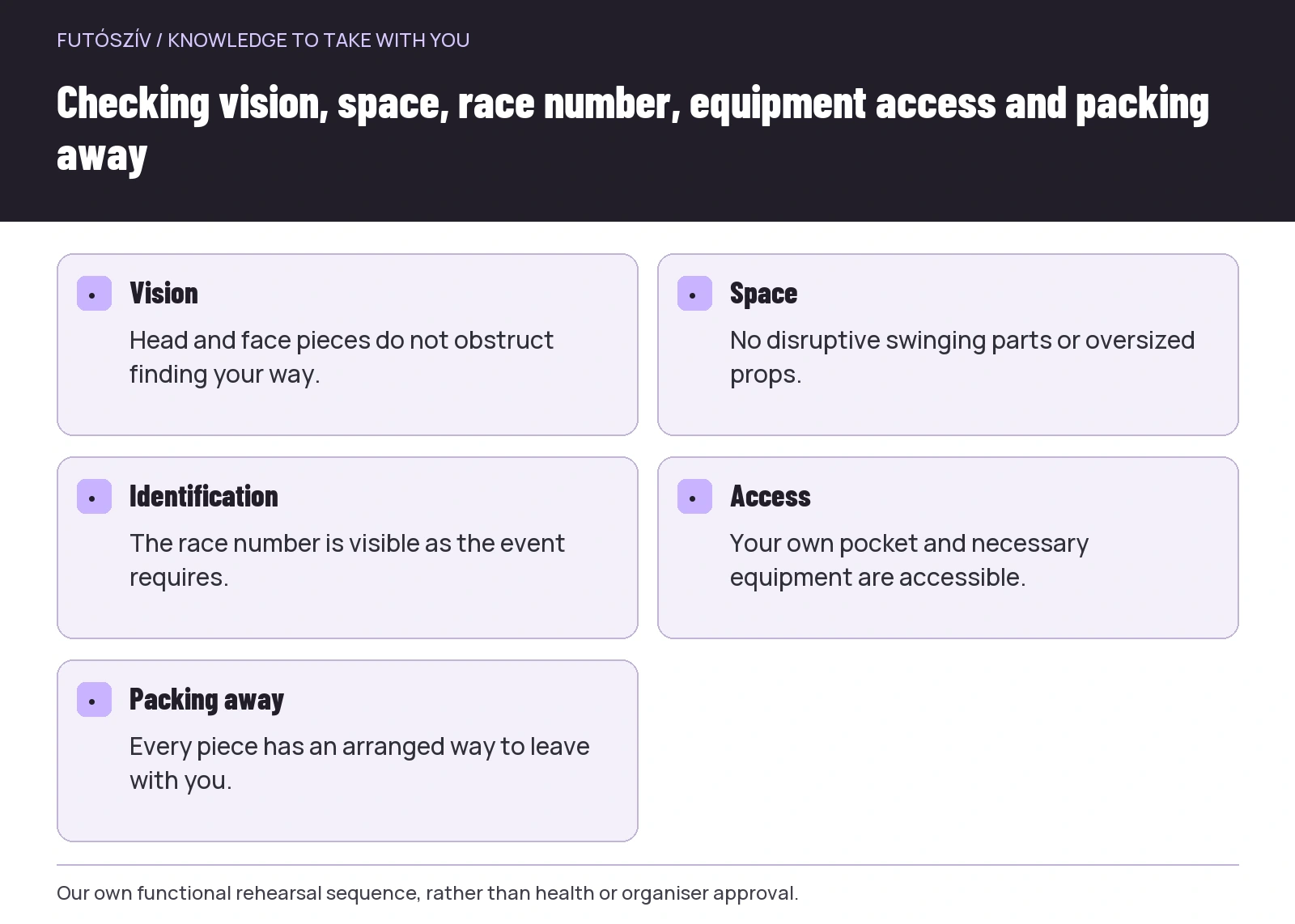
Text version of the diagram
- Vision
- Head and face pieces do not obstruct finding your way.
- Space
- No disruptive swinging parts or oversized props.
- Identification
- The race number is visible as the event requires.
- Access
- Your own pocket and necessary equipment are accessible.
- Packing away
- Every piece has an arranged way to leave with you.
Keep vision and orientation unobstructed
Try pieces worn on or near your head and face while looking sideways, watching the ground below and finding a sign in your surroundings. A stationary portrait will not reveal whether a hat rotates, decoration slips in front of your eyes or a hood changes your field of vision. Do not rehearse in road traffic or somewhere that disturbs others.
Assess glasses, your own light and head decorations together. They need to work in combination, not just separately. If any item constantly needs readjusting, simplify the outfit. The costume should not make organiser information illegible or make it harder to notice signals from event staff.
Whether masks, face coverings and large headpieces are permitted can be particularly event-specific. Do not assume any face covering is allowed at a costumed run. If the rule is unclear, describe the particular item and how you will use it to the organiser. Until you receive a response, do not regard your own home rehearsal as official approval.
Consider space for people moving beside you
A wide wing, rigid side piece or long hanging part affects more than you. At the start, on turns, while overtaking and through narrow passages, it can change the space available to others. Assess the costume’s width and movement during your chosen gentle rehearsal movements, rather than only while standing with your arms outstretched. Anything that swings out affects your surroundings too.
For a handheld prop, ask where you will put it when reaching for other equipment, giving someone room or adjusting your clothing. If the answer is temporarily putting it on the ground on the course, you need another solution. The runners’ route is not costume storage, and a prop cannot stay there because it became unnecessary during the day.
For a group idea, do not physically connect participants with improvised string or a shared frame. Matching colours or motifs can be enough for a coordinated appearance. Check the event conditions for both individual and group costumes; a shared look is no reason to obstruct the start zone, passageways or other runners’ movement.
Leave room for the race number and personal equipment
The organiser’s instructions determine race-number placement. The costume must not cover it, crumple it or hold it on a part that turns with every movement. If timing equipment or other required identification is involved, read its conditions of use too. Do not wait until the venue to work out how everything might somehow fit.
Try reaching your phone, key or other genuinely necessary items while wearing the complete outfit. A pocket that works well in the base clothing may become inaccessible under a decoration. If you have to remove half the costume for one item, that can create extra work both before the event and at the finish.
Decorative lighting and functional lighting are separate matters. A glowing strip can create a visual effect, but do not infer that it can illuminate the route. Find the evening event’s requirements for personal lighting or visibility separately. The outfit should not cover the light you actually use or force it to point in a direction that bothers others.
A rehearsal sequence for the completed outfit
The following table is a functional check, rather than laboratory or health safety certification. Try the costume in a calm, familiar place where you can easily stop and make changes. Do not use the rehearsal to take on harder movement or an unfamiliar environment.
| Test | What should you observe? | When is a change worthwhile? |
|---|---|---|
| Putting on and taking off | Whether you can do it alone or with the planned help | If nobody would be available to help at the end of the day |
| Looking around | Whether you can see the path and the situation to the side | If decoration obstructs your view or keeps rotating |
| Chosen rehearsal movement | Whether clothing shifts or a prop swings out | If it needs constant adjustment |
| Pocket and identification | Whether belongings are accessible and the number is visible | If the costume blocks either |
| Stopping and waiting | Whether the complete outfit is manageable while standing too | If holding it requires a constant additional task |
| Packing away | Whether every piece can go home with you | If your only solution would be leaving something on the course |
After the rehearsal, note more than whether you endured a short period of movement in it. Record which detail needed adjusting, what you could not reach and what took too much space. Those observations lead to specific changes. Even a costume that feels finished is worth simplifying if it would demand too much attention during the event.
 Enlarge diagram
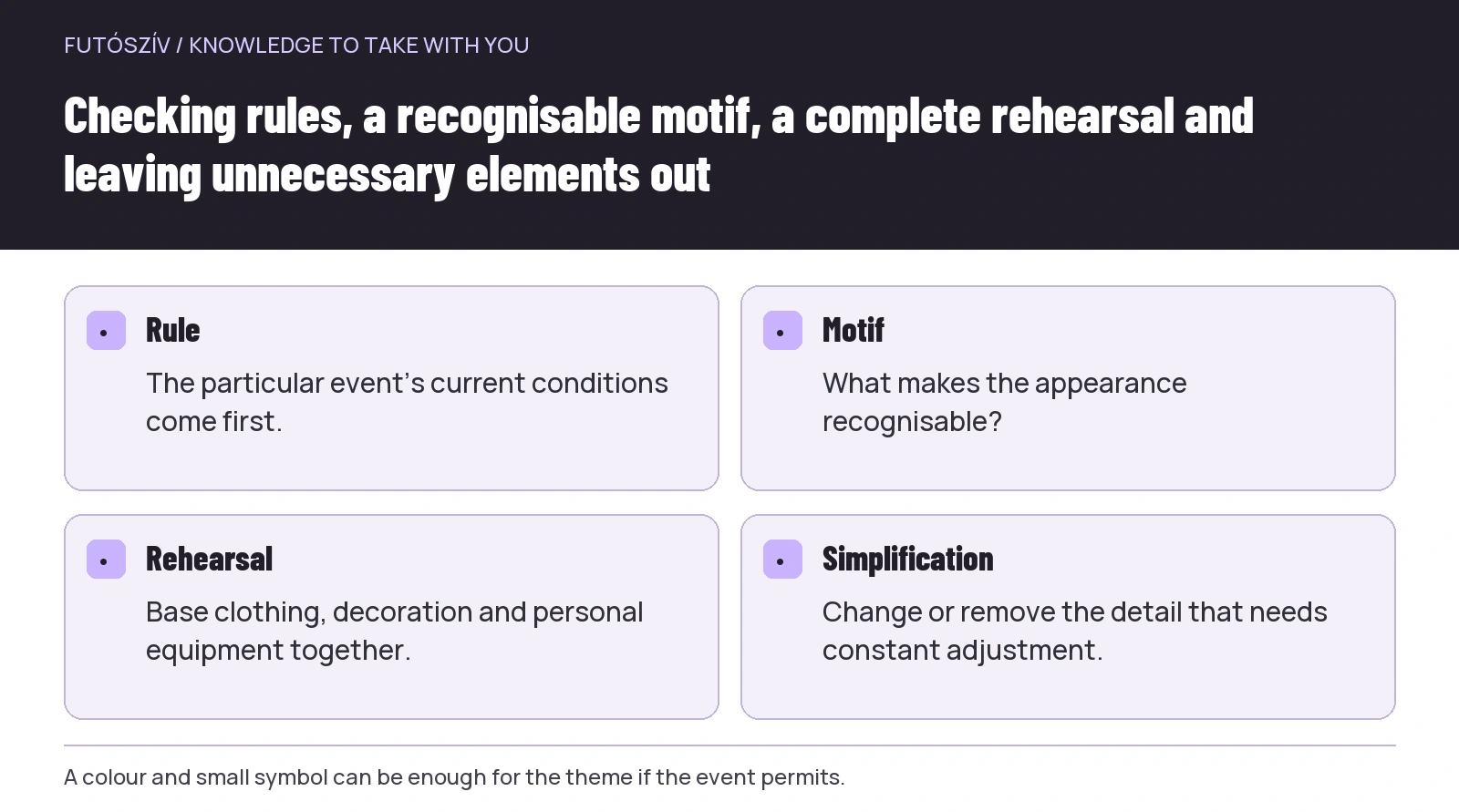
Text version of the diagram
- Rule
- The particular event’s current conditions come first.
- Motif
- What makes the appearance recognisable?
- Rehearsal
- Base clothing, decoration and personal equipment together.
- Simplification
- Change or remove the detail that needs constant adjustment.
Time before and after the start matters too
You wear the costume for more than the running itself. You must reach the venue, collect or check your number, wait and leave later. A piece that is too large or hard to remove can also be an obstacle during travel. Check how it fits your actual transport connection and whether it requires separate transport nobody has agreed to provide.
If you plan to put on decoration at the venue, have a clear plan for where and when, and where the packaging will go. Check baggage-storage conditions separately. The existence of storage does not mean it accepts props of every size or safeguards their value. Do not discover just before starting that costume storage is unresolved.
For the finish, you can also have simpler familiar clothing and a way to pack things away, according to your own needs and the event rules. You need not travel home in the full costume simply because the group picture would look better. Photo timing and actual departure can be coordinated; the picture does not override the family’s or group’s agreed time frame.
Adapt the plan to the conditions too
A costume idea may arise months before an event, but actual conditions need checking again before departure. Include the whole day, waiting and the venue in clothing decisions. Decoration should not make it impossible to change the outfit simply or drop a detail.
If base clothing changes, check the costume’s fastening again as well. Another jacket, vest or pocket may mean a different arrangement. Do not assume the look that worked at home transfers unchanged when the system underneath is different. Reassess function rather than trying to reproduce the earlier successful photograph exactly.
A costume rehearsal does not resolve personal health questions. If you feel unwell or need help at the event, seek appropriate on-site assistance rather than persisting with a problematic outfit for appearances. This article does not prescribe a general temperature, load or number of clothing layers; those figures cannot apply identically to every participant.
Comparing how two costume ideas work
In one imagined outfit, two colours, a small attached symbol and familiar base clothing carry the theme. In the other, a large rigid side piece and a handheld object make the character recognisable. The second may look more impressive in a still photograph, but raises more questions at the start zone, about space for those beside you and access to your own equipment.
There is no need to declare a general winner between the two. The particular event’s conditions may rule out one version, while your own rehearsal can reveal which details are unnecessary. The large prop might remain for a photograph at home, with only the colour and symbol carried into the race. The creative idea can still remain recognisable and personal.
Discuss changes with companions too if you have planned a shared look. Matching clothing must not become an expectation that makes someone start in a costume that does not work for them. A common motif can accommodate several versions if the event rules permit. Enjoying the occasion together does not require agreement in every detail.
Think about reuse while making it
A few detachable decorations are easier to store later and adapt to another outing. Choose fastening that works with the actual garment and does not make its care instructions impossible to follow. You do not need to make existing running clothing unusable for a single occasion. Do not leave completely soaked or damaged decoration on the course either.
The GINETEX information on textile-care symbols provides a basis for interpreting the care symbols on clothing. A part added afterwards for a costume does not make every material cleanable in the same way. Check separately what is removable, what needs different care and how everything will be stored in usable condition.
Ultimately, a good running costume adds to the atmosphere of the outing you have chosen instead of creating separate tasks on the course. After checking rules, rehearsing the complete outfit and leaving unnecessary details out, keep an idea you enjoy moving in. Finding its simplest form that works throughout is part of creativity too.
How Futószív articles are prepared: our editorial guidelines.