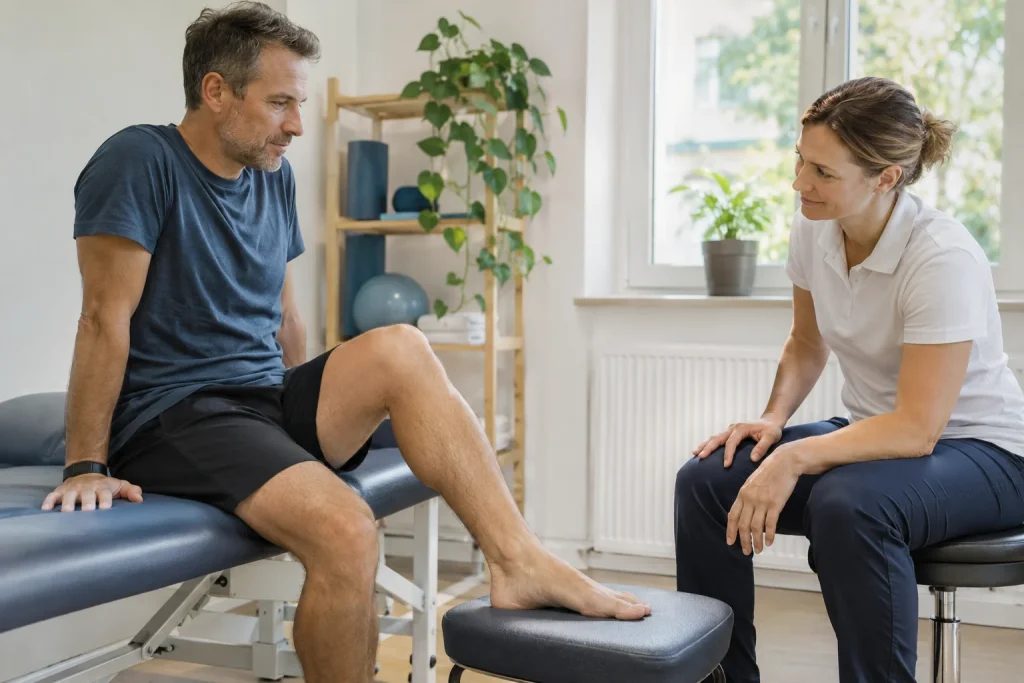
Less swelling does not mean full readiness to run
After a misstep, the initial pain and swelling often receive the most attention. When they ease, it is understandable to want to run again. Yet running may require more than being able to stand on the foot: everyday walking, steady jogging and travelling a long way over uneven ground are different tasks. It is therefore worth discussing return in terms of conditions, rather than simply days elapsed.
First, it also matters whether this really is a lateral ankle ligament sprain. After an injury, major difficulty bearing weight, deformity, increasing pain, numbness, or a cold foot changing colour may need prompt assessment. The NHS information on sprains and strains highlights these situations separately. In a serious accident or life-threatening medical emergency in Hungary, call 112.
This article organises the decision-making questions after an appropriately assessed ankle injury. It does not provide an individual diagnosis, choose a brace or prescribe hopping tests to perform at home. If the nature of the injury or the permitted load is still unclear, clarify this with your healthcare provider before starting a running programme.
When going for care, organise access as well: who will accompany you, how many stairs will there be and what help will let you follow the weight-bearing instructions? If an assistive device is prescribed, ask for a practical demonstration for your own situation. You should not have to work out its first use in a crowded stairwell.
An accurate history matters for rehabilitation too
Explain how the misstep happened, whether you fell, whether you could bear weight afterwards and when swelling appeared. A previous ankle injury and a feeling of giving way that already existed are important details too. You do not need to name in advance which ligament tore. Examination, together with the history and imaging where needed, can provide an interpretation.
The AAOS ankle-sprain guide discusses assessment of severity and function, as well as treatment and rehabilitation options. An ankle injury consists of more than visible swelling. If symptoms do not progress as expected, report this again, because the same initial label cannot explain every persistent symptom.
At the end of the appointment, ask what load you can place on the ankle, whether you need an assistive device or support, and when to have a review. Discuss commuting and stairs at home, rather than running alone. Instructions received in the first days need to remain understandable within your real daily tasks.
Five areas worth assessing before return
PAASS is not a score threshold for runners to use at home, but an expert-consensus framework for sports decisions after an acute lateral ankle ligament injury. It highlights five areas: pain, ankle impairments, the athlete’s own perception and readiness, sensorimotor control, and sport and functional performance. The international consensus organises what is worth assessing rather than providing a single automatic clearance to start.
As a runner, you can translate this into your own goal with your clinician. What are your range of movement, strength and response to load like? How much do you trust your ankle? How are balance and the prescribed movement task? Does the desired training format fit your current capabilities yet? These questions belong together.
Pain therefore matters, but is not the only measure. A pain-free walk does not demonstrate every task needed for trail running. Equally, finding one exercise harder is not a personal failure. Assessment aims to clarify what is already available and what still needs developing for the next step.
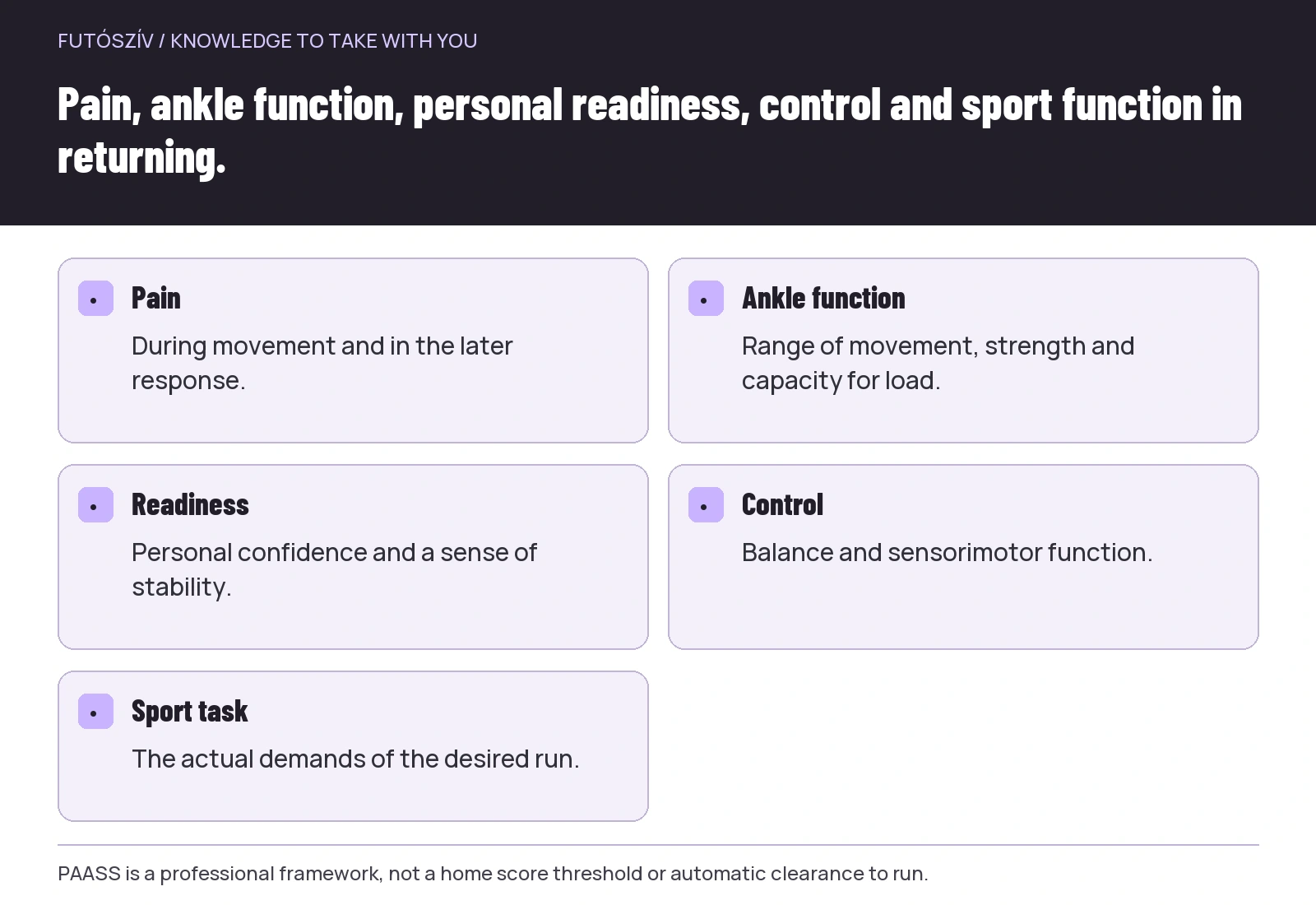 Enlarge diagram
Text version of the diagram
- Pain
- During movement and in the later response.
- Ankle function
- Range of movement, strength and capacity for load.
- Readiness
- Personal confidence and a sense of stability.
- Control
- Balance and sensorimotor function.
- Sport task
- The actual demands of the desired run.
Ankle function needs targeted rebuilding
The 2021 JOSPT guideline considers first-time lateral ligament injury and persistent ankle instability separately. It discusses the role of exercises adapted to the individual condition, including movement, balance and neuromuscular tasks, in rehabilitation. This is more than waiting until visible marks on the skin disappear.
Ask about the purpose of the task you receive. Which ability does it develop, how should you perform it, what is the appropriate amount and what should you do if symptoms worsen? Demonstration and showing it back help with technique. A video’s general description may not suit your injury or stage of recovery.
Plan the exercise’s place in your day as well. If you have already loaded the ankle a great deal at work, the response to an evening task may differ from that on a calmer day. You do not have to replace every minute of your previous sport with rehabilitation repetitions. The plan aims for appropriate development, rather than filling a sense of something missing.
Confidence and uncertainty are both real information
Walking may already be going well while you still feel uncertain on uneven ground. Do not hide that because the rest period has officially elapsed. The athlete’s own perception of the ankle and psychological readiness form a separate area within PAASS too. Confidence is not a compulsory state; it is information relevant to the decision.
Say which situation concerns you: downhill running, a quick turn, moving in the dark or the place where the earlier injury happened? A specific task helps shape a useful next step. Fear does not need to be resolved immediately through a test of courage, nor does complete uncertainty have to mean a permanent ban on sport.
A companion or coach can offer support by choosing an appropriate location, accepting a shortened session and avoiding pressure. Instead of advice to “stop thinking about it”, follow the agreed task and feedback. Trust can grow from understandable, manageable experiences, rather than simply forgetting the injury.
Terrain and session format are separate return questions
A smooth route with good visibility is not the same task as a rocky, root-covered descent. For a return to racing, consider the full demands: length, speed, turns, dark sections and moving while fatigued can all play a part. Merely comparing the entry distance with a short trial session is insufficient.
If running can resume, identify with your clinician and coach which environment is appropriate first. A location where you can shorten or leave the session easily offers an organisational advantage. You need not travel far simply because the route there is prettier. Getting home and being able to contact your companion are part of implementation too.
Do not automatically combine changing terrain with increasing distance and pace. If several demands rise at once, the response is harder to assess. The aim is an understandable transition within your individual plan from an easier session to the running situation you want.
Braces, tape and shoes: support for an appropriate purpose
External support can be useful in some situations, but discuss its selection and use with your provider. The guideline addresses support and loading adapted to the injury’s condition, and also gives certain options a role in reducing the risk of repeat injury. A brace does not remove the need for rehabilitation.
Ask for which activity, for how long and how to wear it, and when the fit needs checking. Numbness, circulation symptoms or a new pressure point are not details to endure for the sake of safety. Use the device according to your own instructions and report problems.
With footwear, fastening, comfort and the real environment of use matter. A higher collar or more expensive model does not, by itself, describe your individual ankle stability. Do not use a product purchase to replace the question of which function and loading boundaries are needed for the next run.
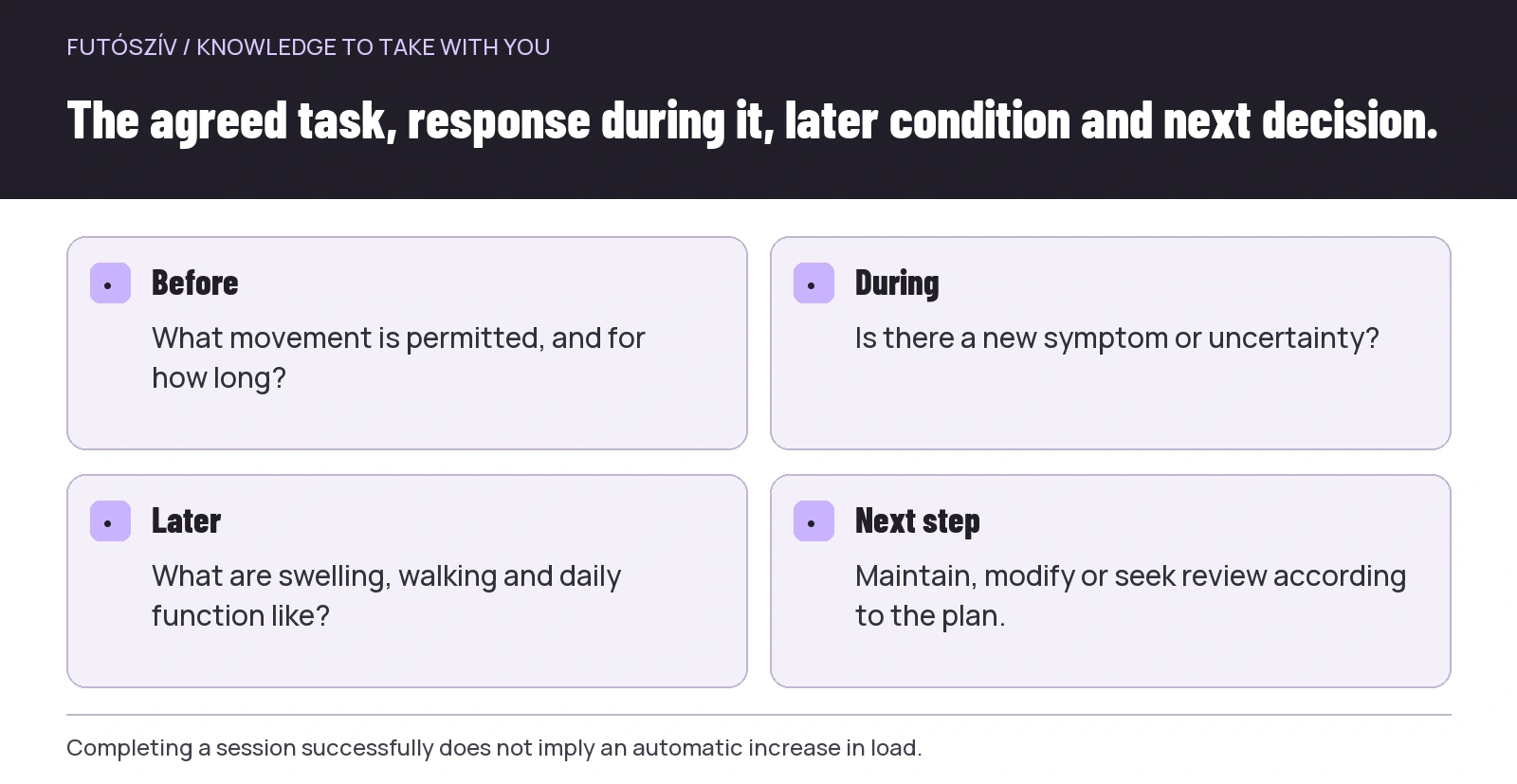 Enlarge diagram
Text version of the diagram
- Before
- What movement is permitted, and for how long?
- During
- Is there a new symptom or uncertainty?
- Later
- What are swelling, walking and daily function like?
- Next step
- Maintain, modify or seek review according to the plan.
How should you track the first session back?
Write down the agreed type and limit of movement in advance, together with the signals that mean stopping. Observe symptoms and uncertainty while moving, then the later response as well. Successfully saving a run is not the only outcome: how walking and daily tasks go the next day matters.
If increasing swelling, new pain or a sense of instability appears, report it according to your individual plan. Do not automatically repeat the same task in a larger amount because you completed it the first time. Monitoring has value when the experience can genuinely influence the next decision.
Keep the diary short and use consistent reference points. What movement took place, how did it feel during it and what changed later? If you miss a day, do not independently double the task the next day. Rehabilitation is not a list of debts, but a programme written for your current condition.
Why do previous giving-way episodes and recurrence matter?
If your ankle used to give way often or feel unstable, report this at the first meeting. Persistent instability may require a different assessment from a one-off injury with no history. You do not have to accept “my ankle is just loose like that” as a natural feature if it interferes with movement.
Discuss earlier rehabilitation too: what tasks did you receive, how long did you perform them and what remained difficult? An honest answer helps make sense of the next plan. If the programme stopped because it did not fit your day or you did not understand it, say so too. Manageability can be improved, rather than only repetition numbers.
In a running community, recurrent injury should not become a joke or a character flaw. Another individual assessment, a more targeted task or different organisation may be needed. Prevention and return cannot guarantee protection against every future misstep, but do justify addressing remaining problems.
Leave the review with a clear next sporting step
Ask which return conditions have been met, which still need development and when they will be reassessed. If commuting is manageable but running is not yet permitted, understand the practical reason and the next step. A clear framework helps cooperation without having to guess from the calendar.
Bring an approaching race or trip into the conversation, but do not make it an automatic recovery deadline. Goals can change, entry may be deferrable and other movement may form part of the day. These are options to adapt to your own situation, rather than compulsory consolation tasks.
Returning to running becomes transparent when ankle function, control, confidence and the real demands of the sport are considered alongside pain. You do not need to try every test at home. With the appropriate professional, clarify conditions and steps that you understand and can implement in daily life.
Sources
- NHS: Sprains and strains
- JOSPT: Lateral ankle ligament sprains, clinical practice guideline revision 2021
- Return to sport after acute lateral ankle sprain: PAASS international consensus
- AAOS OrthoInfo: Sprained ankle
How Futószív articles are prepared: our editorial guidelines.