Symptoms noticed early provide important information
It is easy to treat new pain concentrated in one place during running as a natural part of training, especially if tolerable at first, improving after rest and occurring near a race. A bone stress injury need not begin with one major accident, however. Gradual onset does not prove symptoms harmless.
Bone stress injury is an umbrella term covering conditions from early load-related changes to stress fracture. According to the AAOS OrthoInfo information , an early bone stress reaction may worsen with continued loading. What matters is timely assessment of suspicion, not runners finding the right name themselves.
This article supports recognising warning patterns and preparing for examination. It does not determine fracture from one pain, offer a home hopping test or prescribe an individual offloading programme. If walking hurts, the situation worsens or you cannot bear weight properly, prompt healthcare assessment is needed; a sudden severe injury may require urgent care.
What history might suggest bone involvement?
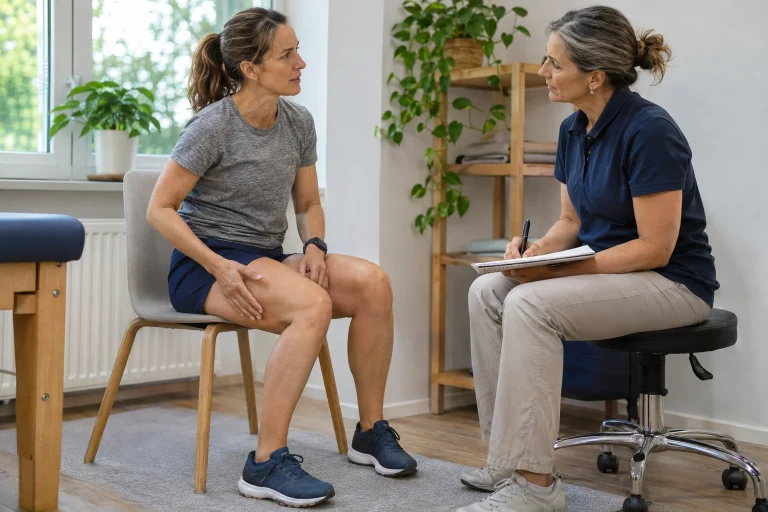
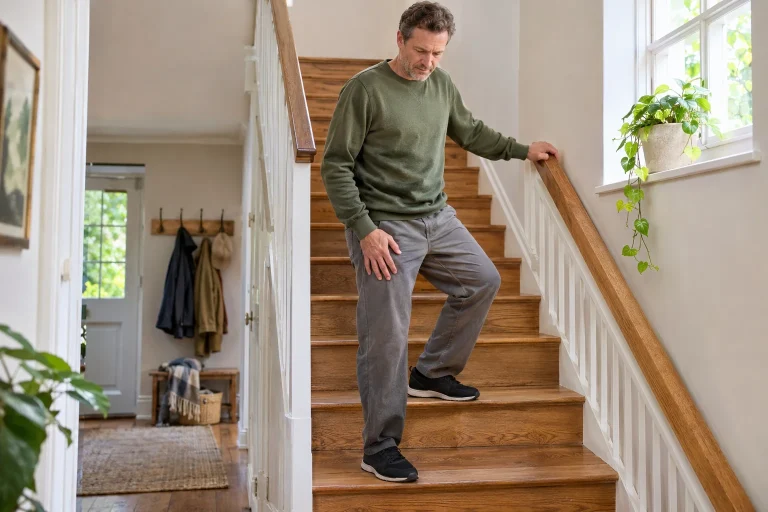
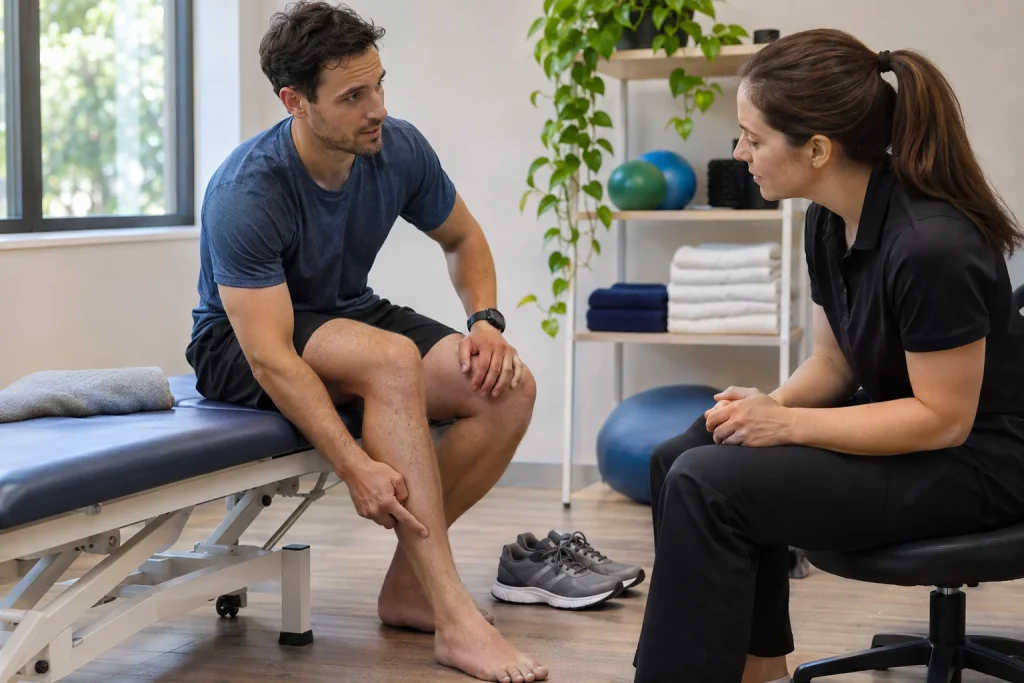
Recurring local pain linked to exertion and appearing progressively earlier may form a pattern worth investigating. It may first bother you only after running, later during activity or everyday walking too. Location and exact progression matter, but symptoms alone cannot reliably identify the tissue cause.
The AOSSM sports medicine information discusses localised pain and uncertainty in early imaging with bone stress injuries. Not everyone describes pain the same way, and intensity is not a simple fracture gauge. Worsening symptoms or changes to daily movement matter more than an arbitrarily selected tolerance threshold.
Do not repeatedly press the area or hop on it to prove suspicion at home. A painful test does not establish diagnosis, while a painless one does not exclude every injury. A professional assesses examination alongside the history and imaging where necessary.
What changed in your loading?
Before the visit, review the recent period, not only the last run. Did distance, fast sections, hills or race frequency increase? Did walking at work, hiking or jumping in the gym change? Total loading on bone extends beyond activities labelled sport in a running app.
The 2025 international Delphi consensus treats bone stress injury as associated with several factors. Alongside training load, bone health, nutrition and previous injury factors have roles. Expert consensus does not prove every individual cause but helps avoid reducing injury to one shoe or one bad session.
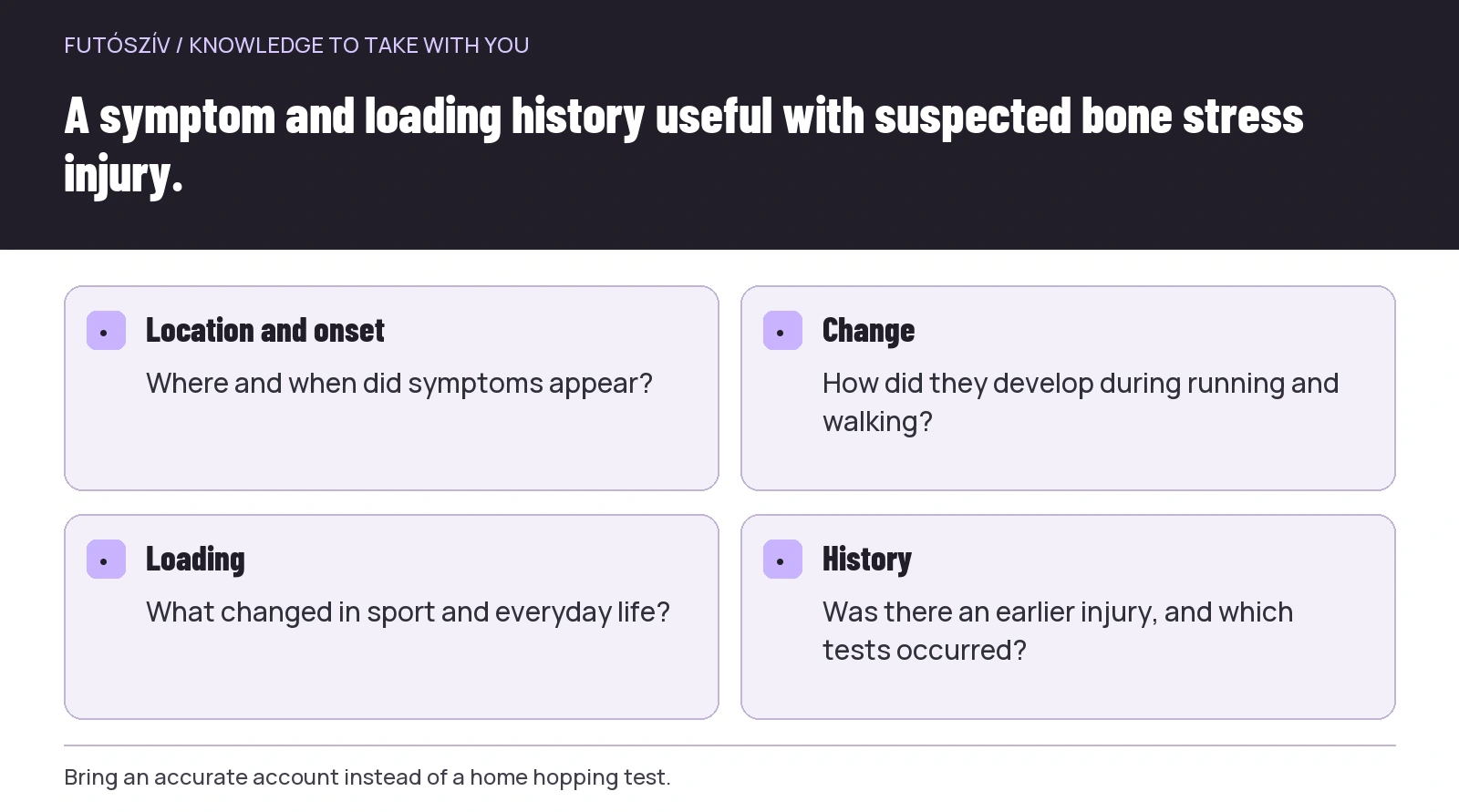
Record changes specifically. Rather than “I have run more lately”, it may help to say you began a new route two months ago while work also started involving more walking. You need not assign blame. The aim is a history from which the examiner genuinely understands circumstances around symptom onset.
 Enlarge diagram
Text version of the diagram
- Location and onset
- Where and when did symptoms appear?
- Change
- How did they develop during running and walking?
- Loading
- What changed in sport and everyday life?
- History
- Was there an earlier injury, and which tests occurred?
An early negative X-ray does not always settle the question
Both AAOS and AOSSM information note an early bone stress injury may look normal on X-ray. Interpret results together with symptoms and examination findings. If symptoms persist, ask the next step and activity framework until then. “No fracture was visible” does not mean unrestricted loading in every situation.
The care provider determines whether further imaging is necessary and which type. You need not order MRI, CT or multiple tests yourself, but can rightly ask how remaining suspicion will be assessed. Alongside arranging examination time and place, make temporary actions clear too.
If walking worsens, pain increases or new symptoms appear meanwhile, do not only count days until the booked appointment. Contact care with urgency appropriate to the situation. An earlier reassuring detail does not override changes, nor does a sporting goal make running during the wait compulsory.
Why does injury location matter?
Not every bone stress injury has identical risk or can be managed with the same loading rule. The international consensus considers precise anatomical location and severity important in treatment too. This is why another runner’s same number of rest weeks cannot be copied to your circumstances.
Do not dismiss new exertional hip or groin pain as a simple strain without assessment either, particularly if walking is difficult. Symptoms elsewhere may also matter. The aim is not choosing “good” and “bad” bones from a map but timely assessment of the specific area.
Within the treatment plan, ask which loading is permitted, whether an aid is necessary and what to do about work or transport. These are individual decisions. Running tolerably with pain relief does not prove safe bone-loading capacity, nor does managing a short flight of stairs.
Energy availability can be discussed regardless of body size
Persistently insufficient energy for sport and daily functioning can also affect bone health. The IOC REDs consensus includes bone stress injury among consequences associated with problematic low energy availability. This is not solely a women’s topic and cannot be determined from appearance.
At the visit, mention increased running alongside more irregular eating or intentional restriction. If you menstruate, cycle changes may be important too; relevant health signs exist for others as well. You need not create a REDs diagnosis from a checklist. Appropriate professionals can assess the whole situation.
During rehabilitation, do not treat less sport as an automatic call to withhold food either. Review personal nutritional needs with a dietitian, especially with recurring injury or eating-related difficulties. This article gives no calorie or vitamin dose; supplementation needs also depend on your circumstances.
Changing shoes can be a detail, not a universal solution
Introducing new shoes or an unfamiliar model is important history but does not alone prove the cause. The 2025 Delphi panel did not reach agreement that minimalist shoes or advanced plated technology generally increase bone stress injury risk. The consensus therefore does not specify one shoe type to modify risk generally.
Practically, discuss comfort, fit and changes in use. If shoes, terrain, pace and distance changed together, choosing one factor retrospectively is difficult. The lesson is not necessarily rejecting a product but making the next change clearer and fitting it into the personal plan.
Shop advice does not replace injury assessment. Do not buy another shoe to continue with the same pain. Clarify loading boundaries first; then the role of equipment can be discussed meaningfully. Even the most expensive model provides no general protection against bone problems.
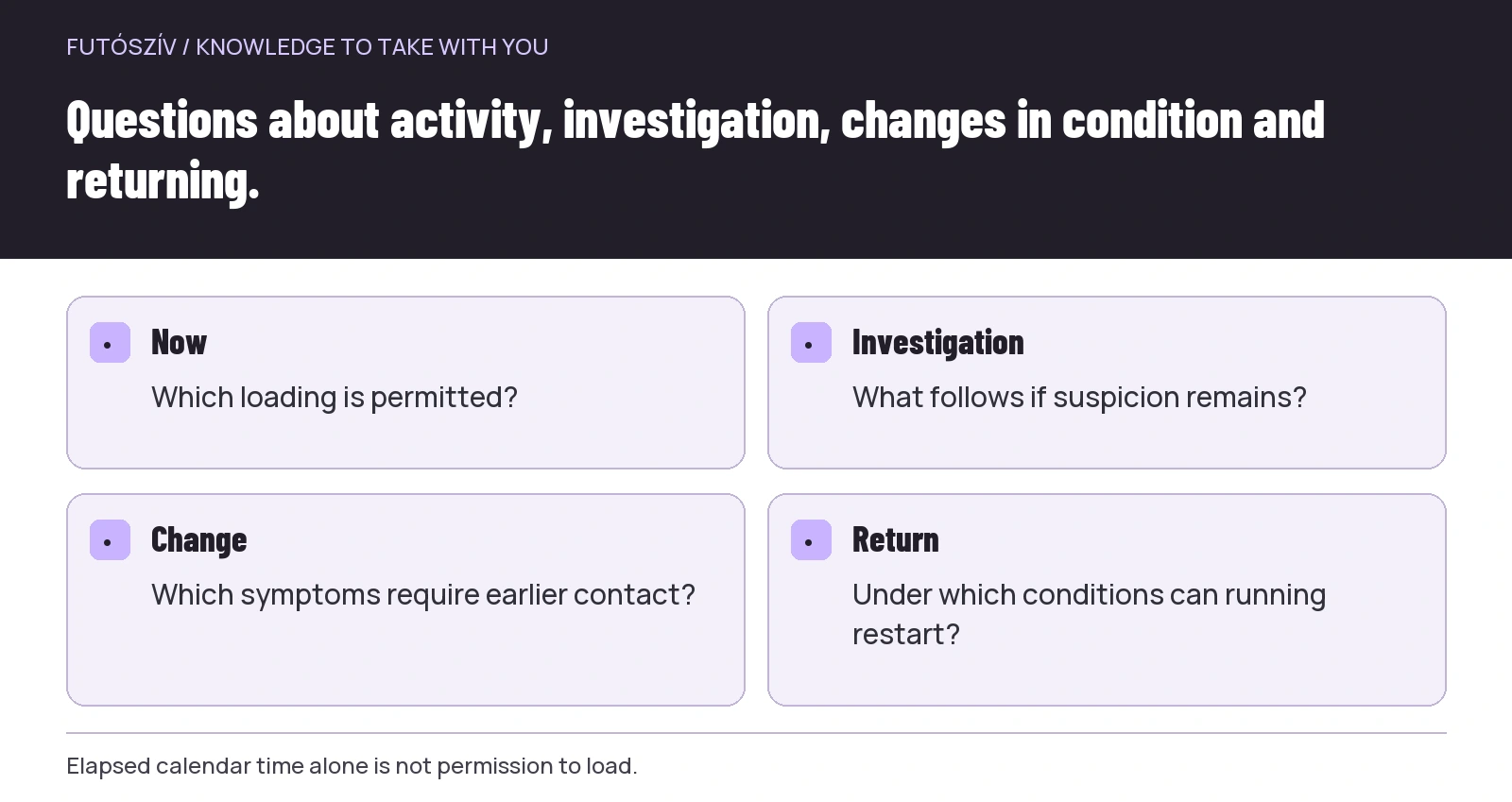 Enlarge diagram
Text version of the diagram
- Now
- Which loading is permitted?
- Investigation
- What follows if suspicion remains?
- Change
- Which symptoms require earlier contact?
- Return
- Under which conditions can running restart?
Cross-training: permitted form first, programme second
Wanting to retain a routine during a running break is understandable. Yet not every other activity is automatically appropriate for the same injury. Cycling, water-based movement or strength work may feature in some plans, but discuss the specific choice alongside injury location and loading instructions.
Ask which form is permitted, under what conditions and which symptoms to report. “Anything is fine if painless” is too broad when bone-loading limits remain unclear. How much cross-training fits alongside work and rehabilitation is another question. You need not exchange missed running minutes one-for-one for other movement.
For the coach, the aim now is not necessarily maintaining the old weekly load total. Following treatment, enjoyment of accessible activity and noticing new symptoms may matter more. Connection with sport can remain without turning rehabilitation into a hidden competition.
Returning needs conditions, not only a date
The calendar alone does not establish healing. Ask the clinician which clinical and, where needed, imaging conditions allow running again. Everyday loading, light jogging and rebuilding the full training routine may differ. A general statement such as “six weeks have passed” does not replace this decision.
When restarting becomes appropriate, organise the programme within permitted boundaries and with manageable changes. Previous weekly kilometres and an approaching entry should not rush a jump to full loading. Record symptoms during and afterwards, and know whom to tell if circumstances change. A permitted first session is not automatic racing clearance.
After a previous bone stress injury, consider that history in later planning too. Recurring symptoms are not personal failure but a new assessment question. Review the plan with the clinician and coach, involving another professional where needed. The aim is usable long-term sport, not the fastest possible tick in a box.
One page for the next appointment
Place pain location and onset at the top. Then describe changes in running, everyday movement and symptoms; what happened with rest; and earlier similar injuries. Collect existing examinations and current instructions separately. You need not prepare perfect sports-medical documentation.
Make questions actionable: what can I load now, what is the next investigation step, when should I make earlier contact and under what conditions can returning begin? These can produce a plan manageable in everyday life too. Mention demands of work, travel and household tasks as well.
If the next run must be postponed for now, a timely decision has value. Reporting symptoms early may help avoid continuing the same loading in uncertainty. Your running experience can now help through precise observation, honest reporting and planning within clarified boundaries.
Sources
- International Delphi consensus on bone stress injuries in athletes, 2025
- AAOS OrthoInfo: Stress fractures
- AOSSM: Stress fractures
- IOC: Consensus statement on Relative Energy Deficiency in Sport, 2023
How Futószív articles are prepared: our editorial guidelines.