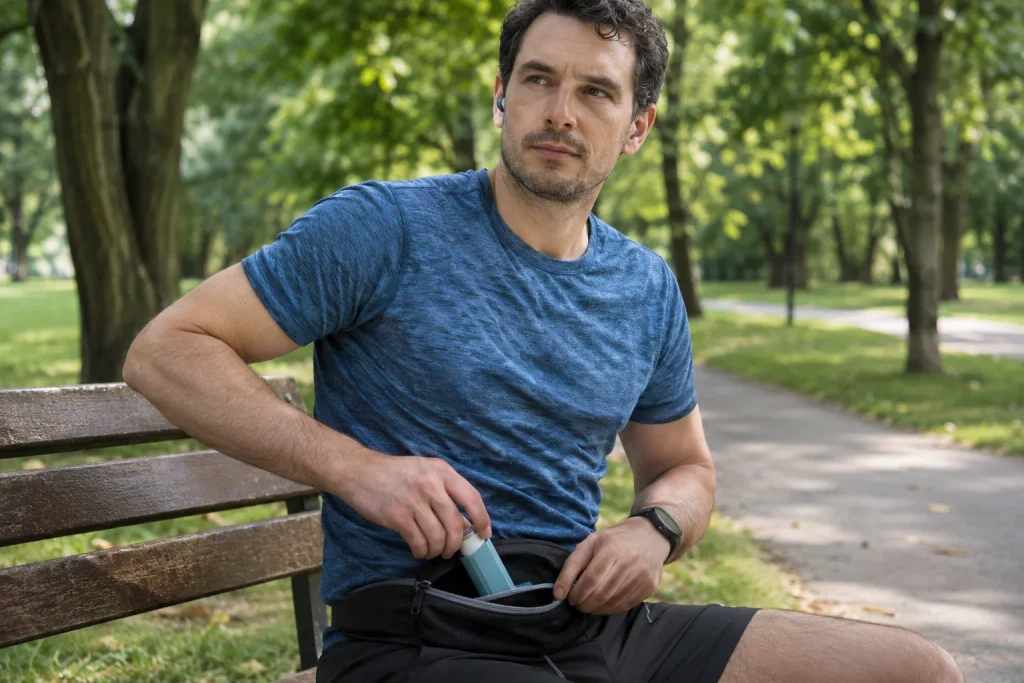
You can plan an active life alongside asthma
For a runner living with asthma, the right goal is not to endure coughing at all costs or hide an inhaler. It is more useful to establish a treatment and activity framework in which you understand your symptoms, know what to do and need not invent the next step in the middle of a park. Training planning and asthma care belong together here, but neither replaces the other.
The GINA 2026 summary encourages regular physical activity for people living with asthma because of its general health benefits. It also considers advice on managing exercise-induced bronchoconstriction necessary. The message is therefore neither an automatic ban on sport nor unconditional clearance to start. The GINA guide takes an individual approach to care.
The framework below helps adult runners understand the topic. It does not choose an inhaler, provide medication doses or diagnose exercise-related symptoms. For a child’s or adolescent’s sport, parents, the care team and coach need to agree an age-appropriate plan. A familiar adult’s successful approach cannot automatically be copied.
When is saying “I ran out of breath” not enough?
Breathing naturally increases during running, so “I am having trouble breathing” is too broad to identify the cause. It matters when symptoms begin, what they feel like, whether they involve coughing, wheezing or chest tightness and what happens after stopping. New or recurring symptoms should not simply be dismissed as poor fitness.
Exercise-induced bronchoconstriction, or EIB, can occur both with asthma and without a known asthma diagnosis. According to the ATS clinical guideline, diagnosis is supported by exercise-related changes in lung function; symptoms alone are not reliable enough. The diagnostic recommendation therefore prioritises appropriate testing rather than an online symptom quiz.
This matters because similar experiences can have different causes. Sorting these out at home is not the runner’s task. A precise account helps, however: did it happen during a fast section, immediately afterwards, in cold weather or in a particular place; how long did it take to settle; and did it recur on other occasions? A smartwatch heart-rate trace may complement this but does not confirm or rule out bronchoconstriction.
Control means more than completing today’s loop
It is worth discussing care even if you can finish the session but regularly wake at night, need your reliever more frequently or have symptoms limiting usual activities. The NHS recommends a care review in these situations. The patient information also treats correctly used devices and a current action plan as parts of treatment.
Do not describe only the worst workout. Bring the everyday pattern too: did symptoms occur on the way to work, on stairs, at night or after an infection? Note how often you interrupted activity. These may create a clearer picture than simply having completed the weekly kilometres. Preserved performance does not prove adequate disease control.
Nor is it a good aim to pay as little attention as possible to treatment because running is going better. Discuss medication changes with your care provider. A symptom-free period is important experience but not an independent instruction to discontinue a medicine. If you are uncertain about maintenance treatment versus steps to follow with symptoms, clarify this before the next session.
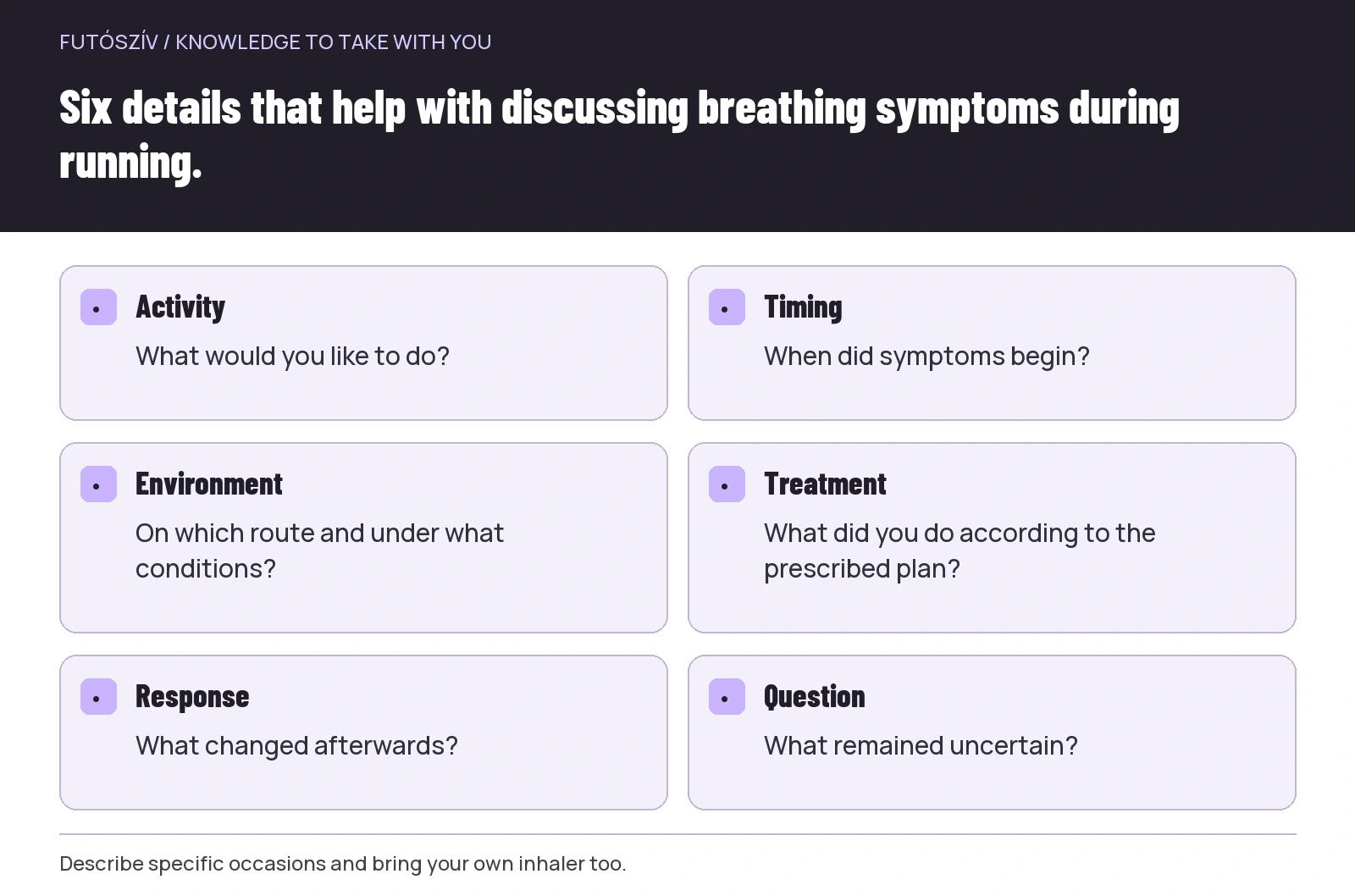 Enlarge diagram
Text version of the diagram
- Activity
- What would you like to do?
- Timing
- When did symptoms begin?
- Environment
- On which route and under what conditions?
- Treatment
- What did you do according to the prescribed plan?
- Response
- What changed afterwards?
- Question
- What remained uncertain?
The written action plan should answer five questions
An action plan is not a general motivational sheet but a set of actions specific to you, developed with your clinician. According to NHLBI, it should include triggers to recognise, which medication to use when, how to recognise worsening and when medical or emergency help is needed. The treatment and action-plan guide can provide a basis for discussion, not a medication prescription created by completing it yourself.
As a runner, ask specifically: what should I do before usual activity; what should I do if symptoms occur along the way; when should I stop the session; when is urgent help needed; and how can I return after worsening? If the doctor also prescribes peak-flow monitoring, learn the measurement method and thresholds belonging to your own plan. Do not invent a new medication step for yourself from a general chart.
The CDC likewise emphasises that everyone needs their own asthma action plan. It distinguishes doing well, worsening and emergency situations. From the structure of the CDC summary , take the principle of making decisions clear beforehand rather than trying to interpret illness only afterwards. Agree arrangements for seeking help in Hungary instead of using US emergency contacts.
Keep medication accessible and its use practised
If your treatment plan requires carrying a reliever device, put it somewhere you can actually retrieve it. An inhaler left in the car on a distant forest loop is not accessible. When choosing a running belt or pocket, try whether it fits securely and how to protect it according to the manufacturer’s directions. Check expiry and how to track the amount of medicine remaining too.
Ask for a device demonstration, then show how you use your own inhaler. The GINA 2026 strategy report emphasises checking technique through demonstration and return demonstration. Different devices may be used differently, so another runner’s sequence of movements is not a reliable guide. If you receive a new type, remember more than the box colour.
Do not decide on medication from running-group messages. The same everyday name may refer to a different preparation or role, and identical instructions do not apply to every inhaler. Write down the precise name, your own usage instructions and the question that arose. A pharmacist or care team can help clarify use; meanwhile, the coach’s task is to respect the agreed activity framework.
Warming up is support, not a home test of fitness to participate
The ATS EIB guideline recommends warming up before planned exertion and also discusses options to warm and humidify inhaled air in the cold. This does not mean a scarf or a few progressive runs replaces personal treatment. For runners sensitive to cold air, choosing the outdoor programme and environment may also need discussion.
Practically, allow time for a gradual start rather than beginning the day’s hardest section as you step through the door. The length and form of the warm-up should match your plan and that day. You do not need to provoke a severe attack to discover whether you are fit to run today. If symptoms appear even at an easy start, return to the action plan rather than increasing pace.
Organise the end of training too. In cold weather, do not remain talking for a long time in sweaty clothing, and have a way to reach shelter. This is a comfort and organising matter; it should not be called asthma treatment in itself. A well-arranged outing consists of many small decisions, but none makes prescribed care unnecessary.
Environment: personal patterns instead of one calendar rule
Cold, dry air, pollution or allergen exposure may be important circumstances for some people. However, not everyone living with asthma has the same triggers. GINA does not recommend indiscriminate allergen avoidance for everyone either and notes that such strategies may be complex. Before buying expensive equipment or changing your whole lifestyle, clarify whether a factor is actually relevant to you.
Record the route, weather and notable circumstances, but do not draw a certain causal conclusion from one bad run. You may also have trained harder that day, an infection may have been beginning or several factors may have coincided. The log’s value lies in discussing patterns, not immediately finding a culprit for every symptom.
Have a preaccepted alternative: a shorter programme, different route, indoor activity or rest according to current health. Indoors is not automatically ideal either if the air is irritating or other troublesome conditions exist. The aim is usable choices. You need not ignore your personal action plan for the sake of one entry or shared run.
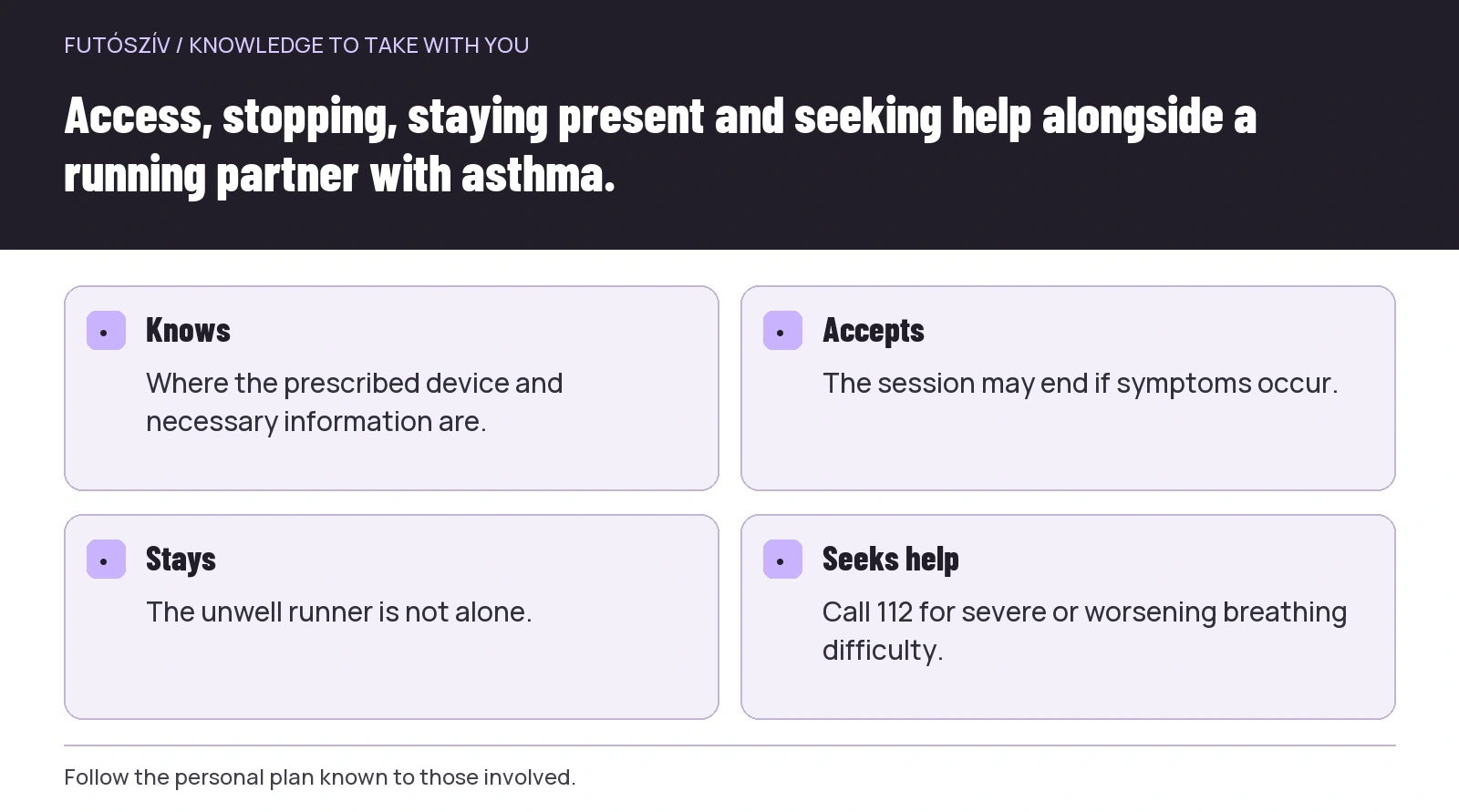 Enlarge diagram
Text version of the diagram
- Knows
- Where the prescribed device and necessary information are.
- Accepts
- The session may end if symptoms occur.
- Stays
- The unwell runner is not alone.
- Seeks help
- Call 112 for severe or worsening breathing difficulty.
What should the coach and running partner know?
You need not share your entire medical history, but sharing information necessary for a safe joint run is useful. Where is your device? Whom should they notify? Which situations require immediate help? A companion should not guess medication doses or persuade a symptomatic runner to reach just the next kilometre.
Brief, easily accessible emergency information may be more useful than a long document buried in a locked phone. Agree how to signal a need to stop and who will stay with you. The group’s pace should not be determined by embarrassment about holding others up. The option of turning back is part of good organisation.
As a coach, the task is to prevent athletes having to choose between the plan and taking symptoms seriously. Ask about limits given by their clinician and adapt training accordingly. Do not promise a breathing technique will definitely eliminate asthma. Joint work is credible when it respects both professional boundaries and the athlete’s right to decide.
If breathing worsens: stop and follow your plan
With symptoms, interrupt running and follow your personal action plan. Severe or rapidly worsening breathing difficulty, difficulty breathing that obstructs speech or a lack of response to prescribed help require urgent assistance. In Hungary, call 112. Do not drive yourself to hospital or leave a running partner alone with “I will catch up later”.
The NHS treats a worsening asthma attack as urgent and considers medical review after an attack important even following improvement. Do not copy the UK emergency number onto a Hungarian runner’s card. Keep local contacts, the precise location and prescribed plan at hand. At a race, involve the organiser’s medical personnel immediately too if available.
After an episode, returning should not depend only on feeling less frightened the next day. Discuss what happened with your clinician and clarify conditions for the next activity. The aim is not to prove the incident did not affect you but to make the next situation clearer and more manageable.
Six lines to take to the next review
List the activities you would like to do; when symptoms occurred; under what circumstances; how you used prescribed treatment; what happened afterwards; and what remained uncertain. Bring a few specific occasions if possible; you need not print months of complete training data. A brief, organised account makes a focused conversation easier.
Also ask clearly when the next review should happen, which changes to report sooner and how to contact the care service. Check that the digital or printed action plan contains the same information as the verbal discussion. A usable document must also be readable when you need it.
Plan the next run from this clarified framework. Choose a suitable route, allow time for a gradual start and accept beforehand that the session may change. Confidence comes not from denying symptoms but from recognising the situation and knowing what to do.
Sources
- GINA: 2026 Summary Guide for Asthma Management and Prevention
- ATS: Exercise-induced bronchoconstriction clinical practice guideline
- NHLBI: Asthma Treatment and Action Plan
- CDC: Living with Asthma
- NHS: Asthma
- GINA: Global Strategy for Asthma Management and Prevention 2026
How Futószív articles are prepared: our editorial guidelines.